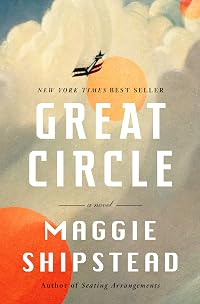
Great Circle
by Maggie Shipstead
On This Page
Description
"After being rescued as infants from a sinking ocean liner in 1914, Marian and Jamie Graves are raised by their dissolute uncle in Missoula, Montana. There --after encountering a pair of pilots passing through town in a beat up Cessna--Marian commences her lifelong love affair with flight. At fifteen, she drops out of school and finds an unexpected and dangerous patron in a wealthy rancher who provides a plane and subsidizes her lessons, an arrangement that will haunt her for the rest of her show more life, even as it allows her to fulfill her destiny: circumnavigating the globe and piloting her plane over the Arctic Circle. A century later, Hadley Baxter is cast to play Marian in a film that centers on Marian's disappearance over the South Pacific. Vibrant, canny, disgusted with the claustrophobia of Hollywood, Hadley is eager to re-define herself after a romantic film franchise has imprisoned her in the grip of cult celebrity. Her immersion into the character of Marian unfolds, thrillingly, alongside Marian's own story, as the two womens' fates--and their hunger for self-determination in vastly different geographies and times-- collide. Epic and emotional, meticulously researched and gloriously told, Great Circle is a monumental work of art, and a tremendous leap forward for the prodigiously gifted Maggie Shipstead"-- show lessTags
Recommendations












Member Recommendations
Member Reviews
Anyone who reads a lot of my reviews will notice that as a general rule my 5-star reviews are often short. This will be no exception. The book is glorious. I can't see it being beaten for best of 2021. Shipstead takes on the old-fashioned epic novel, respects its boundaries, and still utterly recasts the form. It is masterful, and also just a freaking great story filled with fascinating characters that are so fully drawn it often feels as if they are sitting beside you watching you read.
I don't think there is a question that Marian is the star of this story, but she is a secure enough character to cede a whole lot of time to a whole lot of characters. This generosity extends to characters in a dual and current timeline shared in first show more person by its leading lady, Hadley Baxter. Hadley is a young actress playing a significantly fictionalized version of Marian in a film. And Marian should be secure because no one, no matter how fully drawn, overshadows her. Not the violent abusive gangster Brady, the rugged nearly feral Caleb, the sensitive longing Jamie, the good and kind and brave and doomed characters that pop up all along the way. Marian is our north star, and we never forget it. I imagine Marian also relates to Hadley who is, 70 years later, also limited by the fact of being a woman. Both are held back by society's fear of being weakened by allure, a fear so strong that men and women turn venereration into a cage and reduce the alluring woman and her lagacy to the sum of her (actual and purported) romantic attachments.
Is the book too ambitious in its sweep? Maybe? But Shipstead makes it al work and the 600+ pages flew by. In fact I stopped about 30 pages before the final page (where Marian's story completes and Hadley's is just about to do so) and started reading something else because I did not want it to end.
One note: I got this in audio and ebook, and really enjoyed both. I got sick in the middle, and was light sensitive so listening worked best for a lot of this, and the reader is really great. When I was able to read though, I went for the text because the writing, at the sentence level, is astonishingly great, and I wanted to roll around and cover myself in that prose over and over again. show less
I don't think there is a question that Marian is the star of this story, but she is a secure enough character to cede a whole lot of time to a whole lot of characters. This generosity extends to characters in a dual and current timeline shared in first show more person by its leading lady, Hadley Baxter. Hadley is a young actress playing a significantly fictionalized version of Marian in a film. And Marian should be secure because no one, no matter how fully drawn, overshadows her. Not the violent abusive gangster Brady, the rugged nearly feral Caleb, the sensitive longing Jamie, the good and kind and brave and doomed characters that pop up all along the way. Marian is our north star, and we never forget it. I imagine Marian also relates to Hadley who is, 70 years later, also limited by the fact of being a woman. Both are held back by society's fear of being weakened by allure, a fear so strong that men and women turn venereration into a cage and reduce the alluring woman and her lagacy to the sum of her (actual and purported) romantic attachments.
Is the book too ambitious in its sweep? Maybe? But Shipstead makes it al work and the 600+ pages flew by. In fact I stopped about 30 pages before the final page (where Marian's story completes and Hadley's is just about to do so) and started reading something else because I did not want it to end.
One note: I got this in audio and ebook, and really enjoyed both. I got sick in the middle, and was light sensitive so listening worked best for a lot of this, and the reader is really great. When I was able to read though, I went for the text because the writing, at the sentence level, is astonishingly great, and I wanted to roll around and cover myself in that prose over and over again. show less
This big, sprawling novel, begins on a doomed ocean-liner in 1914 and ends in both Antarctica and New Zealand, sometime in the 1950s. It mainly focuses on Marian Graves and her twin brother Jamie, raised by their bachelor uncle in rural Montana. Marian has an early fascination with flight and begins taking lessons as a teenager. She soon becomes an ace pilot, running bootleg liquor. This is just the tiny tip of the iceberg of this story, as it also follows her through WWII, as a member of a female flying brigade and her life beyond, including friendships, romances and lots of adventure. This is a beefy read, but Shipstead is a fine writer and a gifted storyteller, so it pulls the reader along. Her research skills are immense too, which show more I found impressive. This was my first book by her and now I want to read her earlier work. show less
This novel tells 2 tales: the first, of the daring young girl who dreams of flying while tethered to her limited reality, and the second, of the overindulged, narcissistic, oversexed actress of present day who is playing her in a biopic.
The story of Marian Graves is a wonderful tale of a girl growing up poor and orphaned in the west, and the saga of how she fights her way up (literally) and out of her beginnings is engrossing, heart wrenching, touching and endearing. It is a terrific read about a girl and woman who scales the heights of empowerment but also touches the depths of despair and emotional entanglements. It's a full-rounded picture of a complicated woman.
In contrast, Hadley, the present-day actress who is acting the part of show more Marian in a movie about her, is spoiled, rich, shallow, hedonistic, and selfish. There is nothing the reader enjoys about her tale, nor do we sympathize with her shallow problems. It almost feels like two separate authors wrote the two stories.
The second problem with the dual narratives is that Hadley's story adds absolutely nothing to Marian's. The plot twist at the end of the story would have been much better told from Caleb's point of view. I found Hadley's sections of the novel disruptive and distractive, and found myself anxious to get back to Marian's story. For the life of me I cannot understand why Shipstead inserted Hadley in this wonderful tale of the life of a "lady pilot." Hence my 2 stars. show less
The story of Marian Graves is a wonderful tale of a girl growing up poor and orphaned in the west, and the saga of how she fights her way up (literally) and out of her beginnings is engrossing, heart wrenching, touching and endearing. It is a terrific read about a girl and woman who scales the heights of empowerment but also touches the depths of despair and emotional entanglements. It's a full-rounded picture of a complicated woman.
In contrast, Hadley, the present-day actress who is acting the part of show more Marian in a movie about her, is spoiled, rich, shallow, hedonistic, and selfish. There is nothing the reader enjoys about her tale, nor do we sympathize with her shallow problems. It almost feels like two separate authors wrote the two stories.
The second problem with the dual narratives is that Hadley's story adds absolutely nothing to Marian's. The plot twist at the end of the story would have been much better told from Caleb's point of view. I found Hadley's sections of the novel disruptive and distractive, and found myself anxious to get back to Marian's story. For the life of me I cannot understand why Shipstead inserted Hadley in this wonderful tale of the life of a "lady pilot." Hence my 2 stars. show less
"Our flight is in defiance of the sun and its daily traverse. Come west, the sun says. It tugs at us, runs off like a child trying to entice us to follow. But we must go north, leaving the light behind."
---Marian Graves
If you love a big book you can sink into and seldom come up for air; a book that makes you start rationing your reading time because you just don't want it to end; historical fiction that includes real historical figures by a writer that appears to be at the top of her game...well, this just might be the book for you.
The fictional protagonist, Marian Graves, born in 1914 and shipwrecked as an infant along with her twin brother Jamie, longs to fly from her earliest days. Set in Missoula, Montana, Marian and Jamie are show more living with their uncle, an artist and alcoholic who seldom knows their whereabouts or what they're up to. She gets her start flying across the border into Canada, during Prohibition, for the local bootlegger. But like everything in the lives of women, it comes at a price and she soon finds that the mysterious and handsome man who can give her what she wants most, her own plane to fly, is also her worst enemy.
A century later, Hadley Baxter, a scandal-ridden Hollywood starlet, is picked to play Marian in the biopic of her life. It would seem that the two have little in common, but Hadley also lost her parents not at sea, but in a plane crash, and like Marian was brought up by a wayward uncle, a Hollywood producer, strung out on drugs. And Hadley suffers from some of the same barriers that Marian faced seventy years ago just brought up to date by social media.These two threads continue throughout the book and although I thought Marians story was more compelling the author managed to make the connections between the two characters work as the novel progressed.
The research that went into the novel was extensive as Shipstead combined the intertwining stories of the early female aviatrixes and came up with the idea that Marian would at some point in her life attempt to complete a longitudinal great circle around the planet, that would end tragically. But even at that, the author keeps you guessing.
This is a big, big book in so many ways. You might think 615 pages is too long but Shipstead needed every one of those pages to cover not only Marian's remarkable story, but the history that took place during that time. Not a word is wasted as we travel through Prohibition and the Depression, WWII POW camps and the women pilots gathered by (real life) Jackie Cochran, who were used to transfer planes from one location to another but never to fly planes in battle because, well, just because. It just wasn't done. The male pilots wouldn't like it. And finally the post-WWII years when Marian attempts her last flight. In the meantime, Shipstead covers gender identity, the use of artists to portray military life and battles, barn stormers in the early 20th century and more in order to to create a richly expansive story.
So real was Marian's character that at some point in the book I had to google her because I was sure she was a real character. All the characterizations are deep and rich and lively and felt so real to me they nearly jumped off the page. Top-notch historical fiction. show less
---Marian Graves
If you love a big book you can sink into and seldom come up for air; a book that makes you start rationing your reading time because you just don't want it to end; historical fiction that includes real historical figures by a writer that appears to be at the top of her game...well, this just might be the book for you.
The fictional protagonist, Marian Graves, born in 1914 and shipwrecked as an infant along with her twin brother Jamie, longs to fly from her earliest days. Set in Missoula, Montana, Marian and Jamie are show more living with their uncle, an artist and alcoholic who seldom knows their whereabouts or what they're up to. She gets her start flying across the border into Canada, during Prohibition, for the local bootlegger. But like everything in the lives of women, it comes at a price and she soon finds that the mysterious and handsome man who can give her what she wants most, her own plane to fly, is also her worst enemy.
A century later, Hadley Baxter, a scandal-ridden Hollywood starlet, is picked to play Marian in the biopic of her life. It would seem that the two have little in common, but Hadley also lost her parents not at sea, but in a plane crash, and like Marian was brought up by a wayward uncle, a Hollywood producer, strung out on drugs. And Hadley suffers from some of the same barriers that Marian faced seventy years ago just brought up to date by social media.These two threads continue throughout the book and although I thought Marians story was more compelling the author managed to make the connections between the two characters work as the novel progressed.
The research that went into the novel was extensive as Shipstead combined the intertwining stories of the early female aviatrixes and came up with the idea that Marian would at some point in her life attempt to complete a longitudinal great circle around the planet, that would end tragically. But even at that, the author keeps you guessing.
This is a big, big book in so many ways. You might think 615 pages is too long but Shipstead needed every one of those pages to cover not only Marian's remarkable story, but the history that took place during that time. Not a word is wasted as we travel through Prohibition and the Depression, WWII POW camps and the women pilots gathered by (real life) Jackie Cochran, who were used to transfer planes from one location to another but never to fly planes in battle because, well, just because. It just wasn't done. The male pilots wouldn't like it. And finally the post-WWII years when Marian attempts her last flight. In the meantime, Shipstead covers gender identity, the use of artists to portray military life and battles, barn stormers in the early 20th century and more in order to to create a richly expansive story.
So real was Marian's character that at some point in the book I had to google her because I was sure she was a real character. All the characterizations are deep and rich and lively and felt so real to me they nearly jumped off the page. Top-notch historical fiction. show less
As a reader I am inspired by stories that set my imagination afire, bring chills to my spine, tears to my eyes, and comfort in this baffling world. Great Circle is that kind of novel.
As a genealogist, I am fascinated by the hidden stories of my ancestors. I can never learn enough to fully flesh out the details of their lives. What it was like to leave their homes and reinvent themselves in a new land? What lead to the seduction that left them unmarried mothers? How did they face the devastation of a child drowning in the canal they had to pass every day? I only know that they survived, for a while, and then they died, taking their secrets with them. As someday, I will, too.
Life throws us into despair--all of us. We give in and give up, show more or we resist and struggle to the surface of the water, take another breath, and reinvent our life in the after-world. Sometimes there is freedom in reinvention. Sometimes it saves us.
Great Circle is one of those massive reads that sweep us across time and history, a long journey into character's entire lives. They are orphaned or neglected and unprotected by unreliable adults, and make their way as best they can. They lose loves and are loved by monsters. Dreams are fragile and come with a cost. Again and again, they must reinvent a life with a new name or in a new place or with a new love or the end of a love.
First, there is the story of orphans Marian Graves and her brother Jamie who run wild with neighbor boy Caleb, their adult caretakers unreliable. When barnstormers pass through, Marian becomes obsessed with the idea of flying. Caleb cuts her hair so she can pass as a boy to earn money towards flying lessons by secret moonshine deliveries.
Barclay was a criminal, and he was rich, and he was used to getting what he wanted. And he wanted Marian from the first time he saw her as a girl. She entered into a dreadful bargain: he would pay for her flying lessons, and she understood the unspoken agreement that someday she would be his.
Trapped into an abusive and controlling marriage, Marian escapes, disappears into Alaska, reinventing herself as a bush pilot. When WWII broke out, she volunteers for the British Air Transport Auxiliary, ferrying warplanes. She meets Ruth, who becomes her great love, and Ruth's gay husband Eddie. But it is Caleb she still turns to when broken.
After the war with its many losses, Marian is offered financing to fund her dream of flying around the world, pole to pole, she only trusts Eddie to be her navigator. After Antarctica, they are believed to have been lost at sea.
Then there is Hadley, also an orphan and abused by her uncle, who became a beloved child actress, and has a breakdown at age 20. Now, she has a change to reinvent herself in a movie about Marian's life, based on the journal Marian left behind at Antarctica before she disappeared.
Hadley goes on a quest to learn about Marian, discovering the truth of what happened on that great circle trip from pole to pole.
Marian's story gives Hadley a sense of freedom and control. And, and it can free us, too, showing us how to live with courage even in the darkest of times. How we must know what we want, and to always work for our dreams.
This past year has been a horror show of death and fear of death, political clashes and unimaginable chaos, outbreaks of hate and violence. We know full well the disappointments and pain of this world.
A story can help us to heal. To know we are not alone, that there is a way to get through the hell and live into a moment of joy and moments of grace that can be enough to live on. This is the gift of literature.
I received a free ebook from the publisher through NetGalley. My review is fair and unbiased. show less
As a genealogist, I am fascinated by the hidden stories of my ancestors. I can never learn enough to fully flesh out the details of their lives. What it was like to leave their homes and reinvent themselves in a new land? What lead to the seduction that left them unmarried mothers? How did they face the devastation of a child drowning in the canal they had to pass every day? I only know that they survived, for a while, and then they died, taking their secrets with them. As someday, I will, too.
Life throws us into despair--all of us. We give in and give up, show more or we resist and struggle to the surface of the water, take another breath, and reinvent our life in the after-world. Sometimes there is freedom in reinvention. Sometimes it saves us.
Great Circle is one of those massive reads that sweep us across time and history, a long journey into character's entire lives. They are orphaned or neglected and unprotected by unreliable adults, and make their way as best they can. They lose loves and are loved by monsters. Dreams are fragile and come with a cost. Again and again, they must reinvent a life with a new name or in a new place or with a new love or the end of a love.
First, there is the story of orphans Marian Graves and her brother Jamie who run wild with neighbor boy Caleb, their adult caretakers unreliable. When barnstormers pass through, Marian becomes obsessed with the idea of flying. Caleb cuts her hair so she can pass as a boy to earn money towards flying lessons by secret moonshine deliveries.
Barclay was a criminal, and he was rich, and he was used to getting what he wanted. And he wanted Marian from the first time he saw her as a girl. She entered into a dreadful bargain: he would pay for her flying lessons, and she understood the unspoken agreement that someday she would be his.
Trapped into an abusive and controlling marriage, Marian escapes, disappears into Alaska, reinventing herself as a bush pilot. When WWII broke out, she volunteers for the British Air Transport Auxiliary, ferrying warplanes. She meets Ruth, who becomes her great love, and Ruth's gay husband Eddie. But it is Caleb she still turns to when broken.
After the war with its many losses, Marian is offered financing to fund her dream of flying around the world, pole to pole, she only trusts Eddie to be her navigator. After Antarctica, they are believed to have been lost at sea.
Then there is Hadley, also an orphan and abused by her uncle, who became a beloved child actress, and has a breakdown at age 20. Now, she has a change to reinvent herself in a movie about Marian's life, based on the journal Marian left behind at Antarctica before she disappeared.
Hadley goes on a quest to learn about Marian, discovering the truth of what happened on that great circle trip from pole to pole.
Marian's story gives Hadley a sense of freedom and control. And, and it can free us, too, showing us how to live with courage even in the darkest of times. How we must know what we want, and to always work for our dreams.
This past year has been a horror show of death and fear of death, political clashes and unimaginable chaos, outbreaks of hate and violence. We know full well the disappointments and pain of this world.
A story can help us to heal. To know we are not alone, that there is a way to get through the hell and live into a moment of joy and moments of grace that can be enough to live on. This is the gift of literature.
I received a free ebook from the publisher through NetGalley. My review is fair and unbiased. show less
So full of story after story, driving the narrative forward.
Although totally different subject matter, I am reminded of A Gentleman in Moscow and Shadowplay by the ease with which historical detail is woven into the story, but also the books of Taylor Jenkins Reid because of the intertwined contemporary story.
With the two alternating story lines, this book feels more complex than these other books, although the straightforward time lines mean that the separate stories are easy to follow. As I was getting into the ease with which Shipstead alternates storylines, and ends sections on “cliffhangers”, I worried that the book was shallower than I had hoped, just a page-turner (although there is nothing wrong with that). But the show more intertwined stories of Marian Graves, born 1915, her twin brother Jamie, and to a lesser extent Hadley Baxter, born in the 1990’s, complement each other and enriched my enjoyment of the whole.
What is that whole, well, that’s the book!
Quote:
I'd like to think I will remember this particular moon, seen from the particular angle of this balcony on this night, but if I forget, I will never know that I've forgotten, as is the nature of forgetting. I've forgotten so much-almost all I've seen. Experience washes over us in great waves. Memory is a drop caught in a flask, concentrated and briny, nothing like the fresh abundance from which it came. show less
Although totally different subject matter, I am reminded of A Gentleman in Moscow and Shadowplay by the ease with which historical detail is woven into the story, but also the books of Taylor Jenkins Reid because of the intertwined contemporary story.
With the two alternating story lines, this book feels more complex than these other books, although the straightforward time lines mean that the separate stories are easy to follow. As I was getting into the ease with which Shipstead alternates storylines, and ends sections on “cliffhangers”, I worried that the book was shallower than I had hoped, just a page-turner (although there is nothing wrong with that). But the show more intertwined stories of Marian Graves, born 1915, her twin brother Jamie, and to a lesser extent Hadley Baxter, born in the 1990’s, complement each other and enriched my enjoyment of the whole.
What is that whole, well, that’s the book!
Quote:
I'd like to think I will remember this particular moon, seen from the particular angle of this balcony on this night, but if I forget, I will never know that I've forgotten, as is the nature of forgetting. I've forgotten so much-almost all I've seen. Experience washes over us in great waves. Memory is a drop caught in a flask, concentrated and briny, nothing like the fresh abundance from which it came. show less
I would be pressing this into everyone's hands if it weren't so damn long. So enjoyable, from the seafaring to the feral childhoods to the Kristen Stewart-style self-destructive starlet sections. I don't doubt that in years to come I'll still think of Marian Graves as a pioneering pilot, even though she's not real.
Members
- Recently Added By
Published Reviews
ThingScore 75
Shipstead [...] writes with precision on both macro and micro levels, bringing a sure-footed fluency to descriptions of landscape, potted highlights of aviation history and close-up details of people and places [...]
added by Nevov
The start of Shipstead’s book — her third, after “Seating Arrangements” in 2012 and “Astonish Me” in 2014 — is thrilling and complicated, with many different threads laid out and back stories carefully and richly wrought; for the next 500-odd pages, I felt the fear I feel when a student’s work starts strong, when other novels open high — knowing that, more often than not, show more lofty heights can’t be sustained. But “Great Circle” starts high and maintains altitude. One might say it soars.... This is a book explicitly invested in sweep....this far-ranging breadth is as much the project of this novel as any of these individual lives — including all the ways each life exists within the context of so many others, the way the natural world informs and forms us, all the ways we are still only and particularly ourselves. show less
added by Lemeritus
“Great Circle” is a relentlessly exciting story about a woman maneuvering her way between tradition and prejudice to get what she wants. It’s also a culturally rich story that takes full advantage of its extended length to explore the changing landscape of the 20th century.... Shipstead is particularly interested in the way attitudes about gender shape women’s expectations, desires and show more careers. Marian utterly rejects the gallant respect for her femininity, which she knows is just a pretty way of keeping her tethered and hooded like a tame falcon.... Shipstead has boldly complicated this gripping historical novel by weaving in a modern-day story set in Hollywood.... The extraordinary realism of Marian’s chapters can make the broad strokes of Hadley’s sections feel light in comparison....Though separated by decades, the aviator and the actress are both powerful women, rising from devastating tragedies to forge their own way. show less
added by Lemeritus
Lists

2022 Women's Prize for Fiction Longlist
16 works; 7 members

Top Five Books of 2022
736 works; 272 members

Favourite Booker Prize contenders
73 works; 21 members
Booker Prize
491 works; 62 members

Baileys Women's Prize for Fiction Winners and Shortlisted Books
61 works; 11 members

Books Read in 2023
5,547 works; 145 members

Anticipated 2021 Reads
231 works; 7 members

The Economist Best Books 2021: Fiction
8 works; 1 member

Indie Next Picks
196 works; 4 members

Books Read in 2022
5,168 works; 111 members

READ in 2023
244 works; 1 member

Books Read in 2021
5,361 works; 114 members

Queen Camilla's Reading Room
65 works; 6 members
Penguin Random House
458 works; 4 members

Read with Jenna
91 works; 2 members
Talk Discussions
Past Discussions
2021 Booker Prize Longlist: Great Circle by Maggie Shipstead in Booker Prize (August 2021)
Author Information

6+ Works 3,905 Members
Some Editions
Awards and Honors
Awards
Distinctions
The Guardian Book of the Day (2021-05-26)
Read with Jenna (2021-05 – 2021)
Common Knowledge
- Canonical title
- Great Circle
- Original publication date
- 2021
- People/Characters
- Marian Graves; Jamie Graves; Hadley Baxter; Addison Graves; Wallace Graves; Caleb Bitterroot (show all 33); Barclay Macqueen; Mitch; Matilda Feiffer; Lloyd Feiffer; Carol Feiffer; Redwood Feiffer; Ruth; Eddie; Sarah Fahey; Sir Hugo Woolsey; Annabel Graves; Berit; Alexei Young; Oliver; Gwendolyn; Siobhan; Felix Brayfogle; Trixie Brayfogle; Sitting-in-the-Water-Grizzly; Miss Dolly; Trout; Helen Richey; Judith; Sally Ayukawa; Bart Olofsson; Leo; Joey Kamaka
- Important places
- Montana, USA; Alaska, USA; Antarctica; England, UK; New Zealand
- Epigraph
- I live my life in widening circles / that reach out across the world. / I may not complete this last one / but I give myself to it.
I circle around God, around the primordial tower. / I've been circling for thousands of ye... (show all)ars / and I still don't know: am I a falcon, a storm, or a great song? -Rainer Maria Rilke, The Book of Hours - Dedication
- For my brother
- First words
- If you were to put a blade through any sphere and divide it into two perfect halves, the circumference of the cut side of each half would be a great circle: that is, the largest circle than can be drawn on a sphere.
- Quotations
- Closure doesn’t really exist, though. That’s why we’re always looking for it. -Page 13
He could not make peace with the magnitude of suffering in the world. It registered in him as a wave of heat and tingling, an acceleration in his heart and a lightness in his head—a sensation both puny and unbearable. The ... (show all)only way to live was to shut it out, but even when he turned his thoughts away, he was still aware of it, as one who lives alongside a levee is aware of the deluge waiting on the other side. -Page 90
“You wouldn’t think it’d be so hard to stop throwing your money away.” “I think he’s after the thrill.” “What thrill? He never wins.” “And if he quits he never will, either. I think he likes to hope.” â€... (show all)œHope shouldn’t be so expensive.” -Page 134
It’s difficult to believe the gauges, that array of soulless little dashboard windows, over the insistence of the body, which is as sure as you live and breathe that you are funneling down into death. But you’re not. Youâ... (show all)€™re dizzy inside a cloud. That’s all. -Page 174
"People’s wishes for their own lives tend to outweigh others’ ideas about how they should behave.” She paused. “We must bend in the wind sometimes, Jamie. So much is beyond our control.” -Page 241
I’d like to think I will remember this particular moon, seen from the particular angle of this balcony on this night, but if I forget, I will never know that I’ve forgotten, as is the nature of forgetting. I’ve forgotte... (show all)n so much—almost all I’ve seen. Experience washes over us in great waves. Memory is a drop caught in a flask, concentrated and briny, nothing like the fresh abundance from which it came. -Page 257
It’s wind chimes and helicopters, I said. And it’s muscle cars and leaf blowers and trash trucks picking up everyone’s bins and tossing them back like tequila shots. It’s coyotes yipping like delinquents who’ve just... (show all) left lit firecrackers in a mailbox, and it’s mourning doves sitting on power lines practicing the same sad four-note riff. It’s the thrum of hummingbird wings and the silent gliding gyres of vultures and the long-legged stepping of white egrets through shallow green water in the concrete channel that’s the river. It’s dance music pounding in a dark room full of people pedaling bicycles going nowhere. It’s gongs and oms and whale songs soothing in the dim inner sancta of spas. It’s a Norteño song bouncing out of a passing El Camino and schoolkids singing o beautiful for spacious skies in a classroom with the windows open and the rasp of a beat from somebody’s earbuds you pass on the sidewalk. It’s pit bulls barking through chain-link and Chihuahuas yapping behind screen doors and poodles snoozing on terra-cotta tiles. It’s blenders and grinders and juicers and hissing steel espresso machines the size of submarines and waiters who talk too much—Any special plans for the weekend? Do anything special over the weekend?—and water, so precious, splashing into fountains and pools and hot tubs and tall glasses on shaded patios, burbling from hoses and geysering from broken pipes. And underneath, there’s the hum of traffic, always there, like the ocean that lives in seashells, like the cosmic whoosh of the expanding universe. At least that’s what I tried to tell him. I don’t know what I actually said. -Page 264
L.A. is dust and exhaust and the hot, dry wind that sets your nerves on edge and pushes fire up the hillsides in ragged lines like tears in the paper that separates us from hell, and it’s towering clouds of smoke, and it’... (show all)s sunshine that won’t let up and cool ocean fog that gets unrolled at night over the whole basin like a clean white hospital sheet and peeled back again in the morning. It’s a crescent moon in a sky bruised green after the sunset has beaten the shit out of it. It’s a lazy hammock moon rising over power lines, over the skeletal silhouettes of pylons, over shaggy cypress trees and the spiky black lionfish shapes of palm-tree crowns on too-skinny trunks. It’s the Big One that’s coming to turn the city to rubble and set the rubble on fire but not today, hopefully not today. It’s the obviousness of pointing out that the freeway looks like a ruby bracelet stretched alongside a diamond one, looks like a river of lava flowing counter to a river of champagne bubbles. People talk about the sprawl, and, yeah, the city is a drunk, laughing bitch sprawled across the flats in a spangled dress, legs kicked up the canyons, skirt spread over the hills, and she’s shimmering, vibrating, ticklish with light. Don’t buy a star map. Don’t go driving around gawking because you’re already there, man. You’re in it. It’s all one big map of the stars. At least that’s what I heard him saying. -Page 265
L.A. is mysterious crumbling old hilltop piles, and it’s haciendas wrapped in bougainvillea and Craftsman bungalows neat as a pin and little flat-roofed adobe things with bars on the windows, and it’s surf shacks and drug... (show all) shacks and grumpy-old-man-no-solicitors shacks and patchouli shacks strung with prayer flags, windows glowing red through printed Indian cotton as though inside is the beating heart of everything. It’s the tents of the homeless crowded under an overpass; it’s the spherical mud nests of swallows high up under an overpass; it’s vines hanging from an overpass like a beaded curtain. It’s trash blowing around in the hot, dry wind, nesting in ice plant by the freeway. It’s the teasing, skipping, arcing fan dance of lawn sprinklers. It’s the snip snip of pruning shears and the plunk of lemons falling from laden branches to split open and rot on the sidewalk under hovering bees, and it's the placid blue gliding pool net maneuvered by a gardener in a broad straw hat, graceful as a gondolier. -Page 265
She hadn’t anticipated how much of her behavior after marriage would be motivated by a wish not to argue. -Page 280
One thing I learned is that you don’t just love a person, you love a vision of your life with them. And then you have to mourn both. -Page 280
Mother Macqueen had graduated with an esoteric set of beliefs, partly of her own concoction, that Barclay said had both enchanted and deranged his father: She perceived life as a continuous storm of divine wrath and celestial... (show all) mercy, human beings blown one way and then the other by competing gusts on which angels and devils flew like bats. -Page 284
There should be an Antiques Roadshow for memories, and I would sit behind a desk and explain that while your memory might be lovely and have tremendous sentimental value, it was worth nothing to anyone but you. -Page 340
In his sixties, he dedicates himself to advocating for endangered species and indigenous people. He is obsessed with the threat of nuclear war. He’d helped to shrink the world but wishes it had not shrunk. -Page 357
I’ve always needed to feel I had a purpose, and now I have an undeniable one. Is this why people have wars? To give themselves something to do? To feel a part of something? -Page 477
The landscape was huge and beautiful in the way the concept of death is huge and beautiful—its beauty doesn’t really apply to you. -Page 493
You push on men and eventually you get to the bedrock of it all, which is that they think they’re better than us. And they’re the ones who made this war. I’ve been thinking about that. We get angry and nothing happens. ... (show all)Men get angry, and the whole world burns up. -Page 495
Distance equals speed multiplied by time. Time equals distance divided by speed. He feels the lines of latitude sliding underneath like the rungs of a ladder, watches the whitecaps through the drift meter, measuring the diffe... (show all)rence between where they are going and where they mean to go. That’s where life is, that wedge of discrepancy. -Page 525
I cried because Marian Graves hadn’t drowned and, to one person, hadn’t been lost. I cried because of Joey’s kindness, because I was jealous of Kalani having a childhood, because I was the kind of asshole who could be j... (show all)ealous of a little kid whose parents couldn’t take care of her. I cried for Mitch and for my parents. I cried because I’d gotten going and sometimes you just have to ride out the tears. -Page 576 - Last words
- (Click to show. Warning: May contain spoilers.)She would want to rise from her body and have it be like when she'd first gone up with Trout, as though she were being held aloft by pure possibility, as though she were about to see everything.
- Original language*
- Engels
- Canonical DDC/MDS
- 813.6
- Canonical LCC
- PS3619.H586
- Disambiguation notice*
- Een heerlijk dik boek voor in de zomerkoffer – een literaire pageturner!
*Some information comes from Common Knowledge in other languages. Click "Edit" for more information.
Classifications
Statistics
- Members
- 2,064
- Popularity
- 10,055
- Reviews
- 84
- Rating
- (4.01)
- Languages
- 8 — Danish, Dutch, English, Finnish, German, Polish, Portuguese, Spanish
- Media
- Paper, Audiobook, Ebook
- ISBNs
- 24
- ASINs
- 9