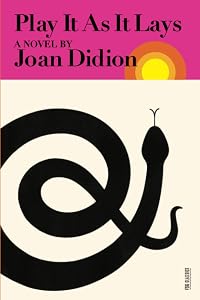
Play it as it Lays
by Joan Didion
On This Page
Description
A ruthless dissection of American life in the late 1960s, Joan Didion's "Play It as It Lays" captures the mood of an entire generation, the ennui of contemporary society reflected in spare prose that blisters and haunts the reader. Set in a place beyond good and evil, literally in Hollywood, Las Vegas, and the barren wastes of the Mojave Desert, but figuratively in the landscape of an arid soul, it remains more than three decades after its original publication a profoundly disturbing novel, show more riveting in its exploration of a woman and a society in crisis and stunning in the still-startling intensity of its prose. show lessTags
Recommendations









Member Recommendations
pitjrw California in it's prime and it's discontents
Member Reviews
Joan Didion's Play It As It Lays is a quick read but it burdens like an anvil with its infectious existential despair after. Maria, an actress, finds herself swimming in worn out Hollywood memories whilst lying in a hospital bed, what's left of its magnetising spark and glamour, and hedonism which are only a temporary reprieve from its monstrosity: the transient fame, the disillusioned promises of films and acting, a rocky and adulterous marriage, a sick daughter, the fake friends, and the ultimate expiration date brought by age and trend. Maria's life is dramatic and tragic like the movies. With the lack of creative control and voice both at home and work they snake their way to Maria's life. She eventually lacks control in any part of show more it. She is looking for purpose, for meaning, anything to make life worth clinging to yet it's devoid of anything. What she has is a series of sexual and superficial encounters as she tethers herself into anything and anyone that alleviates any part of her that aches. Soon, we learn more, the how's, the cries, the tries but not really the why's.
Play It As It Lays is a sad charade of living. Its people have the luxury for everything yet they have nothing. They take anything as a panacea to plaster the malady of emptiness and longing underneath a critical yet debauch society. Along the lights and sounds of Las Vegas hides a bellow for help whilst the thirst of wanting floods the dry Mojave Desert.
Didion writes with high precision and lucidity; its relevance scarily familiar in the present still. The struggles of being a woman, a mother, and an actress embrace its rough pages. She performs an accurate autopsy of our society dead enough not to care about its nauseating norms and impossible expectations. It is an utterly devastating story of surviving day by day with eyes closed whilst hoping for a better tomorrow. Please prepare yourself for the anvil. show less
Play It As It Lays is a sad charade of living. Its people have the luxury for everything yet they have nothing. They take anything as a panacea to plaster the malady of emptiness and longing underneath a critical yet debauch society. Along the lights and sounds of Las Vegas hides a bellow for help whilst the thirst of wanting floods the dry Mojave Desert.
Didion writes with high precision and lucidity; its relevance scarily familiar in the present still. The struggles of being a woman, a mother, and an actress embrace its rough pages. She performs an accurate autopsy of our society dead enough not to care about its nauseating norms and impossible expectations. It is an utterly devastating story of surviving day by day with eyes closed whilst hoping for a better tomorrow. Please prepare yourself for the anvil. show less
Didion is so successfully unsentimental. A sharp observer of humans and culture, precise and terrifying in her insight. Play it as it Lays is a book in the mind of a depressed, listless woman aimlessly floating in what Didion observes as the Californian decadence of the 60s, though the book never gives any such clear cut terms as clues. It's a bored but functioning nihilistic crowd that thinks it's seen everything and has money and nothing else to do. It's striking how she captures what it's like to live without meaning, maybe due to too much freedom of choice. It also feels like a lot of her personal fears jump out of the pages. A very dark, pessimistic mind without hope, so perfectly captured. But which still often feels the show more melancholia of being barely alive. "I know what nothing means, and I keep on playing." The tiny 1.5 to 2 page chapters' format makes it irresistible and hard to put down. show less
I am not much engaged by the problems of what you might call our day but I am burdened by the particular, the mad person who writes me a letter. It is no longer necessary for them even to write me. I know when someone is thinking of me. I learn to deal with this.
A portrait of disaffection, disillusion, and dissociation told in masterful prose—fragmented, hallucinatory, confounding, maddening—that mimics the protagonist's malaise and unraveling.
As relevant now as it was when it was published: this is a journey we've all taken; this is the journey of America—whether you live in it, whether you dream of it, whether you despite it, it's all here, wizardly so.
There’s an old joke that goes, “How do you say ‘I love you’ in New York? Fuck you. How do you say ‘fuck you’ in California? I love you.” That’s the cultural climate in which Joan Didion’s Play It As It Lays takes place. But while that cultural climate is important for the story, it isn’t the main point the author addresses.
Maria is one problem of a woman. She addresses the reader directly in the first person during the opening monologue. From that we learn about the novel’s two elemental metaphors: gambling and rattlesnakes. Maria approaches life as a game of chance. The gambler at the roulette wheel acts without agency over the ball; it just lands where it lands and the player has to accept the result whatever show more that may be. The gambler “plays it as it lays”. The other, more subtle metaphor is that life will bite you whether you like it or not. Rattlesnakes are hiding, biting anyone who is unlucky enough to cross their paths. But rattlesnakes don’t ordinarily attack people. They only bite when provoked so the best way to avoid getting bitten is to play it as it lays. Just avoid getting involved. Knowing this puts Maria into a permanent state of anxiety. After getting bit once, she is expecting another bite to come at some random time. One other detail we learn from Mariah’s opening monologue is that she doesn’t care at all about motivations or explanations. What happens happens and the reason behind it doesn’t matter. Everything is on the surface. Joan Didion, as a master of irony, uses Mariah’s monologue to explain what motivates the protagonist to approach life without the understanding of her own motivations.
Maria’s opening monologue is followed by two other monologues. One is that of her closest friend Helene. The other is that of her husband Carter. From these two we learn that neither of them understand Maria, but they both perceive her as mentally unstable. And although they are the two closest people in her life, both of them are emotionally distant and more like caretakers who put up with her out of a sense of duty more than from genuine interest. There are also subtle foreshadowings of the affair between Helene and Carter, as well as the death of Helene’s husband BZ, all of which culminate at the end of the story.
As a writing technique, the three separate introductory monologues function effectively in presenting three separate perspectives on Maria. This may sound too obvious to be worth mentioning, but what is unique about it is the way the novel shifts back to Maria in the first person throughout the rest of the book. Keeping this in mind, the reader follows Maria’s subjectivity through the lens of two other characters who see her from inaccurate perspectives she can not see herself. Considering that Didion’s style in this novel is called minimalist by some, the perception of depth and multi-dimensionalism in the narrative are heightened. This minimalist irony is taken a step further in that the people surrounding Maria in her life aren’t much more introspective than she is. They aren’t deep thinking. They aren’t analytical people. They just do what they do and when Maria doesn’t make sense to them, they leave her to herself and do soemthing else.
So who are these people? Carter is a film maker. Maria is his wife. They live in Los Angeles. Maria has starred in two movies, but mostly she doesn’t do much. In a haze of tranquilizers and alcohol, she lays by the pool or drives endlessly on the LA freeways in her corvette while listening to the radio. The main source of meaning in her otherwise pointless life is her daughter who lives in a home for mentally disabled children.
One movie Maria starred in was a short experimental film made by Carter. The whole film is close up shots of Maria going about her daily life. She is the only element of the film. The other movie she starred in was made by BZ, Helene’s husband who is also a film maker who sometimes delves into directing pornography. The latter movie stars Maria as the woman in a biker gangbang. BZ describes it as a movie where the female subject is nothing more than a prop since the gangbang is all about the bikers using her body to fulfill their homosexual desires for each other.
Both films are pivotal in understanding Maria because they negate her as a human being in two fundamentally opposing ways. Carter’s film is entirely about her surface, showing only how she appears and what she does with no examination of her subjective life. In the other film, her humanity is negated because, as BZ describes it, she disappears in a screen full of cocks. Inexplicably, Maria claims that BZ’s biker movie is her favorite because it is the one in which her character has the most agency. It is an ironic statement coming from a woman who convinces herself she is refusing to exercise agency in her own life. I say “convincing herself” because she actually does display agency all throughout the book.
Maria does exercise agency when she goes to visit her daughter unannounced at the home for disabled children. The caretaker at the home, however, berates her for not making an appointment because a spontaneous visit like that disrupts her routine and can upset the girl’s stability. Maria also chooses to take her daughter to a Christmas celebration at her ffriends’ mansion, but this results in disaster when her daughter becomes violent.
Maria also exercises agency when she takes trips to Las Vegas to escape from the miseries of life in Los Angeles. On one trip, she randomly encounters her godfather in a casino. The man gives her his phone number and post office box address so she can contact him later. On another trip back to Las Vegas, she tries calling him only to find out the number is invalid. She tries to contact him again by waiting at the post office for several days in hopes he will show up to retrieve his mail from his PO box. But after waiting, Maria learns that the box is rented, not by her godfather, but by an insane woman who doesn’t know him.
Another significant example of Maria exercising agency is when she gets pregnant while cheating on her husband. Carter gives her a choice between having an abortion or divorce. He qualifies the latter option by telling her that he will get custody over their daughter if she chooses to break up with him. Although Carter’s intention is manipulative, he does offer a choice. Since Maria’s daughter is the only thing she cares about in her life, she chooses the abortion. That procedure, illegal at the time of publication, proved to be psychologically traumatic for Maria. Here we see how a pattern in her life emerges: every time Maria tries to exert control over her circumstances, something rotten happens as a result. Every time the rattlesnake bites.
That is a pattern that explains why Maria is the way she is. She runs away from choices and responsibilities because every choice she makes damages her. She numbs the pain with drugs and alcohol in an attempt to erase her mind and emotions. She becomes anhedonic, unable to feel pain or pleasure, living the life of a lobotomy victim or a zombie. For her this is a defense mechanism against the entanglements of the world; for the others in her life, it is a sign of mental illness in a woman having a nervous breakdown. Probably both perspectives are accurate.
And yet another side of Maria is revealed when she visits the supermarket. In the store, she recognizes a crowd of other Southern Californian women whose lives are just as empty and pointless as hers. She recognizes them because they all pirchase the same grocery items. Therefore she consciously chooses to buy groceries that differ from them in an attempt to differentiate herself. It is a form of camouflage. She wants to conceal her similarities to the other lonely shoppers, but there is also a touch of pride in her cover as though she wants to individuate herself in some way. Since the other people in the store can’t see her motivations, if they even notice her at all, this can be little more than a private pleasure. No matter how trivial it is, it is still an attempt at clinging on to some sense of self-worth. Maria also takes a small turn in her rejections of casual sex in Las Vegas towards the end of the novel.
But any subtle changes in Maria are destined to go unnoticed by Helene, Carter, BZ or anybody else around her because they are inattentive to her feelings to begin with. Her husband and friends go out to a remote location in the desert of Nevada and drag her along with them because Carter worries she is losing her grip on reality. Once there, they leave her in the hotel room during the days when they are on a movie set filming a western. Maria mostly stays in a drugged stupor while staying in bed. She finds common ground with BZ who comes to her in despair because Helen and Carter are having an affair and not trying to hide it. Both BZ and Helene have hit rock bottom and BZ tries to convince Maria to overdose on pills with him. He dies in bed beside her but she lives because she refused to kill herself. Suicide would entail taking control over her situation so she does nothing. Ironically, playing it as it lays is what saves her in the end.
On one level, this novel is about the shallow lives of rich people in Hollywood working in the film industry. Maria is surrounded by friends and family acting out of self-interest and brute instinct without any awareness of what is going on with the people around them. Maria’s relationship to them is toxic and dysfunctional. It is through their ignorance that they negate her humanity, treating her like little more than an appendage. And yet they say they love her. Joan Didion’s opinion of the upper crust in California is made clear. On another level, this novel is a character study of a woman who doesn’t have much character whilE in the middle of an existential crisis. But Maria isn’t really on a downward spiral because she was at the bottom to begin with. That’s a shocking statement about somebody with wealth, privilege, and an endless amount of leisure time. She also tries to negate her own humanity by refusing to take control by avoiding choices and letting life happen to her. Despite that, her humanity keeps emerging. Her attempts at self-negation are deliberate, but what I think Joan Didion is demonstrating is that there is something about humanity that can’t be submerged, negated, or denied out of existence no matter how hard people may try. Maria attempts to delude herself into thinking she has no self-awareness or capacity to choose, and yet she keeps making choices in matters that reveal she does have some kind of self-knowledge, albeit self-knowledge that is partially hidden from her conscious mind.
Play It As It Lays could be a 1970s American echo of Albert Camus’s The Stranger, the novel I would argue is the most sadly misinterpreted book of the 20th century. Maria is a lot like Mersault in that she lives the life of a nihilist. It is a life that lacks quality because, like Mersault, she avoids taking control and minimizes her willingness to make choices. Both characters live a pointless, empty existence. But just as so many readers misinterpret Mersault as being some kind of hero, I fear a lot of readers will misinterpret Maria as being a woman who is hopelessly lost in the world. It all depends on how conscientious you are in paying attention to subtle details. If you pay close enough attention, you will notice the abundance of times Joan Didion mentions rattlesnakes in this story. If you read quickly and don’t pay attention, you won’t. If you read carefully enough to be aware of all the rattlesnakes, you should be able to see all the subtle signs that Maria has more agency than you realize. In that there is humanity and in that there is hope. If you only see Maria through the eyes of Helene and Carter then you haven’t understood Joan Didion’s message. The less like them you are, the better off you will be in life anyhow. show less
Maria is one problem of a woman. She addresses the reader directly in the first person during the opening monologue. From that we learn about the novel’s two elemental metaphors: gambling and rattlesnakes. Maria approaches life as a game of chance. The gambler at the roulette wheel acts without agency over the ball; it just lands where it lands and the player has to accept the result whatever show more that may be. The gambler “plays it as it lays”. The other, more subtle metaphor is that life will bite you whether you like it or not. Rattlesnakes are hiding, biting anyone who is unlucky enough to cross their paths. But rattlesnakes don’t ordinarily attack people. They only bite when provoked so the best way to avoid getting bitten is to play it as it lays. Just avoid getting involved. Knowing this puts Maria into a permanent state of anxiety. After getting bit once, she is expecting another bite to come at some random time. One other detail we learn from Mariah’s opening monologue is that she doesn’t care at all about motivations or explanations. What happens happens and the reason behind it doesn’t matter. Everything is on the surface. Joan Didion, as a master of irony, uses Mariah’s monologue to explain what motivates the protagonist to approach life without the understanding of her own motivations.
Maria’s opening monologue is followed by two other monologues. One is that of her closest friend Helene. The other is that of her husband Carter. From these two we learn that neither of them understand Maria, but they both perceive her as mentally unstable. And although they are the two closest people in her life, both of them are emotionally distant and more like caretakers who put up with her out of a sense of duty more than from genuine interest. There are also subtle foreshadowings of the affair between Helene and Carter, as well as the death of Helene’s husband BZ, all of which culminate at the end of the story.
As a writing technique, the three separate introductory monologues function effectively in presenting three separate perspectives on Maria. This may sound too obvious to be worth mentioning, but what is unique about it is the way the novel shifts back to Maria in the first person throughout the rest of the book. Keeping this in mind, the reader follows Maria’s subjectivity through the lens of two other characters who see her from inaccurate perspectives she can not see herself. Considering that Didion’s style in this novel is called minimalist by some, the perception of depth and multi-dimensionalism in the narrative are heightened. This minimalist irony is taken a step further in that the people surrounding Maria in her life aren’t much more introspective than she is. They aren’t deep thinking. They aren’t analytical people. They just do what they do and when Maria doesn’t make sense to them, they leave her to herself and do soemthing else.
So who are these people? Carter is a film maker. Maria is his wife. They live in Los Angeles. Maria has starred in two movies, but mostly she doesn’t do much. In a haze of tranquilizers and alcohol, she lays by the pool or drives endlessly on the LA freeways in her corvette while listening to the radio. The main source of meaning in her otherwise pointless life is her daughter who lives in a home for mentally disabled children.
One movie Maria starred in was a short experimental film made by Carter. The whole film is close up shots of Maria going about her daily life. She is the only element of the film. The other movie she starred in was made by BZ, Helene’s husband who is also a film maker who sometimes delves into directing pornography. The latter movie stars Maria as the woman in a biker gangbang. BZ describes it as a movie where the female subject is nothing more than a prop since the gangbang is all about the bikers using her body to fulfill their homosexual desires for each other.
Both films are pivotal in understanding Maria because they negate her as a human being in two fundamentally opposing ways. Carter’s film is entirely about her surface, showing only how she appears and what she does with no examination of her subjective life. In the other film, her humanity is negated because, as BZ describes it, she disappears in a screen full of cocks. Inexplicably, Maria claims that BZ’s biker movie is her favorite because it is the one in which her character has the most agency. It is an ironic statement coming from a woman who convinces herself she is refusing to exercise agency in her own life. I say “convincing herself” because she actually does display agency all throughout the book.
Maria does exercise agency when she goes to visit her daughter unannounced at the home for disabled children. The caretaker at the home, however, berates her for not making an appointment because a spontaneous visit like that disrupts her routine and can upset the girl’s stability. Maria also chooses to take her daughter to a Christmas celebration at her ffriends’ mansion, but this results in disaster when her daughter becomes violent.
Maria also exercises agency when she takes trips to Las Vegas to escape from the miseries of life in Los Angeles. On one trip, she randomly encounters her godfather in a casino. The man gives her his phone number and post office box address so she can contact him later. On another trip back to Las Vegas, she tries calling him only to find out the number is invalid. She tries to contact him again by waiting at the post office for several days in hopes he will show up to retrieve his mail from his PO box. But after waiting, Maria learns that the box is rented, not by her godfather, but by an insane woman who doesn’t know him.
Another significant example of Maria exercising agency is when she gets pregnant while cheating on her husband. Carter gives her a choice between having an abortion or divorce. He qualifies the latter option by telling her that he will get custody over their daughter if she chooses to break up with him. Although Carter’s intention is manipulative, he does offer a choice. Since Maria’s daughter is the only thing she cares about in her life, she chooses the abortion. That procedure, illegal at the time of publication, proved to be psychologically traumatic for Maria. Here we see how a pattern in her life emerges: every time Maria tries to exert control over her circumstances, something rotten happens as a result. Every time the rattlesnake bites.
That is a pattern that explains why Maria is the way she is. She runs away from choices and responsibilities because every choice she makes damages her. She numbs the pain with drugs and alcohol in an attempt to erase her mind and emotions. She becomes anhedonic, unable to feel pain or pleasure, living the life of a lobotomy victim or a zombie. For her this is a defense mechanism against the entanglements of the world; for the others in her life, it is a sign of mental illness in a woman having a nervous breakdown. Probably both perspectives are accurate.
And yet another side of Maria is revealed when she visits the supermarket. In the store, she recognizes a crowd of other Southern Californian women whose lives are just as empty and pointless as hers. She recognizes them because they all pirchase the same grocery items. Therefore she consciously chooses to buy groceries that differ from them in an attempt to differentiate herself. It is a form of camouflage. She wants to conceal her similarities to the other lonely shoppers, but there is also a touch of pride in her cover as though she wants to individuate herself in some way. Since the other people in the store can’t see her motivations, if they even notice her at all, this can be little more than a private pleasure. No matter how trivial it is, it is still an attempt at clinging on to some sense of self-worth. Maria also takes a small turn in her rejections of casual sex in Las Vegas towards the end of the novel.
But any subtle changes in Maria are destined to go unnoticed by Helene, Carter, BZ or anybody else around her because they are inattentive to her feelings to begin with. Her husband and friends go out to a remote location in the desert of Nevada and drag her along with them because Carter worries she is losing her grip on reality. Once there, they leave her in the hotel room during the days when they are on a movie set filming a western. Maria mostly stays in a drugged stupor while staying in bed. She finds common ground with BZ who comes to her in despair because Helen and Carter are having an affair and not trying to hide it. Both BZ and Helene have hit rock bottom and BZ tries to convince Maria to overdose on pills with him. He dies in bed beside her but she lives because she refused to kill herself. Suicide would entail taking control over her situation so she does nothing. Ironically, playing it as it lays is what saves her in the end.
On one level, this novel is about the shallow lives of rich people in Hollywood working in the film industry. Maria is surrounded by friends and family acting out of self-interest and brute instinct without any awareness of what is going on with the people around them. Maria’s relationship to them is toxic and dysfunctional. It is through their ignorance that they negate her humanity, treating her like little more than an appendage. And yet they say they love her. Joan Didion’s opinion of the upper crust in California is made clear. On another level, this novel is a character study of a woman who doesn’t have much character whilE in the middle of an existential crisis. But Maria isn’t really on a downward spiral because she was at the bottom to begin with. That’s a shocking statement about somebody with wealth, privilege, and an endless amount of leisure time. She also tries to negate her own humanity by refusing to take control by avoiding choices and letting life happen to her. Despite that, her humanity keeps emerging. Her attempts at self-negation are deliberate, but what I think Joan Didion is demonstrating is that there is something about humanity that can’t be submerged, negated, or denied out of existence no matter how hard people may try. Maria attempts to delude herself into thinking she has no self-awareness or capacity to choose, and yet she keeps making choices in matters that reveal she does have some kind of self-knowledge, albeit self-knowledge that is partially hidden from her conscious mind.
Play It As It Lays could be a 1970s American echo of Albert Camus’s The Stranger, the novel I would argue is the most sadly misinterpreted book of the 20th century. Maria is a lot like Mersault in that she lives the life of a nihilist. It is a life that lacks quality because, like Mersault, she avoids taking control and minimizes her willingness to make choices. Both characters live a pointless, empty existence. But just as so many readers misinterpret Mersault as being some kind of hero, I fear a lot of readers will misinterpret Maria as being a woman who is hopelessly lost in the world. It all depends on how conscientious you are in paying attention to subtle details. If you pay close enough attention, you will notice the abundance of times Joan Didion mentions rattlesnakes in this story. If you read quickly and don’t pay attention, you won’t. If you read carefully enough to be aware of all the rattlesnakes, you should be able to see all the subtle signs that Maria has more agency than you realize. In that there is humanity and in that there is hope. If you only see Maria through the eyes of Helene and Carter then you haven’t understood Joan Didion’s message. The less like them you are, the better off you will be in life anyhow. show less
Përmes historisë tronditëse të aktores hollivudiane Maria Uajat, i bëhet një autopsi jetës amerikane në fund të viteve `60, fill pas ndryshimeve të thella sociale që ndodhën atje,
si: revolucioni seksual, lëvizja feministe, kultura e drogës, liria e individit etj. Nëpërmjet një gjuhe tejet filmike, lexuesi arrin të shohë si në ekran shpërbërjen e shoqërisë amerikane të asaj kohe dhe veçanërisht të “botës hollivudiane” ku dukuri, si: vetëvrasjet, dështimet, shkatërrimi i familjes tradicionale, neurozat mbizotërojnë çdo ditë e më shumë.
Sipas kritikut të shquar amerikan John Leonard, vizioni i Didionit në këtë roman është i njëjtë me vizionin e T. S. Eliotit te “Toka e mbeturinave”. Ky show more është një vlerësim i madh për romanin e Didionit, kur mendon që “Toka e mbeturinave” është një nga veprat më madhore të letërsisë moderne. show less
si: revolucioni seksual, lëvizja feministe, kultura e drogës, liria e individit etj. Nëpërmjet një gjuhe tejet filmike, lexuesi arrin të shohë si në ekran shpërbërjen e shoqërisë amerikane të asaj kohe dhe veçanërisht të “botës hollivudiane” ku dukuri, si: vetëvrasjet, dështimet, shkatërrimi i familjes tradicionale, neurozat mbizotërojnë çdo ditë e më shumë.
Sipas kritikut të shquar amerikan John Leonard, vizioni i Didionit në këtë roman është i njëjtë me vizionin e T. S. Eliotit te “Toka e mbeturinave”. Ky show more është një vlerësim i madh për romanin e Didionit, kur mendon që “Toka e mbeturinave” është një nga veprat më madhore të letërsisë moderne. show less
A glimpse into the life and mindset of protagonist Maria Wyeth, a minor Hollywood actress in the 1960s, Divorced, forced through an abortion, drifting through a life of drugs, pills, affairs, parties, emptiness.
Never have I seen major depression – as emptiness and utter indifference, as being cut off and detatched from your feelings – portrayed more truly, accurately and urgently as here.
Love the backdrop of 1960s Hollywood, the stark desert, Nevada, sex, drugs and artist life.
Bleak like the hot desert sand, this is a novel to be felt, to have ingrained into your mind.
Written in a clean-cut, clipped language that is nevertheless sparkling and haunting. A lean, cool force of a story. Joan Didion wrote an unforgettable modern show more American classic. show less
Never have I seen major depression – as emptiness and utter indifference, as being cut off and detatched from your feelings – portrayed more truly, accurately and urgently as here.
Love the backdrop of 1960s Hollywood, the stark desert, Nevada, sex, drugs and artist life.
Bleak like the hot desert sand, this is a novel to be felt, to have ingrained into your mind.
Written in a clean-cut, clipped language that is nevertheless sparkling and haunting. A lean, cool force of a story. Joan Didion wrote an unforgettable modern show more American classic. show less
Didion’s lean and supple prose is excellent. The dialogue is hard and elliptical, sketching the characters in small strokes. Is that enough to make it a great book? The central figure, Maria (pronounced Mar-eye-a) is elusive, not only for the characters with whom she interacts but also for this reader. About one-third in, I wasn’t sure I would finish the book since I didn’t know if I cared what happened to her.
The formal structure of the novel—84 chapters in just 213 pages—indicates how fragmentary the tale, which is appropriate to the plot, since it recounts the disintegration of a personality. Maria's anomie is her own, but also a metaphor for Hollywood in the late Sixties, where this former model, sometime actress, and show more ex-wife of a struggling director, lives. In the end, the book comes to a resolution of sorts; I'm glad I stuck with it, it's a good read. show less
The formal structure of the novel—84 chapters in just 213 pages—indicates how fragmentary the tale, which is appropriate to the plot, since it recounts the disintegration of a personality. Maria's anomie is her own, but also a metaphor for Hollywood in the late Sixties, where this former model, sometime actress, and show more ex-wife of a struggling director, lives. In the end, the book comes to a resolution of sorts; I'm glad I stuck with it, it's a good read. show less
Members
- Recently Added By
Published Reviews
“There’s menace in the way those raw mountains hang over the brightness, the players utterly uninterested, by all appearances, in what lies beyond.”
added by Lemeritus
Lists

The Guardian's 1000 Novels Everyone Must Read
1,005 works; 551 members

1001 Books You Must Read Before You Die
1,448 works; 1,134 members

Novels from The Guardian's Great American Novelist Tournament
148 works; 24 members

Favourite Books
1,819 works; 309 members
Time Magazine's "All-Time 100"
113 works; 15 members

Top Five Books of 2022
736 works; 272 members

Top Five Books of 2019
387 works; 111 members

1970s
657 works; 23 members
Time's All-Time 100 Novels
100 works; 27 members

1960s
281 works; 16 members

Literary Travelogue of the United States Challenge
133 works; 6 members

Cooper
79 works; 1 member
Overdue Podcast
808 works; 9 members

My TBR
371 works; 3 members

Swinging Seventies
255 works; 18 members

sad girl books
41 works; 2 members

Published in 1970
58 works; 7 members

sad girl books
51 works; 3 members

The Atlantic's The Great American Novel
136 works; 12 members
Read These Too
458 works; 9 members

1970 Club
85 works; 2 members
On the pile
20 works; 1 member

Film
114 works; 1 member

el
1,139 works; 1 member
First Novels
373 works; 17 members
Author Information

56+ Works 36,447 Members
Born in Sacramento, California, on December 5, 1934, Joan Didion received a B.A. from the University of California, Berkeley in 1956. She wrote for Vogue from 1956 to 1963, and was visiting regent's lecturer in English at the University of California, Berkeley in 1976. Didion also published novels, short stories, social commentary, and essays. Her show more work often comments on social disorder. Didion wrote for years on her native California; from there her perspective broadened and turned to the countries of Central America and Southeast Asia. Her novels include Democracy (1984) and The Last Thing He Wanted (1996). Well known nonfiction titles include Slouching Towards Bethlehem (1968), The White Album (1979), The Year of Magical Thinking (2005) and Blue Nights (2011). In 1971 Joan Didion was nominated for the National Book Award in fiction for Play It As It Lays. In 1981 she received the American Book Award in nonfiction, and was nominated for a National Book Critics Circle Prize in nonfiction for The White Album. Didion has received a great deal of recognition for The Year of Magical Thinking, which was awarded the National Book Award for Nonfiction in 2005. In 2007, Didion received the National Book Foundation's annual Medal for Distinguished Contribution to American Letters. In 2009, Didion was awarded an honorary Doctor of Letters degree by Harvard University. On July 3, 2013 the White House announced Didion was one of the recipients of the National Medals of Arts and Humanities presented by President Barack Obama. (Bowker Author Biography) show less
Some Editions
Awards and Honors
Distinctions
Notable Lists
Greatest Books algorithm (666)
The Great American Novels (1970)
Series
Belongs to Publisher Series
Work Relationships
Common Knowledge
- Canonical title
- Play it as it Lays
- Original title
- Play It As It Lays
- Original publication date
- 1970
- People/Characters
- Maria Wyeth; BZ; Carter; Helene
- Important places
- Los Angeles, California, USA; Las Vegas, Nevada, USA
- Related movies
- Play It As It Lays (1972 | IMDb)
- Dedication
- FOR JOHN
- First words
- What makes Iago evil? some people ask.
- Quotations
- "Did I catch you in the middle of an overdose, Maria? Or what?"
One thing in my defense, not that it matters: I know something Carter never knew, or Helene, or maybe you. I know what "nothing" means, and keep on playing. - Last words
- (Click to show. Warning: May contain spoilers.)Why, BZ would say.
Why not, I say. - Blurbers
- Frakes, J. R.; Leonard, John
- Original language
- English US
- Canonical DDC/MDS
- 813.54
- Canonical LCC
- PS3554.I33
Classifications
Statistics
- Members
- 3,631
- Popularity
- 4,492
- Reviews
- 72
- Rating
- (3.80)
- Languages
- 9 — Danish, Dutch, English, French, German, Italian, Polish, Spanish, Swedish
- Media
- Paper, Audiobook, Ebook
- ISBNs
- 45
- UPCs
- 1
- ASINs
- 31