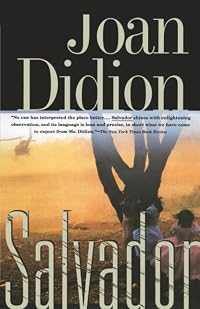
Salvador
by Joan Didion
On This Page
Description
"Terror is the given of the place." The place is El Salvador in 1982, at the ghastly height of its civil war. The writer is Joan Didion, who delivers an anatomy of that country's particular brand of terror - its mechanisms, rationales, and intimate relation to United States foreign policy. As she travels from battlefields to body dumps, interviews a puppet president, and considers the distinctly Salvadoran grammar of the verb "to disappear," Didion gives us a book that is germane to any show more country in which bloodshed has become a standard tool of politics. - Back cover. show lessTags
Recommendations






















Member Reviews
Egy igazi gyöngyszem a Közép-Amerika iránt érdeklődőknek: szubjektív esszé Salvadorról, és egyben politikai pamflet. Az időpont 1982 – a focirajongók tudják, hogy ebben az évben akadt egy Salvadorral kapcsolatos esemény, aminek magyar vonatkozása is van. Nos, ez az esemény legkevésbé sem tárgya ennek a riportkönyvnek, másfelől meg akkoriban annak az országnak a lakosságát sokkal komolyabb problémák foglalkoztatták, mint hogy aranylábú (mert az arany az nehéz, ugye) fiaink 10:1-re leiskolázták őket a VB-n.
Didion túlfűtött, vibráló szövege egy olyan országot mutat be, ahol visszafogott reggelnek minősül, amikor csak hét hullát szállítanak be golyóval a fejükben a helyi hullaházba. show more Ebben az országban a félelem mindent megbénító szelleme uralkodik – az ember egész egyszerűen nem tudhatja, hogy aznap nem pont őt pakolják-e be egy Toyota furgonba valakik… mert tulajdonképpen tényleg bárkik, bármiért megtehetik ezt – jobboldaliak, baloldaliak, bár azért leginkább a kormányerők. Ez egy nyugat-európai aggyal teljesen elképzelhetetlen légkör – és hát egyelőre még közép-keleti aggyal is nehezen elképzelhető, hál’Istennek –, de Didion nagy erővel képes megjeleníteni.
Ezen felül ez a könyv egyben kemény támadás a Reagen-kormányzat külpolitikája ellen, ami (a hidegháborúra hivatkozva) nem hogy nem állította meg a vérontást, de még mélyítette is a válságot. A suskusolás, amit a jenki külügyérek művelnek a földnek abban a szegletében diplomácia címén, olyan tekintetben érthető, hogy őket akkortájt az „ellenségem ellensége a barátom” elv vezérelte. És hát a szemükben akkor a marxizmus volt a főgonosz, a velük szemben álló militarista rezsimek pedig szövetségesnek minősültek. Csak hát ha valami érthető, attól még lehet rohadt ügy, sőt: baromság, látva, hogy az említett rezsimek kicsikarták ugyan a segélyeket az USA-tól (amit aztán magánbankszámlákra utaltak, többnyire Miamiban), de cserébe alig mutattak fel valamit. Persze mindez ’82 előtt történt, vonhatjuk meg a vállunkat, és már csak történelem. Ugyanakkor a fenn említett elv alighanem máig meghatározza a nagyhatalmak viselkedését kritikus geopolitikai régiókban – a kisebbik rossz (monarchista rezsimek és tegnapi terroristák) támogatása annak reményében, hogy a nagyobbikat izoláljuk. Ez a könyv ennek technikájába is villanásnyi betekintést nyújt. Azon túl, hogy közben tényleg nagyon magas szintű, bikaerős irodalmi szöveg. show less
Didion túlfűtött, vibráló szövege egy olyan országot mutat be, ahol visszafogott reggelnek minősül, amikor csak hét hullát szállítanak be golyóval a fejükben a helyi hullaházba. show more Ebben az országban a félelem mindent megbénító szelleme uralkodik – az ember egész egyszerűen nem tudhatja, hogy aznap nem pont őt pakolják-e be egy Toyota furgonba valakik… mert tulajdonképpen tényleg bárkik, bármiért megtehetik ezt – jobboldaliak, baloldaliak, bár azért leginkább a kormányerők. Ez egy nyugat-európai aggyal teljesen elképzelhetetlen légkör – és hát egyelőre még közép-keleti aggyal is nehezen elképzelhető, hál’Istennek –, de Didion nagy erővel képes megjeleníteni.
Ezen felül ez a könyv egyben kemény támadás a Reagen-kormányzat külpolitikája ellen, ami (a hidegháborúra hivatkozva) nem hogy nem állította meg a vérontást, de még mélyítette is a válságot. A suskusolás, amit a jenki külügyérek művelnek a földnek abban a szegletében diplomácia címén, olyan tekintetben érthető, hogy őket akkortájt az „ellenségem ellensége a barátom” elv vezérelte. És hát a szemükben akkor a marxizmus volt a főgonosz, a velük szemben álló militarista rezsimek pedig szövetségesnek minősültek. Csak hát ha valami érthető, attól még lehet rohadt ügy, sőt: baromság, látva, hogy az említett rezsimek kicsikarták ugyan a segélyeket az USA-tól (amit aztán magánbankszámlákra utaltak, többnyire Miamiban), de cserébe alig mutattak fel valamit. Persze mindez ’82 előtt történt, vonhatjuk meg a vállunkat, és már csak történelem. Ugyanakkor a fenn említett elv alighanem máig meghatározza a nagyhatalmak viselkedését kritikus geopolitikai régiókban – a kisebbik rossz (monarchista rezsimek és tegnapi terroristák) támogatása annak reményében, hogy a nagyobbikat izoláljuk. Ez a könyv ennek technikájába is villanásnyi betekintést nyújt. Azon túl, hogy közben tényleg nagyon magas szintű, bikaerős irodalmi szöveg. show less
Didion visited El Salvador for a fortnight in 1982 and this short book expanded upon her New York Review of Books essay.
“Terror is the given of the place” and Didion tries to illustrate this with a montage of incidents and anecdotes which include the humour of the absurd, as you don’t want to think about the details of the horror of the commonplace deaths. This can be theoretically understood from Didion’s descriptions of the body dumps, the government death squads and the“disappearances”, but is numbing.
Didion’s book is not only about the impact of the terror upon her and her thinking, but also the way in which the American military and diplomatic presence had to view the situation in order to justify their involvement show more in assisting the government. She is not opining whether the US presence in El Salvador is right or wrong, just trying to present her impressions and the record of her conversations from a two week visit.
“...nothing came of the day but overheard rumors, indefinite observations, fragments of information that might or might not fit into a pattern we did not perceive.” show less
“Terror is the given of the place” and Didion tries to illustrate this with a montage of incidents and anecdotes which include the humour of the absurd, as you don’t want to think about the details of the horror of the commonplace deaths. This can be theoretically understood from Didion’s descriptions of the body dumps, the government death squads and the“disappearances”, but is numbing.
Didion’s book is not only about the impact of the terror upon her and her thinking, but also the way in which the American military and diplomatic presence had to view the situation in order to justify their involvement show more in assisting the government. She is not opining whether the US presence in El Salvador is right or wrong, just trying to present her impressions and the record of her conversations from a two week visit.
“...nothing came of the day but overheard rumors, indefinite observations, fragments of information that might or might not fit into a pattern we did not perceive.” show less
Salvador is Didion's account her 2-week trip to El Salvador in 1982, then a country in the early stages of a 12 year brutal civil war. Her opening report describes some of the carnage and the everyday terror Salvadorans experience. The opening report is a vividly disturbing picture of just how cruel we can be to one another. From there Didion describes her encounters with various powerful citizens and American embassy officials, who relate the corruption and the utter confusion that permeates this civil war from the top to the bottom. From these interviews it is fairly plan to see that the Salvadorans and those in charge have become desensitized to the violence and disappearances, and are largely apathetic to any reforms proposed by the show more government. Yet the terror is still very much with them without abatement. Reconciliation is clearly not on the table and the average citizen has no hope that this war is ending soon. Also, discussed to some extent is the ineffectiveness of the U.S. Foreign policy in the murkiness of the civil war. A war in which our allies are more content with the continuation of this war in order to consolidate power rather than fight over ideological outcome or for a greater purpose. In the wake of needless bloodshed on such a massive scale, all an ambassador can do is work towards small victories like trials before executions and doing everything possible to insure the safety of the citizens in their charge.
Salvador is not a factual history of the war in 1982. It is, however, the war seen through the eyes of a journalist with limited time and resources in country. Bias is inherit in this kind of journalism and time and events told second hand become as fluid as the eye witness accounts. Didion tries to elevate these problems by sprinkling quotes and statements taken from official and vetted sources related to story is she is conveying. It's a one-sided truth, but I have not doubt that it is the truth to Didion. So while it's not a scholarly account of the events taking place in El Salvador in 1982, it is an invaluable piece that gives voice to the experiences and horrific events that shaped the lives of Salvadorans for over a decade.
Advice for other writers: Do not attempt to write like Didion unless your name is Didion. She does things with her sentence structure I didn't think was possible. At no point in my wildest imagination would paragraph sized sentence featuring a colon, a semi-colon, eight commas, and two sets of parentheses come off as anything but a clunky mess. Yet Didion's prose is so smooth and her phrasing so good that I hardly ever took notice of her peculiar style. She spews words onto the page and it comes out as a coherent, well constructed thought. She's a remarkable talent. show less
Salvador is not a factual history of the war in 1982. It is, however, the war seen through the eyes of a journalist with limited time and resources in country. Bias is inherit in this kind of journalism and time and events told second hand become as fluid as the eye witness accounts. Didion tries to elevate these problems by sprinkling quotes and statements taken from official and vetted sources related to story is she is conveying. It's a one-sided truth, but I have not doubt that it is the truth to Didion. So while it's not a scholarly account of the events taking place in El Salvador in 1982, it is an invaluable piece that gives voice to the experiences and horrific events that shaped the lives of Salvadorans for over a decade.
Advice for other writers: Do not attempt to write like Didion unless your name is Didion. She does things with her sentence structure I didn't think was possible. At no point in my wildest imagination would paragraph sized sentence featuring a colon, a semi-colon, eight commas, and two sets of parentheses come off as anything but a clunky mess. Yet Didion's prose is so smooth and her phrasing so good that I hardly ever took notice of her peculiar style. She spews words onto the page and it comes out as a coherent, well constructed thought. She's a remarkable talent. show less
Essentially a long magazine article about El Salavador during the military dictatorship of the early 1980s. Piles of murdered bodies lie alongside a limping bureaucracy and a populace that must act like citizens of a Shirley Jackson short story and blithely skip along while ignoring the mounting terror around them.
The reporting and cool analysis is vintage Didion and therefore magnificent. The Central American policy is a bit too wonky (and a bit too stuck in 1982) to be all that readable or interesting. But still, this book is fast reading but potent, like a gulp of firm scotch that builds in your throat to a slow, angry boil.
Very worth it.
The reporting and cool analysis is vintage Didion and therefore magnificent. The Central American policy is a bit too wonky (and a bit too stuck in 1982) to be all that readable or interesting. But still, this book is fast reading but potent, like a gulp of firm scotch that builds in your throat to a slow, angry boil.
Very worth it.
On one hand I kept thinking this book was really dated and would have made much more of an impression on me if I had read it years ago, closer to when it was published. Salvador is filled with a litany of terror perpetrated by one side then another. Thirty years ago those horrors were the stuff of every day headlines, and I'm sure I would have wanted this book to help explain--if it could--what it all meant and who were the good guys.
These many years later, the politics don't seem to matter as much anymore, but that litany--the description of one horrific act after another--seems only to prove that inhumanity knows no decade.
These many years later, the politics don't seem to matter as much anymore, but that litany--the description of one horrific act after another--seems only to prove that inhumanity knows no decade.
After reading [Slouching Toward Jeruselum] I was left wanting more [[Didion]]. Stretch's review of [Salvador] and my own interest in the history of U.S. involvement there made it the next logical choice. My four children were mostly out of toddlerhood when this was happening, and my attention was again turning outward. This was really when I first more deeply understood some new things: my country was not the good guy, both
sides in this conflict were slaughtering people, there were more than two sides, it was way more complicated than good guy vs. bad guy. (Yeah, I'm a slow learner.)
It was intriguing to see Didion's writing applied to such a topic as Salvador and the ugliness that was happening. I especially appreciated the way she show more compared Salvadoran use of language to more linear U.S. language use, especially in the use of numbers. She talked about Salvadoran use as being more generally descriptive of their world beyond numbers and into deeper meaning and how this was misunderstood by Americans. It reminded me of a ten year old client who kept insisting there were hundreds of empty beer bottles at his dad's house. His mom was upset and wanted him to be more specific because he was going to have to testify in court. He was an exceptionally bright child so she could not understand nor tolerate his exaggeration. She finally got it tho - he wasn't telling her how many bottles there were. He was telling her how scared and overwhelmed he felt. Didion talks about this difficulty describing Salvador in terms many of us understand, that she found herself without the words.
It's an interesting and quick read at only 100 pages. I had my first Salvadoran student in the early 2000s and wish I could have had more time with him. I'd like current information on it if anyone has any suggestions for sources. show less
sides in this conflict were slaughtering people, there were more than two sides, it was way more complicated than good guy vs. bad guy. (Yeah, I'm a slow learner.)
It was intriguing to see Didion's writing applied to such a topic as Salvador and the ugliness that was happening. I especially appreciated the way she show more compared Salvadoran use of language to more linear U.S. language use, especially in the use of numbers. She talked about Salvadoran use as being more generally descriptive of their world beyond numbers and into deeper meaning and how this was misunderstood by Americans. It reminded me of a ten year old client who kept insisting there were hundreds of empty beer bottles at his dad's house. His mom was upset and wanted him to be more specific because he was going to have to testify in court. He was an exceptionally bright child so she could not understand nor tolerate his exaggeration. She finally got it tho - he wasn't telling her how many bottles there were. He was telling her how scared and overwhelmed he felt. Didion talks about this difficulty describing Salvador in terms many of us understand, that she found herself without the words.
It's an interesting and quick read at only 100 pages. I had my first Salvadoran student in the early 2000s and wish I could have had more time with him. I'd like current information on it if anyone has any suggestions for sources. show less
My heart aches for the (poor) people of this tiny country. The U.S. uses their"aid" to keep communism from getting a toehold. But everyone is so corrupt, especially us, that it's probably worse than keeping our filthy hands out. Didion wrote without emotion of atrocities that are a daily part of life.
Members
- Recently Added By
Lists

Central America
14 works; 1 member

Favourite Books
1,820 works; 316 members

Books Read in 2021
5,361 works; 114 members
Author Information

Born in Sacramento, California, on December 5, 1934, Joan Didion received a B.A. from the University of California, Berkeley in 1956. She wrote for Vogue from 1956 to 1963, and was visiting regent's lecturer in English at the University of California, Berkeley in 1976. Didion also published novels, short stories, social commentary, and essays. Her show more work often comments on social disorder. Didion wrote for years on her native California; from there her perspective broadened and turned to the countries of Central America and Southeast Asia. Her novels include Democracy (1984) and The Last Thing He Wanted (1996). Well known nonfiction titles include Slouching Towards Bethlehem (1968), The White Album (1979), The Year of Magical Thinking (2005) and Blue Nights (2011). In 1971 Joan Didion was nominated for the National Book Award in fiction for Play It As It Lays. In 1981 she received the American Book Award in nonfiction, and was nominated for a National Book Critics Circle Prize in nonfiction for The White Album. Didion has received a great deal of recognition for The Year of Magical Thinking, which was awarded the National Book Award for Nonfiction in 2005. In 2007, Didion received the National Book Foundation's annual Medal for Distinguished Contribution to American Letters. In 2009, Didion was awarded an honorary Doctor of Letters degree by Harvard University. On July 3, 2013 the White House announced Didion was one of the recipients of the National Medals of Arts and Humanities presented by President Barack Obama. (Bowker Author Biography) show less
Some Editions
Awards and Honors
Distinctions
Work Relationships
Is contained in
Common Knowledge
- Original publication date
- 1983
- People/Characters
- Ronald Reagan
- Important places
- El Salvador
Classifications
- Genres
- Nonfiction, General Nonfiction, Travel, History
- DDC/MDS
- 972.84052 — History & geography History of North America Mexico, Central America, West Indies, Bermuda Central America El Salvador
- LCC
- F1488.3 .D53 — Local History of the United States, Canada and Latin America Latin America. Spanish America Salvador (El Salvador)
- BISAC
Statistics
- Members
- 792
- Popularity
- 35,350
- Reviews
- 11
- Rating
- (3.65)
- Languages
- 7 — Danish, Dutch, English, German, Hungarian, Norwegian (Bokmål), Swedish
- Media
- Paper, Audiobook, Ebook
- ISBNs
- 17
- ASINs
- 6