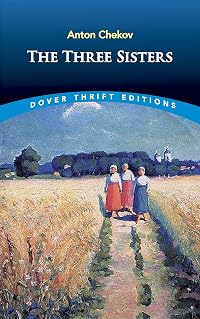
Three Sisters
by Anton Chekhov
On This Page
Description
"A bracing adaptation from the Pulitzer Prize-winning author of August: Osage County"-- The Prozorov sisters pine for Moscow. Culture and life brim in the city center, while they live among the mundane of a crumbling army garrison after their father's death. Though living with their brother Andrey, nothing keeps them back but their own misfortune, decisions, and the inertia of negativity that continues to follow this family.Tags
Recommendations












Member Reviews
At first this play could be entitled Noisy Idiots--it's all very blustery and endearing, and certainly just the kind of warmth and din you'd want on entering the theatre on a January day in Russia in 1901--but you do settle in for some sub-School for Scandal-type proceedings, hijinx in any case. The sisters are bored--bien. Olga is a spinster, Masha is married and bored, Irina is pretty as a sugared confection and doesn't love any of the local notables and gots to get to Moscow where real life will begin. Bien, bien. Their brother Andrei is a big-thought-thinker whose status as the baby of the family has long since shaded into awwardness with the outside world, itself browning into misogyny. And then the soldiers come to town. It's a show more setting rich with promise--everone's so desperate for something to happen that you know when it does they're gonna milk it. X is gonna turn her nose up at Y, who will be overheard speaking to Z by A, who owes money to B, who is in love with C and her barbed tongue, bien, bien, bien! And everyone leaves a little warmer after "visiting with the Prozorovs," as the Russians were (are?) prone to saying they were doing when they went to see this play. Everybody yells, everybody laughs, the inevitable romantic misunderstanding is defused before anyone gets more than a scare.
Except, just as real family life is never as jolly as it seems over the Thanksgiving table or what have you, things are gonna fall apart for our favourite family (the ones whom we wish we could actually visit, all alone in our big house in the winter with nobody but Sergei and Katya and the children and old "Auntie" Lidia Ivanovna in her room on the top floor. If they seem like such a shockingly real family to me with my how-much-poorer twenty-first-century web of one father, one mother, one sister, and one (beautiful!) niece, imagine the shock of recognition for their compeers).
And I am a deeply ignorant fellow, but I don't kow of an earlier example of dramatic family fallapart that feels so real. No fated Greekness, none of that deep French cynicism about the meaningful life, no arbitrary Shakespearean event leading to mutual assured destruction among all the characters (too heroic to ever live anyway, of course). These Russians are, as they always are, the first and best existentialists, all looking for one reason to stop yelling and feel calm in their limitedness and their mortality, even amid the endless steppe (one aspect of Irina's ever-awaited return to Moscow is no doubt to avoid looking out into that perfect dark).
The point of the family is to keep each other going under unbearable circumstances (BY WHICH WE MEAN LIVING, MAN, JUST LIVING), which means absorbing each other's yelling, caprices, cynicisms. In this family, they're doing a great job--you watch them do it and it makes you love them, delightful self-absorbed Irina, sardonic yet deeply loving Masha, sorrowful and strong strong strong Olga--until the soldiers arrive with their brave/stupid/pointlessly selfdestructive need to scratch at the thin human veneer over the hinterland's dark maw. That is, two of our three destroyers are Vershinin, the "philosopher" (a luxury impossible, irresponsible, criminally culpable, in these circumstances, on the ragged frontline of the bourgeois world!) and Solyony (who I think may actually believe he's dealing with the same black-rye-soul stuff that makes the other characters yell, may not recognize that his father was the wolf or the North Wind or, I dunno, Shiva). But three sisters still outweighs two destroyers--it's when their brother marries Natasha that the critical mass becomes unbearable. Amid so much richly realistic human fellowship and strife, she's the only one with whom it's impossible to sympathize--the provincial petty-bourgeois climber, ruthlessly fighting her way into the manor house, that outpost of metropolitan legitimacy. She is reprehensible, and the sisters--distracted by the soldiers, her horsemen--don't have the stomach. And she usurps them, and the last homely house is destroyed.
But it doesn't burn, even though the village does--Chekhov is too sophisticated, too matter of fact for that cheap symbolism. The play ends with the little pas a deux of Chebutykin: "It doesn't matter, it doesn't matter"--and Olga--"If we only knew, if we only knew!" That's still our problem, expressed so mundanely but so hauntingly. How can you bear what is when there's also a what could be? A what could have been?
We do know one thing: contrary to Vershinin's much-expressed hope, life is not gonna become "easier and brighter"; the whole play abuses him, who on the surface seems its romantic hero. Or at least, if utopia is really out there, it's far, far beyond the horizon--the play ends in the revolutionary year 1905, and on his 300-year timeline one wonders how many Russians will be here to see the world in which the yelling soul is soothed. If we only knew, if we only knew! show less
Except, just as real family life is never as jolly as it seems over the Thanksgiving table or what have you, things are gonna fall apart for our favourite family (the ones whom we wish we could actually visit, all alone in our big house in the winter with nobody but Sergei and Katya and the children and old "Auntie" Lidia Ivanovna in her room on the top floor. If they seem like such a shockingly real family to me with my how-much-poorer twenty-first-century web of one father, one mother, one sister, and one (beautiful!) niece, imagine the shock of recognition for their compeers).
And I am a deeply ignorant fellow, but I don't kow of an earlier example of dramatic family fallapart that feels so real. No fated Greekness, none of that deep French cynicism about the meaningful life, no arbitrary Shakespearean event leading to mutual assured destruction among all the characters (too heroic to ever live anyway, of course). These Russians are, as they always are, the first and best existentialists, all looking for one reason to stop yelling and feel calm in their limitedness and their mortality, even amid the endless steppe (one aspect of Irina's ever-awaited return to Moscow is no doubt to avoid looking out into that perfect dark).
The point of the family is to keep each other going under unbearable circumstances (BY WHICH WE MEAN LIVING, MAN, JUST LIVING), which means absorbing each other's yelling, caprices, cynicisms. In this family, they're doing a great job--you watch them do it and it makes you love them, delightful self-absorbed Irina, sardonic yet deeply loving Masha, sorrowful and strong strong strong Olga--until the soldiers arrive with their brave/stupid/pointlessly selfdestructive need to scratch at the thin human veneer over the hinterland's dark maw. That is, two of our three destroyers are Vershinin, the "philosopher" (a luxury impossible, irresponsible, criminally culpable, in these circumstances, on the ragged frontline of the bourgeois world!) and Solyony (who I think may actually believe he's dealing with the same black-rye-soul stuff that makes the other characters yell, may not recognize that his father was the wolf or the North Wind or, I dunno, Shiva). But three sisters still outweighs two destroyers--it's when their brother marries Natasha that the critical mass becomes unbearable. Amid so much richly realistic human fellowship and strife, she's the only one with whom it's impossible to sympathize--the provincial petty-bourgeois climber, ruthlessly fighting her way into the manor house, that outpost of metropolitan legitimacy. She is reprehensible, and the sisters--distracted by the soldiers, her horsemen--don't have the stomach. And she usurps them, and the last homely house is destroyed.
But it doesn't burn, even though the village does--Chekhov is too sophisticated, too matter of fact for that cheap symbolism. The play ends with the little pas a deux of Chebutykin: "It doesn't matter, it doesn't matter"--and Olga--"If we only knew, if we only knew!" That's still our problem, expressed so mundanely but so hauntingly. How can you bear what is when there's also a what could be? A what could have been?
We do know one thing: contrary to Vershinin's much-expressed hope, life is not gonna become "easier and brighter"; the whole play abuses him, who on the surface seems its romantic hero. Or at least, if utopia is really out there, it's far, far beyond the horizon--the play ends in the revolutionary year 1905, and on his 300-year timeline one wonders how many Russians will be here to see the world in which the yelling soul is soothed. If we only knew, if we only knew! show less
A complex and mournful play about a family of sisters who are tired of living in the country and are hoping to move back to Moscow. Beneath this simple longing is a deeper one: to have a meaningful life, to find love, to be of service. Themes of marriage, relationships, infidelity, and impending mortality haunt the action of the play, intensifying at the climax when one of the daughter's suitors is slain in a duel. She didn't love him, per se, but he was a good man and she had resigned herself to a happy life.
The main characters question whether or not they can ever achieve happiness or if these seemingly pressing questions of marriage, work, and moving to Moscow are all vain attempts to chase a figment. Other characters represent show more themselves as happy in spite of their situation.
The acting is lovely but, as always with this medium, it was hard to follow which character is which. Still, I enjoyed the experience and will likely read the play later to better understand it. show less
The main characters question whether or not they can ever achieve happiness or if these seemingly pressing questions of marriage, work, and moving to Moscow are all vain attempts to chase a figment. Other characters represent show more themselves as happy in spite of their situation.
The acting is lovely but, as always with this medium, it was hard to follow which character is which. Still, I enjoyed the experience and will likely read the play later to better understand it. show less
ANOTHER depressing Russian play, complete with covetousness and affairs and dissatisfaction and death. I understand Chekhov is great, but I cannot yet appreciate him. It is rather brilliant, though, in its poetry:
"Why on the very threshold of life do we become dull, grey, uninteresting, lazy, indifferent, useless, unhappy?... Our town has been going on for two hundred years-- there are a hundred thousand people living in it; and there is not one who is not like the rest, not one saint in the past, or the present, not one man of learning, not one artist, not one man in the least remarkable who could inspire envy or a passionate desire to imitate him... They only eat, drink, sleep, and then die... others are born, and they also eat and show more drink and sleep, and not to be bored to stupefaction they vary their lives by nasty gossip, vodka, cards, litigation; and the wives deceive their husbands, and the husbands tell lies and pretend that they see and hear nothing, and an overwhelmingly vulgar influence weighs upon the children, and the divine spark is quenched in them and they become the same sort of pitiful, dead creatures, all exactly alike, as their fathers and mothers..."
Beautifully depressing. show less
"Why on the very threshold of life do we become dull, grey, uninteresting, lazy, indifferent, useless, unhappy?... Our town has been going on for two hundred years-- there are a hundred thousand people living in it; and there is not one who is not like the rest, not one saint in the past, or the present, not one man of learning, not one artist, not one man in the least remarkable who could inspire envy or a passionate desire to imitate him... They only eat, drink, sleep, and then die... others are born, and they also eat and show more drink and sleep, and not to be bored to stupefaction they vary their lives by nasty gossip, vodka, cards, litigation; and the wives deceive their husbands, and the husbands tell lies and pretend that they see and hear nothing, and an overwhelmingly vulgar influence weighs upon the children, and the divine spark is quenched in them and they become the same sort of pitiful, dead creatures, all exactly alike, as their fathers and mothers..."
Beautifully depressing. show less
"Three Sisters" is widely regarded as one of Chekov's two or three best plays (along with "The Cherry Orchard" and "The Seagull"), and with good reason. We witness the decay of the privileged class in pre-revolutionary Russia, through the lives of the three dissatisfied sisters of the Prozorov family -- young women who long for their treasured past while seeking meaning in a society that has come to value "work". The three sisters are Olga (the unmarried matriarch of the family), Masha (a vital and passionate woman trapped in a marriage with a boring school teacher), and 20 year old Irina, who longs to return to Moscow where she hopes to find a husband and raise a family. Their brother Andrei aspired to a professorship in Moscow, but show more becomes trapped in a marriage to an ill-bred commoner, Natasha. By the play's end, Natasha is in control of the house and the family members, and with their respective and collective hopes dashed, the three sisters are destined to live out their lives with none of their dreams fulfilled.
I had the benefit of being able to watch each of the four acts of "Three Sisters" in between reading the text, and the experience greatly enhanced my appreciation. Indeed, reading the 1901 play gave me little sense of its power, and I deeply appreciated how the actors were able to flesh out the characters through vocalizations and body language, and all the subtleties of stage direction that so greatly enhanced the play. In light of my very different experience in reading vs. watching the play, I'm left with the dilemma of how to judge the written work -- the "book" here at LT. I choose to judge the play as the living manifestation of Chekhov's written artistry, and in that respect, a 4+ star ranking seems warranted.
With a full plot summarized in detail at Wikipedia, along with lengthy descriptions of the characters, there's little point to my summarizing both. Further, there are innumerable literary analyses available, to which I can add nothing but personal reaction. I recommend the play, of course, in particular a quality acted version. The recorded version that I saw is a BBC production from 1970, that starred Anthony Hopkins, Janet Suzman, and Michele Dotrice. It is readily available in an excellent 6 DVD collection of Chekhov's plays. There is also an amateur production by students at a university in Colorado, but it is best avoided. As a performance, "Three Sisters" demands highly skilled actors and stage direction, since the play is so much more than the dialogue. show less
I had the benefit of being able to watch each of the four acts of "Three Sisters" in between reading the text, and the experience greatly enhanced my appreciation. Indeed, reading the 1901 play gave me little sense of its power, and I deeply appreciated how the actors were able to flesh out the characters through vocalizations and body language, and all the subtleties of stage direction that so greatly enhanced the play. In light of my very different experience in reading vs. watching the play, I'm left with the dilemma of how to judge the written work -- the "book" here at LT. I choose to judge the play as the living manifestation of Chekhov's written artistry, and in that respect, a 4+ star ranking seems warranted.
With a full plot summarized in detail at Wikipedia, along with lengthy descriptions of the characters, there's little point to my summarizing both. Further, there are innumerable literary analyses available, to which I can add nothing but personal reaction. I recommend the play, of course, in particular a quality acted version. The recorded version that I saw is a BBC production from 1970, that starred Anthony Hopkins, Janet Suzman, and Michele Dotrice. It is readily available in an excellent 6 DVD collection of Chekhov's plays. There is also an amateur production by students at a university in Colorado, but it is best avoided. As a performance, "Three Sisters" demands highly skilled actors and stage direction, since the play is so much more than the dialogue. show less
The play, written in 1900, tells the story of the Prozorov family. Three sisters, Olga, Maria, and Irina Prozorova and their brother Andrei, are living in the Russian countryside.
Olga works and cares for her family. Maria is married, but falls in love with the visiting Colonel Vershinin. Irina is the youngest, an idealistic girl who believes she find her love in Moscow. Andrei has aspirations to become a professor and has fallen for a local girl, Natasha, of whom his sisters do not approve.
The characters debate the meaning of life, the possibility of attaining happiness and more all while dreaming of a better life in Moscow. The first Act is full of hope and possibility, but as the play progresses and the characters’ lives begin to show more stagnant, that optimism diminishes.
It’s a sad story, no one really gets a happy ending, but the dialogue throughout the story is so beautiful. There’s also a lot of humor worked into the writing. It speaks to Chekhov’s talent that every scene isn’t somber. At the end they are all left wanting something, wishing for more knowledge and a better life.
BOTTOM LINE: I loved it. I hope I get a chance to see it performed someday. There are few plays I’ve read that show the drama of a crumbling family quite so eloquently.
“When we are dead, men will fly in balloons, change the fashion of their coats, will discover a sixth sense, perhaps, and develop it, but life will remain just the same, difficult, full of mysteries and happiness. In a thousand years man will sigh just the same, ‘Ah, how hard life is,’ and yet just as now he will be afraid of death and not want it.”
“I think man ought to have faith or ought to seek a faith, or else his life is empty, empty. . . . To live and not to understand why cranes fly; why children are born; why there are stars in the sky. . . . You've got to know what you're living for or else it's all nonsense and waste.” show less
Olga works and cares for her family. Maria is married, but falls in love with the visiting Colonel Vershinin. Irina is the youngest, an idealistic girl who believes she find her love in Moscow. Andrei has aspirations to become a professor and has fallen for a local girl, Natasha, of whom his sisters do not approve.
The characters debate the meaning of life, the possibility of attaining happiness and more all while dreaming of a better life in Moscow. The first Act is full of hope and possibility, but as the play progresses and the characters’ lives begin to show more stagnant, that optimism diminishes.
It’s a sad story, no one really gets a happy ending, but the dialogue throughout the story is so beautiful. There’s also a lot of humor worked into the writing. It speaks to Chekhov’s talent that every scene isn’t somber. At the end they are all left wanting something, wishing for more knowledge and a better life.
BOTTOM LINE: I loved it. I hope I get a chance to see it performed someday. There are few plays I’ve read that show the drama of a crumbling family quite so eloquently.
“When we are dead, men will fly in balloons, change the fashion of their coats, will discover a sixth sense, perhaps, and develop it, but life will remain just the same, difficult, full of mysteries and happiness. In a thousand years man will sigh just the same, ‘Ah, how hard life is,’ and yet just as now he will be afraid of death and not want it.”
“I think man ought to have faith or ought to seek a faith, or else his life is empty, empty. . . . To live and not to understand why cranes fly; why children are born; why there are stars in the sky. . . . You've got to know what you're living for or else it's all nonsense and waste.” show less
2 1/2 stars, maybe? I only read it. I haven't seen/heard it performed, and it seems the sort of thing where a great performance would make all the difference. It is interesting that the only character to show initiative and energy ends up being demonized by the rest. That's like the sheep blaming the wolf in sheep's clothing for secretly being a wolf. Um. Which is to say, I feel like I'm supposed to have more sympathy for the three sisters and their brother, but in my head all I can hear is Paul Simon singing "Fifty Ways": Hop on the bus, Gus. You don't need to discuss much! Just drop off the key, Lee, and get yourself free.
Very much a slice of life drama, but it's a life that I can't particularly identify with. It's supposed to be a "classic" but I just didn't get that much out of it.
Members
- Recently Added By
Lists

New York Public Library's Books of the Century
120 works; 20 members

Best Books With Sisters
130 works; 30 members

Next Plays to Watch
50 works; 1 member

Next Plays / 2025
352 works; 1 member

My Play Collection
769 works; 3 members

Recommended Reading : 600 Classics Reviewed, Editors of Salem Press, 2015
634 works; 6 members

New Lifetime Reading Plan by Fadiman and Major
225 works; 5 members

Mustich's 1000 Books to Read Before You Die: A Life Changing List
1,001 works; 20 members

Greatest Books, allegedly
484 works; 9 members
r/acting on Reddit - Essential Plays
44 works; 2 members
The Top Ten: Writers Pick Their Favorite Books
240 works; 31 members

New York Public Library's Books of the Century - All
170 works; 14 members

Books Read in 2018
4,360 works; 110 members

20th Century Literature
1,161 works; 55 members

Books Read in 2017
4,249 works; 130 members

Books Read in 2016
4,666 works; 199 members

Favourite Books
1,820 works; 309 members

1900s (Decade, not century)
73 works; 17 members

In Our Time books
4,934 works; 2 members
Author Information

Anton Pavlovich Chekhov was born in the provincial town of Taganrog, Ukraine, in 1860. In the mid-1880s, Chekhov became a physician, and shortly thereafter he began to write short stories. Chekhov started writing plays a few years later, mainly short comic sketches he called vaudvilles. The first collection of his humorous writings, Motley show more Stories, appeared in 1886, and his first play, Ivanov, was produced in Moscow the next year. In 1896, the Alexandrinsky Theater in St. Petersburg performed his first full- length drama, The Seagull. Some of Chekhov's most successful plays include The Cherry Orchard, Uncle Vanya, and Three Sisters. Chekhov brought believable but complex personalizations to his characters, while exploring the conflict between the landed gentry and the oppressed peasant classes. Chekhov voiced a need for serious, even revolutionary, action, and the social stresses he described prefigured the Communist Revolution in Russia by twenty years. He is considered one of Russia's greatest playwrights. Chekhov contracted tuberculosis in 1884, and was certain he would die an early death. In 1901, he married Olga Knipper, an actress who had played leading roles in several of his plays. Chekhov died in 1904, spending his final years in Yalta. (Bowker Author Biography) show less
Some Editions
Awards and Honors
Notable Lists
Series
Belongs to Publisher Series
Work Relationships
Is contained in
Plays (Penguin Classics): The Bear / The Cherry Orchard / Ivanov / A Jubilee / The Proposal / The Seagull / Three Sisters / Uncle Vania by Anton Chekhov
Has the adaptation
Has as a student's study guide
Common Knowledge
- Canonical title
- Three Sisters
- Original title
- Три сестры
- Alternate titles
- The Three Sisters
- Original publication date
- 1901
- Related movies
- Three Sisters (1970 | IMDb); Tri sestry (1994 | IMDb); The Sisters (2005 | IMDb)
- Original language
- Russian
- Canonical DDC/MDS
- 891.723
- Disambiguation notice*
- This version is an adaptation, not a translation.
*Some information comes from Common Knowledge in other languages. Click "Edit" for more information.
Classifications
- Genre
- Fiction and Literature
- DDC/MDS
- 891.723 — Literature & rhetoric Literatures of other languages East Indo-European and Celtic literatures Russian and East Slavic languages Russian drama 1800–1917
- LCC
- PG3456 .T8 — Language and Literature Slavic languages and literatures. Baltic languages. Albanian language Slavic. Baltic. Albanian Russian literature Individual authors and works 1870-1917 Chekhov
- BISAC
Statistics
- Members
- 1,181
- Popularity
- 21,231
- Reviews
- 19
- Rating
- (3.85)
- Languages
- 19 — Belarusian, Catalan, Czech, Dutch, English, Finnish, French, German, Greek, Hungarian, Italian, Multiple languages, Norwegian (Bokmål), Norwegian, Portuguese, Russian, Croatian, Spanish, Swedish
- Media
- Paper, Audiobook, Ebook
- ISBNs
- 123
- UPCs
- 3
- ASINs
- 33