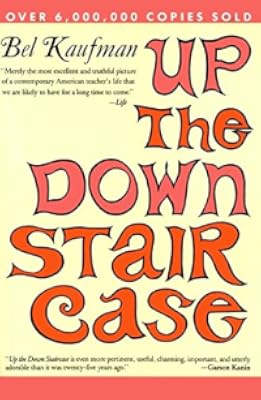
Up the Down Staircase
by Bel Kaufman
On This Page
Description
Bel Kaufman's Up the Down Staircase is one of the best-loved novels of our time. It has been translated into sixteen languages, made into a prizewinning motion picture, and staged as a play at high schools all over the United States; its very title has become part of the American idiom.Never before has a novel so compellingly laid bare the inner workings of a metropolitan high school. Up the Down Staircase is the funny and touching story of a committed, idealistic teacher whose clash with show more school bureaucracy is a timeless lesson for students, teachers, parents-anyone concerned about public education. Bel Kaufman lets her characters speak for themselves through memos, letters, directives from the principal, comments by students, notes between teachers, and papers from desk drawers and wastebaskets, evoking a vivid picture of teachers fighting the good fight against all that stands in the way of good teaching. show lessTags
Recommendations



















Member Reviews
From the book jacket: Never before has a novel so compellingly laid bare the inner workings of a metropolitan high school. This is the funny and touching story of a committed, idealistic teacher whose clash with school bureaucracy is a timeless lesson for students, teachers, parents – anyone concerned about public education.
My reactions
This is written in a kind of epistolary style – notes in the suggestion box, memos from the school principal or nurse or clerk, letters written to a college friend, messages from fellow teachers, items posted on the bulletin board, etc. There are misspellings and doodles (where the kids are writing in the suggestion box or school assignments), ALL CAPS (memos from the “all important” vice show more principal), and bureaucratic gobbledygook psychobabble (from the school counselor who fancies herself a Freudian psychoanalyst). Guess we can be thankful that Kaufman wrote this before texting abbreviations! It makes for a fast and very engaging read, and lends an air of verisimilitude.
The novel crams much truth into this wild ride of a semester’s experiences for this brand new teacher. It’s interesting to watch Sylvia Barrett come to recognize her students’ hidden talents, aspirations and needs. It’s also interesting to witness her growth as a professional educator, how she learns the ins and outs of the system, whom to trust, where to seek mentoring, and determining where her future lies.
I loved the way her students interpreted the classics! Some were hilariously off the mark. But many were poignant and reflected their modern-day experiences.
Some of these students have heartbreaking back stories. Children having to take on responsibility for ailing parents and younger siblings, or fearing for their own safety. Kids facing homelessness, tempted by gangs, or struggling with prejudice or bullying. Girls worrying about their appearance; boys concerned with looking tough. As in real life, this good teacher managed to connect to a few of these students, and tragically lost others.
Hard to believe this was written in the ‘60s and still stands up today. I’ve never seen the movie, but am tempted to track it down. show less
My reactions
This is written in a kind of epistolary style – notes in the suggestion box, memos from the school principal or nurse or clerk, letters written to a college friend, messages from fellow teachers, items posted on the bulletin board, etc. There are misspellings and doodles (where the kids are writing in the suggestion box or school assignments), ALL CAPS (memos from the “all important” vice show more principal), and bureaucratic gobbledygook psychobabble (from the school counselor who fancies herself a Freudian psychoanalyst). Guess we can be thankful that Kaufman wrote this before texting abbreviations! It makes for a fast and very engaging read, and lends an air of verisimilitude.
The novel crams much truth into this wild ride of a semester’s experiences for this brand new teacher. It’s interesting to watch Sylvia Barrett come to recognize her students’ hidden talents, aspirations and needs. It’s also interesting to witness her growth as a professional educator, how she learns the ins and outs of the system, whom to trust, where to seek mentoring, and determining where her future lies.
I loved the way her students interpreted the classics! Some were hilariously off the mark. But many were poignant and reflected their modern-day experiences.
Some of these students have heartbreaking back stories. Children having to take on responsibility for ailing parents and younger siblings, or fearing for their own safety. Kids facing homelessness, tempted by gangs, or struggling with prejudice or bullying. Girls worrying about their appearance; boys concerned with looking tough. As in real life, this good teacher managed to connect to a few of these students, and tragically lost others.
Hard to believe this was written in the ‘60s and still stands up today. I’ve never seen the movie, but am tempted to track it down. show less
From the utterly frantic way the first chapter was written, to the sense of "oh boy, here we go again," of the last couple of pages, this story conveys in a unique way what so many brave heroes have undertaken as their career. Reading this gave me a renewed respect and admiration for such a taxing, rewarding, frustrating profession that remains underpaid and overly bureaucratised. I would love to think that times have changed in the nearly 40 years since Up The Down Stair Case was written, but with the introduction of such idiotic policies as "No Child Left Behind," and standardized testing, I imagine it's only gotten worse. Aside from that, reading words that may have come out of the mouths of children in the early 60s was every bit as show more relatable as those that may come out of children in today's economy; "my income is needed at home; school is worthless; I'll never use this in real life." Clearly this is a story that transcends time and is as relavent now. And to those teachers out there, many many thanks. show less
I can NOT believe I have missed this 1964 classic until now. But... I know that I have an appreciation for this book after five years of teaching under my belt that I never would have before. Wow. Just wow. This book started out as a short story entitled "From a Teacher's Wastebasket," and the author was nudged to turn it into a book at the urging of an editor. What emerged was the correspondence, student contributions, administrative memos, board of education communications of Sylvia Barrett, a first year high school english teacher in New York City. The style of the book ("weird-looking typographically") was groundbreaking in the 1960s, but could be any book's today: a collection of typed and handwritten -- complete with doodles and show more embellishments -- notes and directives. While the style doesn't seem all that odd to a 21st century reader, unfortunately neither do teaching conditions and the state of education. OMG, truly not much has changed in the 60+ years since the book was written. The only thing that truly dates it is a broken foot, which lands the sufferer in the hospital for some weeks!
From Ms. Kaufman's preface:
Some reviewers paid me the ultimate compliment: They thought I had merely collected and arranged the material in the book. But the novel is invented -- except a few directives from the Board of Education, which I had to tone down for credibility (emphasis mine). I made up reports, memos, notes, records, forms, announcements, confidential files of the school nurse and the school psychologist, class minutes, lesson plans, administrative circulars, and comments from the kids themselves. All of it sounded so authentic that I was delighted to learn that when the assistant principal of my former school sent directives to his teachers, he would add in red pencil, "Do not show this to Bel Kaufman."
I loved it. LOVED it. I laughed frequently, cried a lot (sometimes because the book was sad), and fell in love with the students. Ms. Kaufman absolutely "got" them, and their voices, channeled through her, were brought to glorious life by Barbara Rosenblat in one of the best narrations I've ever heard. show less
From Ms. Kaufman's preface:
Some reviewers paid me the ultimate compliment: They thought I had merely collected and arranged the material in the book. But the novel is invented -- except a few directives from the Board of Education, which I had to tone down for credibility (emphasis mine). I made up reports, memos, notes, records, forms, announcements, confidential files of the school nurse and the school psychologist, class minutes, lesson plans, administrative circulars, and comments from the kids themselves. All of it sounded so authentic that I was delighted to learn that when the assistant principal of my former school sent directives to his teachers, he would add in red pencil, "Do not show this to Bel Kaufman."
I loved it. LOVED it. I laughed frequently, cried a lot (sometimes because the book was sad), and fell in love with the students. Ms. Kaufman absolutely "got" them, and their voices, channeled through her, were brought to glorious life by Barbara Rosenblat in one of the best narrations I've ever heard. show less
Way back in the mid-1960s, Bel Kaufman's unorthodox novel “Up the Down Staircase” (1964) was the hottest book in America. Does it hold up more than 60 years later? Well, yes it does, I discovered.
Kaufman, herself a New York City school teacher, imagines Sylvia Barrett as an idealistic young English teacher in her first semester at Calvin Coolidge High School in New York. What's unorthodox is the author's telling of her story without any narrative whatsoever. The novel is simply a collection of memos, announcements, notes, blackboard scribblings, student excuses, etc.
The frustrations Sylvia endures comes as much from the school's administrators as from her students. She writes in a letter to a friend, "We have keys but no locks show more (except in the lavatories), blackboards but no chalk, students but no seats, teachers but no time to teach."
Humor stays plentiful, as when one of her students leaves her a note saying, "You are my most memorial teacher, you teach a subject as fast as it can enter and stay put in my brain." Yet there is as much bitter as sweet, as when a girl attempts suicide and a surly boy corners her in a dark room after school.
Sylvia is pretty — nothing wrong with that, certainly — but Kaufman reminds us of this over and over again until it gets annoying. But perhaps this just helps reveal the immaturity of her students, both boys and girls, who can't resist mentioning it.
Really good books stay good with the passage of time, and I think “Up the Down Staircase” passes this test. show less
Kaufman, herself a New York City school teacher, imagines Sylvia Barrett as an idealistic young English teacher in her first semester at Calvin Coolidge High School in New York. What's unorthodox is the author's telling of her story without any narrative whatsoever. The novel is simply a collection of memos, announcements, notes, blackboard scribblings, student excuses, etc.
The frustrations Sylvia endures comes as much from the school's administrators as from her students. She writes in a letter to a friend, "We have keys but no locks show more (except in the lavatories), blackboards but no chalk, students but no seats, teachers but no time to teach."
Humor stays plentiful, as when one of her students leaves her a note saying, "You are my most memorial teacher, you teach a subject as fast as it can enter and stay put in my brain." Yet there is as much bitter as sweet, as when a girl attempts suicide and a surly boy corners her in a dark room after school.
Sylvia is pretty — nothing wrong with that, certainly — but Kaufman reminds us of this over and over again until it gets annoying. But perhaps this just helps reveal the immaturity of her students, both boys and girls, who can't resist mentioning it.
Really good books stay good with the passage of time, and I think “Up the Down Staircase” passes this test. show less
I'm not usually a big fan of the epistolary style, but Kaufman makes it work beautifully in Up the Down Staircase. I'm always (this is my second read? third?) startled by how much I connect with Sylvia's students even though we only see them through little snippets of their writing and through Sylvia's letters to her friend. The final moment with Joe Ferone is heartrending. Excellent depiction of the hardships and the joys of teaching, with a predictable but believably-rendered outcome. I boggle at administrative life before the advent of electronic mail (I date myself as a young'un, I know)--imagine sending a conventional memo to several hundred people that says only "Ignore the bells." And then sending several more memos to all those show more people later in the day. And then again tomorrow. And the next day. I mean, the paper. show less
Persoonlijk en tegelijk universeel
Bijzondere lerares op uitdagende school met uitdagende leerlingen
Het verhaal opgebouwd uit briefjes van leerlingen en leraren en mededelingen van de schoolleiding. Brieven naar een verwante. Heel knap dat de schrijfstijl past bij de verschillende afzenders. Regelmatig een glimlach. Hilarisch, bij tijden vertederend. - Het blijkt een klassieker, uit 1964 maar nog steeds actueel.
En oproep en een aanklacht. Een hart onder de riem. (voor leraren en leerlingen) De voorkant vind ik net zo kloppend, dit is maar een heel klein deel van de leerlingen.
Jammer dat het uit is."
Bijzondere lerares op uitdagende school met uitdagende leerlingen
Het verhaal opgebouwd uit briefjes van leerlingen en leraren en mededelingen van de schoolleiding. Brieven naar een verwante. Heel knap dat de schrijfstijl past bij de verschillende afzenders. Regelmatig een glimlach. Hilarisch, bij tijden vertederend. - Het blijkt een klassieker, uit 1964 maar nog steeds actueel.
En oproep en een aanklacht. Een hart onder de riem. (voor leraren en leerlingen) De voorkant vind ik net zo kloppend, dit is maar een heel klein deel van de leerlingen.
Jammer dat het uit is."
I don't think I've ever been able to relate to a character in the way that I related to Sylvia. When you're a teacher, you realize that the hopeful expectations, the unbridled giving of yourself, and the love of your subject matter is constantly in contrast with the never-ending, mundane administrative "to-do" list, the constant bullying of helicopter parents, and the reality that most students don't covet, value, or respect the material that you cherish. A work that is even more relevant now that it was when it was written.
Members
- Recently Added By
Lists

Read the book and saw the movie
1,170 works; 195 members

Best School Stories
219 works; 22 members

1960s, Best books published therein
254 works; 22 members

1960s
281 works; 16 members

Epistolary Books
105 works; 27 members

Top Five Books of 2016
795 works; 229 members
Ten Books That Have Stayed With Me
160 works; 30 members
discontinued
24 works; 4 members

Publisher's Weekly Bestsellers - Part II - 1940 - 1979
355 works; 6 members

Teachers
16 works; 2 members

Books I have Recommended
208 works; 1 member

Books set in high school
89 works; 7 members

Favorite Epistolary Fiction
143 works; 144 members

Books Read in 2024
4,727 works; 128 members
Author Information

6+ Works 1,551 Members
Bella Kaufman was born in Berlin, Germany on May 10, 1911. In 1922, she emigrated to the United States with her parents. She received a Bachelor of Arts degree from Hunter College in 1934 and a Master's degree in English from Columbia University in 1936. She worked as a teacher and sold the occasional short story to magazines. Her first novel, Up show more the Down Staircase, was published in 1965. There was a film version of the novel made in 1967. Her other works included Love, Etc. and a collection of short stories entitled La Tigresse. She died on July 25, 2014 at the age of 103. (Bowker Author Biography) show less
Some Editions
Awards and Honors
Series
Belongs to Publisher Series
Work Relationships
Has the adaptation
Is abridged in
Common Knowledge
- Original title
- Up the Down Staircase
- Original publication date
- 1964
- People/Characters
- Sylvia Barrett; Paul Barringer; Bea Schachter; J.J. McHabe; Harry Kagan; Alice Blake (show all 10); Joe Ferone; Jose Rodriguez; Vivian Paine; Edward Williams
- Important places
- New York, USA
- Related movies
- Up the Down Staircase (1967 | IMDb)
- Dedication
- For Thea and Jonathan
For all the dedicated teachers still struggling up that down staircase, and all their students, present and future. - First words
- Hi, Teach!
- Last words
- (Click to show. Warning: May contain spoilers.)Hi, pupe!...Belgado, Ramos?
- Original language
- English
- Disambiguation notice
- Do not combine with play or movie of the same name.
Classifications
Statistics
- Members
- 1,497
- Popularity
- 15,573
- Reviews
- 41
- Rating
- (3.86)
- Languages
- 9 — Czech, English, Estonian, Finnish, French, German, Russian, Swedish, Thai
- Media
- Paper, Audiobook, Ebook
- ISBNs
- 37
- UPCs
- 2
- ASINs
- 35