In the Margins: On the Pleasures of Reading and Writing
by Elena Ferrante
On This Page
Description
A NATIONAL INDIE BESTSELLERA MOST ANTICIPATED BOOK OF 2022
Four new and revelatory essays by the author of My Brilliant Friend and The Lost Daughter.
In 2020, Claire Luchette in O, The Oprah Magazine described the beloved Italian novelist Elena Ferrante as "an oracle among authors." Here, in these four crisp essays, Ferrante offers a rare look at the origins of her literary powers. She writes about her influences, her struggles, and her formation as both a reader and a writer; she describes show more the perils of "bad language" and suggests ways in which it has long excluded women's truth; she proposes a choral fusion of feminine talent as she brilliantly discourses on the work of Emily Dickinson, Gertrude Stein, Ingeborg Bachmann, and many others.
Here is a subtle yet candid book by "one of the great novelists of our time" about adventures in literature, both in and out of the margins.
"Everyone should read everything with Elena Ferrante's name on it."—The Boston Globe
. show less
Tags
Recommendations







Member Reviews
In 2020, Elena Ferrante was supposed to give the Eco Lectures at the University of Bologna. Unfortunately the world closed so she did not get a chance at presenting them (or sending someone else to read them anyway). But she wrote the 3 lectures and they make the bulk of this collection (the 4th essay was also a commission - for the "Dante and Other Classics" conference in 2021. At the end all 4 essays had been read to audience (by an actor for the first 3 and by a Dante scholar for the 4th) and here we have them printed in a book form.
In some ways the first 3 essays are a real series - the later ones refer to and continue the ideas of the earlier ones. Ferrante starts with the physical process of learning to write (including a tidbit show more about how paper looked like in Italy - while the different sized lines was also present when I was learning to write in Bulgaria, our notebooks had only one margin - on the left side. Apparently the Italian ones also had a margin on the right side. I don't know if it was her idea to include the images or her publisher proposed it but it was a good idea - especially because these margins become very important in the essays). Then she moves to learning how to create stories and finding her voice. She cites numerous books, she shares a personal anecdote or two. But her main thread remains the same - for years she believed that in order to be a writer, she needs to write like a man and the walk through her prose shows not only her finding her voice as a novelist but also as a woman.
The 4th essay, the one dealing with Dante is really more about Beatrice than about Dante and it a lot of ways continues the thread from the previous 3 essays. Empowering and empowered women emerge even more strongly as the main point of the whole collection.
I expected to like the essays a lot more than I did. I expected them to be scholarly (considering the expected original audience) but even then the prose was too dense, too... MFA-y. In places it felt like she is using 2 pages to expand on a sentence which was clear to start with - and these 2 pages lead us back where we started. There are some things which made me think but as a whole, it was a somewhat disappointing book. show less
In some ways the first 3 essays are a real series - the later ones refer to and continue the ideas of the earlier ones. Ferrante starts with the physical process of learning to write (including a tidbit show more about how paper looked like in Italy - while the different sized lines was also present when I was learning to write in Bulgaria, our notebooks had only one margin - on the left side. Apparently the Italian ones also had a margin on the right side. I don't know if it was her idea to include the images or her publisher proposed it but it was a good idea - especially because these margins become very important in the essays). Then she moves to learning how to create stories and finding her voice. She cites numerous books, she shares a personal anecdote or two. But her main thread remains the same - for years she believed that in order to be a writer, she needs to write like a man and the walk through her prose shows not only her finding her voice as a novelist but also as a woman.
The 4th essay, the one dealing with Dante is really more about Beatrice than about Dante and it a lot of ways continues the thread from the previous 3 essays. Empowering and empowered women emerge even more strongly as the main point of the whole collection.
I expected to like the essays a lot more than I did. I expected them to be scholarly (considering the expected original audience) but even then the prose was too dense, too... MFA-y. In places it felt like she is using 2 pages to expand on a sentence which was clear to start with - and these 2 pages lead us back where we started. There are some things which made me think but as a whole, it was a somewhat disappointing book. show less
"True writing is the gesture that digs into the warehouse of literature in search of necessary words." –Elena Ferrante, In the Margins: On the Pleasures of Reading and Writing.
Ferrante wrote these essays as lectures and then they hired an actress to read them to the audience at the Unversity of Bologna. That is some A-level introvert behavior and I would expect no less from her.
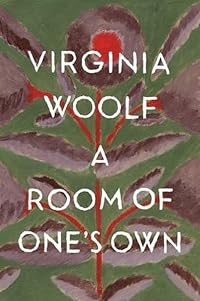
I finished A Swim in the Pond in the Rain by George Saunders based on his workshops of the Russian masters of the 19th century, so I was primed and ready to take on Elena Ferrante’s four essays in In the Margins: On the Pleasures of Reading and Writing. Please, I want more of these books. Ferrante is a credible expert reaching back to authors such as show more Virginia Woolf, Diderot, Dante, and in the process teases out and reveals her own writing process. This is more than the pat answer at an author reading to, “Where do your ideas come from? What is your writing process?” Like Saunders's book, this is a master class from a true master. show less
Ferrante wrote these essays as lectures and then they hired an actress to read them to the audience at the Unversity of Bologna. That is some A-level introvert behavior and I would expect no less from her.
I finished A Swim in the Pond in the Rain by George Saunders based on his workshops of the Russian masters of the 19th century, so I was primed and ready to take on Elena Ferrante’s four essays in In the Margins: On the Pleasures of Reading and Writing. Please, I want more of these books. Ferrante is a credible expert reaching back to authors such as show more Virginia Woolf, Diderot, Dante, and in the process teases out and reveals her own writing process. This is more than the pat answer at an author reading to, “Where do your ideas come from? What is your writing process?” Like Saunders's book, this is a master class from a true master. show less
Pen and Pain
As AnnieMod pointed out in her review, Ferrante wrote three of the four essays for the Eco Lectures at the University of Bologna. Those who know Ferrante would not be surprised that she would have planned a stand-in to deliver her lectures. COVID arrested the lecture plans in 2020. I’m not sure if the work would have made it into book form otherwise (not meant in any way to praise that terrifying pandemic).
That having been said, I truly enjoyed the way Ferrante included us—her readers—in her journey through the margins. She tells us at the beginning that in grade school writing within the red margins was a strict requirement and while having no trouble with the left margin this was not so able with the constraints of show more the right one often overflowing into the forbidden margin. Ferrante tells us that she was “punished so often that the sense of the boundary became part of her.” She goes on to say that she is still very neat in her writing, aligning the margins immediately even when using her computer. Ferrante explores the limits of those margins—for example, the constraints she felt as a woman in a male writer’s world. She wholly accepted that writing like a man was what she needed to do. At about 20 years of age she still believed in “staying strictly in the male tradition.”
Ferrante often refers to herself as timid, though as her reader I don’t see her that way at all. Because she shares with openness and honesty the evolution and struggles that shaped her into the writer she is today, I find her brave. That evolution, as I see it, gave us one of the finest literary classics of the last decade.
At the end of high school, Ferrante discovers the 16th-century sonnet collection Rime by Gaspara Stampa, in which Stampa describes herself as a lowly, abject woman but one that had something to say and argues. if : “…I can carry within so sublime a flame, why shouldn’t I draw out at least a little of its style in vain to show the world?” Ferrante felt that Stampa was speaking directly to her. Because she too had something to say, Ferrante was encouraged—through Stampa—to dissolve the margins within her imposed by nature. She had her own words she wanted to show the world.This is not an essay about a men holding her back but more accurately about the cage that nature and society imposes and that Ferrante had internalized. From the 16th century to the 20th, we move to Virginia Woolf’s, A Writer’s Diary, where Ferrante quotes a conversation between Woolf and Lytton Strachey:
“And your novel?”
“Oh, I put my hand and rummage in the bran pie.”
“That’s what’s so wonderful. And it’s all different.”
“Yes, I am twenty people.”
Ferrante saw this as “a hypersensitive plurality all concentrated in the hand provided with the pen.”
She tells us there are two kinds of writing—but the first contains the second. It’s writing within the margins, but always waiting to erupt and throw the papers into disarray, for the lonely, abject woman she is to find a means of having her say:“I adopt old techniques with pleasure. I’ve spent my life learning how and when to use them, and I’ve always loved novels. I’ve loved betrayal, dangerous investigation, horrific discovery, corrupted youth, miserable lives out of a stroke of luck…”
She tells us she is always waiting for distraction—and the pull to take her where she is afraid to go, a place which she doesn’t know if she could ever return from. Wanting to go there? To me her committed reader, this speaks of bravery. show less
As AnnieMod pointed out in her review, Ferrante wrote three of the four essays for the Eco Lectures at the University of Bologna. Those who know Ferrante would not be surprised that she would have planned a stand-in to deliver her lectures. COVID arrested the lecture plans in 2020. I’m not sure if the work would have made it into book form otherwise (not meant in any way to praise that terrifying pandemic).
That having been said, I truly enjoyed the way Ferrante included us—her readers—in her journey through the margins. She tells us at the beginning that in grade school writing within the red margins was a strict requirement and while having no trouble with the left margin this was not so able with the constraints of show more the right one often overflowing into the forbidden margin. Ferrante tells us that she was “punished so often that the sense of the boundary became part of her.” She goes on to say that she is still very neat in her writing, aligning the margins immediately even when using her computer. Ferrante explores the limits of those margins—for example, the constraints she felt as a woman in a male writer’s world. She wholly accepted that writing like a man was what she needed to do. At about 20 years of age she still believed in “staying strictly in the male tradition.”
Ferrante often refers to herself as timid, though as her reader I don’t see her that way at all. Because she shares with openness and honesty the evolution and struggles that shaped her into the writer she is today, I find her brave. That evolution, as I see it, gave us one of the finest literary classics of the last decade.
At the end of high school, Ferrante discovers the 16th-century sonnet collection Rime by Gaspara Stampa, in which Stampa describes herself as a lowly, abject woman but one that had something to say and argues. if : “…I can carry within so sublime a flame, why shouldn’t I draw out at least a little of its style in vain to show the world?” Ferrante felt that Stampa was speaking directly to her. Because she too had something to say, Ferrante was encouraged—through Stampa—to dissolve the margins within her imposed by nature. She had her own words she wanted to show the world.This is not an essay about a men holding her back but more accurately about the cage that nature and society imposes and that Ferrante had internalized. From the 16th century to the 20th, we move to Virginia Woolf’s, A Writer’s Diary, where Ferrante quotes a conversation between Woolf and Lytton Strachey:
“And your novel?”
“Oh, I put my hand and rummage in the bran pie.”
“That’s what’s so wonderful. And it’s all different.”
“Yes, I am twenty people.”
Ferrante saw this as “a hypersensitive plurality all concentrated in the hand provided with the pen.”
She tells us there are two kinds of writing—but the first contains the second. It’s writing within the margins, but always waiting to erupt and throw the papers into disarray, for the lonely, abject woman she is to find a means of having her say:“I adopt old techniques with pleasure. I’ve spent my life learning how and when to use them, and I’ve always loved novels. I’ve loved betrayal, dangerous investigation, horrific discovery, corrupted youth, miserable lives out of a stroke of luck…”
She tells us she is always waiting for distraction—and the pull to take her where she is afraid to go, a place which she doesn’t know if she could ever return from. Wanting to go there? To me her committed reader, this speaks of bravery. show less
Ferrante takes you on a journey not just of writing but of influence and struggle. The writing is honest, prods you to think about how and what you read. Treats you as equal and does not shy away from questioning. You are left at the end contemplating each of the essays for they challenge you in the best way.
Very cerebral and faintly philosophical, with lots of juicy little thoughts about writing that I enjoyed thinking about. The first two essays in particular I found myself really meditating on. To be honest, there were parts where I didn't understand some of what was said (there was a lot of talking in circles that made me have to reread parts) so maybe this will be something I'd revisit in the future after I've read some of Ferrante's fiction. Also, in my opinion, skip the last essay in this book unless you either LOVE thoughts on Dante or Dante's work- otherwise that essay is kinda dry.
Four Ferrante Essays
Review of the Europa Editions hardcover (March 2022) translated by Ann Goldstein from the original Italian language edition "I margini e il dettato" (The Margins and the Dictation) (November 17, 2021)
See cover detail at https://s26162.pcdn.co/wp-content/uploads/2022/03/margins-300x300.png
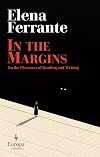
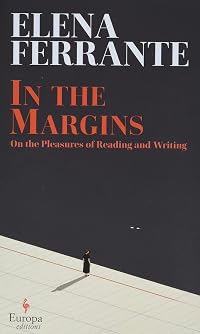
Detail from the cover art for "In the Margins".
In the Margins consists of four essays by the reclusive Italian writer who writes under the pen-name Elena Ferrante and whose real identity has been a regular source of speculation for the Italian press. Three of the essays were a commission for the Umberto Eco Lectures at the University of Bologna, where they were finally delivered in late 2021 after the pandemic delay by an actress in show more the guise of Elena Ferrante. The fourth essay Dante's Rib was prepared for a Dante and Other Classics conference in early 2021 where it was delivered by another Dante scholar.
Ferrante is best known for her quartet of The Neapolitan Novels (2011-2014), also the basis for the adaptation in the currently ongoing Italian language TV-series My Brilliant Friend (2018-2023?).
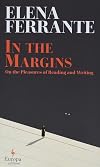
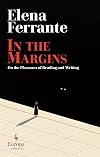
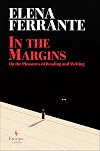
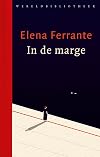
Ferrante's essays are a wonderfully expressive look at her writing and reading life which takes its title from her tendency to write "beyond the margins" of the right lined note paper which she was provided in grade school. This is rather beautifully pictured in the cover art which shows a writer staring into the darkness beyond the page where a possibly dangerous 2-eyed creature lurks and looks back.
From this simple premise, Ferrante extends her thoughts about writing by contrasting styles of those who work 'within' or 'outside' the margins. There is a terrific section to illustrate the 'outside" which is about Gertrude Stein and her "The Autobiography of Alice B. Toklas" (1933), a purported autobiography written by someone else which says more about the writer than about the supposed subject. It is all capped off with the concluding essay and its appreciation of Dante and his inspirational Beatrice (his Dante's Rib):
The translation was by Ferrante's regular English language translator Ann Goldstein and was excellent as always. show less
Review of the Europa Editions hardcover (March 2022) translated by Ann Goldstein from the original Italian language edition "I margini e il dettato" (The Margins and the Dictation) (November 17, 2021)
See cover detail at https://s26162.pcdn.co/wp-content/uploads/2022/03/margins-300x300.png
Detail from the cover art for "In the Margins".
In the Margins consists of four essays by the reclusive Italian writer who writes under the pen-name Elena Ferrante and whose real identity has been a regular source of speculation for the Italian press. Three of the essays were a commission for the Umberto Eco Lectures at the University of Bologna, where they were finally delivered in late 2021 after the pandemic delay by an actress in show more the guise of Elena Ferrante. The fourth essay Dante's Rib was prepared for a Dante and Other Classics conference in early 2021 where it was delivered by another Dante scholar.
Ferrante is best known for her quartet of The Neapolitan Novels (2011-2014), also the basis for the adaptation in the currently ongoing Italian language TV-series My Brilliant Friend (2018-2023?).
Ferrante's essays are a wonderfully expressive look at her writing and reading life which takes its title from her tendency to write "beyond the margins" of the right lined note paper which she was provided in grade school. This is rather beautifully pictured in the cover art which shows a writer staring into the darkness beyond the page where a possibly dangerous 2-eyed creature lurks and looks back.
From this simple premise, Ferrante extends her thoughts about writing by contrasting styles of those who work 'within' or 'outside' the margins. There is a terrific section to illustrate the 'outside" which is about Gertrude Stein and her "The Autobiography of Alice B. Toklas" (1933), a purported autobiography written by someone else which says more about the writer than about the supposed subject. It is all capped off with the concluding essay and its appreciation of Dante and his inspirational Beatrice (his Dante's Rib):
Gorni has correctly pointed out that Beatrice "is the only woman in all of Western literature to be invested with such an honorable role." But why does Dante alone place his woman so high in the contemporary hierarchy of the female? What strategies does he use to get to the point of plausibly assigning her such an honour?.
The translation was by Ferrante's regular English language translator Ann Goldstein and was excellent as always. show less
I only had read her The Brilliant Friend so I was a bit lost when she brought in characters she wrote about into this - so definitely recommend to only read this, if you read the majority of Ferrante's novels!
Members
- Recently Added By
Lists

Books Read in 2022
5,218 works; 114 members

To borrow next
35 works; 1 member

Books Read in 2026
2,018 works; 67 members
Author Information
44+ Works 28,029 Members
Elena Ferrante was born in Naples, Italy. Her work includes Those Who Leave and Those Who Stay, The Story of the Lost Child, The Story of a New Name, The Lost Daughter, Fragments, and My Brilliant Friend. She is the author of My Brilliant Friend which made The New York Times Bestsellers List and The New Zealand Best Seller List 2015. She was show more included on Time magazine's annual list of the 100 most influential people in the world. (Bowker Author Biography) show less
Some Editions
Awards and Honors
Distinctions
Common Knowledge
- Canonical title
- In the Margins: On the Pleasures of Reading and Writing
- Original title
- I margini e il dettato
- Quotations
- True writing is the gesture that digs into the warehouse of literature in search of necessary words.
- Original language
- Italian
Classifications
- Genres
- Literature Studies and Criticism, Biography & Memoir
- DDC/MDS
- 809 — Literature & rhetoric Literature, rhetoric & criticism History, description, critical appraisal of more than two literatures
- LCC
- PQ4866 .E6345 .M3713 — Language and Literature French, Italian, Spanish and Portuguese literatures Italian literature Individual authors, 1961-2000
- BISAC
Statistics
- Members
- 305
- Popularity
- 105,123
- Reviews
- 8
- Rating
- (3.53)
- Languages
- 7 — Catalan, Dutch, English, French, Italian, Portuguese, Spanish
- Media
- Paper, Audiobook, Ebook
- ISBNs
- 21
- ASINs
- 6