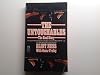
The Untouchables
by Eliot Ness, Oscar Fraley (Author)
On This Page
Description
The Untouchables is the gripping true story of the team of men who broke the back of the vicious Chicago crime mob and its stranglehold on the nation, told by the man who orchestrated the effort.Tags
Recommendations


























Member Reviews
I was just 6 years old when The Untouchables series began running on television, but I have vague memories of the noirish feel of the series and the expressionless, determined face of Robert Stack as Eliot Ness. Kevin Costner's Ness never really took the place of that neo-human hero of the late fifties and early sixties, in atmospheric black and white.
My impression of Ness's own story, told in this book, is close to that mythological Ness. The book feels more like a novel than a modern autobiography. I've heard that Ness exaggerates his own role in the events he describes -- I don't know whether that's true or not. But the narrative is smoother than real life. Ness radiates a kind of all-conquering goodness, enhanced with clever tactics show more and the loyalty of an equally incorruptible team. Good conquers evil, because, well, good is just so . . . good.
We can fault Ness for self-aggrandizing myth making. But, setting that aside, it's fun reading. Ness is a man on a mission. He rejects the corrupt peace that the police and the criminals, most notably of course, Al Capone, have reached. The police force and prohibition agents are ruined by "bad apples" -- the fatal moral weakness that allows Capone and others to rule Chicago in the twenties and thirties. Ness devises a simple plan, a "small select squad" with "no bad apples" -- a team whose greatest strength is its moral incorruptibiity.
As the team goes to work, busting breweries and distribution networks, the bootleggers realize that this is a different game. They can't buy victory, they'll have to outfight and outmaneuver Ness's team. But Ness's team is as determined to bust them as they are to make money and build power. When the bootleggers adopt new tactics, Ness and his team figure out new ways to defeat them. It really is a good story, and the good guys win.
I do have to mention one odd departure from the facts in the book. Betty Andersen appears in the book as Ness's girlfriend, and, in the book's Epilogue, Ness's co-author, Oscar Fraley, notes that she later became his wife. There is no mention of Edna Staley, who was actually Ness's wife during the time covered by the book. Ness and Betty Andersen did marry, but only after his divorce from his second wife, Evaline Ness, in 1946. We can only suspect that this cleaned-up version of his personal life is not the only cleaning up of the facts in the story that Ness tells.
The story makes better reading if we accept that the truth may have suffered a bit, or more than a bit, in the telling. show less
My impression of Ness's own story, told in this book, is close to that mythological Ness. The book feels more like a novel than a modern autobiography. I've heard that Ness exaggerates his own role in the events he describes -- I don't know whether that's true or not. But the narrative is smoother than real life. Ness radiates a kind of all-conquering goodness, enhanced with clever tactics show more and the loyalty of an equally incorruptible team. Good conquers evil, because, well, good is just so . . . good.
We can fault Ness for self-aggrandizing myth making. But, setting that aside, it's fun reading. Ness is a man on a mission. He rejects the corrupt peace that the police and the criminals, most notably of course, Al Capone, have reached. The police force and prohibition agents are ruined by "bad apples" -- the fatal moral weakness that allows Capone and others to rule Chicago in the twenties and thirties. Ness devises a simple plan, a "small select squad" with "no bad apples" -- a team whose greatest strength is its moral incorruptibiity.
As the team goes to work, busting breweries and distribution networks, the bootleggers realize that this is a different game. They can't buy victory, they'll have to outfight and outmaneuver Ness's team. But Ness's team is as determined to bust them as they are to make money and build power. When the bootleggers adopt new tactics, Ness and his team figure out new ways to defeat them. It really is a good story, and the good guys win.
I do have to mention one odd departure from the facts in the book. Betty Andersen appears in the book as Ness's girlfriend, and, in the book's Epilogue, Ness's co-author, Oscar Fraley, notes that she later became his wife. There is no mention of Edna Staley, who was actually Ness's wife during the time covered by the book. Ness and Betty Andersen did marry, but only after his divorce from his second wife, Evaline Ness, in 1946. We can only suspect that this cleaned-up version of his personal life is not the only cleaning up of the facts in the story that Ness tells.
The story makes better reading if we accept that the truth may have suffered a bit, or more than a bit, in the telling. show less
read this after seeing the movie with costner/connery... movie was quite good, but the book is always better. :)
Ratings
Members
- Recently Added By
Author Information

1+ Work 225 Members
Work Relationships
Inspired
Common Knowledge
- Original publication date
- 1957
- Related movies
- The Untouchables (1959 | IMDb); The Untouchables (1987 | IMDb)
Classifications
Statistics
- Members
- 225
- Popularity
- 145,532
- Reviews
- 2
- Rating
- (3.75)
- Languages
- 5 — Dutch, English, Finnish, French, Spanish
- Media
- Paper
- ISBNs
- 13
- ASINs
- 12