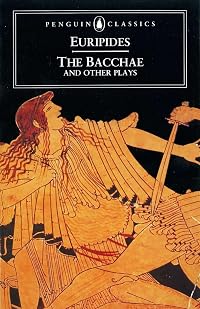
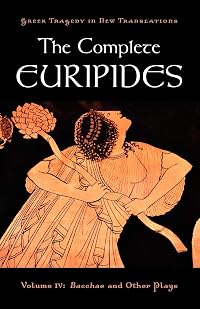
The Bacchae and Other Plays
by Euripides
On This Page
Description
The plays of Euripides have stimulated audiences since the fifth century BC. This volume, containing Phoenician Women, Bacchae, Iphigenia at Aulis, Orestes, and Rhesuscompletes the new editions of Euripides in Penguin Classics.Tags
Recommendations












Member Reviews
This is the third collection of Euripides' plays I have read.
Ion: This play juxtaposes cynicism (although technically cynicism may not have been invented yet?) against credulousity. Ion is either the son of Apollo or the child of some secret dalliance by his mother. His mother insists that Apollo is the father, but Ion is doubtful. I find the mother an interesting character - assuming an earthly conception for Ion, is she deluded, lying, or has she resorted to this story to soothe her own trauma? I also enjoyed the old man slave character, although he and Ion's mother seemed far to quick to resort to murder to solve their problems.
The Women of Troy: This is my favourite of Euripides' plays so far. Not because it's uplifting, in fact the show more content is about as bleak as it comes. But the focus of the aftermath of the war and the fates of the women and children of Troy is tragic and poignant. It brings the Trojan war down from a mythic story of heroism to a brutal story of the impact of war. All the more meaningful as it likely served as Euripides' criticism of Athens' own actions, and a warning for her future. Even the poor messenger hated what he had to do.
Helen: This is a bit out of left field. It picks up an alternative version of Helen of Troy's story in which Helen was sequestered in Egypt for the entirety of the Trojan war while a homunculus went to Troy in her stead. Essentially rendering the whole war meaningless but preserving Helen's chastity. Didn't make a great impression on me but was apparently a self-parody so perhaps I'm just missing the context.
The Bacchae: Hippolytus taught us that Aphrodite is terrifying. The Bacchae does the same, but for Dionysus. Sure he's a party god, but he's also a god of madness and feral pursuits, and disrespecting him might end with you being torn to pieces by a crowd of frenzied women, including your own mother! The main thing that stuck with me about this play was how gruesome the imagery was, especially the Bacchae playing catch with dismembered chunks of flesh. show less
Ion: This play juxtaposes cynicism (although technically cynicism may not have been invented yet?) against credulousity. Ion is either the son of Apollo or the child of some secret dalliance by his mother. His mother insists that Apollo is the father, but Ion is doubtful. I find the mother an interesting character - assuming an earthly conception for Ion, is she deluded, lying, or has she resorted to this story to soothe her own trauma? I also enjoyed the old man slave character, although he and Ion's mother seemed far to quick to resort to murder to solve their problems.
The Women of Troy: This is my favourite of Euripides' plays so far. Not because it's uplifting, in fact the show more content is about as bleak as it comes. But the focus of the aftermath of the war and the fates of the women and children of Troy is tragic and poignant. It brings the Trojan war down from a mythic story of heroism to a brutal story of the impact of war. All the more meaningful as it likely served as Euripides' criticism of Athens' own actions, and a warning for her future. Even the poor messenger hated what he had to do.
Helen: This is a bit out of left field. It picks up an alternative version of Helen of Troy's story in which Helen was sequestered in Egypt for the entirety of the Trojan war while a homunculus went to Troy in her stead. Essentially rendering the whole war meaningless but preserving Helen's chastity. Didn't make a great impression on me but was apparently a self-parody so perhaps I'm just missing the context.
The Bacchae: Hippolytus taught us that Aphrodite is terrifying. The Bacchae does the same, but for Dionysus. Sure he's a party god, but he's also a god of madness and feral pursuits, and disrespecting him might end with you being torn to pieces by a crowd of frenzied women, including your own mother! The main thing that stuck with me about this play was how gruesome the imagery was, especially the Bacchae playing catch with dismembered chunks of flesh. show less
49. The Bacchae and Other Plays : Ion, The Women of Troy, Helen, The Bacchae by Euripides
Translated by Philip Vellacott, 1954, revised 1973
format: 249 page Penguin Classics paperback
acquired: from my library
read: Aug 7-11
rating: 4 stars
Ion 414 bce
The Women of Troy 415 bce
Helen 412 bce
The Bacchae 405 bce (posthumous)
These are all late plays from Euripides. They show a lot of developed complexity compared to the collection of earlier plays I read previously. His understated satire is still prominent, but has become much more sophisticated and not entirely negative. His play structure no longer feels like a selection of long dull monologues that only affect in sum, and that are entirely disturbing. They are more dynamic, they keep the show more reader/viewer entertained, and still, there is so much going on behind the words that is completely counter to what is overtly being said. In sum, these are complex and interesting works that deserve multiple readings...but I have only read them once so far. They are also largely anti-war statements, a reflection of his times.
Euripides lived from c. 480 – c. 406 bce. This meant he lived through Athens 50 years of Greek dominance that lasted from roughly the battle of Salamis in 480 to the beginning of the Peloponnesian war in 431. Athenian citizens would struggle during the long wars with Sparta, especially during the last tens years, and Athens eventually lost in 404 bce. Euripides left Athens late in life, retiring in Macedonia.
Ion 414 bce
I can't recall how I know the story of Ion, but it must be somewhat common knowledge. Fathered by Apollo, his mother, Creusa, abandons him, then later becomes wife of the ruler of Athens, and barren. Ion is raised in Delphi by Apollo worshipers and becomes and attendant at the temple. Years later Creusa comes to Delphi to ask Apollo about her son. In the ritual process, her husband, Xuthus, is told that Ion is his own son and Creusa and Xuthus take him home to Athens to be their heir.
The play has many comic elements, such as when Ion and Creusa first meet and, not knowing who each other are, tell their parallel stories. Creusa's are told as if they are the tragic story of her close friend. But the heart of this story seems to an exploration of truth and how to deal with its uncertainty. Ion is quite a lovely character, but the more he learns the less he can be certain of. Even Athena's appearance does not really help. We sense, along with Ion, a great deal of uncomfortable doubt as the play closes.
The Women of Troy 415 bce
A really sad play set in Troy just after its fall. The Trojan women have lost their luxury, their sons and husbands and any hope for the future. They are to become slaves. Hecabe, queen of Troy, morning the loss of her husband and most of her children, including Hector, is the focus as she looks ahead to her future life of slavery. She is assigned to Odysseus. Cassandra, not yet raped, and knowing all that will come ahead, makes an appears, as does Andromache, who still has her and Hector's son. Then Helen appears. Her situation is in notable contrast to the hopeless defeated lives around her. Helen still has a future. Her speech is striking for its lack of guilt. But her words can be read in contrasting ways, making her the most interesting part of the play.
The Women of Troy was written in the shadow of the Battle of Melos in 415 bce. Melos had tried to stay neutral between Athens and Sparta. Athens attacked and had every man who could bear arms executed and enslaved the women and children.
Helen 412 bce
A surreal plot, has Helen sits in Egypt, trapped. She never was taken by Paris to Troy, but instead a ghost made of air was taken. The play is about her getting reunited with her husband, Menelaus, and their comic escape from Egypt. But, the unstated point is that Trojan war and all it's consequences were for nothing but a puff of air. It's a very strong antiwar play, told in a way to get past the Athenian censors.
The Bacchae 405 bce (posthumous)
Written in exile, and free of Athenian wartime censorship, Euripides put his whole life of play-writing into the The Bacchae. On the surface it's the story of how Dionysus, still a young unproven god, takes revenge on his family, rulers in Thebes. His cousin, Pentheus, bull-headed ruler of Thebes, has fiercely banned worship of Dionysos and this Bacchanal frenzy. But, worship continues. Dionysus uses the frenzy as his tool. He sets up Pentheus to be torn apart alive by his own mother and his aunts.
It's, first, a curious look into (the mythology of?) Bacchic worship and its rituals. Worshipers are viewed as promiscuous and insane, but are actually quite modest in their actions. A contrast is explored between the controlled cities and their view on what they see as civilization (think war-time, repressive Athens) and humanity's animal natures. It's the most interesting play of Euripides that I've read.
2016
https://www.librarything.com/topic/226898#5688989 show less
Translated by Philip Vellacott, 1954, revised 1973
format: 249 page Penguin Classics paperback
acquired: from my library
read: Aug 7-11
rating: 4 stars
Ion 414 bce
The Women of Troy 415 bce
Helen 412 bce
The Bacchae 405 bce (posthumous)
These are all late plays from Euripides. They show a lot of developed complexity compared to the collection of earlier plays I read previously. His understated satire is still prominent, but has become much more sophisticated and not entirely negative. His play structure no longer feels like a selection of long dull monologues that only affect in sum, and that are entirely disturbing. They are more dynamic, they keep the show more reader/viewer entertained, and still, there is so much going on behind the words that is completely counter to what is overtly being said. In sum, these are complex and interesting works that deserve multiple readings...but I have only read them once so far. They are also largely anti-war statements, a reflection of his times.
Euripides lived from c. 480 – c. 406 bce. This meant he lived through Athens 50 years of Greek dominance that lasted from roughly the battle of Salamis in 480 to the beginning of the Peloponnesian war in 431. Athenian citizens would struggle during the long wars with Sparta, especially during the last tens years, and Athens eventually lost in 404 bce. Euripides left Athens late in life, retiring in Macedonia.
Ion 414 bce
I can't recall how I know the story of Ion, but it must be somewhat common knowledge. Fathered by Apollo, his mother, Creusa, abandons him, then later becomes wife of the ruler of Athens, and barren. Ion is raised in Delphi by Apollo worshipers and becomes and attendant at the temple. Years later Creusa comes to Delphi to ask Apollo about her son. In the ritual process, her husband, Xuthus, is told that Ion is his own son and Creusa and Xuthus take him home to Athens to be their heir.
The play has many comic elements, such as when Ion and Creusa first meet and, not knowing who each other are, tell their parallel stories. Creusa's are told as if they are the tragic story of her close friend. But the heart of this story seems to an exploration of truth and how to deal with its uncertainty. Ion is quite a lovely character, but the more he learns the less he can be certain of. Even Athena's appearance does not really help. We sense, along with Ion, a great deal of uncomfortable doubt as the play closes.
The Women of Troy 415 bce
A really sad play set in Troy just after its fall. The Trojan women have lost their luxury, their sons and husbands and any hope for the future. They are to become slaves. Hecabe, queen of Troy, morning the loss of her husband and most of her children, including Hector, is the focus as she looks ahead to her future life of slavery. She is assigned to Odysseus. Cassandra, not yet raped, and knowing all that will come ahead, makes an appears, as does Andromache, who still has her and Hector's son. Then Helen appears. Her situation is in notable contrast to the hopeless defeated lives around her. Helen still has a future. Her speech is striking for its lack of guilt. But her words can be read in contrasting ways, making her the most interesting part of the play.
The Women of Troy was written in the shadow of the Battle of Melos in 415 bce. Melos had tried to stay neutral between Athens and Sparta. Athens attacked and had every man who could bear arms executed and enslaved the women and children.
Helen 412 bce
A surreal plot, has Helen sits in Egypt, trapped. She never was taken by Paris to Troy, but instead a ghost made of air was taken. The play is about her getting reunited with her husband, Menelaus, and their comic escape from Egypt. But, the unstated point is that Trojan war and all it's consequences were for nothing but a puff of air. It's a very strong antiwar play, told in a way to get past the Athenian censors.
The Bacchae 405 bce (posthumous)
Written in exile, and free of Athenian wartime censorship, Euripides put his whole life of play-writing into the The Bacchae. On the surface it's the story of how Dionysus, still a young unproven god, takes revenge on his family, rulers in Thebes. His cousin, Pentheus, bull-headed ruler of Thebes, has fiercely banned worship of Dionysos and this Bacchanal frenzy. But, worship continues. Dionysus uses the frenzy as his tool. He sets up Pentheus to be torn apart alive by his own mother and his aunts.
It's, first, a curious look into (the mythology of?) Bacchic worship and its rituals. Worshipers are viewed as promiscuous and insane, but are actually quite modest in their actions. A contrast is explored between the controlled cities and their view on what they see as civilization (think war-time, repressive Athens) and humanity's animal natures. It's the most interesting play of Euripides that I've read.
2016
https://www.librarything.com/topic/226898#5688989 show less
- I have seen the holy Bacchae, who like a flight of spears
Went streaming bare-limbed, frantic, out of the city gate.
- What, woman? What was that you said? Do you exult
When such a cruel fate has overtaken the king?
- I am no Greek.
I sing my joy in a foreign tune.
- When bull led man to the ritual slaughter-ring.
He'd have been my god, were I Greek (or one of these foreign women). Even without him, I believe that his forces or his spheres, unacknowledged, are dangerous; whether religous or psychological, this play always talked to me. Perhaps the part where Agave triumphs ignorantly with her son's head, is drawn-out, over-milked, but that's theatre for you. The effeminate foreigner who is Dionysus in disguise -- who celebrates that 'rare show more goddess', Peace; who cross-dresses the king to make a laughingstock of him; whose worshippers abandon the loom to tear wild beasts limb from limb... what's not to love and fascinate? So much, too, is uncannily familiar.
My personal no. 1 ancient Greek play. show less
Went streaming bare-limbed, frantic, out of the city gate.
- What, woman? What was that you said? Do you exult
When such a cruel fate has overtaken the king?
- I am no Greek.
I sing my joy in a foreign tune.
- When bull led man to the ritual slaughter-ring.
He'd have been my god, were I Greek (or one of these foreign women). Even without him, I believe that his forces or his spheres, unacknowledged, are dangerous; whether religous or psychological, this play always talked to me. Perhaps the part where Agave triumphs ignorantly with her son's head, is drawn-out, over-milked, but that's theatre for you. The effeminate foreigner who is Dionysus in disguise -- who celebrates that 'rare show more goddess', Peace; who cross-dresses the king to make a laughingstock of him; whose worshippers abandon the loom to tear wild beasts limb from limb... what's not to love and fascinate? So much, too, is uncannily familiar.
My personal no. 1 ancient Greek play. show less
I can't believe this was written so long ago.
Different millennium, same blame game for rape victims.
Different millennium, same blame game for rape victims.
Rightly did the ancient Athenians regard Euripidies as a sombre misfit: The Bacchae, first read by me 23 years ago at university, still has power to move and disturb. A truly unsettling examination of family ties, pride, and the capricious world in which we seem to live. Atmospheric.
I read Philip Vellacott's translation of The Bacchae and The Women of Troy by Euripides for a Greek and Roman mythology course this summer. Having no previous experience with Greek plays, I found that these two plays have universal themes that still resonate down to our time.
The Bacchae was written around 406 B.C. when Euripides was approximately seventy years old. The play is a dramatization of Dionysus' return to his birthplace Thebes where he exacts revenge, because he is not given proper recognition as a divinity. The main themes include the superiority of the gods and the importance of appeasement and justice. Pentheus, the protagonist, represents human failing to respect the gods so that he, along with the rest of society, is show more guilty of hubris. The story also illustrates that a complete state of ecstasy can be sanctioned through Dionysiac worship as long as it is controlled by the god. There is also a patriarchal element that outlines the gender hierarchy within the divine and mortal societies of the Greeks.
The Women of Troy highlights the trials and tribulations of three women who were most affected by the Trojan War. Andromache, Cassandra, and Helen all have stories of heartbreak to tell and Euripides tells their stories in a sympathetic fashion. This play was produced in 415 BC, and it was a part of a trilogy, but the other two plays have been lost. Historically, the play was performed after the massacre on the island of Melos when the Athenians severely punished the inhabitants who wanted to withdraw from the League. Scholars have seen the play as a condemnation of the massacre set outside the walls of Troy.
I enjoyed reading these plays, and when I have some free time I'd like to continue on and read Ion and Helen which are plays also found in this edition. show less
The Bacchae was written around 406 B.C. when Euripides was approximately seventy years old. The play is a dramatization of Dionysus' return to his birthplace Thebes where he exacts revenge, because he is not given proper recognition as a divinity. The main themes include the superiority of the gods and the importance of appeasement and justice. Pentheus, the protagonist, represents human failing to respect the gods so that he, along with the rest of society, is show more guilty of hubris. The story also illustrates that a complete state of ecstasy can be sanctioned through Dionysiac worship as long as it is controlled by the god. There is also a patriarchal element that outlines the gender hierarchy within the divine and mortal societies of the Greeks.
The Women of Troy highlights the trials and tribulations of three women who were most affected by the Trojan War. Andromache, Cassandra, and Helen all have stories of heartbreak to tell and Euripides tells their stories in a sympathetic fashion. This play was produced in 415 BC, and it was a part of a trilogy, but the other two plays have been lost. Historically, the play was performed after the massacre on the island of Melos when the Athenians severely punished the inhabitants who wanted to withdraw from the League. Scholars have seen the play as a condemnation of the massacre set outside the walls of Troy.
I enjoyed reading these plays, and when I have some free time I'd like to continue on and read Ion and Helen which are plays also found in this edition. show less
I can't believe this was written so long ago.
Different millennium, same blame game for rape victims.
Different millennium, same blame game for rape victims.
Members
- Recently Added By
Lists

How to Read a Book's Recommended Reading List
309 works; 10 members

In Our Time books
4,934 works; 2 members
Author Information

1,345+ Works 34,154 Members
Euripides was born in Attica, Greece probably in 480 B.C. He was the youngest of the three principal fifth-century tragic poets. In his youth he cultivated gymnastic pursuits and studied philosophy and rhetoric. Soon after he received recognition for a play that he had written, Euripides left Athens for the court of Archelaus, king of Macedonia. show more Fragments of about fifty-five plays survive. Among his best-known plays are Alcestis, Medea and Philoctetes, Electra, Iphigenia in Tauris, The Trojan Women, and Iphigenia in Aulis Iphigenia. He died in Athens in 406 B.C. (Bowker Author Biography) show less
Some Editions
Series
Belongs to Publisher Series
Penguin Classics (L044)
Work Relationships
Contains
Common Knowledge
- Canonical title
- The Bacchae and Other Plays
- Original title
- The Bacchae and other plays : Ion / The women of Troy / Helen / The Bacchae
- Original publication date
- 403 B.C.E. (Bacchae) (Bacchae); c. 413 B.C.E. (Ion) (Ion); 415 B.C.E (Trojan Women) (Trojan Women); 412 B.C.E. (Helen) (Helen)
- People/Characters
- Dionysus (Bacchae); Tiresias (Bacchae); Pentheus (Bacchae); Hermes (Ion); Creusa (Ion); Xuthus (Ion) (show all 14); Ion (Ion); Hecuba (Trojan Women); Andromache (Trojan Women); Cassandra (of Troy | Trojan Women); Helen of Troy (Trojan Women/Helen); Menelaus (Trojan Women/Helen); Theonoe (Helen); Theoclymenos (Helen)
- Important places
- Thebes, Greece (Bacchae); Delphi, Greece (Ion); Troy (Trojan Women); Egypt (Helen); Argos, Greece
- Epigraph
- [None]
- Dedication
- [None]
- First words
- The four plays in this volume are arranged in the probable order of their production at Athens; and this order is also, as it were, symphonically suitable, providing a sequence of Allegro, Andante Maestoso, Scherzo, and Final... (show all)e.
Introduction (Penguin Classics ed.).
HERMES : I am Hermes, servant of the Immortals.
Ion.
POSEIDON: I come from the salt depths of the Aegean Sea,
Where the white feet of the Nereids tread their circling dance:
I am Poseidon.
<... (show all)br>The women of Troy.
HELEN: This is Egypt; here flows the virgin river, the lovely Nile, who brings down melted snow to slake the soil of the Egyptian plain with the moisture heaven denies.
Helen.
DIONYSUS: I am Dionysus, son of Zeus.
The Bacchae.
(Penguin Classics ed.). - Last words
- (Click to show. Warning: May contain spoilers.)CHORUS: Gods manifest themselves in many forms,
Bring many matters to surprising ends;
The things we thought would happen do not happen;
The unexpected God makes possible:
And that is what has happened here to-day.
Exeunt.
(Penguin Classics ed.). - Original language
- Ancient Greek
- Disambiguation notice
- This record is only for collections containing only these four plays: 'Ion', 'The women of Troy', 'Helen' and 'The Bacchae', including the 1954 Penguin Classics edition (L 44). Ignore the "Book description" below, scraped fro... (show all)m the Penguin website; besides being badly formatted, it relates to a different (2005) Penguin Classics edition (L 726) containing a different collection of plays, on LT at https://www.librarything.com/work/5683...
Classifications
- Genre
- Fiction and Literature
- DDC/MDS
- 882.01 — Literature & rhetoric Classical & modern Greek literatures Classical Greek dramatic poetry and drama standard subdivisions; collections; history, description, critical appraisal; Specific periods Ancient period to ca. 499
- LCC
- PA3975 .A2 — Language and Literature Greek language and literature. Latin language and literature Greek literature Individual authors Euripedes
- BISAC
Statistics
- Members
- 1,395
- Popularity
- 16,958
- Reviews
- 12
- Rating
- (3.94)
- Languages
- English
- Media
- Paper, Audiobook
- ISBNs
- 6
- ASINs
- 19