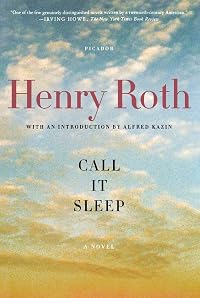
Call It Sleep
by Henry Roth
On This Page
Description
Lauded as the most profound novel of Jewish life ever written by an American, Call It Sleep seamlessly weaves together the searing pains and subtle joys of immigrant life in New York's Lower East Side. It is the story of David Schearl, a dangerously imaginative little boy who arrives from Eastern Europe in 1907. Shock by shock, he is exposed to the blows-and occasional pleasures-of life in the crowded tenements.Tags
Recommendations












Member Recommendations

Member Reviews
I am always amazed at the bibliofates who direct me to books. No matter how randomly I choose the books I read, these fates always seem to bring a shape to the story of my reading. I’ve been reading through stacks of books that have lingered on my shelves for some time without attention, either because they were once recommended to me or because they hold a place on a ‘best’ list. The last few stacks I’ve chosen alphabetically, grabbing title off my shelves by the author’s last name, without any regard to their topic or style. Then, I chose at random between about 13 books in the stack. The last three I read are Henry Roth’s [Call It Sleep], a book about an Jewish immigrant boy in New York City; Yann Martel’s [Life of Pi], show more which recounts the story of a young Indian boy trapped on a life boat with a tiger; and Charles Portis’ [True Grit], the tale of a young girl avenging her father’s murder in the Old West territory of Arkansas and Oklahoma. The books were published in different decades, separated by at least a couple of decades, by authors from vastly different ethnic and social backgrounds. But I couldn’t have chosen three books that share more in common if I’d tried.
How do we see ourselves and the events of our lives? How do they shape us into the people we are? How do the people we already are affect how we react to watershed moments? All of these books deal with such questions – reading [Call It Slepp] first, helped to focus my own thoughts on the topic. Though not told in his personal voice, [Call It Sleep] centers on David Schearl, adolescent Jewish boy growing up on New York’s Lower East Side. David is a recent immigrant, having traveled over with his doting mother, Genya, to join his father, Albert. David has to learn to navigate life in America on the lower reaches of the economic spectrum and as member of a reviled minority. Added to this, he has to deal with an explosively abusive father. There are episodes common to any young man’s life, building self-esteem and making friends. But it is the unique quality of his life, as reflected in the trials of his families struggle to make ends meet and to assimilate into such a foreign culture, that resonate more powerfully. David’s character is constructed by Roth to be such an outsider, looking in from the outside of poverty and race, that his story helps us to understand our own internal feelings of isolation and universal yearnings to belong.
Roth’s genius is present nowhere more powerfully than in David’s battle to make sense of the swirling religious powers influences around him. His father is Jewish by birth primarily but not in so much in practice and his mother is the product of very strict religious family, though she herself has lost her faith. They enlist David with a local Rabbi to develop a sense of history and solidarity with his ethnicity. While David shows a knack for learning Hebrew text, he befriends a young Catholic boy who begins to educate him on the death of Christ. David fights to make sense of the conflicting deities of Judaism and Christianity, deeply hoping to connect a unifying and guiding force that he feels without being able to understand.
Roth’s novel is deeply affecting. The streets of his New York boil with the smells and the feel of a different time and place. You can feel the diverse cultures of the Lower East Side roiling into something new and different with each day that passes on the page.
Ultimately, even though David’s voice is not the narrative force, it is his perspective that drives the story, and everything that he faces is viewed through his eyes. His choices make sense only through the filter how he battles his fears, of his father and of the foreign city around him. When he makes a stand against these forces, you see how he is baptized in his own courage to become something new, something that is related to what he was before but also related to the new things around him.
Bottom Line: Vibrant immigrant life, told through the eyes of a young Jewish boy becoming something new on the grimy streets of a New York City neighborhood.
4 ½ bones!!!!! show less
How do we see ourselves and the events of our lives? How do they shape us into the people we are? How do the people we already are affect how we react to watershed moments? All of these books deal with such questions – reading [Call It Slepp] first, helped to focus my own thoughts on the topic. Though not told in his personal voice, [Call It Sleep] centers on David Schearl, adolescent Jewish boy growing up on New York’s Lower East Side. David is a recent immigrant, having traveled over with his doting mother, Genya, to join his father, Albert. David has to learn to navigate life in America on the lower reaches of the economic spectrum and as member of a reviled minority. Added to this, he has to deal with an explosively abusive father. There are episodes common to any young man’s life, building self-esteem and making friends. But it is the unique quality of his life, as reflected in the trials of his families struggle to make ends meet and to assimilate into such a foreign culture, that resonate more powerfully. David’s character is constructed by Roth to be such an outsider, looking in from the outside of poverty and race, that his story helps us to understand our own internal feelings of isolation and universal yearnings to belong.
Roth’s genius is present nowhere more powerfully than in David’s battle to make sense of the swirling religious powers influences around him. His father is Jewish by birth primarily but not in so much in practice and his mother is the product of very strict religious family, though she herself has lost her faith. They enlist David with a local Rabbi to develop a sense of history and solidarity with his ethnicity. While David shows a knack for learning Hebrew text, he befriends a young Catholic boy who begins to educate him on the death of Christ. David fights to make sense of the conflicting deities of Judaism and Christianity, deeply hoping to connect a unifying and guiding force that he feels without being able to understand.
Roth’s novel is deeply affecting. The streets of his New York boil with the smells and the feel of a different time and place. You can feel the diverse cultures of the Lower East Side roiling into something new and different with each day that passes on the page.
Ultimately, even though David’s voice is not the narrative force, it is his perspective that drives the story, and everything that he faces is viewed through his eyes. His choices make sense only through the filter how he battles his fears, of his father and of the foreign city around him. When he makes a stand against these forces, you see how he is baptized in his own courage to become something new, something that is related to what he was before but also related to the new things around him.
Bottom Line: Vibrant immigrant life, told through the eyes of a young Jewish boy becoming something new on the grimy streets of a New York City neighborhood.
4 ½ bones!!!!! show less
Memo to Saul Bellow THIS is how you write an American Jewish novel. Joking aside, and with little in the way of preamble, please allow me to say that this truly is an opus of the rarest kind. Akin to Melville's Moby Dick and Jones' From Here to Eternity, this work is the result of a soul laid bare and detailed with the heaviest, the most austere, but in the end, most telling kind of language. Though some of the dialogue (better parsed as dialect) is hard to read (probably more so for those without at least a cursory knowledge of Hebrew and Yiddish) this partial opacity is a necessary sacrifice at the altar of verisimilitude. And authentic it reads as, through the eyes of main character David Schearl, we see the dank squalor and raw show more feeling of his existence. Interspersed between the bouts of brutality (namely by way of David's viciously complex father Albert and the bullies of the story's later turns) there are moments of description in the text that bespeak a gorgeous sense of the beauty inhering in the urban and the squalid. I could write volumes more in laudatory verbiage but just, please, read this book if ever you've wondered about the truth of the immigrant experience in general, and the Jewish Ashkenaic American Exile in particular, it brings tears of alternating despair and joy, like the average life, I guess. show less
Told from the perspective of six year old David Schearl, Call It Sleep relates the hardships of immigrant life in turn of the century gritty New York City. In the prologue, David and his mother arrive from Austria to join her abusive and angry husband. This is the of the few times the narrative is outside little six year old David's head. The majority of the story is a stream of consciousness, skillfully painting a portrait of inner city life from a child's point of view.
As an aside, in the beginning I questioned why David's father would abhor David to the point of criminal abuse. It took awhile to figure out why.
But, back to little David. His young life is filled with fear. He is overwhelmed by language differences between Yiddish and show more English, overly sensitive to the actions of his peers, clings to his mother with Freudian zeal. I found him to be a really hopeless child and my heart bled for him. While most of the story is bleak, there is the tiniest ray of hope at the end. The pessimists in the crowd might have a negative explanation for what David's father does, but I saw it as a small gesture of asking for forgiveness. show less
As an aside, in the beginning I questioned why David's father would abhor David to the point of criminal abuse. It took awhile to figure out why.
But, back to little David. His young life is filled with fear. He is overwhelmed by language differences between Yiddish and show more English, overly sensitive to the actions of his peers, clings to his mother with Freudian zeal. I found him to be a really hopeless child and my heart bled for him. While most of the story is bleak, there is the tiniest ray of hope at the end. The pessimists in the crowd might have a negative explanation for what David's father does, but I saw it as a small gesture of asking for forgiveness. show less
This is a classic story of immigrants, people who take the chance of not only a new country but a new way of life. Albert has come to New York City from rural eastern Europe, and when the book opens he has been in the city for over a year, and meets his wife and toddler son David on the ship that has brought them after him.
After this first meeting, we see the story through David's childish viewpoint: his reactions to his hostile father and loving mother, his fear of dark places like the cellar, the normal cruelty of children, the terror of being lost, of not being understood, of not understanding what goes on around him. Some of this is just being a child, some the hostility that surrounds him, only alleviated by his doting mother.
And show more through him, we see the strains on the adults in his life: his father's uncontrollable temper and paranoia drives him from one printing house to another until he gives up the trade altogether, preferring to work alone. His view of his mother is colored by men's reactions to her (written in the thirties, the book blatantly exhales the Freudian atmosphere of the time) and his need for her. Roth uses a sort of stream of consciousness to portray David's confusion, questioning, pain and fear. Plenty of all of that.
Language plays a huge role in the story. David's parents speak Yiddish, the street kids a mix of Yiddish and English, the non-Jews in the story the dialects of English of the Polish and Irish immigrants around him. Lack of English limits his mother's domain, limits his understanding of the world beyond his few blocks of home. (One of my fellow book club readers had listened to it and found the dialects much easier to understand when spoken than when transliterated, and I'm sure that would have helped.)
David is seeking something in the light, some sort of freedom and redemption that he doesn't understand but yearns for. The ending is explosive.
So it is a deep, non-trivial story. I had expected to like it more. The middle somehow wore me out, with its stereotypical psychology, then the end, with its flashes of almost inappropriate comedy and desperate fury, flew by. Some of the descriptive writing was gorgeous, some of the dialog too beautiful to be quite believable.
I found myself wishing my father were still alive to read it with me. He was a Brownsville boy himself, although of a slightly later era, and I would have learned more about him if we could have shared this story. show less
After this first meeting, we see the story through David's childish viewpoint: his reactions to his hostile father and loving mother, his fear of dark places like the cellar, the normal cruelty of children, the terror of being lost, of not being understood, of not understanding what goes on around him. Some of this is just being a child, some the hostility that surrounds him, only alleviated by his doting mother.
And show more through him, we see the strains on the adults in his life: his father's uncontrollable temper and paranoia drives him from one printing house to another until he gives up the trade altogether, preferring to work alone. His view of his mother is colored by men's reactions to her (written in the thirties, the book blatantly exhales the Freudian atmosphere of the time) and his need for her. Roth uses a sort of stream of consciousness to portray David's confusion, questioning, pain and fear. Plenty of all of that.
Language plays a huge role in the story. David's parents speak Yiddish, the street kids a mix of Yiddish and English, the non-Jews in the story the dialects of English of the Polish and Irish immigrants around him. Lack of English limits his mother's domain, limits his understanding of the world beyond his few blocks of home. (One of my fellow book club readers had listened to it and found the dialects much easier to understand when spoken than when transliterated, and I'm sure that would have helped.)
David is seeking something in the light, some sort of freedom and redemption that he doesn't understand but yearns for. The ending is explosive.
So it is a deep, non-trivial story. I had expected to like it more. The middle somehow wore me out, with its stereotypical psychology, then the end, with its flashes of almost inappropriate comedy and desperate fury, flew by. Some of the descriptive writing was gorgeous, some of the dialog too beautiful to be quite believable.
I found myself wishing my father were still alive to read it with me. He was a Brownsville boy himself, although of a slightly later era, and I would have learned more about him if we could have shared this story. show less
This is a magnificent book, and to describe it as a portrait of 'the immigrant experience' or 'Jewish life' not only misses the mark but will make a reader impatient for impossible details. Everything we're given is conveyed through the pinhole of a child's mind. And the child, on the whole, sees 'friction' and little else: friction in languages, races, generations, neighbours. It's not wholly clear to me whether the child is looking to reconcile or reduce or transcend the friction, but it's clear he's striving do something about it, and he proceeds in a thoughtful and intelligent way. That striving makes up the entirety of the book's structure.
Okay, I'll admit it: when I picked this up at Borders, I thought I was buying a Phillip Roth novel. After finishing "Call it Sleep," I rather wish that I had. I guess it pays to read the cover carefully. "Call it Sleep" is a rather obvious American Jewish gloss on Joyce's "Portrait of the Artist as a Young Man" with some of D.H. Lawrence's mommy issues thrown in for good measure. It features lots of stream-of-consciousness interior monologues, piles of exacting description, numerous high-Modernist epiphanies and obvious, ever-present Freudian symbolism. Roth even goes all Circe chapter on us in the book's final section. His Lower East Side is as dear and as dirty as Joyce's Dublin, but since Roth lacks Joyce's humor and his sense of show more linguistic playfulness, the prose in "Call it Sleep" is, like its main character, rather introverted and neurotic and it seldom sparkles like Joyce's best stuff does. While much can be made of the polyglot, multiethnic community that Roth describes, his decision to render their speech phonetically strikes this reader modern as something close to minstrelsy. I couldn't help but think that later Jewish writers, like Bellow and the other Roth, were able to capture the particularly musical argot of the New York streets without forsaking recognizable spellings. Roth's characters, though carefully drawn, present another problem for the reader. Those of us who found Stephen Daedalus to be something of a wet blanket are unlikely to be charmed by Roth's protagonist, David Schearl, who comes off as the wimpiest, whiniest kid in his tenement. David's mother is more sympathetic, but his brutal, angry father is perhaps one of the most unpleasant characters I've encountered in all of my reading, which might be considered an achievement of sorts. I found myself slogging through this one before it was half over, but, to Roth's credit, it is written with a sort of dogged care. Even if I didn't find it particularly involving, one gets a sense that Roth himself really valued these characters and was determined to preserve the world of his childhood. He succeeded, I suppose, but I'm not likely to revisit it. show less
A vividly painted experience of Jewish immigration in the early 1900's. It is told through the eyes of a child, David Schearl, who arrives from Austria-Hungary as a toddler with his parents. The book encompasses several years of David's childhood, as he navigates the streets and gangs of a poor New York neighborhood, the stifling cheder where he learns the Hebrew of his heritage, and the tumult of his family life (his father paranoid and violent, his mother meek and secretive). One of the great things about this novel is its use of language. Yiddish is the most fluid and pure language, (written as English in the book). David's awkwardness with English and the slang of the street kids are rendered phonetically. Then there are Hebrew and show more Polish phrases, languages David struggles to understand- Hebrew veiling the secrets of religion he yearns to own, Polish used by his parents to conceal information from his innocent ears. But David wants most of all to understand, to belong, to feel safe- and his quest soon brings him to a loss of innocence. I've never read another book that more eloquently depicts what it is like inside the mind of a child. Highly recommended.
From Dog Ear Diary show less
From Dog Ear Diary show less
Members
- Recently Added By
Lists

1001 Books You Must Read Before You Die
1,448 works; 1,133 members

The Guardian's 1000 Novels Everyone Must Read
1,005 works; 547 members

In or About the 1930s
198 works; 27 members

Time Magazine's "All-Time 100"
113 works; 15 members

Canon de la narrativa universal del siglo XX
254 works; 6 members
Time's All-Time 100 Novels
100 works; 27 members

Jewish Books
367 works; 24 members

Books Set in New York City
127 works; 21 members
The American Experience
173 works; 18 members
Harold Bloom - The Western Canon: D. The Chaotic Age
833 works; 24 members
LibraryThingers' 1001 Books You Must Read Before You Die
442 works; 30 members
1,001 BYMRBYD Concensus
723 works; 27 members
Fiction about the Working Class
74 works; 10 members

Best Domestic Fiction
77 works; 6 members
The College Board: 101 Great Books Recommended for College-Bound Readers
111 works; 7 members

1930s
262 works; 5 members
American Lit for Eng 11 Research Project
368 works; 6 members

Books You Couldn't Finish
202 works; 32 members

Books and authors mentioned by Le Clézio in his Nobel Prize speech
87 works; 3 members

Mustich's 1000 Books to Read Before You Die: A Life Changing List
1,001 works; 19 members

Top Five Books of 2023
767 works; 317 members
Canon de la narrativa universal del s. XX (cicutadry)
499 works; 3 members
Tablet Magazine's List of 101 Great Jewish Books
103 works; 9 members

JBC's Classic Jewish Literature
5 works; 1 member
Author Information

10+ Works 3,372 Members
Some Editions
Awards and Honors
Notable Lists
Daniel S. Burt's Novel 100 (067 – 67)
Series
Belongs to Publisher Series
Work Relationships
Contains
Is abridged in
Has as a study
Has as a student's study guide
Common Knowledge
- Canonical title
- Call It Sleep
- Original title
- Call It Sleep
- Alternate titles*
- Noem het maar slaap; Noem het slaap : roman
- Original publication date
- 1934
- People/Characters
- David Schearl
- Important places
- New York, New York, USA
- Dedication
- A Eda Lou Walton
- First words
- Standing before the kitchen sink and regarding the bright brass faucets that gleamed so far away, each with a bead of water at its nose, slowly swelling, falling, David again became aware that this world had been created with... (show all)out thought of him.
De pie ante el fregadero de la cocina y mirando los relucientes grifos de latón que brillaban muy lejos, cada uno de ellos con una gota de agua en la nariz, que lentamente se hinchaba y caía, David se dio cuentan vez más d... (show all)e que este mundo había sido creado sin pensar en él. - Last words
- (Click to show. Warning: May contain spoilers.)He shut his eyes.
- Publisher's editor
- Mayer, Peter
- Original language
- English
*Some information comes from Common Knowledge in other languages. Click "Edit" for more information.
Classifications
Statistics
- Members
- 2,323
- Popularity
- 8,529
- Reviews
- 43
- Rating
- (3.85)
- Languages
- 17 — Catalan, Czech, Danish, Dutch, English, Finnish, French, German, Hungarian, Italian, Polish, Russian, Spanish, Swedish, Turkish, Portuguese (Portugal), Portuguese (Brazil)
- Media
- Paper, Audiobook, Ebook
- ISBNs
- 47
- UPCs
- 2
- ASINs
- 40