

The Dictionary of Cultural Literacy
by James Trefil, E.D. Hirsch, Jr., Joseph F. Kett
On This Page
Description
Alphabetically arranged in 23 sections, includes individual entries under several categories of knowledge, including American politics, history, geography, and more.Tags
Recommendations






















Member Reviews
Content is probably geared towards the 8th or 9th grade level. Unless you were raised by wolves, you probably won't find this to be a useful reference.
I don't necessarily subscribe to his theory of education, but this is a good reference book.
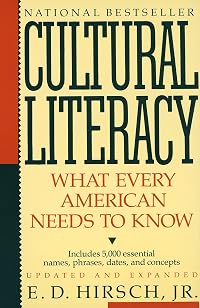
A comprehensive reference guide to American cultural heritage. Defines the fundamental information we all should share: people, places, sayings, happenings, ideas, books, art, and much more. Fun to read and an invaluable reference. A companion to "Cultural Literacy" by E. D. Hirsch Jr.
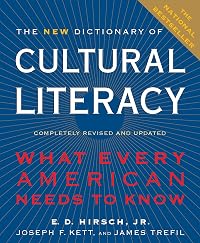
“Dictionary of Cultural Literacy: What Every American Needs to Know” by E. D. Hirsch, Jr.; Joseph F Kett, James Trefil
BIBLIOGRAPHIC DETAILS:
*Print: COPYRIGHT: 1988; ISBN 0395437482; PUBLISHER: Houghton Mifflin Company; PAGES: 586; Unabridged (Hardcover info from hardcover print copy.)
-Digital: COPYRIGHT: 7/2006; PUBLISHER: Harper-Collins eBooks; ISBN 9780061760907; PAGES 400; Unabridged (Kindle edition info from Amazon.com and Libby app version from LAPL)
-Audio: COPYRIGHT: 1/20/2005; PUBLISHER: Books in Motion; DURATION: 6:16:00; Unabridged (Audio info from Amazon.com)
-Feature Film or tv: No
SERIES: N/A
SUMMARY/ EVALUATION:
-SELECTED: I saw this at the Newport Beach Public Library used book sale, and was thrilled to think I might get show more to learn what every American should know about The Bible; Mythology and Folklore; Proverbs; Idioms World Literature, Philosophy, Religion; Literature in English; Conventions of Written English; Fine Arts; World History to 1550; World History since 1550; American History to 1865; American History since 1865; World Politics; World Geography; Anthropology, Psychology, and Sociology; Business and Economics; Physical Sciences and Mathematics; Earth Sciences; Life Sciences; Medicine and Health; & Technology. Of course, for me, being exposed to, and retaining all that information is not the same thing.
-ABOUT: The book contains approximately 5,000 terms related to the above topics.
-OVERALL: It was a bit dry reading, so hard to get more than a few pages read at one time, but it was fun. Since this version is 1988 though, it’s out of date. It would be useful if writing a historical fiction book to be reminded that a CRT (cathode ray tube) was in your television and computer monitors. Some day maybe I’ll read a current one, but since it took more that a couple of years to get through this one, that won’t be any time soon….maybe the audio version would go faster.
AUTHOR:
E. D. Hirsch, Jr.: (Excerpt from Wikipedia)
“Eric "E. D." Donald Hirsch Jr. /hɜːrʃ/ (born March 22 1928) is an American educator, literary critic, and theorist of education.[1] He is professor emeritus of humanities at the University of Virginia.[HirschPublications 1]
Hirsch is best known for his 1987 book Cultural Literacy, which was a national best-seller and a catalyst for the standards movement in American education.[2] Cultural Literacy included a list of approximately 5,000 "names, phrases, dates, and concepts every American should know" in order to be "culturally literate."[3][4] Hirsch's arguments for cultural literacy and the contents of the list were controversial and widely debated in the late 1980s and early '90s.[5]
Hirsch is the founder and chairman of the non-profit Core Knowledge Foundation, which publishes and periodically updates the Core Knowledge Sequence, a set of unusually detailed curriculum guidelines for Pre-K through 8th grade.
In 1991, Hirsch and the Core Knowledge Foundation put out What Your First Grader Needs to Know, the first volume in what is popularly known as "the Core Knowledge Series."[6] Additional volumes followed, as did revised editions. The series now begins with What Your Preschooler Needs to Know and ends with What Your Sixth Grader Needs to Know. The "series" books are based on the curriculum guidelines in the Core Knowledge Sequence. The books are used in Core Knowledge schools and other elementary schools. However, they have also been popular with homeschooling parents.
Before turning to education, Hirsch wrote on English literature and theory of interpretation (hermeneutics). His book Validity in Interpretation (1967) is considered an important contribution to hermeneutics.[7] In it, Hirsch argues for intentionalism—the idea that the reader's goal should be to recover the author's meaning.[8][9]”
AUTHOR:
Joseph F Kett: (Excerpt from Wikitia)
"Joseph F. Kett (born March 11, 1938) is an American historian."
"Kett completed his bachelor's degree in history at Holy Cross University in 1959; his masters degree in history at Harvard University in 1960; and his PhD in history at Harvard University in 1964.[1]"
"He is the James Madison professor emeritus of history at the Corcoran Department of History of the University of Virginia.[1]"
AUTHOR:
James Trefil: (Excerpt from Wikipedia)
“James Stanley Trefil (born September 10, 1938) is an American physicist (Ph.D. in physics at Stanford University in 1966) and author of nearly fifty books. Much of his published work focuses on science for the general audience. He has served as Professor of Physics at the University of Virginia and, since 1988, as Robinson Professor of Physics at George Mason University. Among his books is Are We Unique?, an argument for human uniqueness in which he questions the comparisons between human intelligence and artificial intelligence. Trefil has also given presentations to judges and public officials about the intersections between science and the law.”
GENRE:
Nonfiction; Dictionary
SUBJECTS:
United States; Civilization; Dictionaries; English Language
TIME FRAME:
Contemporary (1988)
DEDICATION:
None
EXCERPT: “The Theory Behind the Dictionary”
"The conceptions that underlie this dictionary are outlined in my book Cultural Literacy, published in 1987. But in fact, the dictionary project was begun before I thought of writing a separate book, and the book itself was first conceived merely as a technical explanation of the ideas that led us to undertake the dictionary. The scope of the book outgrew that aim, but no one even considered the possibility that the book would become a a best-seller or that it would be read outside the field of education. Although it did become a best-seller and its ideas have been widely discussed, many users of this dictionary may not be familiar with the concept of cultural literacy. So here, in brief compass, is why this project was undertaken, and why we hope it will help improve American public education and public discourse.
One good way of explaining the cultural literacy project might well be to list the points of strong agreement that have appeared in reviews of the book and in the hundreds of letters I have received from teachers and nonteachers alike. All these reviews and letters endorse the proposition that achieving high universal literacy out to be a primary focus of educational reform in this country. They all accept the evidence that our national literacy had been declining since 1965, not only among disadvantaged children but also among our top students. They agree that the decline has occurred at a time when truly functional literacy is becoming ever more important to our economic well-being. And they have usually stressed the idea that providing everyone with a high level of literacy is important in holding together the social fabric of the nation.”
RATING:
5 stars
STARTED READING – FINISHED READING
10/3/2021 to 2/10/2024 show less
BIBLIOGRAPHIC DETAILS:
*Print: COPYRIGHT: 1988; ISBN 0395437482; PUBLISHER: Houghton Mifflin Company; PAGES: 586; Unabridged (Hardcover info from hardcover print copy.)
-Digital: COPYRIGHT: 7/2006; PUBLISHER: Harper-Collins eBooks; ISBN 9780061760907; PAGES 400; Unabridged (Kindle edition info from Amazon.com and Libby app version from LAPL)
-Audio: COPYRIGHT: 1/20/2005; PUBLISHER: Books in Motion; DURATION: 6:16:00; Unabridged (Audio info from Amazon.com)
-Feature Film or tv: No
SERIES: N/A
SUMMARY/ EVALUATION:
-SELECTED: I saw this at the Newport Beach Public Library used book sale, and was thrilled to think I might get show more to learn what every American should know about The Bible; Mythology and Folklore; Proverbs; Idioms World Literature, Philosophy, Religion; Literature in English; Conventions of Written English; Fine Arts; World History to 1550; World History since 1550; American History to 1865; American History since 1865; World Politics; World Geography; Anthropology, Psychology, and Sociology; Business and Economics; Physical Sciences and Mathematics; Earth Sciences; Life Sciences; Medicine and Health; & Technology. Of course, for me, being exposed to, and retaining all that information is not the same thing.
-ABOUT: The book contains approximately 5,000 terms related to the above topics.
-OVERALL: It was a bit dry reading, so hard to get more than a few pages read at one time, but it was fun. Since this version is 1988 though, it’s out of date. It would be useful if writing a historical fiction book to be reminded that a CRT (cathode ray tube) was in your television and computer monitors. Some day maybe I’ll read a current one, but since it took more that a couple of years to get through this one, that won’t be any time soon….maybe the audio version would go faster.
AUTHOR:
E. D. Hirsch, Jr.: (Excerpt from Wikipedia)
“Eric "E. D." Donald Hirsch Jr. /hɜːrʃ/ (born March 22 1928) is an American educator, literary critic, and theorist of education.[1] He is professor emeritus of humanities at the University of Virginia.[HirschPublications 1]
Hirsch is best known for his 1987 book Cultural Literacy, which was a national best-seller and a catalyst for the standards movement in American education.[2] Cultural Literacy included a list of approximately 5,000 "names, phrases, dates, and concepts every American should know" in order to be "culturally literate."[3][4] Hirsch's arguments for cultural literacy and the contents of the list were controversial and widely debated in the late 1980s and early '90s.[5]
Hirsch is the founder and chairman of the non-profit Core Knowledge Foundation, which publishes and periodically updates the Core Knowledge Sequence, a set of unusually detailed curriculum guidelines for Pre-K through 8th grade.
In 1991, Hirsch and the Core Knowledge Foundation put out What Your First Grader Needs to Know, the first volume in what is popularly known as "the Core Knowledge Series."[6] Additional volumes followed, as did revised editions. The series now begins with What Your Preschooler Needs to Know and ends with What Your Sixth Grader Needs to Know. The "series" books are based on the curriculum guidelines in the Core Knowledge Sequence. The books are used in Core Knowledge schools and other elementary schools. However, they have also been popular with homeschooling parents.
Before turning to education, Hirsch wrote on English literature and theory of interpretation (hermeneutics). His book Validity in Interpretation (1967) is considered an important contribution to hermeneutics.[7] In it, Hirsch argues for intentionalism—the idea that the reader's goal should be to recover the author's meaning.[8][9]”
AUTHOR:
Joseph F Kett: (Excerpt from Wikitia)
"Joseph F. Kett (born March 11, 1938) is an American historian."
"Kett completed his bachelor's degree in history at Holy Cross University in 1959; his masters degree in history at Harvard University in 1960; and his PhD in history at Harvard University in 1964.[1]"
"He is the James Madison professor emeritus of history at the Corcoran Department of History of the University of Virginia.[1]"
AUTHOR:
James Trefil: (Excerpt from Wikipedia)
“James Stanley Trefil (born September 10, 1938) is an American physicist (Ph.D. in physics at Stanford University in 1966) and author of nearly fifty books. Much of his published work focuses on science for the general audience. He has served as Professor of Physics at the University of Virginia and, since 1988, as Robinson Professor of Physics at George Mason University. Among his books is Are We Unique?, an argument for human uniqueness in which he questions the comparisons between human intelligence and artificial intelligence. Trefil has also given presentations to judges and public officials about the intersections between science and the law.”
GENRE:
Nonfiction; Dictionary
SUBJECTS:
United States; Civilization; Dictionaries; English Language
TIME FRAME:
Contemporary (1988)
DEDICATION:
None
EXCERPT: “The Theory Behind the Dictionary”
"The conceptions that underlie this dictionary are outlined in my book Cultural Literacy, published in 1987. But in fact, the dictionary project was begun before I thought of writing a separate book, and the book itself was first conceived merely as a technical explanation of the ideas that led us to undertake the dictionary. The scope of the book outgrew that aim, but no one even considered the possibility that the book would become a a best-seller or that it would be read outside the field of education. Although it did become a best-seller and its ideas have been widely discussed, many users of this dictionary may not be familiar with the concept of cultural literacy. So here, in brief compass, is why this project was undertaken, and why we hope it will help improve American public education and public discourse.
One good way of explaining the cultural literacy project might well be to list the points of strong agreement that have appeared in reviews of the book and in the hundreds of letters I have received from teachers and nonteachers alike. All these reviews and letters endorse the proposition that achieving high universal literacy out to be a primary focus of educational reform in this country. They all accept the evidence that our national literacy had been declining since 1965, not only among disadvantaged children but also among our top students. They agree that the decline has occurred at a time when truly functional literacy is becoming ever more important to our economic well-being. And they have usually stressed the idea that providing everyone with a high level of literacy is important in holding together the social fabric of the nation.”
RATING:
5 stars
STARTED READING – FINISHED READING
10/3/2021 to 2/10/2024 show less
Bought this book 20 years ago. I believe they have updated editions now.
Ratings
Members
- Recently Added By
Author Information

59+ Works 5,211 Members
James Trefil was born in Chicago and educated at the University of Illinois, Oxford University, and Stanford University, where he earned a Ph.D. in physics. Currently Clarence H. Robinson Professor of physics at George Mason University, he is among the well-respected scientists who have the skill to translate physics for the general reader into show more prose worthy of an English major. For example, his "meditation trilogy," described below, recounts interesting examples, clear explanations, and the wonder of science in Trefil's beautiful and lively language. (Bowker Author Biography) show less

63+ Works 10,946 Members
Hirsch is a conservative critic best known for his repudiation of critical approaches to literature (chiefly poststructuralism and New Criticism) that assume that the author's intentions do not determine readings. He argues that any such methodology is guilty of "the organic fallacy," the belief that the text leads a life of its own. For Hirsch, show more the author's authority is the key to literary interpretation: The critic's job is to reproduce textual meaning by recovering the author's consciousness, which guarantees the validity of an interpretation. In his two most important books, Validity in Interpretation (1967) and its sequel, The Aims of Interpretation (1976), Hirsch warns against the "critical anarchy" that follows from the "cognitive atheism" of both relativism and subjectivism. For him, these result from a corollary of the organic fallacy, the thesis that meaning is ultimately indeterminate because it changes over time or with the differing interests and values of different readers. According to Hirsch, meaning does not change; only value or significance does, as readers relate a text's fixed meaning to their cultures. If there is more than one valid interpretation of a text, it is because literature may be reduced to more than one "intrinsic genre" or meaning type---the particular set of conventions governing ways of seeing and of making meaning at the time the author was writing. Many critics suggest that the intentions Hirsch recovers in intrinsic genres are really his own, rather than those of the author, because no one, including Hirsch, can escape his or her historically conditioned frame of reference when developing interpretations of literature. Hirsch's recent books, including Cultural Literacy (1987), are seen as proof of those flaws by those who are troubled by the history and values of the dominant culture that Hirsch insists is the only culture. Hirsch argues that "common knowledge" is being denied minority students and others by feminists and other "radicals" who have undermined the authority of its great texts. (Bowker Author Biography) show less
8+ Works 1,604 Members
Awards and Honors
Distinctions
Common Knowledge
- Original publication date
- 1988
- First words
- Introduction: Although it is true that no two humans know exactly the same things, they often have a great deal of knowledge in common.
- Last words
- (Click to show. Warning: May contain spoilers.)Their flight was made at Kitty Hawk, North Carolina , in 1903.
Classifications
Statistics
- Members
- 1,308
- Popularity
- 18,429
- Reviews
- 5
- Rating
- (4.02)
- Languages
- English, Japanese
- Media
- Paper, Ebook
- ISBNs
- 5
- UPCs
- 2
- ASINs
- 7