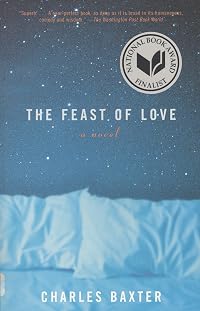
The Feast of Love
by Charles Baxter
On This Page
Description
From "one of our most gifted writers" (Chicago Tribune), here is a superb new novel that delicately unearths the myriad manifestations of extraordinary love between ordinary people. In vignettes both comic and sexy, men and women speak of and desire their ideal mates: The owner of a coffee shop recalls the day his first wife seemed to achieve a moment of simple perfection; a young couple spends hours at the coffee shop fueling the idea of their fierce love; a professor of philosophy, show more stopping by for a cup of coffee, makes a valiant attempt to explain what he knows to be the inexplicable working of the human heart. Their voices resonate with each other and come together in a tapestry that depicts the most irresistible arena of life. show lessTags
Recommendations



Member Recommendations
Member Reviews
Devoured this book. Now I wonder what took me so long to read it, because I've had it on my shelf for a few years now, ever since I happened to see the film adaptation of THE FEAST OF LOVE on TV one night. I loved the movie so much that I emailed Charles Baxter to tell him. He responded graciously, thanking me, but said the film was really rather different from his novel, that he'd had little input into the screenplay.
And now that I've finally read the book - immersed myself in it for the past two days; didn't want to put it down - I can't really remember much about the film. Because my head is too full of the book.
The title comes from a painting by one of the book's main characters. But hey, painting, shmainting - it's the characters show more that rule in Baxter's novel. One of the voices here, a narrator who frames the stories of the other characters, is a guy named Charlie Baxter, who is a writer living in Ann Arbor. (Baxter was teaching at U of M at the time he wrote this.) Then there's Bradley Smith, who suggests that Charlie just write down regular people's stories - which is what he does. Poor Bradley, who runs Jitters, a coffe shop, and is also a painter (that title I mentioned), has no luck with women, having gone through two marriages already. His story is in here. As is Kathryn's, who leaves Bradley for a woman. And there is Diana, Bradley's second wife, very briefly. She is a high-powered, rather cold-blooded type who carries on with David, a married man. And Bradley's elderly neighbors, Harry and Esther Ginsberg, a philosophy professor and a scientist, respectively. But probably the best characters of all here are teenage Chloe (pronounced Clo-AY; she 'customized' her name) and her quirky, recovering addict lover, Oscar. It was Chloe's voice that really slew me. She is an older, wiser, corrupt-but-innocent 'Phoebe' sort- remember Holden Caulfield's sister? Estranged for some time from her parents, she later bridges that gap, in fact worrying about her parents -
"... I was my own woman and not their little girl anymore. Besides, I wanted to show them how mature I'd gotten by not saying f**k all the time, a habit that's hard to give up. That's scary for parents. You have to be careful with parents once you're grown up into mature adulthood. They get 'sensitive.' Almost anything you say, you hurt their feelings. Their aging hearts get broken. They just crumple up. Besides, I was about to become one of them."
You see? You chuckle at what she says, and yet at the same time you ache for her innocence. How author Baxter got so fully inside the head of types like Chloe - and Diana and Kathryn and others - is anybody's guess, but he does it, and he does it so damn well you just keep turning those pages wanting to find out what the hell these people will do next. Because this is a book full of wisdom, humor and the sadness and sometimes silliness of everyday living, all about love in its many permutations. It is indeed a 'feast' for anyone who loves good writing. I cannot recommend this book highly enough. Did I say I loved this book? Well, I did. Bravo, Mr. Baxter!
- Tim Bazzett, author of the memoir, BOOKLOVER show less
And now that I've finally read the book - immersed myself in it for the past two days; didn't want to put it down - I can't really remember much about the film. Because my head is too full of the book.
The title comes from a painting by one of the book's main characters. But hey, painting, shmainting - it's the characters show more that rule in Baxter's novel. One of the voices here, a narrator who frames the stories of the other characters, is a guy named Charlie Baxter, who is a writer living in Ann Arbor. (Baxter was teaching at U of M at the time he wrote this.) Then there's Bradley Smith, who suggests that Charlie just write down regular people's stories - which is what he does. Poor Bradley, who runs Jitters, a coffe shop, and is also a painter (that title I mentioned), has no luck with women, having gone through two marriages already. His story is in here. As is Kathryn's, who leaves Bradley for a woman. And there is Diana, Bradley's second wife, very briefly. She is a high-powered, rather cold-blooded type who carries on with David, a married man. And Bradley's elderly neighbors, Harry and Esther Ginsberg, a philosophy professor and a scientist, respectively. But probably the best characters of all here are teenage Chloe (pronounced Clo-AY; she 'customized' her name) and her quirky, recovering addict lover, Oscar. It was Chloe's voice that really slew me. She is an older, wiser, corrupt-but-innocent 'Phoebe' sort- remember Holden Caulfield's sister? Estranged for some time from her parents, she later bridges that gap, in fact worrying about her parents -
"... I was my own woman and not their little girl anymore. Besides, I wanted to show them how mature I'd gotten by not saying f**k all the time, a habit that's hard to give up. That's scary for parents. You have to be careful with parents once you're grown up into mature adulthood. They get 'sensitive.' Almost anything you say, you hurt their feelings. Their aging hearts get broken. They just crumple up. Besides, I was about to become one of them."
You see? You chuckle at what she says, and yet at the same time you ache for her innocence. How author Baxter got so fully inside the head of types like Chloe - and Diana and Kathryn and others - is anybody's guess, but he does it, and he does it so damn well you just keep turning those pages wanting to find out what the hell these people will do next. Because this is a book full of wisdom, humor and the sadness and sometimes silliness of everyday living, all about love in its many permutations. It is indeed a 'feast' for anyone who loves good writing. I cannot recommend this book highly enough. Did I say I loved this book? Well, I did. Bravo, Mr. Baxter!
- Tim Bazzett, author of the memoir, BOOKLOVER show less
From "one of our most gifted writers" (Chicago Tribune), here is a superb new novel that delicately unearths the myriad manifestations of extraordinary love between ordinary people.The Feast of Love is just that -- a sumptuous work of fiction about the thing that most distracts and delights us. In a re-imagined Midsummer Night's Dream, men and women speak of and desire their ideal mates; parents seek out their lost children; adult children try to come to terms with their own parents and, in some cases, find new ones.In vignettes both comic and sexy, the owner of a coffee shop recalls the day his first wife seemed to achieve a moment of simple perfection, while she remembers the women's softball game during which she was stricken by the show more beauty of the shortstop. A young couple spends hours at the coffee shop fueling the idea of their fierce love. A professor of philosophy, stopping by for a cup of coffee, makes a valiant attempt to explain what he knows to be the inexplicable workings of the human heart Their voices resonate with each other -- disparate people joined by the meanderings of love -- and come together in a tapestry that depicts the most irresistible arena of life. Crafted with subtlety, grace, and power, The Feast of Love is a masterful novel. show less
I wish you could see my face as I type this review. It is gleaming, it is beaming, it is radiant with the kind of glow reserved for moonlight and prom queens. You see, my eyes have just been released from the final word of the final sentence of Charles Baxter’s The Feast of Love, a novel that gleams, beams and glows.
In the past 365 days, I have read 40 books—amassing to roughly 3.5 million words. You have seen me praise authors to the high heavens, you’ve witnessed me gush and spew forth great fountains of hyperbole. But nothing could have prepared me for the wordy delights of The Feast of Love. Purely by accident, it was the last book I read in 2000. Talk about saving the best for last!
It’s going to be difficult, but I’ll show more try to calm down enough so that I can type out a lucid, rational review of this novel. But please excuse me if the fountain of superlative praise starts gushing again—Charles Baxter has earned all the lofty blurbs that we critics can shower on him.
So, you ask, what is The Feast of Love about? On the surface of the page, nothing happens. And yet, scratch beneath the pulp and ink and you’ll see it’s about everything, the castoff moments of our daily lives, the silences, the chatter, the longings, the heartbreak, the joy, the death, the sex. In short, The Feast of Love is an album of Polaroid snapshots capturing the intimate moments between lovers, between parents and children, between close friends and casual acquaintances. In this book, Baxter is the literary equivalent of filmmaker Robert Altman gliding his roving camera through a big cast of characters, all of them connected in one way or another.
Baxter, the author of three novels and three short story collections, has always impressed me with his attention to the details of modern living—his prose reads like a fattened-up Raymond Carver. Baxter has been good before, but here he ascends to the realm of masterpiece. The Feast of Love was nominated for a National Book Award, but lost to Susan Sontag’s In America. I can only imagine that Ms. Sontag’s book transcends the heavenly, because Baxter’s is already at the highest celestial level.
The novel opens with Charles Baxter, the character (a successfully bold move by Baxter, the author), waking from a bad dream. His wife rouses next to him (“the slight saltine-cracker scent of her bodyâÂ?), murmuring that âÂÂItâÂÂs only a dream.âÂ? But now heâÂÂs awake, his mind restless. He gets up, goes out for a walk in the middle of the night and ends up at the University of Michigan football stadium where he spies âÂÂan actively nakedâÂ? couple locked in a tryst on the 50-yard line. Outside the stadium, Charles Baxter runs into his neighbor, Bradley.
âÂÂListen, Charlie,âÂ? Bradley says. âÂÂIâÂÂve got an ideaâ¦Why donâÂÂt you let me talk? Let everybody talk. IâÂÂll send you people, you know, actual people, for a change, like for instance human beings who genuinely exist, and you listen to them for a while. EverybodyâÂÂs got a story, and weâÂÂll just start telling you the stories we have.âÂ?
And so, a novel is born.
In an interview on his publisherâÂÂs website, Baxter describes the genesis of The Feast of Love like this: âÂÂI came up with this idea out of sheer desperation. I was stuck on a new project, which I wanted to be a love story of some sort, and I didn't know how to go about it, or even how to start it. So I began by using my own insomnia, and a nighttime walk I took once down to the vacant lot at the corner of our street. I heard voices coming from someone's house, and I thought of that line from Shakespeare, âÂÂthe night air is full of voices,â and I thought: I'll write a novel with voices, a sort of Midsummer Night's Dream in which people are paired off with the wrong partners at first, and then are paired off with the right partners later, and everyone will tell their stories to Charlie, who will be this shadowy listener, like the reader. Like a friend, a therapist, or a detective.âÂ?
Baxter, the character, gradually fades into the scenery and a chorus of other voices take center stage:
Bradley, the owner of a coffee shop in a shopping mall and an amateur painter (âÂÂThe Feast of LoveâÂ? is one of his impressionistic pieces heâÂÂs got hanging in the coffee shop). BradleyâÂÂs life is a string of fizzled relationships and now he finds himself in âÂÂan emotional tangle.âÂ? HereâÂÂs what one ex-wife says of him: âÂÂAfter we were married, I realized that I had no particular idea who he was. I once called him the Lon Chaney of Ann Arbor, and instead of being hurt, he was pleased. At least IâÂÂm a star, he said.âÂ?
Diana, another of BradleyâÂÂs former wives. SheâÂÂs a lawyer and approaches love as if it were a court case. SheâÂÂs smart and beautiful, but she never really unlocks her heart for Bradley. âÂÂSome matters you shouldnâÂÂt verbalize. I mean really, BradleyâÂ?âÂÂand here she raised her hand and caressed my cheekâÂÂâÂÂall this love business is just natureâÂÂs way of getting more babies into the world. The rest of it is just all this romance nonsense.âÂ? She struggled for the word. âÂÂThe rest of it is just superstructure.âÂ?
Harry and Esther, BradleyâÂÂs next-door neighbors. HarryâÂÂs a professor of philosophy (which allows Baxter to include academic paragraphs on the nature of love) and EstherâÂÂs a biochemist. Their children are grown and living elsewhereâÂÂall of them successful except for Aaron, their mentally-ill son who calls in the middle of the night to curse them in one breath then beg for money in the next. Harry is troubled by the mysteries of parental love: âÂÂTo have a son or daughter like this is to have a portion of the spirit shrivel and die, never to recover. You witness the lost soul of your child floating out into the ethers of eternity.âÂ?
Chloe and Oscar, the lovemaking couple on the 50-yard line. They work for Bradley at his Jitters coffee shop. ThereâÂÂs only one way to describe these teenagers: crazy in love. Here, IâÂÂll let Chloe explain: âÂÂHe told me he was burning for me, and he meant it. When he was around me, he gave off a smell of young man musk, mixed of salt and leather and grass. HeâÂÂd stare at me desperately, smoldering his life away. To be more romantic than we were, youâÂÂd have to kill yourself in the middle of the street and then write about it. Shakespeare did that.âÂ?
Ah yes, the Bard. Dropping ShakespeareâÂÂs name into the conversation is not unintentional. There are plenty of references to A Midsummer NightâÂÂs Dream in The Feast of Love. While it isnâÂÂt a literal retelling of that romantic romp in the woods, the novel has ShakespeareâÂÂs sensibility washing over every page like moonlight. Remember the pleasant, near-giddy feeling that went through you when you first read (or saw) Midsummer? ThatâÂÂs how BaxterâÂÂs book will make you feel.
IâÂÂve been quoting a lot from the novel; more than usual, I suppose. But thatâÂÂs because this book works best, as all great novels do, at the basic level of language. What is literature anyway, but the precise arrangement of words and punctuation? Baxter certainly knows how to compose prose. The Feast of Love is a sumptuous banquet of voices, each unique and compelling. My favorite, however, (and IâÂÂll bet yours, too, once you read the book) belongs to Chloe. HereâÂÂs another sample:
"I can be so unmotivated. For example. You know the dust that can, like, float in the air? Me, I was totally capable of sitting in a chair for hours, watching the dust-fuzz hanging in front of me. If there was sunlight in the room, just the particles of visible molecules or whatever, I was excellent and enthralled. IâÂÂm not saying that IâÂÂm deep, IâÂÂm just saying I watch the dust, and IâÂÂm not stoned either, when I do it. Just observant. IâÂÂm concentrating on it, figuring out its mystery, its purpose for being here in the same universe with us."
Baxter creates real character who inhabit our universe, too. He has taken his time writing this bookâÂÂI can picture him sitting in a coffee house somewhere, eavesdropping on the rabble-babble around him, then writing it all down on scraps of paper. Because he has paid attention to the details of relationships, Baxter creates a universal story. This is a book for everyone to enjoyâÂÂthose in the bloom of love, those whose hearts have withered and those who are impatiently waiting for someone to plant a seed.
As Bradley says, âÂÂIn truth, there are only two realities: the one for people who are in love or love each other, and the one for people who are standing outside all that.âÂ? In this, the best book of 2000, Charles Baxter invites readers to step inside and gorge themselves on a very satisfying feast of words. show less
In the past 365 days, I have read 40 books—amassing to roughly 3.5 million words. You have seen me praise authors to the high heavens, you’ve witnessed me gush and spew forth great fountains of hyperbole. But nothing could have prepared me for the wordy delights of The Feast of Love. Purely by accident, it was the last book I read in 2000. Talk about saving the best for last!
It’s going to be difficult, but I’ll show more try to calm down enough so that I can type out a lucid, rational review of this novel. But please excuse me if the fountain of superlative praise starts gushing again—Charles Baxter has earned all the lofty blurbs that we critics can shower on him.
So, you ask, what is The Feast of Love about? On the surface of the page, nothing happens. And yet, scratch beneath the pulp and ink and you’ll see it’s about everything, the castoff moments of our daily lives, the silences, the chatter, the longings, the heartbreak, the joy, the death, the sex. In short, The Feast of Love is an album of Polaroid snapshots capturing the intimate moments between lovers, between parents and children, between close friends and casual acquaintances. In this book, Baxter is the literary equivalent of filmmaker Robert Altman gliding his roving camera through a big cast of characters, all of them connected in one way or another.
Baxter, the author of three novels and three short story collections, has always impressed me with his attention to the details of modern living—his prose reads like a fattened-up Raymond Carver. Baxter has been good before, but here he ascends to the realm of masterpiece. The Feast of Love was nominated for a National Book Award, but lost to Susan Sontag’s In America. I can only imagine that Ms. Sontag’s book transcends the heavenly, because Baxter’s is already at the highest celestial level.
The novel opens with Charles Baxter, the character (a successfully bold move by Baxter, the author), waking from a bad dream. His wife rouses next to him (“the slight saltine-cracker scent of her bodyâÂ?), murmuring that âÂÂItâÂÂs only a dream.âÂ? But now heâÂÂs awake, his mind restless. He gets up, goes out for a walk in the middle of the night and ends up at the University of Michigan football stadium where he spies âÂÂan actively nakedâÂ? couple locked in a tryst on the 50-yard line. Outside the stadium, Charles Baxter runs into his neighbor, Bradley.
âÂÂListen, Charlie,âÂ? Bradley says. âÂÂIâÂÂve got an ideaâ¦Why donâÂÂt you let me talk? Let everybody talk. IâÂÂll send you people, you know, actual people, for a change, like for instance human beings who genuinely exist, and you listen to them for a while. EverybodyâÂÂs got a story, and weâÂÂll just start telling you the stories we have.âÂ?
And so, a novel is born.
In an interview on his publisherâÂÂs website, Baxter describes the genesis of The Feast of Love like this: âÂÂI came up with this idea out of sheer desperation. I was stuck on a new project, which I wanted to be a love story of some sort, and I didn't know how to go about it, or even how to start it. So I began by using my own insomnia, and a nighttime walk I took once down to the vacant lot at the corner of our street. I heard voices coming from someone's house, and I thought of that line from Shakespeare, âÂÂthe night air is full of voices,â and I thought: I'll write a novel with voices, a sort of Midsummer Night's Dream in which people are paired off with the wrong partners at first, and then are paired off with the right partners later, and everyone will tell their stories to Charlie, who will be this shadowy listener, like the reader. Like a friend, a therapist, or a detective.âÂ?
Baxter, the character, gradually fades into the scenery and a chorus of other voices take center stage:
Bradley, the owner of a coffee shop in a shopping mall and an amateur painter (âÂÂThe Feast of LoveâÂ? is one of his impressionistic pieces heâÂÂs got hanging in the coffee shop). BradleyâÂÂs life is a string of fizzled relationships and now he finds himself in âÂÂan emotional tangle.âÂ? HereâÂÂs what one ex-wife says of him: âÂÂAfter we were married, I realized that I had no particular idea who he was. I once called him the Lon Chaney of Ann Arbor, and instead of being hurt, he was pleased. At least IâÂÂm a star, he said.âÂ?
Diana, another of BradleyâÂÂs former wives. SheâÂÂs a lawyer and approaches love as if it were a court case. SheâÂÂs smart and beautiful, but she never really unlocks her heart for Bradley. âÂÂSome matters you shouldnâÂÂt verbalize. I mean really, BradleyâÂ?âÂÂand here she raised her hand and caressed my cheekâÂÂâÂÂall this love business is just natureâÂÂs way of getting more babies into the world. The rest of it is just all this romance nonsense.âÂ? She struggled for the word. âÂÂThe rest of it is just superstructure.âÂ?
Harry and Esther, BradleyâÂÂs next-door neighbors. HarryâÂÂs a professor of philosophy (which allows Baxter to include academic paragraphs on the nature of love) and EstherâÂÂs a biochemist. Their children are grown and living elsewhereâÂÂall of them successful except for Aaron, their mentally-ill son who calls in the middle of the night to curse them in one breath then beg for money in the next. Harry is troubled by the mysteries of parental love: âÂÂTo have a son or daughter like this is to have a portion of the spirit shrivel and die, never to recover. You witness the lost soul of your child floating out into the ethers of eternity.âÂ?
Chloe and Oscar, the lovemaking couple on the 50-yard line. They work for Bradley at his Jitters coffee shop. ThereâÂÂs only one way to describe these teenagers: crazy in love. Here, IâÂÂll let Chloe explain: âÂÂHe told me he was burning for me, and he meant it. When he was around me, he gave off a smell of young man musk, mixed of salt and leather and grass. HeâÂÂd stare at me desperately, smoldering his life away. To be more romantic than we were, youâÂÂd have to kill yourself in the middle of the street and then write about it. Shakespeare did that.âÂ?
Ah yes, the Bard. Dropping ShakespeareâÂÂs name into the conversation is not unintentional. There are plenty of references to A Midsummer NightâÂÂs Dream in The Feast of Love. While it isnâÂÂt a literal retelling of that romantic romp in the woods, the novel has ShakespeareâÂÂs sensibility washing over every page like moonlight. Remember the pleasant, near-giddy feeling that went through you when you first read (or saw) Midsummer? ThatâÂÂs how BaxterâÂÂs book will make you feel.
IâÂÂve been quoting a lot from the novel; more than usual, I suppose. But thatâÂÂs because this book works best, as all great novels do, at the basic level of language. What is literature anyway, but the precise arrangement of words and punctuation? Baxter certainly knows how to compose prose. The Feast of Love is a sumptuous banquet of voices, each unique and compelling. My favorite, however, (and IâÂÂll bet yours, too, once you read the book) belongs to Chloe. HereâÂÂs another sample:
"I can be so unmotivated. For example. You know the dust that can, like, float in the air? Me, I was totally capable of sitting in a chair for hours, watching the dust-fuzz hanging in front of me. If there was sunlight in the room, just the particles of visible molecules or whatever, I was excellent and enthralled. IâÂÂm not saying that IâÂÂm deep, IâÂÂm just saying I watch the dust, and IâÂÂm not stoned either, when I do it. Just observant. IâÂÂm concentrating on it, figuring out its mystery, its purpose for being here in the same universe with us."
Baxter creates real character who inhabit our universe, too. He has taken his time writing this bookâÂÂI can picture him sitting in a coffee house somewhere, eavesdropping on the rabble-babble around him, then writing it all down on scraps of paper. Because he has paid attention to the details of relationships, Baxter creates a universal story. This is a book for everyone to enjoyâÂÂthose in the bloom of love, those whose hearts have withered and those who are impatiently waiting for someone to plant a seed.
As Bradley says, âÂÂIn truth, there are only two realities: the one for people who are in love or love each other, and the one for people who are standing outside all that.âÂ? In this, the best book of 2000, Charles Baxter invites readers to step inside and gorge themselves on a very satisfying feast of words. show less
Charles Baxter's The Feast of Love was a finalist for the National Book Award in 2000 and has been made into an excellent film with Morgan Freeman. I've just finished reading the novel, finding it charming and moving. Rather than focusing on a single protagonist, Baxter coaxes together a wonderful ensemble of characters, each recounting his or her own amorous tale.
The unifying device is the notion that each character is speaking to the author, Baxter himself, as he seeks out people to tell him about their encounters with Cupid. Baxter is deft in creating the unique voice of each character, and perhaps he's at the top of his game with the character of Chloe, a latter-day flower child who broke my heart and then put it together show more again.
More...
Chloe experiences the extremes of sexual love--the ecstatic highs and the gloomy lows--the highs with her boyfriend and then husband, Oscar, and the lows as she is accosted by Oscar's father, whom the two kids call The Bat. While people like The Bat remain unredeemed, most of Baxter's characters are transformed and elevated by love. This is true even of Diane, whom we first meet as a cynical and predatory lawyer. Baxter is again brilliant as Diane's words reveal her inner being in ways that she herself does not fully understand--and as they slowly reveal her changes. One of Baxter's recent nonfiction books is called The Art of Subtext, and there is plenty of subtext to Diane.
Books like Baxter's (another is Thanksgiving Night by Richard Bausch) alter the traditional notion of the novel as the narrative of a single character's experiences--novels with titles such as Tom Jones, David Copperfield, Emma, and Daniel Deronda. The ensemble novel widens it's focus to show us how the stories of various characters mingle with and transform one another. These novels, it seems to me, have at their core the deeply ethical perception that in human relations there is no single, privileged point of view. Andre Dubus makes a similar point on a smaller scale when his short stories (or many of them) refuse to remain merely with one person's perceptions.
If the modernists thought it was careless craftsmanship for a writer to "violate" the one point of view established at the start of the story, writers such as Baxter, Dubus, and Bausch show us that it is a moral necessity to acknowledge various view points. show less
The unifying device is the notion that each character is speaking to the author, Baxter himself, as he seeks out people to tell him about their encounters with Cupid. Baxter is deft in creating the unique voice of each character, and perhaps he's at the top of his game with the character of Chloe, a latter-day flower child who broke my heart and then put it together show more again.
More...
Chloe experiences the extremes of sexual love--the ecstatic highs and the gloomy lows--the highs with her boyfriend and then husband, Oscar, and the lows as she is accosted by Oscar's father, whom the two kids call The Bat. While people like The Bat remain unredeemed, most of Baxter's characters are transformed and elevated by love. This is true even of Diane, whom we first meet as a cynical and predatory lawyer. Baxter is again brilliant as Diane's words reveal her inner being in ways that she herself does not fully understand--and as they slowly reveal her changes. One of Baxter's recent nonfiction books is called The Art of Subtext, and there is plenty of subtext to Diane.
Books like Baxter's (another is Thanksgiving Night by Richard Bausch) alter the traditional notion of the novel as the narrative of a single character's experiences--novels with titles such as Tom Jones, David Copperfield, Emma, and Daniel Deronda. The ensemble novel widens it's focus to show us how the stories of various characters mingle with and transform one another. These novels, it seems to me, have at their core the deeply ethical perception that in human relations there is no single, privileged point of view. Andre Dubus makes a similar point on a smaller scale when his short stories (or many of them) refuse to remain merely with one person's perceptions.
If the modernists thought it was careless craftsmanship for a writer to "violate" the one point of view established at the start of the story, writers such as Baxter, Dubus, and Bausch show us that it is a moral necessity to acknowledge various view points. show less
For some reason I couldn't really get into this book. I suppose it's very well written, and there were a couple of very insightful passages that almost shook me awake, but ... meh. For one thing, I didn't think there was any justification or purpose as to why the author had inserted himself into the story, it just made it a little bit pretentious. The last chapter, "Postludes", should have been left out entirely; it's just this unneeded scrap of metatextual vanity. I'd have preferred it if there was a little less of the originality, in fact. The changing perspectives worked for me and I liked most of the characters, but the occasional artsy-fartsiness turned me off.
My problem wasn't the plot, per se. It was interesting enough and I show more thought it improved towards the end. The last real chapter was very nearly brilliant, actually. There was just something a bit clinical about it, or academic, maybe. Like the author was trying so hard to show all these different sides to love and ending up trying a little too hard. An older couple, check. An affair, check. Young love, tragic love, unrequited love, unconventional love, unconditional love, check check check. The lesbian storyline especially felt so ... must-not-discriminate.
Also, I was a little repulsed by some of the more creative, shall we say, expressions. "Woman rash", "mushroom sex" and being "fat with love" come to mind.
Final word: I liked the movie better. show less
My problem wasn't the plot, per se. It was interesting enough and I show more thought it improved towards the end. The last real chapter was very nearly brilliant, actually. There was just something a bit clinical about it, or academic, maybe. Like the author was trying so hard to show all these different sides to love and ending up trying a little too hard. An older couple, check. An affair, check. Young love, tragic love, unrequited love, unconventional love, unconditional love, check check check. The lesbian storyline especially felt so ... must-not-discriminate.
Also, I was a little repulsed by some of the more creative, shall we say, expressions. "Woman rash", "mushroom sex" and being "fat with love" come to mind.
Final word: I liked the movie better. show less
This is a really clever story. Charlie Baxter (the character...or the author?) wakes from a bad dream and, like any real insomniac, chooses to walk it off. His 1am stroll leads him to a bench where he finds his neighbor, also wide awake. The two start a conversation about relationships and Charlie's neighbor urges him to write about "real" people in "real" relationships, starting with his own twice-divorced life. From there, we are introduced to a myriad of characters. The theme throughout is love, love, love. Love of all shapes, sizes, complexities, and intricacies are on display. It is though a curtain has been drawn back and we are allowed to view the more intimate ups and downs of a relationship.
Three interweaved narratives populate Charles Baxter's "The Feast of Love." One involves Bradley Smith, something of a putz whose two unfortunate marriages (so far) ended badly: one wife leaves him for a woman, and the second leaves him for her long-time sex partner. That relationship ends badly for the self-absorbed cheating wife.
My favorite plot has to do with Chloe (pronounced clo-WAY). Chloe has outrageous sex with, and then marries, Oscar. A couple of months later the poor thing is widowed. Chloe has visions; she's quite young but has wisdom in worldly matters; she sees mystical things while high, but understands their import in the cold light of day. She undergoes the worst heartache in the book, but she emerges from it. She's a show more goddess - she even says so. You can't read this book and not fall in love with her. She's Venus with 21st century techno-patter.
"The Feast of Love" is replete with lessons: don't pick someone based solely on looks; don't blame the other person exclusively when he or she cuts and runs; don't settle; don't invest too much emotion in your partner; trust your local psychic.
This highly readable book will engage you with its characters. You will come away wiser and with an appreciative smile for the author. By all means, read "The Feast of Love."
http://bassoprofundo1.blogspot.com/2010/06/feast-of-love-by-charles-baxter.html show less
My favorite plot has to do with Chloe (pronounced clo-WAY). Chloe has outrageous sex with, and then marries, Oscar. A couple of months later the poor thing is widowed. Chloe has visions; she's quite young but has wisdom in worldly matters; she sees mystical things while high, but understands their import in the cold light of day. She undergoes the worst heartache in the book, but she emerges from it. She's a show more goddess - she even says so. You can't read this book and not fall in love with her. She's Venus with 21st century techno-patter.
"The Feast of Love" is replete with lessons: don't pick someone based solely on looks; don't blame the other person exclusively when he or she cuts and runs; don't settle; don't invest too much emotion in your partner; trust your local psychic.
This highly readable book will engage you with its characters. You will come away wiser and with an appreciative smile for the author. By all means, read "The Feast of Love."
http://bassoprofundo1.blogspot.com/2010/06/feast-of-love-by-charles-baxter.html show less
Members
- Recently Added By
Lists

Read the book and saw the movie
1,170 works; 192 members

Llibres que he llegit el 2019
42 works; 1 member

National Book Award Finalists - Fiction
377 works; 12 members

Mustich's 1000 Books to Read Before You Die: A Life Changing List
1,001 works; 20 members

Fiction With Familiar Settings
280 works; 93 members
Author Information

34+ Works 5,667 Members
Charles Baxter is the author of novels and short story collections. His novels include The Feast of Love, The Soul Thief, Saul and Patsy, Shadow Play, and First Light. His short story collections include Gryphon, Believers, A Relative Stranger, Through the Safety Net, Harmony of the World, and There's Something I Want You to Do. He teaches at the show more University of Minnesota and in the MFA Program for Writers at Warren Wilson College. (Bowker Author Biography) Charles Baxter is author of several novels, including "The Feast of Love", "Shadow Play", & "First Light", & collections of stories including "Believers" & "A Relative Stranger". He teaches writing at the University of Michigan. (Publisher Provided) He lives in Ann Arbor, Michigan. He is the recipient of a Lila Wallace-Reader's Digest Foundation Award for Writers & an Academy Award in Literature from the American Academy of Arts & Letters. (Publisher Provided) show less
Awards and Honors
Awards
Notable Lists
Common Knowledge
- Canonical title
- The Feast of Love
- Original title
- The Feast of Love
- Original publication date
- 2000
- Important places
- Michigan, USA
- Related movies
- Feast of Love (2007 | tt0800027)\ (2007 | IMDb)
- Epigraph
- Yes, there were time when I forgot not only who I was, but that I was, forgot to be. -Samuel Beckett, Molloy
- First words
- The Man-Me, this pale being, no one else, it seems-wakes in fright, tangled up in the sheets
- Last words
- (Click to show. Warning: May contain spoilers.)"Where were you?" but already I am drifting off to sleep and cannot formulate the words in time to name aloud those places I have been.
Classifications
Statistics
- Members
- 1,889
- Popularity
- 11,381
- Reviews
- 40
- Rating
- (3.69)
- Languages
- 8 — Catalan, Dutch, English, French, German, Italian, Polish, Spanish
- Media
- Paper, Audiobook, Ebook
- ISBNs
- 26
- ASINs
- 10