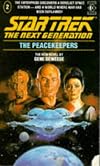
The Peacekeepers
by Gene DeWeese
Star Trek: The Next Generation (2), Star Trek (novels) (1988.09), Star Trek (1988.09)
On This Page
Description
Fiction. Science Fiction. HTML:Exploring a deserted alien spaceship, Lt. Commander Data and Lt. Geordi LaForge suddenly find themselves transported light-years away — into the prison cell, into the middle of a deadly conflict!While Captain Picard and the crew of the U.S.S. EnterpriseTM search feverishly for the missing crewmen, Data and LaForge discover they are in a station almost identical to the one they were exploring, high in orbit around an Earth-type world. Years before, the show more occupants of that planet accidentally stumbled onto the ship and its advanced technology — and since then have used its weapons to keep the nations on the planet below disarmed, and at peace.
Now their own arrival has precipitated a crisis on the station. Somehow, Data and LaForge must find a way to restore trust between the planet below and the station's guardians up above — before a final, destructive war breaks out!. show less
Tags
Recommendations












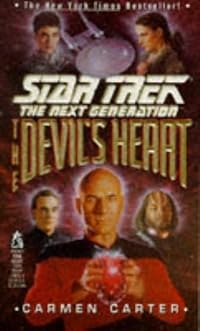



Member Reviews
This is an old The Next Generation novel, the second original one ever published. At the time Gene DeWeese wrote it, I am not sure he would have even seen any episodes of the show, probably just read scripts. I felt like the influence of "Heart of Glory" was particularly obvious here: like in that episode, a significant early sequence is about Geordi going aboard a derelict vessel, his VISOR allowing him to see what others cannot.
I was surprised to see on LibraryThing that I read this before. Admittedly, it was exactly twenty years ago, but there are Star Trek books I read longer ago that I still have detailed, vivid memories of. Even as I reread this, absolutely nothing struck a chord of familiarity.I assume this is because the show more book is dead boring. It's slow, agonizingly so, like DeWeese realized he had a 200-page idea but had to turn it into a 300-page book. Characters have long conversations, the action is repetitive for no purpose. The alien society is not at all interesting, nor is the dilemma that the book tries to set up, even though I feel like it could be. I think it would take a lot of reworking to make these basic ingredients come alive. show less
I was surprised to see on LibraryThing that I read this before. Admittedly, it was exactly twenty years ago, but there are Star Trek books I read longer ago that I still have detailed, vivid memories of. Even as I reread this, absolutely nothing struck a chord of familiarity.I assume this is because the show more book is dead boring. It's slow, agonizingly so, like DeWeese realized he had a 200-page idea but had to turn it into a 300-page book. Characters have long conversations, the action is repetitive for no purpose. The alien society is not at all interesting, nor is the dilemma that the book tries to set up, even though I feel like it could be. I think it would take a lot of reworking to make these basic ingredients come alive. show less
This is the one in which we learn more about Data's special abilities, and about LaForge's. Apparently Geordi can interpret infrared emanations (of at least some humans and humanoids) enough to have a sense of their emotions almost as perceptive as Troi's. Now, she's also a trained psychiatrist so she had dibs, but if he can really do that, why wasn't he used more often to aid her?
The price of power, the price of peace, gatekeepers & guardians, and technology that lasts a long long time more than its builders. The climax jars but is fun, and the very ending fixes what seemed 'off' about it. The Prime Directive is explored yet again.
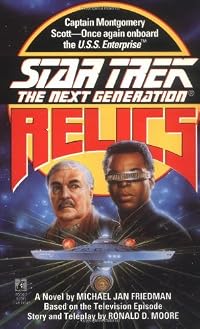
And, yes, the cover is all wrong. Geordi and Data should be the only ones on it. Maybe Yar and Riker in show more the background. show less
The price of power, the price of peace, gatekeepers & guardians, and technology that lasts a long long time more than its builders. The climax jars but is fun, and the very ending fixes what seemed 'off' about it. The Prime Directive is explored yet again.
And, yes, the cover is all wrong. Geordi and Data should be the only ones on it. Maybe Yar and Riker in show more the background. show less
Generally pretty interesting, I especially liked getting to spend so much time with Geordi and seeing how his vision altered his perspective on the world. The brief uses of Troi and her connection with Riker were also surprisingly good, although I wish I had seen more of both her and Yar - it was a very dudely book. Unfortunately, the end was rather flimsy: I didn't, and don't, believe that massive multigenerational conflict on a planetary scale can be solved by "ooh scary aliens." But Star Trek has repeatedly suggested that it can be, so this is more a Trek problem than a this-book problem.
Even twenty years or more after reading it, I remember that this was a particularly interesting and engrossing Star Dreck novel. Gene DeWeese's Star Dreck novels usually are. It's about someone using abandoned alien weapons to prevent war through fear on his planet.
Being very early in the TNG timeline, both show and novel, this was "nothing more" than a parable of our world and future potentially going astray if we don't get our act together. Low-tech and unknowingly inaccurate (it claims Geordi has no physical eyes vs. just being blind), but the episodic beats were predictably hit. The ending was an incredible farce of eye-widening "really?!"
Ratings
Members
- Recently Added By
Author Information

Thomas Eugene DeWeese was born in Rochester, Indiana on January 31, 1934. He received an associate degree in electronics from Valparaiso Technical Institute in 1953. He worked for General Motors' Delco Electronics Division as a technician from 1954 to 1959 and as a technical writer from 1959 to 1974. Afterwards, he became a full-time freelance show more writer. His first novels, The Invisibility Affair and The Mind-Twisters Affair were both published in 1967 and were part of the Man from U.N.C.L.E. series written under the pseudonym Thomas Stratton with Buck Coulson. He also wrote under the pseudonyms Gene DeWeese and Jean DeWeese. During his lifetime, he wrote more than 40 books including novels in the Star Trek, Ravenloft, Dinotopia, and Amazing Stories series. His young adult novel The Adventures of a Two-Minute Werewolf was made into a television movie of the same name. He died from Lewy body dementia on March 19, 2012. (Bowker Author Biography) show less
Some Editions
Series


Work Relationships
Common Knowledge
- Canonical title
- The Peacekeepers
- Original publication date
- 1988-09
- People/Characters*
- Jean-Luc Picard; William T. Riker; Data; Geordi La Forge; Tasha Yar; Worf (show all 9); Beverly Crusher; Wesley Crusher; Deanna Troi
- Dedication
- For Becky Bontreger
You were there when I couldn't be,
and you did more for her than I could
ever have done. . .
Thanks. - First words
- "It was a wild-goose chase, Number One, but I have to admit I am not at all displeased at that."
- Last words
- (Click to show. Warning: May contain spoilers.)"But, then, it's only a hunch."
*Some information comes from Common Knowledge in other languages. Click "Edit" for more information.
Classifications
Statistics
- Members
- 762
- Popularity
- 36,721
- Reviews
- 6
- Rating
- (3.01)
- Languages
- 6 — Czech, Dutch, English, French, German, Spanish
- Media
- Paper, Ebook
- ISBNs
- 10
- ASINs
- 7