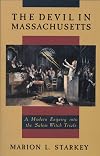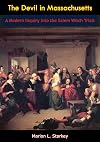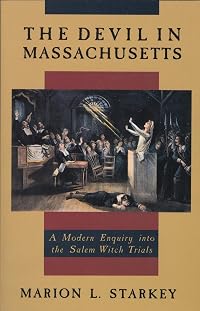
The Devil in Massachusetts: A Modern Enquiry into the Salem Witch Trials
by Marion L. Starkey
On This Page
Description
This volume addresses the perennial issue of unity and diversity in the New Testament canon. Celebrating the academic legacy of Fr. Frank J. Matera, colleagues and friends interact with elements of his many important works. Scholars and students alike will find fresh and stimulating discussions that navigate the turbulent waters between the Gospels and Paul, ranging from questions of Matthew's so-called anti-Pauline polemic to cruciform teaching in the New Testament. The volume includes show more contributions from leading scholars in the field, offering a rich array of insights on issues such as Christology, social ethics, soteriology, and more. The contributors are Paul J. Achtemeier, Sherri Brown, Raymond F. Collins, A. Andrew Das, John R. Donahue, S.J., Francis T. Gignac, S.J., Michael J. Gorman, Kelly R. Iverson, Luke Timothy Johnson, Jack Dean Kingsbury, William S. Kurz, S.J., John P. Meier, Francis J. Moloney, S.D.B., Christopher W. Skinner, and Matt Whitlock. show lessTags
Recommendations

















Member Reviews
This is a riveting account of the Salem Witch Trials. Marion Starkey includes just the right amount of detail to portray all the elements of this horrifying story. From the hysteria spun out of fanaticism to the economic and social background that provided a fertile ground, the events unfold in a way that kept this reader spellbound. The author highlights the relationships of the people in the community and how their bonds were broken by the reactions of the accusations of the young girls. This was well before the era when hysteria was diagnosed as a psychiatric disorder, thus it seems that the townspeople had fewer coping mechanisms when the emotions went out of control. Neither Church nor Civil authorities were able to maintain show more control and their actions probably aggravated the crisis. There may be more recent accounts that cover more details, but this is the classic telling of this tale of witchcraft and evil. show less
Religion is dangerous. So are teenage girls. This seems to be the main theme of this book. Starkey has gathered myriad sources on the Salem Witch Trials and managed to put together a cohesive account which is neither dry nor dense. Though written in 1949, it is comprehensible to the modern reader and also fascinating. Starkey has taken great care not to fabricate action or dialogue in order to add drama to her tale; she hardly needs to. She has copied entire sections of dialogue from court reports and detailed diaries of eyewitnesses to the trials.
Starkey also claims in her introduction that she has tried to apply some 'modern psychology' to the major players in the conflict, but I saw little evidence of that. There was definitely some show more borderline personality disorder among the 'afflicted girls,' most notably Abigail Williams.
Overall, an engaging and informative non-fiction work. show less
Starkey also claims in her introduction that she has tried to apply some 'modern psychology' to the major players in the conflict, but I saw little evidence of that. There was definitely some show more borderline personality disorder among the 'afflicted girls,' most notably Abigail Williams.
Overall, an engaging and informative non-fiction work. show less
3.25 stars
This book was originally published in 1949, and looks at the trials of the Salem witches in 1692.
The book was pretty good. Unfortunately, it just didn't make me want to pick up the book and keep reading. There were times when it was just a little dry for me, even though I am interested in the topic. There are just so many people and events (and accusations!) to keep straight! I think the research was very well done, though.
This book was originally published in 1949, and looks at the trials of the Salem witches in 1692.
The book was pretty good. Unfortunately, it just didn't make me want to pick up the book and keep reading. There were times when it was just a little dry for me, even though I am interested in the topic. There are just so many people and events (and accusations!) to keep straight! I think the research was very well done, though.
A modern look at the Salem witch trials. First written in 1949, there is nothing about this book that feels dated except the typeface. The author writes history that reads like a novel, and even though it is a history that many have written before and since, she still brings a new voice and some new information. The dry wit and frequent use of what can only be read as sarcasm actually enhances the book. She focuses a great deal more on the character of the 'witches' than on the accusers, but she does spend a little time building up the tale to its onset with the first calling out of a witch, perhaps with a bit more interpolation than is acceptable in a purely scientific or historical work, as she makes assumptions about what is going show more through the mind of young Abigail Williams. After the first chapter, though, she pieces together most of her information from the copious records kept of the hearings, the diaries of people in the town, and other contemporary sources, only occasionally straying inside the psyche of the long-dead, and then usually with a disclaimer about what they "might" be thinking or feeling. Overall, a decent way to spend a few days of my reading time. show less
I’ve been working my way through a series of books on the Salem witchcraft outbreak of 1692; so far this includes Stacy Schiff’s The Witches, Paul Boyer and Stephen Nissenbaums’s Salem Possessed, and Cotton Mather’s The Wonders of the Invisible World.
Marion Starkey’s The Devil in Massachusetts is the most readable so far, although the almost novelistic treatment may disguise some historical inaccuracy (in her Preface, she notes she “…has taken slight liberties with the records”). Her narration is in chronological order and her characters all have real personalities – perhaps not their actual personalities, of course. In Starkey’s version, Reverend Samuel Parris, the slave Tituba, and the children Betty Parris and show more Abigail Williams are somewhat more culpable in the initial events here than they are in the other books, as is Cotton Mather in the later part of the story (particularly the trial and execution of George Burroughs). Starkey, like Schiff, buys into “hysteria” as the cause of the girls’ accusations – even putting Freud in her references section. Starkey also refers to a suggestion – not in the main text but in her endnotes – that some of the accusers’ “possession” may have been due to consuming or handling Jimson weed. She doesn’t go to far with that and none of the other books I’ve read have mentioned it.
Of the work’s I’ve read, Boyer and Nissenbaum’s is the only one that really goes into the sociological background of what went on – the political and social aspects of living in 17th century Massachusetts. Starkey mentions a little of this – how the inhabitants of Salem were historically contentious, ready to dispute with each other over details of land boundaries and minister’s salaries, and suggests that perhaps some of these disputes may have metamorphosed into accusations of witchcraft.
One of the things that’s missing is any reference to the McCarthy Hearings – because they hadn’t happened yet; this book was written in 1947. And of course the Satanic Panic of the 1970s was decades in the future; in Starkey’s final chapter Massachusetts has redeemed itself by the early 1700s, offering compensation to those accused of witchcraft; there’s not the slightest suggestion that anything like Salem could ever happen again. Optimism springs eternal.
No illustrations. Starkey doesn’t use numbered notes; instead a “Notes” section has a discussion of the sources used for each chapter. There is a good reference section. The index seems sparse; I had a hard time finding some things I wanted to look up. show less
Marion Starkey’s The Devil in Massachusetts is the most readable so far, although the almost novelistic treatment may disguise some historical inaccuracy (in her Preface, she notes she “…has taken slight liberties with the records”). Her narration is in chronological order and her characters all have real personalities – perhaps not their actual personalities, of course. In Starkey’s version, Reverend Samuel Parris, the slave Tituba, and the children Betty Parris and show more Abigail Williams are somewhat more culpable in the initial events here than they are in the other books, as is Cotton Mather in the later part of the story (particularly the trial and execution of George Burroughs). Starkey, like Schiff, buys into “hysteria” as the cause of the girls’ accusations – even putting Freud in her references section. Starkey also refers to a suggestion – not in the main text but in her endnotes – that some of the accusers’ “possession” may have been due to consuming or handling Jimson weed. She doesn’t go to far with that and none of the other books I’ve read have mentioned it.
Of the work’s I’ve read, Boyer and Nissenbaum’s is the only one that really goes into the sociological background of what went on – the political and social aspects of living in 17th century Massachusetts. Starkey mentions a little of this – how the inhabitants of Salem were historically contentious, ready to dispute with each other over details of land boundaries and minister’s salaries, and suggests that perhaps some of these disputes may have metamorphosed into accusations of witchcraft.
One of the things that’s missing is any reference to the McCarthy Hearings – because they hadn’t happened yet; this book was written in 1947. And of course the Satanic Panic of the 1970s was decades in the future; in Starkey’s final chapter Massachusetts has redeemed itself by the early 1700s, offering compensation to those accused of witchcraft; there’s not the slightest suggestion that anything like Salem could ever happen again. Optimism springs eternal.
No illustrations. Starkey doesn’t use numbered notes; instead a “Notes” section has a discussion of the sources used for each chapter. There is a good reference section. The index seems sparse; I had a hard time finding some things I wanted to look up. show less
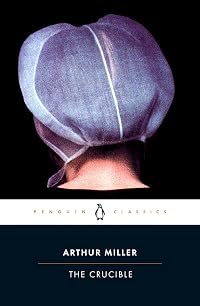
A new and refreshing look into the Salem Witch trials. Starkey creates a whirlpool that quickly sucks the reader into the hysteria and fear of the New World at a time when witchcraft was a legitimate fear. Unlike "The Crucible" "The Devil in Massachusetts" takes a much closer look at the likely underlying causes that led to the horrific trials and executions. Come along for the ride from start to aftermath as the Puritans give in to their worst fears.
Starkey uses the now rather dated technique of Freudian analysis (which she cops to right in her title) to inspect the hysteria surrounding the Salem witch trials of 1692. Whether or not this was an appropriate way to study a sordid tale from Puritan times (I don't believe it was), I got the feeling she was trying to inject drama into a story that already had plenty of drama. I would have gotten more out of it had she talked more about the link between Puritans and their homeland of England, and the demons and spirits they brought with them overseas.
Members
- Recently Added By
Lists

Witch Hunts
30 works; 7 members

New England Witch Trials -- nonfiction
9 works; 1 member
Author Information

11+ Works 1,033 Members
Series
Belongs to Publisher Series
Common Knowledge
- Original publication date
- 1949
- People/Characters
- Samuel Parris; Abigail Williams; Betty Parris; Deodat Lawson; Tituba; Elizabeth Hubbard (show all 27); Sarah Churchill; Mary Warren; Ann Putnam, Sr.; Mercy Lewis; Nicholas Noyes; Sarah Good; Sarah Osborne; John Hathorne; Ezekiel Cheever; Joseph Putnam; Martha Corey; Gertrude Pope; Dorcas Good; Rebecca Nurse; Sarah Bibber; Bridget Bishop; Susanna Martin; Cotton Mather; John Proctor; Giles Corey; Martha Corey
- Important places
- Salem Village, Massachusetts, USA; Salem Town, Massachusetts, USA; Boston, Massachusetts, USA; Andover, Massachusetts, USA
- Important events
- Salem witch trials (1692 | 1693)
- Dedication
- For MY MOTHER
- First words
- One does not commonly shape destiny at the age of nine or eleven, and until the middle of January 1692, Betty and Abigail had given no indication that they were about to do so.
- Last words
- (Click to show. Warning: May contain spoilers.)What one feels now for deluded Salem Village is less pity than admiration and hope - admiration for men whose sanity in the end proved stronger than madness, hope that "enlightenment" too is a phenomenon that may recur.
Classifications
Statistics
- Members
- 861
- Popularity
- 31,644
- Reviews
- 13
- Rating
- (3.70)
- Languages
- English
- Media
- Paper, Ebook
- ISBNs
- 8
- ASINs
- 36