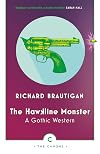
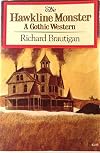
The Hawkline Monster
by Richard Brautigan
On This Page
Description
The time is 1902, the setting eastern Oregon. Magic Child, a fifteen-year-old Native American girl, wanders into the wrong whorehouse looking for the right men. She finds Cameron and Greer, two gunmen taking a timeout from the game after an aborted job in Hawaii. Their violent past doesn't concern Magic Child. She wants them to kill a monster for her, one she says lives in the ice caves under the basement of Miss Hawkline's yellow house, and one she says has killed before. But the more she show more tells them about the monster, the more her story unravels until it isn't clear if the monster is even real, or if anything else is. Richard Brautigan's classic surrealist novel has inspired readers for decades with its wild, witty, and bizarre encounters with western-themed psychedelia. show lessTags
Recommendations





















Member Reviews
Brautigan indolently saunters his way through this wonderfully playful novella like a mischievous puck. Love this:
The voyage from San Francisco to Hawaii had been the most terrifying experience Greer and Cameron had ever gone through, even more terrible than the time they shot a deputy sheriff in Idaho ten times and he wouldn't die and Greer finally had to say to the deputy sheriff,
"Please die because we don't want to shoot you again".
And the deputy sheriff had said, "Ok, I'll die, but don't shoot me again".
"We won't shoot you again", Cameron had said.
"Ok, I'm dead", and he was.
The voyage from San Francisco to Hawaii had been the most terrifying experience Greer and Cameron had ever gone through, even more terrible than the time they shot a deputy sheriff in Idaho ten times and he wouldn't die and Greer finally had to say to the deputy sheriff,
"Please die because we don't want to shoot you again".
And the deputy sheriff had said, "Ok, I'll die, but don't shoot me again".
"We won't shoot you again", Cameron had said.
"Ok, I'm dead", and he was.
The attitude is everything in this story, from the author to the characters, to the behavior of the monster. A monster that can change the physical world around it but mostly messes with minds, which is actually quite frightening, though with a couple of exceptions seem satisfied with malicious mischief. Beyond the surface and the ideas, however, there isn't much done with the scant substance that is offered.
What a gem! Subtitled "A Gothic Western," this odd excursion through absurdity to joy is a grand example of the brilliance of its author, Richard Brautigan.
On the back of one Brautigan novel, some critic states that "in the future, they won't write novels any more, they'll write brautigans."
I wish that had proved true.
But the truth is simple: Richard Brautigan's laconic, whimsical romps through his sunny nighmares have proven unique, and inimitable. It's a pity that his popularity waned, and that he, in bitterness, shot himself. What a sad end to a life. But his fiction remains, clear and winning as ever. And well worth a popular revival.
Forget the hippy context of Brautigan's day; in our day and age, these books haven't aged at all, show more and "The Hawkline Monster: A Gothic Western," in particular, has proved an enduring joy. show less
On the back of one Brautigan novel, some critic states that "in the future, they won't write novels any more, they'll write brautigans."
I wish that had proved true.
But the truth is simple: Richard Brautigan's laconic, whimsical romps through his sunny nighmares have proven unique, and inimitable. It's a pity that his popularity waned, and that he, in bitterness, shot himself. What a sad end to a life. But his fiction remains, clear and winning as ever. And well worth a popular revival.
Forget the hippy context of Brautigan's day; in our day and age, these books haven't aged at all, show more and "The Hawkline Monster: A Gothic Western," in particular, has proved an enduring joy. show less
A very peculiar but readable surreal and odd novel about killers versus evil chemical byproducts playing games with reality in an old house in Eastern Oregon at the start of the 20th century. If the tone seems lackadaisical, the prose is crisp and there are all sorts of things that tell you this is from the seventies, with its amoral but manly characters of violent action and literally interchangeable women who sleep around a lot, and the whole plot seems vaguely alchemy in the wild west. There are some lovely flourishes in the writing, and the whole thing is a bit of a curate's egg of a book.
This is another book I inherited from my late Uncle’s collection. It’s okay. It’s not as dynamic and entertaining as Willard and His Bowling Trophies or as utterly fantastical as In Watermelon Sugar. It is of the Western genre only in that there are two gunfighters gathered to confront the eponymous Hawkline Monster. The rest is pure Brautigan.
The story is set primarily amongst desert hills upon which rests a gothic mansion surrounded and covered in frost due to the mysterious creature in the ice caves below the basement laboratory with a large pile of black coal next to it – a very surreal image. Rooms are always ice-cold whilst the windows look out onto the sun-seared fields of tall yellow grass and summer sun of Eastern show more Oregon. Reminds me of those summer days in my childhood when the swamp cooler was especially effective in our cement-block house, and I would be shivering cold while looking out onto a sunblasted yard during what had to be a 100-degree summer day. Anyway, there is a plot so-to-speak.
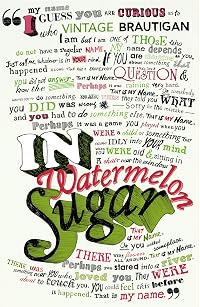
Plots in Brautigan’s stories seem to be a series of scenes and character interactions that are loosely related, typically strung together on a single premise. In Willard, it was the Logan Brothers’ vengeful quest to recover their stolen trophies. In Watermelon Sugar, the plot is held together via the conflict between the narrator, the rebellious inBOIL, and Margaret the narrator’s ex, and thus between inBOIL’s rebels and the commune of iDEATH between which the climax happens. Here, they are joined together in the first half of the book by the fact that the pair of gunmen guided by Magic Child (one of the Miss Hawklines transformed into a Native American by the monster) are traveling to Hawkline Manor. The second half which occurs within the Victorian manor is an extended setup for the anti-climactic face-off with the monster.
Another significant thing I noticed with this story is that all the primary characters (the house counts as a character in this case I’m pretty sure) come in pairs. The Hawkline women are twins, the gunfighters are a pair of friends distinguished by one having an intense desire to count everything, and the Hawkline Monster and its incompetent shadow, yet another pair, reflect the frosted mansion and its adjacent coal pile (two pairs). The pair of protagonists are described as having the same basic outfit and are even introduced as ‘they’ in the first few lines of the first chapter. What’s the significance? I do not know but I don’t think it was accidental.
I have to say, I did find this one interesting, and took a little while to digest it. However, so far, in my trip through Richard Brautigan’s oeuvre, this is the weakest as it’s the plainest if that makes any sense. I recommend this one as either an entry point into his work or to someone who is already a fan. It lacks a lot of the color and plain weird settings of the previous pair of his books that I have finished: Willard and his Bowling Trophies and In Watermelon Sugar. show less
The story is set primarily amongst desert hills upon which rests a gothic mansion surrounded and covered in frost due to the mysterious creature in the ice caves below the basement laboratory with a large pile of black coal next to it – a very surreal image. Rooms are always ice-cold whilst the windows look out onto the sun-seared fields of tall yellow grass and summer sun of Eastern show more Oregon. Reminds me of those summer days in my childhood when the swamp cooler was especially effective in our cement-block house, and I would be shivering cold while looking out onto a sunblasted yard during what had to be a 100-degree summer day. Anyway, there is a plot so-to-speak.
Plots in Brautigan’s stories seem to be a series of scenes and character interactions that are loosely related, typically strung together on a single premise. In Willard, it was the Logan Brothers’ vengeful quest to recover their stolen trophies. In Watermelon Sugar, the plot is held together via the conflict between the narrator, the rebellious inBOIL, and Margaret the narrator’s ex, and thus between inBOIL’s rebels and the commune of iDEATH between which the climax happens. Here, they are joined together in the first half of the book by the fact that the pair of gunmen guided by Magic Child (one of the Miss Hawklines transformed into a Native American by the monster) are traveling to Hawkline Manor. The second half which occurs within the Victorian manor is an extended setup for the anti-climactic face-off with the monster.
Another significant thing I noticed with this story is that all the primary characters (the house counts as a character in this case I’m pretty sure) come in pairs. The Hawkline women are twins, the gunfighters are a pair of friends distinguished by one having an intense desire to count everything, and the Hawkline Monster and its incompetent shadow, yet another pair, reflect the frosted mansion and its adjacent coal pile (two pairs). The pair of protagonists are described as having the same basic outfit and are even introduced as ‘they’ in the first few lines of the first chapter. What’s the significance? I do not know but I don’t think it was accidental.
I have to say, I did find this one interesting, and took a little while to digest it. However, so far, in my trip through Richard Brautigan’s oeuvre, this is the weakest as it’s the plainest if that makes any sense. I recommend this one as either an entry point into his work or to someone who is already a fan. It lacks a lot of the color and plain weird settings of the previous pair of his books that I have finished: Willard and his Bowling Trophies and In Watermelon Sugar. show less
This book was a delight, quick and completely bizarre, I truly never once gained my footing when reading this book. A brief passage from early on in the story may illustrate what kind of incongruous, off beat, and often hilarious tone this novel has:
“The voyage from San Francisco to Hawaii had been the most terrifying experience Greer and Cameron had ever gone through, even more terrible than the time they shot a deputy sheriff in Idaho ten times and he wouldn’t die and Greer finally had to say to the deputy sheriff, “Please die because we don’t want to shoot you again.” And the deputy sheriff had said, “OK, I’ll die, but don’t shoot me again.”
“We won’t shoot you again,” Cameron had said.
“OK, I’m dead,” show more and he was.
Certainly may not be everyone’s taste or humor, but I would definitely recommend giving it a try if you manage to come across it. It entertained me thorough in the few hours it took to complete. show less
“The voyage from San Francisco to Hawaii had been the most terrifying experience Greer and Cameron had ever gone through, even more terrible than the time they shot a deputy sheriff in Idaho ten times and he wouldn’t die and Greer finally had to say to the deputy sheriff, “Please die because we don’t want to shoot you again.” And the deputy sheriff had said, “OK, I’ll die, but don’t shoot me again.”
“We won’t shoot you again,” Cameron had said.
“OK, I’m dead,” show more and he was.
Certainly may not be everyone’s taste or humor, but I would definitely recommend giving it a try if you manage to come across it. It entertained me thorough in the few hours it took to complete. show less
Well.. maybe giving this a 4 star rating is too much but it's hard for me to be so middle-of-the-road-ish about a writer that I do, indeed, like - who committed suicide. It wd seem like a disservice.
When I was a teenager still in high school there were several writers who my peers & I were reading w/ a particular avidity: Brautigan, Kahil Gibran, Herman Hesse, Antoine de Saint-Exupéray, & Kurt Vonnegut being perhaps at the forefront. Maybe they were all writers who addressed spiritual quests somehow. After high school, I seemed to move on from these writers pretty quickly - consigning them somehow to being teen-aged interests & seeking out different writers to explore. Then my friend Alan Davies asked me an interview question about show more what I read when I was younger & I remembered Brautigan. SO then I was in Book Thing of Baltimore (www.bookthing.org) looking for some free bks I might like &, Lo & Behold!, there were 2 Brautigan bks I hadn't read. The timing was perfect.
I read this in just a few hrs. It was such an easy read that I was somewhat astounded. The language was simple in an absurdist Hemingway sortof way. I liked the genre twist of its being a "Gothic Western". Looking over some of the other reviews for this I suspect that many people don't really understand the origins of Gothic. I think of Walpole's "The Castle of Otranto", M.G.Lewis' "The Monk", Mary Shelley's "Frankenstein", Ann Radcliffe's "The Mysteries of Udolpho", & Thomas Love Peacock's satire "Nightmare Abbey". The general trend of these novels is to have the story take place in a remote castle or stronghold of some sort where eerie, perhaps haunted, things may occur.
Brautigan's novel fits right in - in a somewhat refreshingly updated way. The sadism of "The Monk" gets replaced w/ the more light-hearted easy fucking of the "free love" of the 1960s transplanted into the early twentieth century. I suppose what little problem I had w/ this bk was that since I read it in such a short amt of time it felt ephemeral, forgettable. I totally enjoyed it & it was even an original read but the easiness of it made it seem a bit too insubstantial.
According to Brautigan's Wikipedia bio:
"On December 14, 1955, Brautigan was arrested for throwing a rock through a police-station window, supposedly in order to be sent to prison and fed. He was arrested for disorderly conduct and fined $25. He was then committed to the Oregon State Hospital on December 24, 1955, after police noticed patterns of erratic behavior.
"At the Oregon State Hospital Brautigan was diagnosed with paranoid schizophrenia and clinical depression, and was treated with electroconvulsive therapy 12 times."
That makes me mad enuf to hate society even more than I already do. The bio further states that: "Generally dismissed by literary critics and increasingly abandoned by his readers, Brautigan's popularity waned throughout the late 1970s and 1980s." That makes me even sadder, since, in retrospect, I like Brautigan quite alot & hate to think of myself as having in any way contributed to Brautigan's declining readership. What can I say? His suicide makes me wish I cd change all that. show less
When I was a teenager still in high school there were several writers who my peers & I were reading w/ a particular avidity: Brautigan, Kahil Gibran, Herman Hesse, Antoine de Saint-Exupéray, & Kurt Vonnegut being perhaps at the forefront. Maybe they were all writers who addressed spiritual quests somehow. After high school, I seemed to move on from these writers pretty quickly - consigning them somehow to being teen-aged interests & seeking out different writers to explore. Then my friend Alan Davies asked me an interview question about show more what I read when I was younger & I remembered Brautigan. SO then I was in Book Thing of Baltimore (www.bookthing.org) looking for some free bks I might like &, Lo & Behold!, there were 2 Brautigan bks I hadn't read. The timing was perfect.
I read this in just a few hrs. It was such an easy read that I was somewhat astounded. The language was simple in an absurdist Hemingway sortof way. I liked the genre twist of its being a "Gothic Western". Looking over some of the other reviews for this I suspect that many people don't really understand the origins of Gothic. I think of Walpole's "The Castle of Otranto", M.G.Lewis' "The Monk", Mary Shelley's "Frankenstein", Ann Radcliffe's "The Mysteries of Udolpho", & Thomas Love Peacock's satire "Nightmare Abbey". The general trend of these novels is to have the story take place in a remote castle or stronghold of some sort where eerie, perhaps haunted, things may occur.
Brautigan's novel fits right in - in a somewhat refreshingly updated way. The sadism of "The Monk" gets replaced w/ the more light-hearted easy fucking of the "free love" of the 1960s transplanted into the early twentieth century. I suppose what little problem I had w/ this bk was that since I read it in such a short amt of time it felt ephemeral, forgettable. I totally enjoyed it & it was even an original read but the easiness of it made it seem a bit too insubstantial.
According to Brautigan's Wikipedia bio:
"On December 14, 1955, Brautigan was arrested for throwing a rock through a police-station window, supposedly in order to be sent to prison and fed. He was arrested for disorderly conduct and fined $25. He was then committed to the Oregon State Hospital on December 24, 1955, after police noticed patterns of erratic behavior.
"At the Oregon State Hospital Brautigan was diagnosed with paranoid schizophrenia and clinical depression, and was treated with electroconvulsive therapy 12 times."
That makes me mad enuf to hate society even more than I already do. The bio further states that: "Generally dismissed by literary critics and increasingly abandoned by his readers, Brautigan's popularity waned throughout the late 1970s and 1980s." That makes me even sadder, since, in retrospect, I like Brautigan quite alot & hate to think of myself as having in any way contributed to Brautigan's declining readership. What can I say? His suicide makes me wish I cd change all that. show less
Members
- Recently Added By
Lists

Favourite Books
1,820 works; 316 members

Books Read in 2023
5,638 works; 147 members

Jones & Newman: Best Horror Books Further Recommended Reading
577 works; 4 members
Author Information

50+ Works 14,823 Members
Some Editions
Series
Belongs to Publisher Series
La intrusa (11)
Lanterne (L 335)
Work Relationships
Common Knowledge
- Canonical title
- The Hawkline Monster
- Original title
- The Hawkline Monster
- Original publication date
- 1974
- People/Characters
- Greer; Cameron; Magic Child; The Hawkline Monster; Professor Hawkline; Miss Hawkline
- Important places
- Oregon, USA
- First words
- They crouched with their rifles in the pine-apple field, watching a man teach his son how to ride a horse.
- Original language
- English
Classifications
Statistics
- Members
- 952
- Popularity
- 27,976
- Reviews
- 28
- Rating
- (3.71)
- Languages
- 14 — Catalan, Czech, Danish, Dutch, English, Finnish, French, German, Italian, Norwegian (Bokmål), Norwegian, Russian, Spanish, Swedish
- Media
- Paper, Audiobook, Ebook
- ISBNs
- 40
- ASINs
- 10