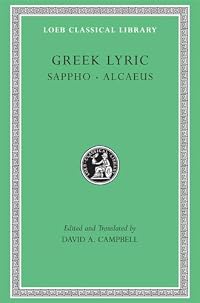
Greek Lyric, Volume I: Sappho and Alcaeus
by David A. Campbell (Translator), Alcaeus, Sappho
On This Page
Description
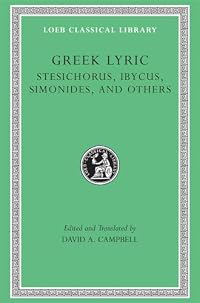
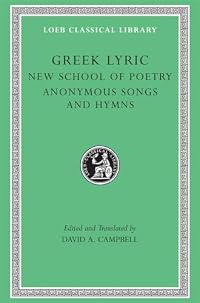
The four volumes of Greek Lyric contain the surviving fragments of solo song and choral song. This poetry was not preserved in medieval manuscripts and few complete poems remain. Later writers quoted from the poets, but only so much as suited their needs; these book-quotations are supplemented by papyrus texts found in Egypt, most of them badly damaged. The high quality of what remains makes us realize the enormity of our loss. Volume One contains the poetic fragments of the two illustrious show more singers of early sixth-century Lesbos: Sappho, the most famous woman poet of antiquity, whose main theme was love; and Alcaeus, poet of wine, war, and politics, and composer of short hymns to the gods. Also included are the principal testimonia -- the ancients' reports about the lives and work of the two poets. -- JACKET. Volume Two concludes solo lyric with Anacreon (and the Anacreontea, here given special attention) and covers choral lyric from Olympus to Alcman, including Eumelus and Terpander. Comprehensive testimonia are given, as also all papyris fragments which yield adequate sense. Bibliographies, concordance-tables, an index of names and sources, and a general index are included. The most important poets writing in Greek in the sixth century BC came from Sicily and southern Italy. Stesichorus was called by ancient writers "most Homeric"--A recognition of his epic themes and noble style. He composed verses about the Trojan War and its aftermath, the Argonauts, the adventures of Heracles. He may have been a solo singer, performing these poems to his own cithara accompaniment. Ibycus probably belonged to the colony of Rhgium in southwestern Italy. Like Stesichorus he wrote lyrical narratives on mythological themes, but he also composed erotic poems. Simonides is said to have spent his later years in Sicily. He was in Athens at the time of the Persian Wars, though, and was acclaimed for his epitaph of the Athenians who died at Marathon. He was a successful poet in various genres, including victory odes, dirges, and dithyrambic poetry. The power of his pathos emerges in the fragments we have here. All the extant verse of these poets is given in this third volume of David Campbell's edition of Greek lyric poetry along with the ancients' accounts of their lives and works. Ten contemporary poets are also included among them Arion, Lasus, and Pratinas. Bacchylides, nephew of Simonides and rival of Pindar, wrote choral poetry of many types. We have a number of his victory odes -- poems celebrating victories in athletic contests -- as well as dithyrambs and otehr hymns. He was a master of the captivating narrative. Also represented in this volume is the Boeotian Corinna, whose work, versions of local myths, survives in greater quantity than that of any other Greek Poetess except Sappho. Ancient authorities regard Corinna as an older contemporary and mentor of Pindar; but some modern scholars place her later in the third century BC. Other women are here too: Myrtis, also from Boeotia; Telesilla of Argos, famous for her military leadership as well as her hymns; the shadowy Charixena; and Praxilla of Sicyoon, author of choral poems and drinking songs. David Campbell gives all the extant verse of these poets, along with the anceints accounts of their lives and works. This fourth volume of his much-praised edition of Greek lyric poetry also includes Timocreon of Rhodes, pentathlete and wirter of invective; Diagoras of Melos, choral poet and alleged atheist; and Ion of Chios. Sophocles is represented by fragments of his paean Ascelpius, Euripides by the few surviving lines of his ode for Alcibiades' dazzling victory in the chariot race at Olympia. Towards the end of the fifth century B.C. Aristophanes and the otehr writers of comedy used contemporary poets and musicians as targets for their jokes, making fun of their innovations in language and music. The dithyrambs of Melanippides, Cinesias, Phrynis, Timotheus, and Philoxenus are remarkable examples of this new style. The poets of the new school, active from the mid-fifth to the mid-fourth century, are presented in this final volume of David Campbell's widely praised edition of Greek lyric poetry. The longest piece extant is a nome by Timotheus -- the foremost of these poets -- called The Persians; it is a florid account of the battle of Salamis, to be sung solo to cithara accompaniment. This volume also collects folk songs, drinking songs, and other anonymous pieces. The folk songs come from many parts of Greece and include children's ditties, marching songs, love songs, and snatches of culllt poetry. The drinking songs are derived mainly from Athenaeus' collection of Attic scolia, short pieces performed at after-dinner drinking parties in Athens. The anonymous pieces come from papyrus, vases, and stone as well as from literary textsssssss, and include hymns, narrative poetry, and satirical writing. -- JACKET. show lessTags
Recommendations


Member Reviews
•Greek Lyric: Sappho · Alcaeus, tr. David A Campbell, Loeb 1990
•If Not, Winter: Fragments of Sappho, tr. Anne Carson, Virago 2002
•Stung With Love: Poems and Fragments, tr. Aaron Poochigian, Penguin 2015
SAPPHICS FOR SAPPHO
Each ellipsis teases, inviting dreams – dreams
Formed from torn papyruses' single words. Bare,
Lonely scrawls of sigmas and psis that sing, still,
Sticky with meaning.
Fragments all. What's left is the one percent, rich,
Rare. When Alexandria burned, the whole world
Choked to breathe the smoke of the ninety-nine. Now,
Desperate to get you
Back, we trawl millennia-old unearthed dumps,
Hunting out your clotted Aeolic strung lines.
Lone hendecasyllables' sounds that awed Greeks
After you quoted.
Questing, reading, show more marvelling – so we search on,
Poets seeking answers to questions all lost
Lovers ask. Your answers still reach us, drenched, fresh
From the Aegean.
A LIFE IN FRAGMENTS
Towards the end of the second century AD, in the last flickering light of classical Greece, a philosopher called Maximus, in a city on the Levantine coast, wrote a grammatical textbook about figures of speech. Casting around in old books for examples of how poets have described love, he writes: ‘Diotima says that Love flourishes when he has abundance but dies when he is in need: Sappho combined these ideas and called Love bitter-sweet and “ἀλγεσίδωρον”.’
So we have this one word that Sappho wrote, some eight centuries before Maximus was born. This is what we mean when we talk about her poetry existing in ‘fragments’. The Canadian poet Anne Carson translates this example as:
171
paingiver
Very often these remnants are quoted with no regard to any poetic quality, but rather in illustration of some grammatical point. Apollonius Dyscolus, for instance, writing again some time in the 100s AD, included a throwaway remark on variant dialects during an essay on pronouns. ‘The Aeolians,’ he said, ‘spell ὅς [‘his, hers, its’] with digamma in all cases and genders, as in Sappho's τὸν ϝὸν παῖδα κάλει.’ Again Carson's translation gives us just the phrase in question:
164
she summons her son
Carson's translation of Sappho's oeuvre is well subtitled ‘Fragments of Sappho’, since most of what's left is of this nature. It's certainly nice to have everything collected in this way in English, though it must be admitted that her book sometimes seems more an exercise in completionism than in poetic expression. That said, as other reviewers have pointed out, reading pages and pages of these deracinated terms (‘holder…crossable…I might go…downrushing’) can succeed in generating a certain hypnotic, Zen-like appeal.
Nevertheless, such things lose a lot by being read in isolation; the as it were archaeological pleasure of digging them out of their original context, in works of grammar or rhetoric, is completely absent. For that, the Loeb edition translated by David A. Campbell is far preferable, for all that he has no pretensions to being a poet, just because you get Sappho delivered in that context of other writers. The fonts used for the Greek are also much more readable in the Loeb. (The Carson edition does include the original Greek, and points for that – though there are some strange editorial…choices? mistakes? – such as printing ς for σ in all positions.)
MUSIC AND LYRICS
To the Ancient Greeks, Homer was simply ‘The Poet’ – and ‘The Poetess’ was Sappho. She was held in extraordinarily high esteem, which makes it the more frustrating that so much of her has been lost: ninety-nine percent, according to some experts. Only one or two poems remain that can be said to be more or less complete.
Her poetry is mainly ‘lyric’, that is, designed to be sung while strumming along on the lyre. Sappho was, in modern terms, a singer-songwriter; she was known to be an extremely talented musician, designing a new kind of lyre and perhaps even inventing the plectrum. When we read her poetry now, we have to remember that we're looking at something like a shredded collection of Bob Dylan or Georges Brassens lyrics, with no idea of how their meaning would have interacted with the music.
But however important the lost melodies, we do know that she was revered for the beauty of her phrasing. This is something translators struggle with. Fragment 146, a proverb about not wanting to take the bad with the good, is rendered literally by Campbell as ‘I want neither the honey nor the bee’ and by Carson, ‘Neither for me honey nor the honey bee’ – which is better, but consider the alliterative dazzle of the original:
μήτε μοι μέλι μήτε μέλισσα
[mēte moi meli mēte melissa]
Reading the Greek, even if you don't understand what any of the words mean, will often get you halfway there with Sappho. Say it out loud and you'll get a tingle, as it starts to dawn on you what all the fuss might have been about.
But the rest of the job has to be done by translators. The Loeb edition will not help you here: its prose translations are only a crib to help you study the original. Carson's approach is slightly conflicted. She quotes approvingly a well-known statement from Walter Benjamin to the effect that a translation should ‘find that intended effect…which produces in it the echo of the original’, i.e. that one should translate ideas and feelings rather than words. But she also claims to be trying to use ‘where possible the same order of words and thoughts as Sappho did’, which is the sort of thing that makes me instantly suspicious.
Here's her version of Fragment 2, which is one of the more complete poems we have, scratched on to a broken piece of pottery which has miraculously survived from the second century AD. The first stanza (an invocation to Aphrodite) is probably missing, but the next two run like this:
]
here to me from Krete to this holy temple
where is your graceful grove
of apple trees and altars smoking
with frankincense.
And it in cold water makes a clear sound through
apple branches and with roses the whole place
is shadowed and down from radiant-shaking leaves
sleep comes dropping.
This is not bad. I think the word order is unnecessarily foreign at times, but it does sound good and Carson even includes a few of Sappho's famous hendecasyllabic lines – though they are not true ‘Sapphic’ verses, a very strict form which is not well adapted to English (as you may be able to tell from my attempt at the top of this review).
Aaron Poochigian, in a selected edition for Penguin Classics, takes a different approach. ‘Sappho did not compose free verse,’ he chides, perhaps with one eye on Carson, ‘and free-verse translations, however faithful they may be to her words, betray her poems by their very nature.’ Poochigian's version of the stanzas above goes like this:
Leave Crete and sweep to this blest temple
Where apple-orchard's elegance
Is yours, and smouldering altars, ample
Frankincense.
Here under boughs a bracing spring
Percolates, roses without number
Umber the earth and, rustling,
The leaves drip slumber.
I think that's pretty great. It takes much more liberties with Sappho's actual words but, to the extent that it produces a sensual thrill in English, it more faithfully reproduces the effect that Sappho had on her original audience. At least, to me it does. Poochigian's selection, called Stung with Love, is much shorter than the other two I read, but a very good encapsulation of her qualities. It also has by far the best introduction, a brilliant essay which puts Sappho in her context extremely well. And because it's the most recently published, it's also able to include the magic new Sappho poem discovered in 2013, written on a scrap of papyrus used to stuff a mummy.
BIGGER THAN A BIG MAN
‘Someone will remember us / I say / even in another time.’ Another fragment. The irony of this one upset me at first, because she should have survived in far greater quantities than she did. But even so, the thrill of hearing the voice of a woman who lived six centuries before Christ was enough to catch my breath over and over again. Generally speaking, women in antiquity are pretty silent. But Sappho isn't, and her influence, despite the meagre remains we have, is ginormous.
It might sound hyperbolic to claim that all modern love poetry is inherited from Sappho, but in fact there's a very real sense in which that's true – so great was her reputation among Classical writers and the Europeans who, in turn, studied them, that it's quite possible to trace a direct line from Sappho, through Catullus, to the Romantic poets and from them to contemporary pop lyrics. Every song about the pain of unrequited love owes something to Sappho's Fragment 31, for example – ideas now so clichéd that we forget they have an ancestry at all. That's just natural, surely – just the way people speak? But no, it isn't natural, it's Sappho. She's part of our inheritance, part of our language. She's under our tongue. show less
•If Not, Winter: Fragments of Sappho, tr. Anne Carson, Virago 2002
•Stung With Love: Poems and Fragments, tr. Aaron Poochigian, Penguin 2015
SAPPHICS FOR SAPPHO
Each ellipsis teases, inviting dreams – dreams
Formed from torn papyruses' single words. Bare,
Lonely scrawls of sigmas and psis that sing, still,
Sticky with meaning.
Fragments all. What's left is the one percent, rich,
Rare. When Alexandria burned, the whole world
Choked to breathe the smoke of the ninety-nine. Now,
Desperate to get you
Back, we trawl millennia-old unearthed dumps,
Hunting out your clotted Aeolic strung lines.
Lone hendecasyllables' sounds that awed Greeks
After you quoted.
Questing, reading, show more marvelling – so we search on,
Poets seeking answers to questions all lost
Lovers ask. Your answers still reach us, drenched, fresh
From the Aegean.
A LIFE IN FRAGMENTS
Towards the end of the second century AD, in the last flickering light of classical Greece, a philosopher called Maximus, in a city on the Levantine coast, wrote a grammatical textbook about figures of speech. Casting around in old books for examples of how poets have described love, he writes: ‘Diotima says that Love flourishes when he has abundance but dies when he is in need: Sappho combined these ideas and called Love bitter-sweet and “ἀλγεσίδωρον”.’
So we have this one word that Sappho wrote, some eight centuries before Maximus was born. This is what we mean when we talk about her poetry existing in ‘fragments’. The Canadian poet Anne Carson translates this example as:
171
paingiver
Very often these remnants are quoted with no regard to any poetic quality, but rather in illustration of some grammatical point. Apollonius Dyscolus, for instance, writing again some time in the 100s AD, included a throwaway remark on variant dialects during an essay on pronouns. ‘The Aeolians,’ he said, ‘spell ὅς [‘his, hers, its’] with digamma in all cases and genders, as in Sappho's τὸν ϝὸν παῖδα κάλει.’ Again Carson's translation gives us just the phrase in question:
164
she summons her son
Carson's translation of Sappho's oeuvre is well subtitled ‘Fragments of Sappho’, since most of what's left is of this nature. It's certainly nice to have everything collected in this way in English, though it must be admitted that her book sometimes seems more an exercise in completionism than in poetic expression. That said, as other reviewers have pointed out, reading pages and pages of these deracinated terms (‘holder…crossable…I might go…downrushing’) can succeed in generating a certain hypnotic, Zen-like appeal.
Nevertheless, such things lose a lot by being read in isolation; the as it were archaeological pleasure of digging them out of their original context, in works of grammar or rhetoric, is completely absent. For that, the Loeb edition translated by David A. Campbell is far preferable, for all that he has no pretensions to being a poet, just because you get Sappho delivered in that context of other writers. The fonts used for the Greek are also much more readable in the Loeb. (The Carson edition does include the original Greek, and points for that – though there are some strange editorial…choices? mistakes? – such as printing ς for σ in all positions.)
MUSIC AND LYRICS
To the Ancient Greeks, Homer was simply ‘The Poet’ – and ‘The Poetess’ was Sappho. She was held in extraordinarily high esteem, which makes it the more frustrating that so much of her has been lost: ninety-nine percent, according to some experts. Only one or two poems remain that can be said to be more or less complete.
Her poetry is mainly ‘lyric’, that is, designed to be sung while strumming along on the lyre. Sappho was, in modern terms, a singer-songwriter; she was known to be an extremely talented musician, designing a new kind of lyre and perhaps even inventing the plectrum. When we read her poetry now, we have to remember that we're looking at something like a shredded collection of Bob Dylan or Georges Brassens lyrics, with no idea of how their meaning would have interacted with the music.
But however important the lost melodies, we do know that she was revered for the beauty of her phrasing. This is something translators struggle with. Fragment 146, a proverb about not wanting to take the bad with the good, is rendered literally by Campbell as ‘I want neither the honey nor the bee’ and by Carson, ‘Neither for me honey nor the honey bee’ – which is better, but consider the alliterative dazzle of the original:
μήτε μοι μέλι μήτε μέλισσα
[mēte moi meli mēte melissa]
Reading the Greek, even if you don't understand what any of the words mean, will often get you halfway there with Sappho. Say it out loud and you'll get a tingle, as it starts to dawn on you what all the fuss might have been about.
But the rest of the job has to be done by translators. The Loeb edition will not help you here: its prose translations are only a crib to help you study the original. Carson's approach is slightly conflicted. She quotes approvingly a well-known statement from Walter Benjamin to the effect that a translation should ‘find that intended effect…which produces in it the echo of the original’, i.e. that one should translate ideas and feelings rather than words. But she also claims to be trying to use ‘where possible the same order of words and thoughts as Sappho did’, which is the sort of thing that makes me instantly suspicious.
Here's her version of Fragment 2, which is one of the more complete poems we have, scratched on to a broken piece of pottery which has miraculously survived from the second century AD. The first stanza (an invocation to Aphrodite) is probably missing, but the next two run like this:
]
here to me from Krete to this holy temple
where is your graceful grove
of apple trees and altars smoking
with frankincense.
And it in cold water makes a clear sound through
apple branches and with roses the whole place
is shadowed and down from radiant-shaking leaves
sleep comes dropping.
This is not bad. I think the word order is unnecessarily foreign at times, but it does sound good and Carson even includes a few of Sappho's famous hendecasyllabic lines – though they are not true ‘Sapphic’ verses, a very strict form which is not well adapted to English (as you may be able to tell from my attempt at the top of this review).
Aaron Poochigian, in a selected edition for Penguin Classics, takes a different approach. ‘Sappho did not compose free verse,’ he chides, perhaps with one eye on Carson, ‘and free-verse translations, however faithful they may be to her words, betray her poems by their very nature.’ Poochigian's version of the stanzas above goes like this:
Leave Crete and sweep to this blest temple
Where apple-orchard's elegance
Is yours, and smouldering altars, ample
Frankincense.
Here under boughs a bracing spring
Percolates, roses without number
Umber the earth and, rustling,
The leaves drip slumber.
I think that's pretty great. It takes much more liberties with Sappho's actual words but, to the extent that it produces a sensual thrill in English, it more faithfully reproduces the effect that Sappho had on her original audience. At least, to me it does. Poochigian's selection, called Stung with Love, is much shorter than the other two I read, but a very good encapsulation of her qualities. It also has by far the best introduction, a brilliant essay which puts Sappho in her context extremely well. And because it's the most recently published, it's also able to include the magic new Sappho poem discovered in 2013, written on a scrap of papyrus used to stuff a mummy.
BIGGER THAN A BIG MAN
‘Someone will remember us / I say / even in another time.’ Another fragment. The irony of this one upset me at first, because she should have survived in far greater quantities than she did. But even so, the thrill of hearing the voice of a woman who lived six centuries before Christ was enough to catch my breath over and over again. Generally speaking, women in antiquity are pretty silent. But Sappho isn't, and her influence, despite the meagre remains we have, is ginormous.
It might sound hyperbolic to claim that all modern love poetry is inherited from Sappho, but in fact there's a very real sense in which that's true – so great was her reputation among Classical writers and the Europeans who, in turn, studied them, that it's quite possible to trace a direct line from Sappho, through Catullus, to the Romantic poets and from them to contemporary pop lyrics. Every song about the pain of unrequited love owes something to Sappho's Fragment 31, for example – ideas now so clichéd that we forget they have an ancestry at all. That's just natural, surely – just the way people speak? But no, it isn't natural, it's Sappho. She's part of our inheritance, part of our language. She's under our tongue. show less
Good and thorough treatment, but how little remains: mere scraps, mostly incomplete pieces, in the vast majority simply isolated lines in quotation, and even then tattered and lacunose. What can philology do but sweep up stale crumbs? Immortality sought in word is not as certain as we may hope. Still, some immortality has been gained by reputation alone; yet, what is the worth of it without a voice to justify it?
A beautiful book that I carry everywhere. Even the fragments of Sappho's poetry are memorable. She used words in a subtle, surprising way and was rightly regarded as the 'tenth Muse'.
Ratings
Members
- Recently Added By
Lists

In Our Time books
4,934 works; 2 members
Author Information
14+ Works 258 Members

206+ Works 6,701 Members
Sappho, whom Plato (see Vols. 3 and 4) called "the tenth Muse," was the greatest of the early Greek lyric poets. She was born at Mytilene on Lesbos and was a member---perhaps the head---of a group of women who honored the Muses and Aphrodite. Her family was aristocratic; it is said that she was married and had a daughter. Her brilliant love show more lyrics, marriage songs, and hymns to the gods are written in Aeolic dialect in many meters, one of which is named for her---the Sapphic. Mostly fragments survive of the nine books she is thought to have authored. Her verse is simple and direct, exquisitely passionate and vivid. Catullus, Ovid, and Swinburne (see Vol. 1) were among the many later poets she influenced. (Bowker Author Biography) show less
Series
Belongs to Publisher Series
Loeb Classical Library (142N)
Common Knowledge
- Canonical title
- Greek Lyric, Volume I: Sappho and Alcaeus
Classifications
Statistics
- Members
- 200
- Popularity
- 162,815
- Reviews
- 3
- Rating
- (3.89)
- Languages
- English, Greek (Ancient)
- Media
- Paper, Ebook
- ISBNs
- 3
- ASINs
- 2