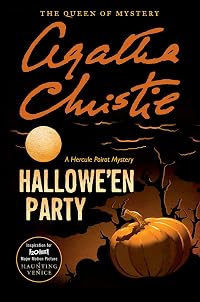
On This Page
Description
When a Halloween Party turns deadly, it falls to Hercule Poirots to unmask a murderer in Agatha Christie's classic murder mystery, Hallowe'en Party. At a Halloween party, Joyce--a hostile thirteen-year-old--boasts that she once witnessed a murder. When no one believes her, she storms off home. But within hours her body is found, still in the house, drowned in an apple-bobbing tub. That night, Hercule Poirot is called in to find the `evil presence'. But first he must establish whether he is show more looking for a murderer or a double-murderer... show lessTags
Recommendations













Member Reviews
Hmm. This is a hard book to rate because, while it clearly demonstrates Christie's reach exceeding her grasp, it's also demonstrably more interesting because of that. Late-stage Christie is always an odd stew, because her razor-sharp capacity for puzzle box mysteries is obviously declining, but at the same time, she's trying to meet modern trends. In fact, she almost seems to relish them.
Having recently read (well, heard) "Cat Among the Pigeons" and "The Clocks," I was struck by not only how much Christie seems to be tired of mysteries at this point, but that she seems to be wanting to write about the dark side of human psychology. Could Christie have written a Patricia Highsmith-style thriller? It seems doubtful - but there are long show more stretches of "The Clocks" that play out exactly like a Hitchcock film, all gossipy people with their everyday human callousness. There's a lot of humor in that book and most of it is very dark. The tone works, even if the mystery fizzles out.
"Hallowe'en Party," in contrast, isn't very funny at all. It's terrifying - or it wants to be, anyway. This is Christie's attempt at a new, visceral, earthy kind of horror, one in which children are just as likely to be murdered as adults and some may even go willingly as sacrifices. Knowing this book came out in 1969, it's impossible not to see it trying to ride the crest of grisly, sometimes sacrilegious British horror that popped right at the end of the '60s and into the '70s.
That's not to say Christie entirely gets away with it. She doesn't, and not just because she leaves a few loose ends. You can't go halfway with this kind of horror-thriller, and I Christie's upbringing just won't let her get down in the dirt enough to give it enough welly. She's too old-fashioned; she's too genteel. She has basically all the problems attributed to Hercule Poirot and his great age in this novel (and maybe that's the point).
Having said that, it's nice to see Poirot take part in the entire novel again, even if he seems to wander a little aimlessly sometimes. Ariadne Oliver isn't *too* irritating, either. And while other reviewers have commented on the repetitive nature of the dialogue, that didn't bother me much.
As usual, I listened to Hugh Fraser read this one in my ears: calm and serenity personified. If you're going to experience "lesser later" Christie, this is the best way to do it. show less
Having recently read (well, heard) "Cat Among the Pigeons" and "The Clocks," I was struck by not only how much Christie seems to be tired of mysteries at this point, but that she seems to be wanting to write about the dark side of human psychology. Could Christie have written a Patricia Highsmith-style thriller? It seems doubtful - but there are long show more stretches of "The Clocks" that play out exactly like a Hitchcock film, all gossipy people with their everyday human callousness. There's a lot of humor in that book and most of it is very dark. The tone works, even if the mystery fizzles out.
"Hallowe'en Party," in contrast, isn't very funny at all. It's terrifying - or it wants to be, anyway. This is Christie's attempt at a new, visceral, earthy kind of horror, one in which children are just as likely to be murdered as adults and some may even go willingly as sacrifices. Knowing this book came out in 1969, it's impossible not to see it trying to ride the crest of grisly, sometimes sacrilegious British horror that popped right at the end of the '60s and into the '70s.
That's not to say Christie entirely gets away with it. She doesn't, and not just because she leaves a few loose ends. You can't go halfway with this kind of horror-thriller, and I Christie's upbringing just won't let her get down in the dirt enough to give it enough welly. She's too old-fashioned; she's too genteel. She has basically all the problems attributed to Hercule Poirot and his great age in this novel (and maybe that's the point).
Having said that, it's nice to see Poirot take part in the entire novel again, even if he seems to wander a little aimlessly sometimes. Ariadne Oliver isn't *too* irritating, either. And while other reviewers have commented on the repetitive nature of the dialogue, that didn't bother me much.
As usual, I listened to Hugh Fraser read this one in my ears: calm and serenity personified. If you're going to experience "lesser later" Christie, this is the best way to do it. show less
''The past is the father of the present.
The ''crime'' writers who write like Christie are few. The ones who try to write mysteries similar to her own are non-existent. I may sound harsh, but those who struggle to imitate her should take a step back and reconsider. And why is that? Because she understood, embraced and elevated to a whole new level the implications of the past when facing the present. As horrible as a present situation may be, the roots of all evil lie in the deeds of the past. This is present to every work of the Queen of Crime. In my opinion, ''Hallowe'en Party'' delivers this notion in a highly atmospheric manner and presents one of the most elaborate crimes Agatha ever delivered.
13 year old Joyce, a little busybody show more who wants to be in the centre of attention, is found murdered in a tub filled with apples, in a twisted apple-bobbing game on Halloween. Hercule and the wonderful Ariadne Oliver are called to solve the crime. In this work, sexual passion and obsession are the motives that guide each suspect and there is a plethora of fascinating stories of people attracted to beauty, vice and a twisted notion of love. Agatha creates a unique atmosphere, with prominent descriptions of the Halloween festivities, the beautiful garden, the temptations that guide the characters to questionable deeds. The snapdragon scene, a haunting game that isn't included in many works of Fiction, is among my favourites in all of Christie's novels and stories. Not to mention that I love Ariadne to pieces. I think she's an exciting character on her own and the proper equivalent to our beloved Hercule. And, naturally, the ITV film production was perfect, despite some deviations from the novel.
If you want to experience Halloween through Crime Fiction, don't look further. ''Hallowe'en Party'' is just what you want, with a healthy dose of good old British mystery. Can't get any more perfect than that... show less
The ''crime'' writers who write like Christie are few. The ones who try to write mysteries similar to her own are non-existent. I may sound harsh, but those who struggle to imitate her should take a step back and reconsider. And why is that? Because she understood, embraced and elevated to a whole new level the implications of the past when facing the present. As horrible as a present situation may be, the roots of all evil lie in the deeds of the past. This is present to every work of the Queen of Crime. In my opinion, ''Hallowe'en Party'' delivers this notion in a highly atmospheric manner and presents one of the most elaborate crimes Agatha ever delivered.
13 year old Joyce, a little busybody show more who wants to be in the centre of attention, is found murdered in a tub filled with apples, in a twisted apple-bobbing game on Halloween. Hercule and the wonderful Ariadne Oliver are called to solve the crime. In this work, sexual passion and obsession are the motives that guide each suspect and there is a plethora of fascinating stories of people attracted to beauty, vice and a twisted notion of love. Agatha creates a unique atmosphere, with prominent descriptions of the Halloween festivities, the beautiful garden, the temptations that guide the characters to questionable deeds. The snapdragon scene, a haunting game that isn't included in many works of Fiction, is among my favourites in all of Christie's novels and stories. Not to mention that I love Ariadne to pieces. I think she's an exciting character on her own and the proper equivalent to our beloved Hercule. And, naturally, the ITV film production was perfect, despite some deviations from the novel.
If you want to experience Halloween through Crime Fiction, don't look further. ''Hallowe'en Party'' is just what you want, with a healthy dose of good old British mystery. Can't get any more perfect than that... show less
My wife checked this out of the library the other day and as soon as she mentioned it, I remembered being obsessed with this book when I was a preteen, maybe 10 or 11, a little bit younger than the book's main murder victim. But it was clear from our discussions that I only remembered very specific pieces of the book (the party itself, Ariadne Oliver, Miranda). In particular, I remembered preteen me being fascinated by the realization that many of Mrs. Oliver's speeches are clearly the author talking through the character's mouth. (It was the first time I recognized that.) Since my memory didn't have much more in it than that, I read this after my wife was done.
I'm sorry, ten year old me: this book is. Well. Bad. For one thing, Christie show more isn't just talking through Mrs. Oliver's mouth. Almost every adult character in this prates on for pages about how there are definitely all these psychopaths murdering people constantly and it's the fault of people not being hanged and not getting lengthy prison terms anymore. They all hold precisely the same opinions and talk in precisely the same way, even characters you really wouldn't expect to do that. It's jarringly weird and dull.
Also, everyone interviewed by Poirot talks about the *child* who has been murdered by listing off all her faults: she was such a liar, gosh, just a terrible girl, couldn't trust a word she said, and not very bright or interesting. No one shows any regret over the murder that happened while they were grabbing burning raisins with their bare hands, and only one person has anything nice to say about the victim.
The net effect is that almost every character in this book seems to be made of cardboard and the reader spends far too much time listening to Old Woman Yelling at Clouds (Through Her Characters). The mystery itself was fine, but gosh this is not one of Christie's better books. show less
I'm sorry, ten year old me: this book is. Well. Bad. For one thing, Christie show more isn't just talking through Mrs. Oliver's mouth. Almost every adult character in this prates on for pages about how there are definitely all these psychopaths murdering people constantly and it's the fault of people not being hanged and not getting lengthy prison terms anymore. They all hold precisely the same opinions and talk in precisely the same way, even characters you really wouldn't expect to do that. It's jarringly weird and dull.
Also, everyone interviewed by Poirot talks about the *child* who has been murdered by listing off all her faults: she was such a liar, gosh, just a terrible girl, couldn't trust a word she said, and not very bright or interesting. No one shows any regret over the murder that happened while they were grabbing burning raisins with their bare hands, and only one person has anything nice to say about the victim.
The net effect is that almost every character in this book seems to be made of cardboard and the reader spends far too much time listening to Old Woman Yelling at Clouds (Through Her Characters). The mystery itself was fine, but gosh this is not one of Christie's better books. show less
In my mind, courtesy of all those Miss Marple and Poirot TV series, I think of Agatha Christie as writing contemporaneously about England between the wars, still hanging on to its empire and with upper-class privilege unchallenged.
In reality, Agatha Christie continued to publish crime novel into the mid-1970s.
I was shocked to realise that, when this book was published in 1969, I would have been of an age to attend the children's Halloween party that the book starts with.
Yet Poirot is still there. An older dies-his-hair-to-keep-it-black Poirot, now on his thirty-ninth fiction outing. He is brought into this case by Adriadne Walker, crime writer a sort of fictional twin for Agatha Christie herself. Both of them are clearly creatures from show more an earlier age, (a phenomenon I am becoming personally acquainted with as a plod on into my sixties). They, and the older characters around them, spend a great deal of time discussing how times have changed for the worse.
There are recurring laments about the mentally ill being let loose to threaten the populace because the asylums are too full; about the sad loss of the death penalty as a deterrent to "wronguns"; about young women who, no longer protected by their families, place themselves at risk by venturing out alone and being attracted to the wrong kind of man; by the rise to normalcy of sexual assaults on children and the inappropriateness of empathy in magistrates which results in mercy taking precedence over justice.
At times, I felt as if I had wandered into an editorial from the Daily Mail.
"The Halloween Party" has what these days I'd think of as a post-episode-100 feel, when a TV series is stocked with characters we know so well that there is nothing new that they can do but we enjoy watching them do it anyway. The pace is leisurely. We gently trotted through the evidence gathering as Poirot interviewed the people who were at the Halloween Party in which a child was drowned in an apple-bobbing bucket. I was surprised at the way this death was treated - as if it were not so much a tragedy as a slightly embarrassing inconvenience. This turned out to be a plot device of sorts but it fitted into the emotional climate of the community so well that I didn't realise that until later. As we reach the denouement we do have to canter a bit and there is some physical action, although it does not, of course, involve the elderly Belgian gentleman with the big moustaches and the too-tightly-fitting patent leather shoes.
Beneath the culture-shocked social commentary and the only slightly muted patronising of those who live in "the kind of new houses that ordinary people can afford" there is a quite respectable plot, involving forgery, deception, murder and a lethal form of narcissism that was quite chilling.
What stood out for me was how well some of the children were drawn although they seemed rather old-fashioned children for the times. It also seemed to me that all the energy of this book came from the women. The men were little more than plot devices but I was left seeing the women as powerhouses of energy looking for an outlet.
I rather liked Adriadne and I found Poirot's small vanities combined with his controlled compassion rather endearing.
Hugh Fraser narrated the novel, with his, to my ear, perfect mimicry of David Suchet's Poirot and gaveAdriadne a voice that invoked the ghost of a slightly higher pitched Margaret Rutherford.
This is a comfortable mystery, despite its grim content. I enjoyed it as much for its timely reminder of unrepentantly Tory views on English life and morals were (are?) like and for its insights into how the old can fail truly to see the world the young live in as for the mystery itself show less
In reality, Agatha Christie continued to publish crime novel into the mid-1970s.
I was shocked to realise that, when this book was published in 1969, I would have been of an age to attend the children's Halloween party that the book starts with.
Yet Poirot is still there. An older dies-his-hair-to-keep-it-black Poirot, now on his thirty-ninth fiction outing. He is brought into this case by Adriadne Walker, crime writer a sort of fictional twin for Agatha Christie herself. Both of them are clearly creatures from show more an earlier age, (a phenomenon I am becoming personally acquainted with as a plod on into my sixties). They, and the older characters around them, spend a great deal of time discussing how times have changed for the worse.
There are recurring laments about the mentally ill being let loose to threaten the populace because the asylums are too full; about the sad loss of the death penalty as a deterrent to "wronguns"; about young women who, no longer protected by their families, place themselves at risk by venturing out alone and being attracted to the wrong kind of man; by the rise to normalcy of sexual assaults on children and the inappropriateness of empathy in magistrates which results in mercy taking precedence over justice.
At times, I felt as if I had wandered into an editorial from the Daily Mail.
"The Halloween Party" has what these days I'd think of as a post-episode-100 feel, when a TV series is stocked with characters we know so well that there is nothing new that they can do but we enjoy watching them do it anyway. The pace is leisurely. We gently trotted through the evidence gathering as Poirot interviewed the people who were at the Halloween Party in which a child was drowned in an apple-bobbing bucket. I was surprised at the way this death was treated - as if it were not so much a tragedy as a slightly embarrassing inconvenience. This turned out to be a plot device of sorts but it fitted into the emotional climate of the community so well that I didn't realise that until later. As we reach the denouement we do have to canter a bit and there is some physical action, although it does not, of course, involve the elderly Belgian gentleman with the big moustaches and the too-tightly-fitting patent leather shoes.
Beneath the culture-shocked social commentary and the only slightly muted patronising of those who live in "the kind of new houses that ordinary people can afford" there is a quite respectable plot, involving forgery, deception, murder and a lethal form of narcissism that was quite chilling.
What stood out for me was how well some of the children were drawn although they seemed rather old-fashioned children for the times. It also seemed to me that all the energy of this book came from the women. The men were little more than plot devices but I was left seeing the women as powerhouses of energy looking for an outlet.
I rather liked Adriadne and I found Poirot's small vanities combined with his controlled compassion rather endearing.
Hugh Fraser narrated the novel, with his, to my ear, perfect mimicry of David Suchet's Poirot and gaveAdriadne a voice that invoked the ghost of a slightly higher pitched Margaret Rutherford.
This is a comfortable mystery, despite its grim content. I enjoyed it as much for its timely reminder of unrepentantly Tory views on English life and morals were (are?) like and for its insights into how the old can fail truly to see the world the young live in as for the mystery itself show less
An Enjoyable Late Hercule Poirot Mystery
When reviewing a work, I ignore other adaptations unless necessary, but here, it is necessary, because the newest editions of this novel have been published under the title A Haunting in Venice rather than its original, Halowe'en Party. This is what's called "cross-marketing" for the 2023 film, but it's silly, because the original has no haunting - not even of the Scooby-Doo variety - and the setting is not Venice. There is, however, a Halowe'en party. There is also at least one murder, which Agatha Christie's iconic detective Hercule Poirot and his sometimes sidekick Ariadne Oliver - whom I greatly prefer to the pale John Watson imitation Arthur Hastings - must solve. Those are the only show more similarities with the film, which is an otherwise original script inspired solely by the title of the novel, which it doesn't use.
Poirot novels don't need cross-marketing. They're like Snickers bars: Most people have had one before, and the ones who liked their last one will probably like this one, and the ones who didn't much like it before won't much like this one now. To be sure, there are also Snickers connoisseurs who savor and review each bite individually, but for casual fans like me, a Snickers bar is a Snickers bar with very little variation, and it's a reliably enjoyable treat. It's also unlikely Hallowe'en Party would be any reader's first Poirot novel, because even those introduced to the character through the recent film series would presumably start with the far more famous and far more faithfully adapted Murder on the Orient Express (1934) or Death on the Nile (1937) as the film series does.
Connoisseurs may not like this novel as much because it was written and published in 1969, at the end of a decade that saw a general decline in popularity of the prim and proper locked-room British whodunits that were the character's and his creator's natural habitat of their interwar heyday. The series and its characters are showing their age, and frequent references are made to these darned kids today and their pop star fashions and sociopathic serial killers. In this "brave new world," Poirot and Christie with their lists of suspects and murders committed for love and/or money are the literary equivalent of an old pair of slippers, and just as welcome when enjoyed with a pot of hot tea by the fireplace on a cold autumn evening.
[For more on this series, see also my review of Death on the Nile (1937).] show less
When reviewing a work, I ignore other adaptations unless necessary, but here, it is necessary, because the newest editions of this novel have been published under the title A Haunting in Venice rather than its original, Halowe'en Party. This is what's called "cross-marketing" for the 2023 film, but it's silly, because the original has no haunting - not even of the Scooby-Doo variety - and the setting is not Venice. There is, however, a Halowe'en party. There is also at least one murder, which Agatha Christie's iconic detective Hercule Poirot and his sometimes sidekick Ariadne Oliver - whom I greatly prefer to the pale John Watson imitation Arthur Hastings - must solve. Those are the only show more similarities with the film, which is an otherwise original script inspired solely by the title of the novel, which it doesn't use.
Poirot novels don't need cross-marketing. They're like Snickers bars: Most people have had one before, and the ones who liked their last one will probably like this one, and the ones who didn't much like it before won't much like this one now. To be sure, there are also Snickers connoisseurs who savor and review each bite individually, but for casual fans like me, a Snickers bar is a Snickers bar with very little variation, and it's a reliably enjoyable treat. It's also unlikely Hallowe'en Party would be any reader's first Poirot novel, because even those introduced to the character through the recent film series would presumably start with the far more famous and far more faithfully adapted Murder on the Orient Express (1934) or Death on the Nile (1937) as the film series does.
Connoisseurs may not like this novel as much because it was written and published in 1969, at the end of a decade that saw a general decline in popularity of the prim and proper locked-room British whodunits that were the character's and his creator's natural habitat of their interwar heyday. The series and its characters are showing their age, and frequent references are made to these darned kids today and their pop star fashions and sociopathic serial killers. In this "brave new world," Poirot and Christie with their lists of suspects and murders committed for love and/or money are the literary equivalent of an old pair of slippers, and just as welcome when enjoyed with a pot of hot tea by the fireplace on a cold autumn evening.
[For more on this series, see also my review of Death on the Nile (1937).] show less
While some of Agatha Christie’s mysteries remain immensely satisfying, there are a few that just don’t work, whether from cultural shift or a more experimental approach. I was worried when I picked up Hallowe’en Party; I had been operating with a suspicion that her best work was earlier in her extensive career. However, it wasn’t long before my concern was dismissed as I settled into an engrossing tale of Hercule Poirot investigating a murder at a Halloween party.
Poor Joyce; thirteen and a bit desperate for attention, she’s become known for telling tales. Perhaps hoping to impress Mrs. Oliver during the preparations for a Halloween party, she claims to have seen a murder. When the Halloween party is over, Joyce is discovered show more dead, but only Mrs. Oliver connects the earlier boast to the death–the rest of the village is prefers to blame an anonymous unstable person. She calls on dear, aging Hercule. He concurs with her fine instincts and arranges to stay with retired Inspector Spence, coincidentally living in the same village.
Hercule focuses on Jane’s tall tale, convinced the solution lies in the past. He digs into the history of the village; a disappearing au pair girl, a wealthy widow who died unexpectedly, a forger who was stabbed, a man killed in a hit-and-run, a strangled girl in a gravel pit. As he talks with the villagers, the ominous atmosphere increases.
Almost everything about the book is lovely. The writing shines, the characters are complex. Christie can paint a portrait in only a few sentences: “His friend, Mrs. Oliver, sounded in a highly excitable condition. Whatever was the matter with her, she would no doubt spend a very long time pouring out her grievances, her woes, her frustrations or whatever was ailing her…The things that excited Mrs. Oliver were so numerous and frequently so unexpected that one had to be careful how one embarked upon a discussion of them.”
The atmosphere is sinister, and the setting feels fully realized, although I still don’t understand why snap-dragon would be the capstone to a children’s party. Once again Mrs. Oliver serves as a authorial voice, particularly when Hercule notes how an author tends to co-opt characters from real people. Her bits calling out Hercule are particularly amusing:
“The trouble with you is,” said Mrs. Oliver…”the trouble with you is that you insist on being smart. You mind more about your clothes and your moustaches and how you look and what you wear than comfort. Now comfort is really the great thing. Once you’ve passed, say, fifty, comfort is the only thing that matters.”
Straight from the mouth of a seventy-nine year old.
An excellent read, and well worth re-reading. show less
Poor Joyce; thirteen and a bit desperate for attention, she’s become known for telling tales. Perhaps hoping to impress Mrs. Oliver during the preparations for a Halloween party, she claims to have seen a murder. When the Halloween party is over, Joyce is discovered show more dead, but only Mrs. Oliver connects the earlier boast to the death–the rest of the village is prefers to blame an anonymous unstable person. She calls on dear, aging Hercule. He concurs with her fine instincts and arranges to stay with retired Inspector Spence, coincidentally living in the same village.
Hercule focuses on Jane’s tall tale, convinced the solution lies in the past. He digs into the history of the village; a disappearing au pair girl, a wealthy widow who died unexpectedly, a forger who was stabbed, a man killed in a hit-and-run, a strangled girl in a gravel pit. As he talks with the villagers, the ominous atmosphere increases.
Almost everything about the book is lovely. The writing shines, the characters are complex. Christie can paint a portrait in only a few sentences: “His friend, Mrs. Oliver, sounded in a highly excitable condition. Whatever was the matter with her, she would no doubt spend a very long time pouring out her grievances, her woes, her frustrations or whatever was ailing her…The things that excited Mrs. Oliver were so numerous and frequently so unexpected that one had to be careful how one embarked upon a discussion of them.”
The atmosphere is sinister, and the setting feels fully realized, although I still don’t understand why snap-dragon would be the capstone to a children’s party. Once again Mrs. Oliver serves as a authorial voice, particularly when Hercule notes how an author tends to co-opt characters from real people. Her bits calling out Hercule are particularly amusing:
“The trouble with you is,” said Mrs. Oliver…”the trouble with you is that you insist on being smart. You mind more about your clothes and your moustaches and how you look and what you wear than comfort. Now comfort is really the great thing. Once you’ve passed, say, fifty, comfort is the only thing that matters.”
Straight from the mouth of a seventy-nine year old.
An excellent read, and well worth re-reading. show less
DNF Honestly A Haunting in Venice makes better use of the Halloween setting than this does. The Halloween party is merely the scenery around which a murder is committed, and the investigation neither suggests nor reveals any substantial Halloween-related curiosities. It might as well have taken place at a New Year’s party, or anything else. And there’s way, way too much useless exposition. Poirot’s method just seems to repeat itself in the dullest way possible chapter by chapter. There’s an unfortunate perfunctory feel to the story’s development—here’s some information, and here’s some more, and here’s some more, and here’s the killer. And the end. The movie provides some motivation of pride to Poirot’s show more investigation, and this one only acknowledges how uninteresting its mystery is to him without giving him a reason to care along the way. I don’t even particularly like the movie but at least it seemed interested in telling its spooky tale. Christie seems bored by this book and the only thing that aroused her passion was pearl-clutching about modern life and “kids these days.” A waste of time! (p126, skimmed to end) show less
Members
- Recently Added By
Lists

British Mystery
469 works; 14 members

Crime and Mysteries to Read
746 works; 31 members

Agatha Christie Poirot
43 works; 2 members

Books About Murder
313 works; 7 members

Favorite Books from the 1960s
34 works; 3 members

Detective Stories
343 works; 5 members

Books Read in 2026
1,912 works; 66 members

Books Read in 2025
4,091 works; 97 members

Books Read in 2024
4,623 works; 126 members

TBR
77 works; 1 member

Horror Spotlight Readalong Buddy Reads
14 works; 1 member

Books Read in 2023
5,547 works; 145 members

Halloween Stories
31 works; 5 members

Books Read in 2022
5,166 works; 112 members

Books Read in 2020
4,379 works; 123 members

Books Read in 2019
4,052 works; 110 members

Authors from England
147 works; 4 members

Elevenses
316 works; 88 members

Chronological 2015
39 works; 1 member

Agatha Christie Chronology
93 works; 1 member
Author Information

2,150+ Works 439,851 Members
One of the most successful and beloved writer of mystery stories, Agatha Mary Clarissa Christie was born in 1890 in Torquay, County Devon, England. She wrote her first novel, The Mysterious Affair at Styles, in 1920, launching a literary career that spanned decades. In her lifetime, she authored 79 crime novels and a short story collection, 19 show more plays, and six novels written under the name of Mary Westmacott. Her books have sold over a billion copies in the English language with another billion in 44 foreign languages. Some of her most famous titles include Murder on the Orient Express, Mystery of the Blue Train, And Then There Were None, 13 at Dinner and The Sittaford Mystery. Noted for clever and surprising twists of plot, many of Christie's mysteries feature two unconventional fictional detectives named Hercule Poirot and Miss Jane Marple. Poirot, in particular, plays the hero of many of her works, including the classic, The Murder of Roger Ackroyd (1926), and Curtain (1975), one of her last works in which the famed detective dies. Over the years, her travels took her to the Middle East where she met noted English archaeologist Sir Max Mallowan. They married in 1930. Christie accompanied Mallowan on annual expeditions to Iraq and Syria, which served as material for Murder in Mesopotamia (1930), Death on the Nile (1937), and Appointment with Death (1938). Christie's credits also include the plays, The Mousetrap and Witness for the Prosecution (1953; film 1957). Christie received the New York Drama Critics' Circle Award for 1954-1955 for Witness. She was also named Dame Commander of the Order of the British Empire in 1971. Christie died in 1976. (Bowker Author Biography) show less
Some Editions
Awards and Honors
Notable Lists
Series


Belongs to Publisher Series
Work Relationships
Is contained in
Has the adaptation
Inspired
Common Knowledge
- Canonical title
- Hallowe'en Party
- Original title
- Hallowe'en party
- Alternate titles
- Halloween Party
- Original publication date
- 1969
- People/Characters
- Hercule Poirot; Ariadne Oliver; Judith Butler; Miranda Butler; Michael Garfield; Superintendent Spence
- Important places
- Woodleigh Common, England, UK
- Important events
- Halloween
- Related movies
- "Agatha Christie: Poirot" Hallowe'en Party (2009 | IMDb); A Haunting in Venice (2023 | IMDb)
- Dedication
- To P. G. Wodehouse
whose books and stories have brightened my
life for many years. Also to show my pleasure
in his having be... (show all)en kind enough to tell me
that he enjoys my books - First words
- Mrs. Ariadne Oliver had gone with the friend with whom she was staying, Judith Butler, to help with the preparations for a children's party which was to take place that same evening.
- Quotations
- (Judith Butler on teenage parties:) "Peculiar drugs and – what do they call it? – Flower Pot or Purple Hemp or L.S.D., which I always have thought just meant money, but apparently it doesn't."
"I suppose it costs it," ... (show all)suggested Ariadne Oliver. - Last words
- (Click to show. Warning: May contain spoilers.)"That's right," said Mrs. Oliver in an exasperated voice, "blame it all on me as usual!"
- Original language
- English
Classifications
Statistics
- Members
- 5,859
- Popularity
- 2,212
- Reviews
- 146
- Rating
- (3.50)
- Languages
- 25 — Bulgarian, Czech, Danish, Dutch, English, Estonian, Finnish, French, German, Greek, Hungarian, Indonesian, Italian, Japanese, Norwegian (Bokmål), Norwegian, Polish, Romanian, Serbian, Croatian, Slovenian, Spanish, Swedish, Turkish, Portuguese (Portugal)
- Media
- Paper, Audiobook, Ebook
- ISBNs
- 179
- UPCs
- 2
- ASINs
- 78