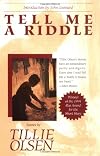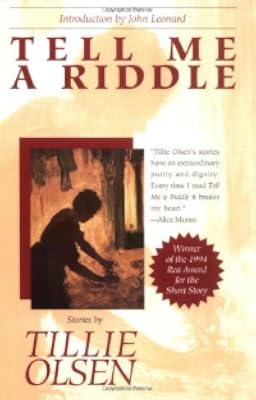
Tell Me a Riddle
by Tillie Olsen
On This Page
Description
This collection of four stories, "I Stand Here Ironing," "Hey Sailor, what Ship?," "O Yes," and "Tell me a Riddle," had become an American classic. Since the title novella won the O. Henry Award in 1961, the stories have been anthologized over a hundred times, made into three films, translated into thirteen languages, and - most important - once read, they abide in the hearts of their readers.Tags
Recommendations

















Member Recommendations
Member Reviews
In my continuing attempt to read things with some Nebraska connection, and also (mostly) in honor of Olsen's passing at the beginning of the year, I thought I would read something from her. It turns out that this is really her only completed book of fiction, so I suppose it's not unusual that this is the one I would settle on. Having read the book, in any case, there is one thing I can say for sure: Holy hell, this woman could write. I'm not sure I've ever read a more powerful collection of stories. She has an incredibly tight grip on the human psyche, and from the very first page she takes you exactly where she wants you to go. Not to say that the writing is manipulative. It's just so evocative and compelling. If you don't cry while show more reading this book, you're not human. When I finished the last (and most gripping) story, I was physically unable to rise from the chair.
In case you hadn't guessed, this isn't a real light, cheery book. This may give you some sense: I found myself thinking, throughout the book, that Olsen is the writer Annie Proulx wishes she could be. There are several significant differences between the two (not least that Olsen is simply a better writer), but the one that stands out for me most now that I've finished the book is that Olsen's writing—while every bit as depressing as Proulx's—has more to it. After reading Annie Proulx, you get this feeling that someone has just drug you to the ground and kicked the hell out of you for no good reason. With Olsen, on the other hand, it's more like you've spent time with an angel, or even a god, who has managed to illuminate for you some of the inner workings of the world and the human mind. There is a sadness which suffuses the book, but that's not its goal.
I'm not sure why I'm spending so much time comparing these two authors, in any case. But there you go. show less
In case you hadn't guessed, this isn't a real light, cheery book. This may give you some sense: I found myself thinking, throughout the book, that Olsen is the writer Annie Proulx wishes she could be. There are several significant differences between the two (not least that Olsen is simply a better writer), but the one that stands out for me most now that I've finished the book is that Olsen's writing—while every bit as depressing as Proulx's—has more to it. After reading Annie Proulx, you get this feeling that someone has just drug you to the ground and kicked the hell out of you for no good reason. With Olsen, on the other hand, it's more like you've spent time with an angel, or even a god, who has managed to illuminate for you some of the inner workings of the world and the human mind. There is a sadness which suffuses the book, but that's not its goal.
I'm not sure why I'm spending so much time comparing these two authors, in any case. But there you go. show less
The 4 stories in this book are full of the stuff of real life: family, love, poverty, hunger, alcoholism, racism, growing up, and much more. Olsen uses dialogue distinctively to depict the pain and sadness in everyday life while capturing the honor of each of her characters. Despite their meager lots in life her characters feel strongly, try hard to do right for their families, and are remorseful for their human frailties.
I found her stories so real, raw and direct it was as though I was right there suffering along with the family.
This collection of stories is so strikingly different than most other story collections I've read. I don't think anyone can read this book and not experience a strong reaction.
I found her stories so real, raw and direct it was as though I was right there suffering along with the family.
This collection of stories is so strikingly different than most other story collections I've read. I don't think anyone can read this book and not experience a strong reaction.
I read the edition which contains both the four short stories of Tell Me a Riddle and the unfinished novel Yonnondio, which Olsen started in the 1930s at the age of 19 and pieced together in 1974.
This is another in an ever increasing number of beautiful and grim works I've read this year, and it makes me very sad that this is the sum total of Olsen's published fiction. She blends the endless grind of depression era living -- the struggle for human dignity -- with intense sympathy, intimacy and moments of beauty and joy.
That said, none of the stories is "happy", so if that's something you need in your reading matter you would be disappointed.
One of my favourite moments of beauty:
"On her way home -- where she will be beaten for having show more been gone, for having been born, for having been born crippled and epileptic, for being one more mouth to feed and because out of sheer nervousness and exhaustion there is a need for someone to beat -- Erina no longer feels heat or thirst or the gnawing in her belly. On a tin-can roof of one of the shacks someone has set a pan of shining water where cat and dog cannot reach it, and a bird is bathing itself, fluttering its wings in delight. In its tiny spray that the sun rainbows, Erina stands motionless, feeling in herself the shining, the fluttering happiness. The thigh-high weeds are powdered white with dust. When the bird is done, she climbs to drink of the water in which feathers float, takes and holds one to dry in the furnace air, turns and smooths it over and over against her bruised cheek. The vast winds of fit may blow any minute; the shameful trembling and great darkness begin, but she walks now in the fluttering shining and the peace." show less
This is another in an ever increasing number of beautiful and grim works I've read this year, and it makes me very sad that this is the sum total of Olsen's published fiction. She blends the endless grind of depression era living -- the struggle for human dignity -- with intense sympathy, intimacy and moments of beauty and joy.
That said, none of the stories is "happy", so if that's something you need in your reading matter you would be disappointed.
One of my favourite moments of beauty:
"On her way home -- where she will be beaten for having show more been gone, for having been born, for having been born crippled and epileptic, for being one more mouth to feed and because out of sheer nervousness and exhaustion there is a need for someone to beat -- Erina no longer feels heat or thirst or the gnawing in her belly. On a tin-can roof of one of the shacks someone has set a pan of shining water where cat and dog cannot reach it, and a bird is bathing itself, fluttering its wings in delight. In its tiny spray that the sun rainbows, Erina stands motionless, feeling in herself the shining, the fluttering happiness. The thigh-high weeds are powdered white with dust. When the bird is done, she climbs to drink of the water in which feathers float, takes and holds one to dry in the furnace air, turns and smooths it over and over against her bruised cheek. The vast winds of fit may blow any minute; the shameful trembling and great darkness begin, but she walks now in the fluttering shining and the peace." show less
These stories are sad, but realistic, and make me glad I read them. Especially "Tell me a riddle," the short story for which the book is named. Since my Dad recently died, and I was his caretaker, I identified with the way his wife's life continued to become limited, until she was bedridden, and eventually died. The whole senselessness of a life that had been full with a brain full of compassion and knowledge, ending, and going where?, emanated from this story.
First rate writing. The title story, wow, such execution. The final pages so authentic.
These four stories tackle issues that are still prevalent today: racism, addiction, feminism. All of these stories will stand up to rereading. The first of my favorites is “As I Stand Ironing,” a mother’s melancholy musings on the young life of her first daughter, which was lived by necessity, with hardships. The second favorite, “Tell Me a Riddle,” is really a novella and is the best in this slim book. It is about an aging couple, émigrés from Russia, who have both made sacrifices for themselves and their children, and who have differing ideas about how to live out their remaining years. It’s a poignant tearjerker of the very best kind!
Ignoring the first three stories, the title story was phenomenally good, sad, devastating. Taught me that even at the end, life never gets easy. Reminded me that everyone, no matter how puzzling or deplorable, has within them a rich, rational world of thought, carries a history worth imploring.
Members
- Recently Added By
Lists

Best Feminist Literature
188 works; 26 members

Jewish Books
367 works; 24 members

100 Most Recommended Works
100 works; 11 members

Literature About Women and Girls
394 works; 39 members

Mustich's 1000 Books to Read Before You Die: A Life Changing List
1,001 works; 19 members

Books mentioned in Vandermeer's Wonderbook
34 works; 2 members

bound
100 works; 1 member
Author Information

20+ Works 1,912 Members
Born in Omaha, Nebraska, Tillie Olsen received only a high school education. But because of her success as a writer, she has served as a visiting lecturer and writer-in-residence at a number of colleges, including Amherst College, Stanford University, and MIT. She has received numerous awards for her work, including an O. Henry Award for best show more American short story (1961) and a Guggenheim fellowship (1976-77). The widely anthologized "I Stand Here Ironing" (1961), in the circumstances of its publication and its voice and subject, embodies the concerns of Olsen's literary career. In this monologue of a woman reviewing her relationship to her 19-year-old daughter, Olsen suggests the themes of the blighted potential and wasted talent of working-class women that have preoccupied her throughout her career. As she irons, the woman mournfully meditates on how she may have prevented her daughter's full "flowering" - a flowering that she herself has never had. Most intensely recalled is how she had to leave her infant daughter to go to work after her husband abandoned them. A mother herself by age 19, Olsen did not publish her first work until she was in her forties (though she began to write in her teens) when the pressures of supporting herself and her four children lessened and she felt she had written something worthy of publication. At times considered unrelenting in the despair that she attributes to her characters, Olsen's style is marked by a rhythmic, hypnotic lyricism and an evocative use of language. Olsen later published an introductory essay to the reprint of Rebecca Harding Davis's nineteenth-century novel, Life in the Iron Mills. In Silences (1978), a collection of essays, she addresses directly the various cultural, political, and economic forces that silence women writers and writers from working-class or minority backgrounds. (Bowker Author Biography) show less
Some Editions
Awards and Honors
Series
Belongs to Publisher Series
Sammlung Luchterhand (285)
Work Relationships
Common Knowledge
- Canonical title
- Tell Me a Riddle
- Original publication date
- 1961
- Important events
- World War II (1939 | 1945); Atomic Bombings of Hiroshima and Nagasaki (1945)
- Related movies
- Tell Me a Riddle (1980 | IMDb); I Stand Here Ironing (2005 | IMDb)
- Dedication
- FOR MY MOTHER 1885-1956
- First words
- I stand here ironing, and what you asked me moves tormented back and forth with the iron.
- Last words
- (Click to show. Warning: May contain spoilers.)Come back, come back and help her poor body to die.
Classifications
Statistics
- Members
- 712
- Popularity
- 39,890
- Reviews
- 13
- Rating
- (3.87)
- Languages
- 7 — English, Finnish, German, Italian, Portuguese, Spanish, Swedish
- Media
- Paper, Ebook
- ISBNs
- 18
- ASINs
- 20