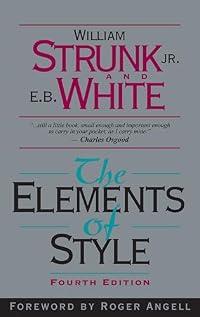
The Elements of Style
by William Strunk, E.B. White
On This Page
Description
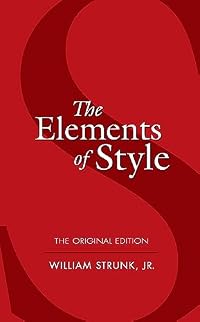
The Elements of Style (1918), by William Strunk, Jr., and E.B. White, is an American English writing style guide. It is the best-known, most influential prescriptive treatment of English grammar and usage, and often is required reading and usage in U.S. high school and university composition classes. This edition of The Elements of Style details eight elementary rules of usage, ten elementary principles of composition, "a few matters of form," and a list of commonly misused words and show more expressions. show lessTags
Recommendations












Member Recommendations

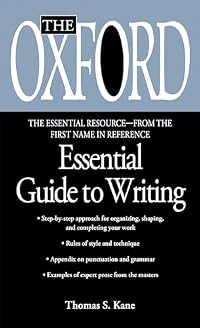
aulsmith Reader Over Your Shoulder has the same sort of advice as Elements of Style, but with many interesting examples of prose written in violation of the principle they are advocating.
32

Member Reviews
There are some books that everyone should own a copy of. The Elements of Style is one of those books. Although it is only eighty-five pages long (with an additional seven page index), the book is an essential guide to the basics of writing concisely, clearly, and effectively.
The book lays out rules and suggestions for writing in the English language, starting with the mandatory, moving on to the strongly suggested, and finally to the merely recommended. As a rule of thumb, it seems that the earlier an item appears in the book, the more critical it is that a writer follow the instructions given if they want their end product to be worthwhile. So, for example, a writer could ignore some (or all) of the advice regarding style in Chapter V show more and still produce a coherent and readable piece of work, but ignoring the rules of usage in Chapter I will almost certainly result in an incomprehensible mess.
Following the rules and advice laid out in this book will result in a clear and straightforward piece of writing. Most writers would do well to try to follow all of the rules and pointers in the book, especially those who are producing written material in a professional context. When writing a business letter, or a grant proposal, or even just an e-mail to a work associate, the most important goal for the writer is to convey his intended meaning properly, and following the advice in this book will substantially aid in reaching that goal.
But wait, I hear you cry, my favorite author routinely ignores several points that the book makes. I'm sure they do. But I would also lay heavy odds that they are aware of the stylistic element that they are flouting, and they are doing so deliberately, and after at least some consideration as to the impact of making such a choice. The Elements of Style provides the template for what might be called conventional writing. If one wants to be rebellious and engage in unconventional writing, and be effective when doing so, one has to know the conventional rules first. Even still, all but the most skilled writer ignores the advice contained in this book at his peril.
Anyone who writes should have a copy of this book on their shelf, and should read and reread it on a regular basis. Even the most experienced writer who peruses this manual is likely to be reminded of some tidbit of advice that could strengthen their prose. And even for those who reject all of the advice on the way to forging their own unique style, this book is a must read, as one should at least be conscious of what one is rejecting (although, to be perfectly honest, I cannot imagine the output of a writer who did reject all of the suggestions in this book being anything other than an unreadable nightmare). The Elements of Style is an essential part of every person's library.
This has also been posted to my blog Dreaming About Other Worlds. show less
The book lays out rules and suggestions for writing in the English language, starting with the mandatory, moving on to the strongly suggested, and finally to the merely recommended. As a rule of thumb, it seems that the earlier an item appears in the book, the more critical it is that a writer follow the instructions given if they want their end product to be worthwhile. So, for example, a writer could ignore some (or all) of the advice regarding style in Chapter V show more and still produce a coherent and readable piece of work, but ignoring the rules of usage in Chapter I will almost certainly result in an incomprehensible mess.
Following the rules and advice laid out in this book will result in a clear and straightforward piece of writing. Most writers would do well to try to follow all of the rules and pointers in the book, especially those who are producing written material in a professional context. When writing a business letter, or a grant proposal, or even just an e-mail to a work associate, the most important goal for the writer is to convey his intended meaning properly, and following the advice in this book will substantially aid in reaching that goal.
But wait, I hear you cry, my favorite author routinely ignores several points that the book makes. I'm sure they do. But I would also lay heavy odds that they are aware of the stylistic element that they are flouting, and they are doing so deliberately, and after at least some consideration as to the impact of making such a choice. The Elements of Style provides the template for what might be called conventional writing. If one wants to be rebellious and engage in unconventional writing, and be effective when doing so, one has to know the conventional rules first. Even still, all but the most skilled writer ignores the advice contained in this book at his peril.
Anyone who writes should have a copy of this book on their shelf, and should read and reread it on a regular basis. Even the most experienced writer who peruses this manual is likely to be reminded of some tidbit of advice that could strengthen their prose. And even for those who reject all of the advice on the way to forging their own unique style, this book is a must read, as one should at least be conscious of what one is rejecting (although, to be perfectly honest, I cannot imagine the output of a writer who did reject all of the suggestions in this book being anything other than an unreadable nightmare). The Elements of Style is an essential part of every person's library.
This has also been posted to my blog Dreaming About Other Worlds. show less
There's a lot to be said about this book in the other reviews here. Some people hate it, some people love it, others are ambivalent and can name better books on the same subject, and almost everyone has an opinion about whether or not this book is still relevant today.
Myself? I'm in the camp that it's still relevant today.
Unlike the usual reviews I do for fiction stories, I'm going to keep this pretty succinct for those who are scrolling through and want to see whether they agree with me, or an unbiased opinion, and happen to find my review. This book is great for UNDERSTANDING grammar and how to structure sentences and all that, but it's not the end-all, be-all of writing for fiction authors. It's an amazing foundation for show more understanding the rules and why certain things work and don't, but you can always break the rules if you want.
After all, it's better to break the rules when you know why something works rather than through ignorance. Though it is still full of good advice on how to structure sentences properly when something gets stuck, or feels 'wrong' when you revise and edit in the future.
Overall, you'll like this book if you want to brush up on your grammar and understanding of the English language. It's really just a textbook meant to be in easy reach and re-read every so often. show less
Myself? I'm in the camp that it's still relevant today.
Unlike the usual reviews I do for fiction stories, I'm going to keep this pretty succinct for those who are scrolling through and want to see whether they agree with me, or an unbiased opinion, and happen to find my review. This book is great for UNDERSTANDING grammar and how to structure sentences and all that, but it's not the end-all, be-all of writing for fiction authors. It's an amazing foundation for show more understanding the rules and why certain things work and don't, but you can always break the rules if you want.
After all, it's better to break the rules when you know why something works rather than through ignorance. Though it is still full of good advice on how to structure sentences properly when something gets stuck, or feels 'wrong' when you revise and edit in the future.
Overall, you'll like this book if you want to brush up on your grammar and understanding of the English language. It's really just a textbook meant to be in easy reach and re-read every so often. show less
http://nhw.livejournal.com/872531.html
This has been on my shelf for several years, and I took it down on Monday on impulse. It was a good impulse. This is a great little book, and should be read by anyone who writes for a living or in their spare time, ie pretty much anyone reading this. The one off-putting element for us on this side of the Atlantic is that it proclaims its American credentials loudly, but most of its grammar and usage points are relevant to any English idiom, and the tips on good and clear writing style are relevant to any language.
It is also beautifully written - and one suspects that the best bits came from the pen of the author of Charlotte's Web and Stuart Little. For instance:
"Writing is, for most, laborious and show more slow. The mind travels faster than the pen; consequently, writing becomes a question of learning to make occasional wing shots, bringing down the bird of thought as it flashes by. A writer is a gunner, sometimes waiting in the blind for something to come in, sometimes roaming the countryside hoping to scare something up. Like other gunners, the writer must cultivate patience, working many covers to bring down one partridge."
That's from the closing chapter on style in general. But some of the illustrations of the particular are memorable too. I remember once in a previous job sending a cross note to a colleague complaining about his use of colons: I wish I had been able to quote Strunk and White's lucid explanation of the topic. And this illustration of how to construct a sentence badly will linger in my mind:
"New York's first commercial human-sperm bank opened Friday with semen samples from eighteen men frozen in a stainless steel tank."
As the text goes on to say, "the reader's heart goes out to those eighteen poor fellows"!
Anyway, a tremendously useful read. I hope that I follow most of its recommendations instinctively, but it never does any harm to be reminded, to sharpen the saw as it were. I would say it's actually of greater relevance to the general writer than the Economist Style Guide, though the latter is also essential in my own line of work. show less
This has been on my shelf for several years, and I took it down on Monday on impulse. It was a good impulse. This is a great little book, and should be read by anyone who writes for a living or in their spare time, ie pretty much anyone reading this. The one off-putting element for us on this side of the Atlantic is that it proclaims its American credentials loudly, but most of its grammar and usage points are relevant to any English idiom, and the tips on good and clear writing style are relevant to any language.
It is also beautifully written - and one suspects that the best bits came from the pen of the author of Charlotte's Web and Stuart Little. For instance:
"Writing is, for most, laborious and show more slow. The mind travels faster than the pen; consequently, writing becomes a question of learning to make occasional wing shots, bringing down the bird of thought as it flashes by. A writer is a gunner, sometimes waiting in the blind for something to come in, sometimes roaming the countryside hoping to scare something up. Like other gunners, the writer must cultivate patience, working many covers to bring down one partridge."
That's from the closing chapter on style in general. But some of the illustrations of the particular are memorable too. I remember once in a previous job sending a cross note to a colleague complaining about his use of colons: I wish I had been able to quote Strunk and White's lucid explanation of the topic. And this illustration of how to construct a sentence badly will linger in my mind:
"New York's first commercial human-sperm bank opened Friday with semen samples from eighteen men frozen in a stainless steel tank."
As the text goes on to say, "the reader's heart goes out to those eighteen poor fellows"!
Anyway, a tremendously useful read. I hope that I follow most of its recommendations instinctively, but it never does any harm to be reminded, to sharpen the saw as it were. I would say it's actually of greater relevance to the general writer than the Economist Style Guide, though the latter is also essential in my own line of work. show less
Some of the advice in this sententious style book (note: not a grammar book) is solid, but it is also simplistic, misleading, and self-contradictory. Strunk's precepts, useful up to a point, have unfortunately been elevated to the status of dogma by generations of nitpicking pedants.
Is this a flawed book?
Of course. The style of prose it advocates was already out of date when it was published. It presents the taste of its authors' as inviolable laws, leading to painful contortions in the written language of those who try to follow it.
As the previous sentence indicates, even in matters of simple punctuation I do not agree with The Elements of Style.
And yet much of the advice is still solid. Even if you disagree with Strunk and White, it is better to have consciously rejected a rule than to have never considered the matter.
There is also a surprising playfulness with language that appears between dour pronunciations. This side of The Elements of style was unknown to me prior to reading it, seemingly having been missed show more by both its detractors and fanatics. show less
Of course. The style of prose it advocates was already out of date when it was published. It presents the taste of its authors' as inviolable laws, leading to painful contortions in the written language of those who try to follow it.
As the previous sentence indicates, even in matters of simple punctuation I do not agree with The Elements of Style.
And yet much of the advice is still solid. Even if you disagree with Strunk and White, it is better to have consciously rejected a rule than to have never considered the matter.
There is also a surprising playfulness with language that appears between dour pronunciations. This side of The Elements of style was unknown to me prior to reading it, seemingly having been missed show more by both its detractors and fanatics. show less
If you write anything, for any reason, ever, you should read this book repeatedly. Strunk and White lay out logical, easily-understood rules for clear and effective prose. The rules cover punctuation, parts of speech, sentence and paragraph structure, and spelling, not in exhaustive detail, but in a way that makes it easy to remember. The advice is solid and sound. The book includes a glossary at the end; if you need a refresher on grammatical terminology, start there first and then read the book. Strunk and White assume the reader is conversant in the parts of speech, and I found myself a bit at sea, since the last real grammar instruction I had was in 1992.
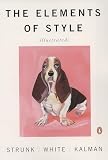
My edition is the one illustrated by Maira Kalman, and while the illustrations show more are whimsical and entertaining, they are more or less the visual equivalent of what the book suggests one not do with one's prose. Rarely do they elucidate any point made by the authors; frequently, they are either obscure themselves, or obscure the authors' points. As nice-looking as this edition is, I'd probably go for something less frilly if I ever needed to replace it.
If you write, this book should be on your desk. It's concise, engaging, and an excellent resource. show less
My edition is the one illustrated by Maira Kalman, and while the illustrations show more are whimsical and entertaining, they are more or less the visual equivalent of what the book suggests one not do with one's prose. Rarely do they elucidate any point made by the authors; frequently, they are either obscure themselves, or obscure the authors' points. As nice-looking as this edition is, I'd probably go for something less frilly if I ever needed to replace it.
If you write, this book should be on your desk. It's concise, engaging, and an excellent resource. show less
It may be of a shock to those who do not live a day without typing, but there was life before the Internet. The Internet has many unintended consequences, and one of the most horrendous was the rebirth of the grammar snob. As a writer (who needs a full time gig, anyone?), it is important that I learn as much as possible about style and usage. That does not mean that I should decry those who choose to ignore the rules. Grammarians were decrying the falling standards of language long before people spent the majority of their days exchanging correspondence. Now because so much time is spent sending and receiving written communication, grammarians have reared back for the kill.
To fend off such irritants, always have a curse word handy. It show more is good to know the proper usage and mechanics. Strunk and White is a slim book written in a very readable format. It escapes the textbook trapping, and manages to seem leisurely even when lecturing you. This edition was a revision from 2000, and includes some modern problems into the mix. My only complaint with the editing of the classic, is that it was done by a snide editor. The added suggestions take an insulting tone not present anywhere else in the text.
So as a closing note to all the Grammarians who choose to be assholes, read Strunk and White again. You already know the rules, but great care was taken to seem helpful. The scornful condescension is not needed.
http://pissandvinegar.vox.com/library/post/elements-of-style-the-terse-little-bo... show less
To fend off such irritants, always have a curse word handy. It show more is good to know the proper usage and mechanics. Strunk and White is a slim book written in a very readable format. It escapes the textbook trapping, and manages to seem leisurely even when lecturing you. This edition was a revision from 2000, and includes some modern problems into the mix. My only complaint with the editing of the classic, is that it was done by a snide editor. The added suggestions take an insulting tone not present anywhere else in the text.
So as a closing note to all the Grammarians who choose to be assholes, read Strunk and White again. You already know the rules, but great care was taken to seem helpful. The scornful condescension is not needed.
http://pissandvinegar.vox.com/library/post/elements-of-style-the-terse-little-bo... show less
Members
- Recently Added By
Published Reviews
ThingScore 44
I believe the success of Elements to be one of the worst things to have happened to English language education in America in the past century. The book’s style advice, largely vapid and obvious (“Do not overwrite”; “Be clear”), may do little damage; but the numerous statements about grammatical correctness are actually harmful. They are riddled with inaccuracies, uninformed by show more evidence, and marred by bungled analysis. Elements is a dogmatic bookful of bad usage advice, and the people who rely on it have no idea how badly off-beam its grammatical claims are. show less
added by private library
Buy it, study it, enjoy it. It's as timeless as a book can be in our age of volubility. (previous edition)
added by ArrowStead
...still a little book, small enough and important enough to carry in your pocket, as I carry mine.
added by ArrowStead
Lists

Best Reference Books
53 works; 34 members

Non-Fiction Worth Reading
1,015 works; 260 members

Modern Library 100 Best Nonfiction Books
100 works; 8 members

What're you reading? ..Words, words words.
11 works; 2 members

Writing
10 works; 4 members

Books Read in 2016
4,666 works; 199 members

Books talked about in Pamela Dean's Tam Lin
74 works; 1 member

1970s
657 works; 23 members

Publisher's Weekly NON-Fiction list - 1912 - 1975
486 works; 4 members

College Reads (Lit Edition)
75 works; 5 members

Creativity and the Creative Process
20 works; 4 members

The Books I Read in 2016
54 works; 1 member

Overdue Podcast
803 works; 9 members

Best Books on Writing for Writers
36 works; 19 members

Blue Pyramid 1,276 Best Books of All Time
1,248 works; 32 members
Craft Books
41 works; 1 member

Ambleside Books
459 works; 18 members

Tagged by Tim or Meh!
91 works; 8 members

el
1,139 works; 1 member

Unread books
1,063 works; 83 members
Author Information

20 Works 26,051 Members
William Strunk Jr. was born in Cincinnati, Ohio on July 1, 1869. He received a bachelor's degree at the University of Cincinnati in 1890 and Ph.D. at Cornell University in 1896. He taught English at Cornell University for forty-six years. He wrote two books: The Elements of Style, which was later published under the title The Elements and Practice show more of Composition, and English Metres. He was also an editor and edited important works by such authors as William Shakespeare, John Dryden, and James Fenimore Cooper. He served as a literary consultant to the 1936 MGM film version of Romeo and Juliet. He died on September 26, 1946. (Bowker Author Biography) show less

94+ Works 111,142 Members
Born in Mount Vernon, New York, E. B. White was educated at Cornell University and served as a private in World War I. After several years as a journalist, he joined the staff of the New Yorker, then in its infancy. For 11 years he wrote most of the "Talk of the Town" columns, and it was White and James Thurber who can be credited with setting the show more style and attitude of the magazine. In 1938 he retired to a saltwater farm in Maine, where he wrote essays regularly for Harper's Magazine under the title "One Man's Meat." Like Thoreau, White preferred the woods; he also resembled Thoreau in his impatience and indignation. White received several prizes: in 1960, the gold medal of the American Academy of Arts and Letters; in 1963, the Presidential Medal of Freedom, the nation's highest civilian award (he was honored along with Thornton Wilder and Edmund Wilson); and in 1978, a special Pulitzer Prize. His verse is original and witty but with serious undertones. His friend James Thurber described him as "a poet who loves to live half-hidden from the eye." Three of his books have become children's classics: Stuart Little (1945), about a mouse born into a human family, Charlotte's Web (1952), about a spider who befriends a lonely pig, and The Trumpet of the Swan (1970). Among his best-known and most widely used books is The Elements of Style (1959), a guide to grammar and rhetoric based on a text written by one of his professors at Cornell, William Strunk, which White revised and expanded. White was married to Katherine Angell, the first fiction editor of the New Yorker. (Bowker Author Biography) Elwyn Brooks White was born on July 11, 1899, in Mt. Vernon, New York. After graduating from Cornell University, he worked briefly for an advertising agency and as a newspaper reporter before joining the staff of The New Yorker magazine in 1927. As a columnist for The New Yorker and a contributor to Harper's Magazine, White established a reputation as a prose stylist of exceptional elegance, clarity and wit. His interests, as reflected in his writing, were numerous and varied; his essays touched on such wide-ranging subjects as politics, farm animals, and life in New York City. White married Katharine S. Angell in 1929. They had one son, and in 1957 the family left New York for a farm in North Brookline, Maine. Writings from The New Yorker, 1927-1976 is a compilation of columns and essays produced during White's long relationship with the magazine. One Man's Meat, published in 1942, is a collection of his writings for Harper's. White adapted a short guide to English grammar and usage, The Elements of Style, from a college text written by one of his professors at Cornell, William Strunk Jr. It has sold millions of copies since it was first published in 1959 and has become a cherished resource for guidance in writing. White also co-authored Is Sex Necessary? with the humorist James Thurber, a fellow staff member at The New Yorker. E.B. White died on October 1, 1985 after succumbing to Alzheimer's. His diverse legacy also includes three children's books: Stuart Little, Charlotte's Web, and The Trumpet of the Swan. In 1970 the American Library Association presented White the Laura Ingalls Wilder Award in recognition of his "substantial and lasting contribution to literature for children." He was also awarded the Presidential Medal of Freedom in 1963 and received a special Pulitzer Prize citation for his body of work in 1970. (Bowker Author Biography) show less
Some Editions
Awards and Honors
Awards
Distinctions
Notable Lists
Series
Belongs to Publisher Series
Work Relationships
Is an expanded version of
Is expanded in
Inspired
Has as a student's study guide
Common Knowledge
- Canonical title
- The Elements of Style
- Alternate titles
- Elements of Style
- Original publication date
- 1959 (copyright) (copyright); 1972 (copyright, second edition) (copyright, second edition); 1979 (copyright, third edition) (copyright, third edition); 2000 (copyright, fourth edition) (copyright, fourth edition)
- Epigraph
- The first writer I watched at work was my stepfather, E.B. White.
- First words
- 1. Form the possessive singular of nouns by adding 's.
Introduction: At the close of the first World War, when I was a student at Cornell, I took a course called English 8.
[50th anniversary and 1979 editions.]
Introduction: A small book arrived in my mail not long ago, a gift from a friend in Ithica.
[1959 edition] - Last words
- (Click to show. Warning: May contain spoilers.)Like the steadfast writer, she is at home in the wind and the rain; and, thanks to one moment of felicity, she will live on and on and on.
- Canonical DDC/MDS
- 808'.042; 808.042; 808
- Canonical LCC
- PE1408.S772
- Disambiguation notice
- "The Elements of Forbidden" about 5 copies of which are buried in this work, are due to a since-corrected LibraryThing error, and are really also 'Style' works
This is the edition of The Elements of Style that was written by William Strunk and later expanded upon by E.B. White. Please do not combine with the original, unexpanded version by Strunk alone, nor with the illustra... (show all)ted edition.
Classifications
Statistics
- Members
- 21,789
- Popularity
- 247
- Reviews
- 206
- Rating
- (4.14)
- Languages
- 6 — Chinese, English, French, German, Italian, Portuguese
- Media
- Paper, Audiobook, Ebook
- ISBNs
- 173
- UPCs
- 3
- ASINs
- 173