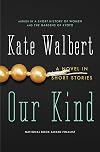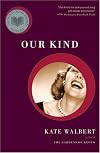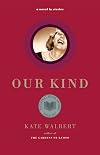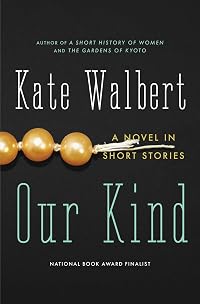
Our Kind
by Kate Walbert
On This Page
Description
From the award-winning author of The Gardens of Kyoto comes this witty and incisive novel about the lives and attitudes of a group of women--once country-club housewives; today divorced, independent, and breaking the rules. In Our Kind, Kate Walbert masterfully conveys the dreams and reality of a group of women who came into the quick rush of adulthood, marriage, and child-bearing during the 1950s. Narrating from the heart of ten companions, Walbert subtly depicts all the anger, show more disappointment, vulnerability, and pride of her characters: "Years ago we were led down the primrose lane, then abandoned somewhere near the carp pond." Now alone, with their own daughters grown, they are finally free--and ready to take charge: from staging an intervention for the town deity to protesting the slaughter of the country club's fairway geese, to dialing former lovers in the dead of night. Walbert's writing is quick-witted and wry, just like her characters, but also, in its cumulative effect, moving and sad. Our Kind is a brilliant, thought-provoking novel that opens a window into the world of a generation and class of women caught in a cultural limbo. show lessTags
Recommendations




Member Reviews
I find some of the reviews below interesting. It is as if they did not get the subtlety of the writing. Walbert forces the reader to think and challenges with observations that cause you to "Okay, I think I get it". Some people can be put off by the style but I enjoyed the creativity of it and her wonderful prose. I had previously read her most recent novel and picked this one up not knowing that it was nominated for the National Book Award in 2004. An excellent book about a transition time for women.
somewhere between 2.5 and 3 stars. i wanted to like this book more than i did overall, but at the same time there were parts that were just so beautifully written, and so astute.
it's called a "novel in stories" which basically means that each chapter stands alone but is related to all the others. they are not in chronological order and the main focus of each is not the same character, although the same characters are in all of the chapters. i would have liked a little more to tie the chapters all together, or to feel some more resolution. i'm left a bit unsatisfied. maybe that's the story or maybe it's the writing, which was at times so so so good, and at other times just a let down. she overused some phrasing ("Right at this moment show more cider simmers on her range, cinnamon sticks like so many tiny logjams." it's the "like so many" that at first sounds so lovely, but when repeated so often is kind of ruined.) in a book this short and this quick to read, i think it's important for a writer not to do that. but there were also so many really great parts and phrases and images. and one chapter/story in particular (sick chicks) that i loved.
the stories themselves are about relationship and divorce - the women all know each other from the country club they belong to, have all had children around the same time, are all divorced. they spend all of their time together but aren't friends. they are incredibly unlikeable for the most part, but you also know that they aren't who they really are because society hasn't let them be. they did what they were "supposed to do" - getting married, having kids, and for the most part are pretty empty shells of people. definitely some interesting things in this book.
a quote that i feel like kind of represents the dichotomy of the writing in the book: "It made us feel sophisticated and boorish at the same time." leaning more toward the sophisticated. show less
it's called a "novel in stories" which basically means that each chapter stands alone but is related to all the others. they are not in chronological order and the main focus of each is not the same character, although the same characters are in all of the chapters. i would have liked a little more to tie the chapters all together, or to feel some more resolution. i'm left a bit unsatisfied. maybe that's the story or maybe it's the writing, which was at times so so so good, and at other times just a let down. she overused some phrasing ("Right at this moment show more cider simmers on her range, cinnamon sticks like so many tiny logjams." it's the "like so many" that at first sounds so lovely, but when repeated so often is kind of ruined.) in a book this short and this quick to read, i think it's important for a writer not to do that. but there were also so many really great parts and phrases and images. and one chapter/story in particular (sick chicks) that i loved.
the stories themselves are about relationship and divorce - the women all know each other from the country club they belong to, have all had children around the same time, are all divorced. they spend all of their time together but aren't friends. they are incredibly unlikeable for the most part, but you also know that they aren't who they really are because society hasn't let them be. they did what they were "supposed to do" - getting married, having kids, and for the most part are pretty empty shells of people. definitely some interesting things in this book.
a quote that i feel like kind of represents the dichotomy of the writing in the book: "It made us feel sophisticated and boorish at the same time." leaning more toward the sophisticated. show less
I have often mentioned my “Rule of 50” in this series, and Kate Walbert’s Our Kind is a perfect example of how well that rule works. I read this book in 2007 and barely got passed the first story. My Page-a-Day Calendar recently featured this novel told in a collection of vignettes, so I decided to give it another try. A caterpillar has evolved into a magnificent butterfly.
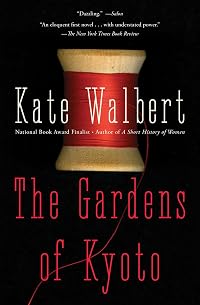
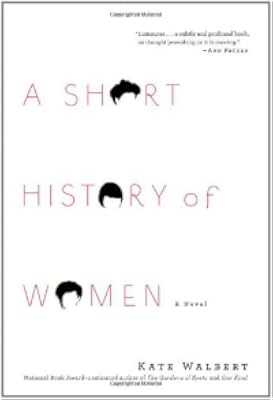
According to her website, Kate Walbert was born in New York City and raised in Georgia, Texas, Japan, and Pennsylvania, among other places. She is the author of A Short History of Women, chosen by The New York Times Book Review as one of the ten best books of 2009 and a finalist for the LA Times Book Prize. Our Kind was a finalist for the National Book Award in show more fiction in 2004. She also wrote The Gardens of Kyoto, which won awards as well. Her short fiction has been published in The New Yorker, The Paris Review, The Best American Short Stories, and The O. Henry Prize Stories.
This collection relates the stories of about 9 women loosely connected by social class, club membership, and the fact they had all lost their husbands – mostly to divorce. As Walbert writes, “Here was the dawn of Something Big, Canoe said, a shifting of the paradigm. A creative burst! You couldn’t not read about it: women in their middle years coming into their own, meeting second husbands, starting businesses, traveling around the globe. We could do any damn thing we liked, Canoe said, unfettered as we were, and we would, we knew, just as soon as we thought what” (160).
So their days revolve around lunches at the club, tennis, visiting a sick friend in a nursing home, or organizing an intervention for an alcoholic friend. Set in the 60s and 70s, they smoke and drink with elegance. The women have an entire array of problems and difficulties, but these women are strong – for the most part – and determined to live the remainder of their lives to the fullest extent possible.
While Walbert’s style is a bit peculiar – it resembles a series of thoughts linked to lead the reader to an idea the narrator seeks. For example, Walbert writes, “He was someone we loved. Someone we could not help but love. A colleague of our ex-husbands, a past encounter. We had known Him since before we were we, from our first weeks in this town, early summers. We loved His hair. Golden. The color of that movie actor’s hair, the famous one. Sometimes we caught just the gleam of it through the windshield of his BMW as He drove by. Sporty. Waving. Green metallic, leather interior” (3-4). However, I stuck with it this time, and easily began to slide along with the narrator.
Kate Walbert’s Our Kind is a wonderful story of women taking control of their lives and enjoying themselves and each other. Mimi, Esther, Suzie, Viv, Canoe, Judy, Bambi, Cookie, Louise, and Barbara are all interesting, introspective women who hold their own in this complicated dance of mid-life. 5 stars.
--Chiron, 1/5/14 show less
According to her website, Kate Walbert was born in New York City and raised in Georgia, Texas, Japan, and Pennsylvania, among other places. She is the author of A Short History of Women, chosen by The New York Times Book Review as one of the ten best books of 2009 and a finalist for the LA Times Book Prize. Our Kind was a finalist for the National Book Award in show more fiction in 2004. She also wrote The Gardens of Kyoto, which won awards as well. Her short fiction has been published in The New Yorker, The Paris Review, The Best American Short Stories, and The O. Henry Prize Stories.
This collection relates the stories of about 9 women loosely connected by social class, club membership, and the fact they had all lost their husbands – mostly to divorce. As Walbert writes, “Here was the dawn of Something Big, Canoe said, a shifting of the paradigm. A creative burst! You couldn’t not read about it: women in their middle years coming into their own, meeting second husbands, starting businesses, traveling around the globe. We could do any damn thing we liked, Canoe said, unfettered as we were, and we would, we knew, just as soon as we thought what” (160).
So their days revolve around lunches at the club, tennis, visiting a sick friend in a nursing home, or organizing an intervention for an alcoholic friend. Set in the 60s and 70s, they smoke and drink with elegance. The women have an entire array of problems and difficulties, but these women are strong – for the most part – and determined to live the remainder of their lives to the fullest extent possible.
While Walbert’s style is a bit peculiar – it resembles a series of thoughts linked to lead the reader to an idea the narrator seeks. For example, Walbert writes, “He was someone we loved. Someone we could not help but love. A colleague of our ex-husbands, a past encounter. We had known Him since before we were we, from our first weeks in this town, early summers. We loved His hair. Golden. The color of that movie actor’s hair, the famous one. Sometimes we caught just the gleam of it through the windshield of his BMW as He drove by. Sporty. Waving. Green metallic, leather interior” (3-4). However, I stuck with it this time, and easily began to slide along with the narrator.
Kate Walbert’s Our Kind is a wonderful story of women taking control of their lives and enjoying themselves and each other. Mimi, Esther, Suzie, Viv, Canoe, Judy, Bambi, Cookie, Louise, and Barbara are all interesting, introspective women who hold their own in this complicated dance of mid-life. 5 stars.
--Chiron, 1/5/14 show less
This book is written by "we", it is narrated by the group, with different details about different women included but the narrative is not owned by any individual character. Like "Then We Came to the End." Only not so definite. I'm not sure I would call this A Novel in Stories because it doesn't really have a plot, it is more of a set of interlinked stories about the lives of middle-aged, middle-class women who mostly don't have husbands, and how they deal with their lives & the losses.
In keeping with the title, Walbert has written an entire “novel in stories” in seamless first person plural, the first of its kind I’ve ever read. It is a masterpiece of powerful yet understated writing, vivid character and compelling stories. National Book Award Finalist, 2005.
Reviewed by: Landis
Reviewed by: Landis
I could not finish this book. It was just disjointed and, IMO, poorly written. There was really no plot and no cohesive story.
Members
- Recently Added By
Lists

"We" narration
49 works; 2 members

National Book Award Finalists - Fiction
377 works; 12 members
Author Information

11+ Works 1,692 Members
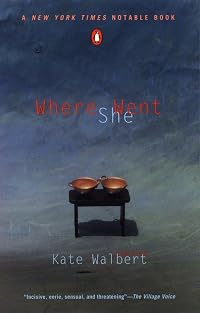
Kate Walbert has published fiction and articles in the Paris Review, DoubleTake, The New York Times, and numerous other publications. The recipient of fellowships from Yaddo, MacDowell, and the National Endowment for the Arts, as well as a grant from the Connecticut Commission on the Arts, she is the author of "Where She Went," a short story show more collection. Her most recent novel is called A Short History of Women. Walbert teaches writing at Yale University and lives in New York City and Branford, Connecticut. (Publisher Provided) show less
Awards and Honors
Awards
Common Knowledge
- Canonical title
- Our Kind
Classifications
Statistics
- Members
- 198
- Popularity
- 166,041
- Reviews
- 8
- Rating
- (3.32)
- Languages
- English
- Media
- Paper, Ebook
- ISBNs
- 4
- ASINs
- 2