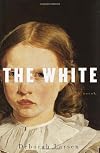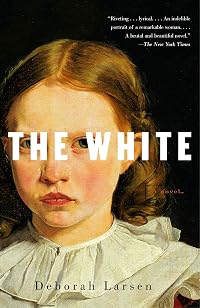
The White
by Deborah Larsen
On This Page
Description
"I was born a white at sea on the way to the New World ... But I was taken by those whom we called Indians. Nearly speechless for a time, I was beset by terrors." This is the voice of Mary Jemison, who, in 1758, at the age of sixteen, was taken by a Shawnee raiding party from her home near what would become Gettysburg, Pennsylvania. In this intimate reimagining of her life story, Mary endures the brutal scalpings of her parents and siblings and is given to two Seneca sisters who treat her as show more their own-a symbolic replacement for the brother they lost to the white colonists. Renamed Two-Falling-Voices, she gradually becomes integrated into her new family, learning to assist with the hunt and to cultivate corn. She marries a Delaware warrior, raises a family in her adoptive culture, becomes friends with two former slaves, and eventually, remarkably, fulfills her lifelong dream "to own land bordered by sky, as my mother and father had once purchased woods and fields which were dappled with changing light." show lessTags
Recommendations






Member Reviews
In 1758, when Mary Jemison is about sixteen, a Shawnee raiding party captures her Irish family near Gettysburg, Pennsylvania. Mary is the only one not killed and scalped. She is instead given to two Seneca sisters to replace their brother who was killed by whites. Emerging slowly from shock, Mary--now named Two-Falling-Voices--begins to make her home in Seneca culture and the wild landscape. She goes on to marry a Delaware, then a Seneca, and, though she contemplates it several times, never rejoins white society. Larsen alludes beautifully to the way Mary apprehends the brutality of both the white colonists and the native tribes; and how, open-eyed and independent, she thrives as a genuine American.
I read of Mary Jemeson first as a child in Lois Lenski's book, Indian Captive, a book I read many times. So I was interested in reading a different telling. And Deborah Larsen's telling was very different.
Larsen's tale has much more to do with Mary's inner journey than her outer one. We see Mary change and come to grips with her life --and the words are beautiful, almost poetic - but in the end we still don't have the answer to that nagging question -- why?
Mary seems to be simply captured by inertia. She is, and that in the end leaves us wanting - its like taking a bite of a rich pastry, getting a taste, but when you look for more - there's only air.
Larsen's tale has much more to do with Mary's inner journey than her outer one. We see Mary change and come to grips with her life --and the words are beautiful, almost poetic - but in the end we still don't have the answer to that nagging question -- why?
Mary seems to be simply captured by inertia. She is, and that in the end leaves us wanting - its like taking a bite of a rich pastry, getting a taste, but when you look for more - there's only air.
I expected more from this somehow. What I read was detached and dreamlike in the fact that it didn’t mesh to reality very well. It seemed that Mary didn’t really believe what was happening to her and recounted events dispassionately. Like she was describing what happened to another person.
All through the book we had paragraphs of inner monologue that seemed to be in an entirely different voice then the other paragraphs. At first I thought these were taken from the actual manuscript of Mary’s story, but they weren’t. They were just thoughts.
All through the book we had paragraphs of inner monologue that seemed to be in an entirely different voice then the other paragraphs. At first I thought these were taken from the actual manuscript of Mary’s story, but they weren’t. They were just thoughts.
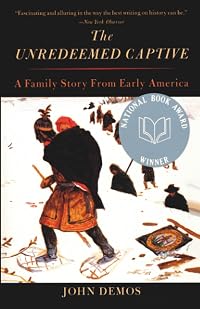
I didn't plan this, but this book fit well with The Unredeemed Captive which I read last year. This is a fictionalized account of another white woman who was captured by Indians and chose to stay with them, and who told her story late in life to a historian.
It's kind of a dull book, though. Not a whole lot happens except gathering and preparing food, with an occasional battle. Our heroine Mary of the Senecas is kind of a Mary Sue: red hair and blue eyes (of course). She's patient and kind, forgives her hateful father and her Indian captives, and teaches her children about the loving Great Spirit. She becomes a wise woman and shares her wisdom with a historian, humbling him with her forgiving spirit. Zzzzzzz.
It's kind of a dull book, though. Not a whole lot happens except gathering and preparing food, with an occasional battle. Our heroine Mary of the Senecas is kind of a Mary Sue: red hair and blue eyes (of course). She's patient and kind, forgives her hateful father and her Indian captives, and teaches her children about the loving Great Spirit. She becomes a wise woman and shares her wisdom with a historian, humbling him with her forgiving spirit. Zzzzzzz.
Based on the life of an historical Indian captive, this is the story of Mary Jemison from her point of view as a captive who gradually integrates into the Indian way of life. Although the book contains descriptions of some of the terrible violence between Indian and European, the book focuses on Mary’s ability to overcome and master the worst situations without losing herself in hate and self pity.
Though based on the actual captivity narrative of a Mary Jamison in the 18th century, Larsen has her own Mary tell a tale. A beautiful, lyrical tale.
With a choppy start, this book ended up being an interesting read. The best parts in my opinion were the italized paragraphs, presumably quoted right from Mary. Very interesting, onlu took a couple of hours to read.
Members
- Recently Added By
Lists

Historical Fiction
889 works; 91 members

Historical Fiction Lovers
88 works; 4 members

Authors from the United States
245 works; 3 members
Author Information

7 Works 606 Members
Deborah Larsen grew up in St. Paul, Minnesota, and currently lives with her husband in Gettysburg, Pennsylvania. She teaches creative writing at Gettysburg College, where she holds the Merle S. Boyer Chair.
Common Knowledge
- Canonical title
- The White
- Alternate titles
- The White
- People/Characters
- Mary Jemison; Slight Wind; Branch; Sheninjee; Thomas; Bending Tree (show all 11); Black Coals; Hiokatoo; Cleopha; Simon; Dr. Seaver
- Important places
- Pennsylvania, USA; Genesee River Valley, USA
- First words
- The sky is pale margin.
- Last words
- (Click to show. Warning: May contain spoilers.)She died on September19, 1833.
Classifications
Statistics
- Members
- 484
- Popularity
- 62,690
- Reviews
- 12
- Rating
- (3.37)
- Languages
- English
- Media
- Paper, Ebook
- ISBNs
- 4
- ASINs
- 4