On This Page
Description
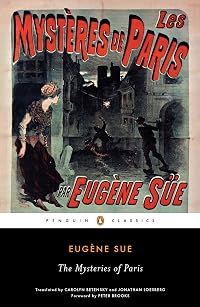
Sensational, engrossing, and heartbreaking, TheMysteries of Parisis doubtless one of the most entertaining and influential works to emerge from the nineteenth century. It was one of France's first serial novels, and for sixteen months, Parisians rushed in droves to the newsstands each week for the latest installment. Eug ne Sue's intricate melodrama unfolds around a Paris where, despite the gulf between them, the fortunes of the rich and poor are inextricably tangled. The suspenseful story show more of Rodolphe, a magnetic hero of noble heart and shadowy origins, was spun out over 150 issues-garnering wild popularity, influencing political change, and inspiring a raft of successors, including Les Miserablesand The Count of Monte Cristo. At long last, this lively translation makes the riveting drama of Sue's classic available to a new century of readers. For more than sixty-five years, Penguin has been the leading publisher of classic literature in the English-speaking world. With more than 1,500 titles, Penguin Classics represents a global bookshelf of the best works throughout history and across genres and disciplines. Readers trust the series to provide authoritative texts enhanced by introductions and notes by distinguished scholars and contemporary authors, as well as up-to-date translations by award-winning translators. show lessTags
Recommendations


















Member Recommendations
Member Reviews
… I won’t let the last leg of this affect my mark (it was awful soap, and I’m disappointed in him that he cannot let his ex-prostitute marry happily. He has been so radical, and so feminist among other things). Obviously this ‘book’ was a live thing in its maker’s hands, that changed shape as he wrote the serial instalments, and listened to his public, and changed himself. Along the way he began to call himself a socialist, as he got a speedy education through a project he had started as just another potboiler. This is a fascinating novel, not least for how it was composed. I’d like to get hold of the study that examines it as the first crowd-written fiction, ‘by the people for the people’: For the People by the show more People? Eugene Sue's Les Mysteres de Paris--A Hypothesis in the Sociology of Literature. People communicated with him who weren’t literate, and had their experiences incorporated.
It caught on because it’s a thriller, sensational, but at the same time a scandalously realist social document. With a plot faster than Monte Cristo, and an exploration of society’s underworlds more intrepid than Les Miserables, it influenced both. These more famous authors took from Sue and made him more polite. Yes, that’s a reason to read this extraordinary book.
Feminist? There’s an abortionist in these pages (I couldn’t remember abortionists in other 19thC lit – remind me), and crucially, the women who visit him are not wicked, they are unfortunate. There’s an argument against husbands’ sudden rights to sex upon marriage, when girls have been brought up to be queasy. It’s a fine piece of understanding a woman’s psychology, may I say.
Radical? He proposes a Bank for the Poor, with interest-free loans to unemployed workers. And so on. Sue either suggests or illustrates new endeavours and ideas to tackle inequality on the streets of Paris.
His position? This is of the tribe of ‘Utopian Socialist’ literature, pre-Marxism, and which, as the Penguin introduction tells us, Marx scorned as unscientific. It was the tribe Dostoyevsky belonged to when he was a young revolutionary, for these French Utopian Socialist writers were a big fashion in Russia. The school is sentimentalist and not afraid to lean on Christ’s Sermon on the Mount. Let me avow myself: give me pre-scientific socialism any day.
But before I go on too much about its social interest, I’d better repeat, it’s a thriller. He takes us to the seamy side for shock and horror, as well as a big dose of social concern. I won’t accept that he can only write stereotypes. His declared belief that people are good at bottom is evident in the salvation of several villains. His Bruce Wayne-Batman German prince in disguise helps the virtuous and punishes the vicious – but he is a Dark Knight Batman, with his hatred of evil presented as obsessive and ugly. Let me mention the She-Wolf and Rigolette. Splendid young women each in her own way, and not usual types at all in 19thC fiction. show less
It caught on because it’s a thriller, sensational, but at the same time a scandalously realist social document. With a plot faster than Monte Cristo, and an exploration of society’s underworlds more intrepid than Les Miserables, it influenced both. These more famous authors took from Sue and made him more polite. Yes, that’s a reason to read this extraordinary book.
Feminist? There’s an abortionist in these pages (I couldn’t remember abortionists in other 19thC lit – remind me), and crucially, the women who visit him are not wicked, they are unfortunate. There’s an argument against husbands’ sudden rights to sex upon marriage, when girls have been brought up to be queasy. It’s a fine piece of understanding a woman’s psychology, may I say.
Radical? He proposes a Bank for the Poor, with interest-free loans to unemployed workers. And so on. Sue either suggests or illustrates new endeavours and ideas to tackle inequality on the streets of Paris.
His position? This is of the tribe of ‘Utopian Socialist’ literature, pre-Marxism, and which, as the Penguin introduction tells us, Marx scorned as unscientific. It was the tribe Dostoyevsky belonged to when he was a young revolutionary, for these French Utopian Socialist writers were a big fashion in Russia. The school is sentimentalist and not afraid to lean on Christ’s Sermon on the Mount. Let me avow myself: give me pre-scientific socialism any day.
But before I go on too much about its social interest, I’d better repeat, it’s a thriller. He takes us to the seamy side for shock and horror, as well as a big dose of social concern. I won’t accept that he can only write stereotypes. His declared belief that people are good at bottom is evident in the salvation of several villains. His Bruce Wayne-Batman German prince in disguise helps the virtuous and punishes the vicious – but he is a Dark Knight Batman, with his hatred of evil presented as obsessive and ugly. Let me mention the She-Wolf and Rigolette. Splendid young women each in her own way, and not usual types at all in 19thC fiction. show less
This immensely long early 19th century French novel is by an author little known today but who was described by Victor Hugo as the French Dickens. In describing the lives and activities of a wide variety of strata of Parisian society of the time, this is an accurate description. There are moving descriptions of wretched poverty and the gap between rich and poor, redolent of Dickens. Perhaps more pertinently, this novel is also seen as a precursor of Hugo's Les Miserables, and so it is in structure and multiplicity of characters of various backgrounds. There are some colourful characters, especially the villains, though they lack the grandeur of the leading personalities of Hugo's masterpiece. I haven't quite managed to finish this novel show more and have stopped reading it some 80% of the way through - though I may be tempted to finish it some day. This definitely should be better known. show less
ok- i only read Book 1 (of how many books- maybe 12)? but that was hundreds of pages (?). I say "read" i mean "listened to" - via LibriVox with so many different readers - a new one for most chapters. What a great story! Maybe not up to Dumas, but that is as high as it goes, no? Our protag - a mysterious man in the shadows, saves a poor woman from being man handled by a roustabout in the initial scene. Turns out our protag is an extraordinary fighter (!) as the roustabout acknowledges (as he is not too shabby himself). These 3 characters will be launched in this way to a varied adventure - they're all great and a bit of 3 musketeers about them. The protag is a secret nobleman from some place in Germany but out to do good with his show more influence, money and fisticuffs- so a bit of a super hero story. But so well told. I will read more, but chose to move on for now. show less
Not Proust!!! Yet, despite it's age (circa 1840), style (trite & melodramatic), and length (over 1300 pages), The Mysteries of Paris is a surprisingly entertaining read. Multiple plots and diverse characters populate this "epic" story. Originally presented in newspaper installments, the book features short chapters with more than a few cliff hangers. A prominent, and ultimately tiring aspect, is the author's overt insertion of his observations and recommendations for social progress. It seems his work and he himself did help bring about needed reform. None-the-less, the work's likely most enduring value is as a historical snapshot of Paris' underbelly of the time.
My summer read, at 1300 pages, it took nearly all summer. Lots of digressions on the author's views on poverty, the penal system, and the nature of evil, some of the things he muses about are not out of place in modern times. The more things change the more they stay the same.
Un livre fascinant. Je l'ai lu à l'âge de 15-16 ans, j'ai été transportée dans ce Paris d'un autre siècle. Les personnages sont attachants, il est très facile de rentrer dans l'histoire (ou plutôt les histoires). Ce livre m'a fait réfléchir sur la société de l'époque, mais aussi sur celle de maintenant. Je regrette sincèrement que les autres ouvrages d'Eugène Sue soient si difficiles à trouver en version papier. Cette oeuvre est la plus facile à trouver et je la recommande fortement.
Members
- Recently Added By
Lists

Paris, City of Lights
103 works; 17 members

F. B. Perkins' List of 100 Best Fiction
100 works; 5 members

French Fiction of the 18th and 19th Centuries in English Translation
169 works; 3 members

Books mentioned in Julian Symons’ Bloody Murder
438 works; 6 members
150 Best Novels Selected by Brander Matthews (1883)
150 works; 7 members

Books in The Club Dumas
72 works; 1 member
Author Information

207+ Works 1,328 Members
Eugene Sue was a contemporary of Dickens and Thackeray. Immensely succesful, he was known as "the king of the popular novel." One of the most elegant members of Parisian society, he was a passionate horse-lover and eager to do all he could to help improve the quality of French bloodstock Alex de Jonge was an Oxford don for most of his professional show more life. He is the author of numerous books and articles on a wide variety of subjects and has appeared on A&E's Biography and The History Channel. He and his wife live on a horse farm in Virginia show less
Some Editions
Awards and Honors
Series

Belongs to Publisher Series
Work Relationships
Is contained in
Has the adaptation
Common Knowledge
- Canonical title
- The Mysteries of Paris
- Original title
- Les Mystères de Paris
- Original publication date
- 1842-06-19 to 1843-10-15: Serialised
- People/Characters
- She-Wolf; Princess Amelia, Fleur de Marie, Songbird; Rigollette; Monsieur Rodolphe, Count of Gerostein
- Important places
- Paris, France
- First words
- Un tapis-franc, en argot de vol et de meurtre, signifie un estaminet ou un cabaret du plus bas étage.
In the slang of murderers and thieves, a "joint " is the lowest sort of drinking establishment. - Last words
- (Click to show. Warning: May contain spoilers.)Rodolphe was not left alone for Fleur-de-Marie's funeral.
Classifications
Statistics
- Members
- 376
- Popularity
- 83,278
- Reviews
- 11
- Rating
- (3.56)
- Languages
- 13 — Danish, Dutch, English, French, German, Hungarian, Italian, Korean, Polish, Portuguese, Romanian, Spanish, Swedish
- Media
- Paper, Audiobook, Ebook
- ISBNs
- 41
- ASINs
- 20