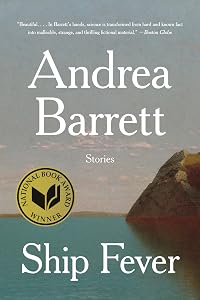
Ship Fever: Stories
by Andrea Barrett
On This Page
Description
One novella and seven stories dealing with science and set in the 19th Century. In The Behavior of the Hawkweeds, the spirit of Mendel, the discoverer of the laws of heredity, haunts a geneticist of whose work Mendel disapproves, in Birds with No Feet, Darwin's theory of evolution provides a zoologist with consolation for his personal misfortunes, while in The English Pupil, Linnaeus, who brought order to botany, must deal with the mental disorder of his advancing age. By the author of The show more Middle Kingdom. show lessTags
Recommendations



















Member Recommendations
Member Reviews
Summary: Ship Fever is a collection of stories (although the titular story is more of a novella) that revolve around science, particularly science in the late eighteenth and nineteenth centuries, and the way that the scientific worldview affects the lives of the people who practice it, and the people who come afterward.
"The Behavior of the Hawkweeds" is a story of Gregor Mendel, the father of genetics, and how his disillusionment with science is mirrored by the growing alienation between a professor and his wife. I thought this was an excellent opening story that set the tone for the entire volume quite well: they're stories about science, but they're not about science so much as the people doing to the science, and how that science show more can echo through time, and affect - or reflect - the lives of the people it touches.
"The English Pupil" focuses on the dying days of Carl Linnaeus, as he reflects over all of the eager young naturalists who died pursuing the passion that he instilled in them. This story was very sad, but also very interesting - I don't think I'd ever learned about Linnaeus's students, or what happened to them - but it's no wonder that Barrett chose them as the subject of a story. Full of pathos, and very, very human.
"The Littoral Zone" is a story of memory and relationships and reconstruction, as a married couple think about the events that took them away from their first marriages and brought them together. It's a story about the tiny threads of regret and sadness that linger even in what we would call a happy life, and the overall tone is almost melancholy. I did love that it was set at the same marine field station where I spent a summer during college, though.
"Rare Bird" is a story of a young woman in the 1760s, interested in science and natural history but kept from their pursuit by her gender. This was easily my favorite story, most likely because I had the easiest time identifying with the protagonist, and of all of the stories, it was the only one that I thought leaned more towards hope than bleakness.
"Soroche" involves a woman cast adrift within a family that doesn't belong to her, and contrasts her lot with Jemmy Button, one of the native Fuegians who was aboard the Beagle with Darwin. As a story, or a character study, this one was excellently crafted and very intriguing. However, I felt like it had to stretch to draw the historical parallels, and so the message of the story wound up feeling more labored than it needed to be.
"Birds with No Feet" is the story of a young naturalist/collector who was working in the Malay Archipelago at the same time as Alfred Russell Wallace, who came up with the theory of evolution by natural selection contemporaneously with Darwin. I liked this story quite a bit, mostly for the glances it gave us of Wallace, who is a fascinating figure, and has been largely - and unfairly - eclipsed by Darwin in the history of science.
"The Marburg Sisters" tells the tale of two estranged sisters returning home to care for their dying father. It's the only story that doesn't particularly involve the history of science, and therefore felt a bit out of place. It was also my least favorite; I didn't particularly care for either Rose or Bianca, and the inconsistent use of the first-person plural bugged me.
"Ship Fever" is set during the typhus epidemic in Canada following the influx of Irish immigrants during the Great Potato Famine. A young and idealistic doctor is called to help at the quarantine station, only to find conditions worse than he expected and deteriorating rapidly, with no guarantee that help is coming, or that the city he calls home will remain unaffected. Harrowing and thoroughly engrossing.
Overall Review and Recommendation: This is the first of Barrett's work I've read, but it won't be the last. Her prose is lovely, striking just the right balance between economy and sparseness, and oftentimes cutting to the bone with a single well-crafted phrase. Her characterization, even in the limited space of a short story, is rich and complex, and she's capable of evoking a surprising amount of emotion in the same short period.
This book probably requires a certain mood to really enjoy - the tone of most of the stories is certainly stark, if not outrightly bleak, and by the time I finished it, I felt like I'd made several passes through the emotional wringer. Still, each of the stories, even the short ones, had a certain heft, a certain gravity to it, and in sum, they added up to a thoroughly compelling read. 4 out of 5 stars. show less
"The Behavior of the Hawkweeds" is a story of Gregor Mendel, the father of genetics, and how his disillusionment with science is mirrored by the growing alienation between a professor and his wife. I thought this was an excellent opening story that set the tone for the entire volume quite well: they're stories about science, but they're not about science so much as the people doing to the science, and how that science show more can echo through time, and affect - or reflect - the lives of the people it touches.
"The English Pupil" focuses on the dying days of Carl Linnaeus, as he reflects over all of the eager young naturalists who died pursuing the passion that he instilled in them. This story was very sad, but also very interesting - I don't think I'd ever learned about Linnaeus's students, or what happened to them - but it's no wonder that Barrett chose them as the subject of a story. Full of pathos, and very, very human.
"The Littoral Zone" is a story of memory and relationships and reconstruction, as a married couple think about the events that took them away from their first marriages and brought them together. It's a story about the tiny threads of regret and sadness that linger even in what we would call a happy life, and the overall tone is almost melancholy. I did love that it was set at the same marine field station where I spent a summer during college, though.
"Rare Bird" is a story of a young woman in the 1760s, interested in science and natural history but kept from their pursuit by her gender. This was easily my favorite story, most likely because I had the easiest time identifying with the protagonist, and of all of the stories, it was the only one that I thought leaned more towards hope than bleakness.
"Soroche" involves a woman cast adrift within a family that doesn't belong to her, and contrasts her lot with Jemmy Button, one of the native Fuegians who was aboard the Beagle with Darwin. As a story, or a character study, this one was excellently crafted and very intriguing. However, I felt like it had to stretch to draw the historical parallels, and so the message of the story wound up feeling more labored than it needed to be.
"Birds with No Feet" is the story of a young naturalist/collector who was working in the Malay Archipelago at the same time as Alfred Russell Wallace, who came up with the theory of evolution by natural selection contemporaneously with Darwin. I liked this story quite a bit, mostly for the glances it gave us of Wallace, who is a fascinating figure, and has been largely - and unfairly - eclipsed by Darwin in the history of science.
"The Marburg Sisters" tells the tale of two estranged sisters returning home to care for their dying father. It's the only story that doesn't particularly involve the history of science, and therefore felt a bit out of place. It was also my least favorite; I didn't particularly care for either Rose or Bianca, and the inconsistent use of the first-person plural bugged me.
"Ship Fever" is set during the typhus epidemic in Canada following the influx of Irish immigrants during the Great Potato Famine. A young and idealistic doctor is called to help at the quarantine station, only to find conditions worse than he expected and deteriorating rapidly, with no guarantee that help is coming, or that the city he calls home will remain unaffected. Harrowing and thoroughly engrossing.
Overall Review and Recommendation: This is the first of Barrett's work I've read, but it won't be the last. Her prose is lovely, striking just the right balance between economy and sparseness, and oftentimes cutting to the bone with a single well-crafted phrase. Her characterization, even in the limited space of a short story, is rich and complex, and she's capable of evoking a surprising amount of emotion in the same short period.
This book probably requires a certain mood to really enjoy - the tone of most of the stories is certainly stark, if not outrightly bleak, and by the time I finished it, I felt like I'd made several passes through the emotional wringer. Still, each of the stories, even the short ones, had a certain heft, a certain gravity to it, and in sum, they added up to a thoroughly compelling read. 4 out of 5 stars. show less
The first story in this collection, 'The Behavior of the Hawkweeds', was in Best American Short Stories, where I read it and immediately sought out more by Andrea Barrett. I wasn't disappointed with this book.
In 'Rare Bird', it's 1762 and we meet Sarah Anne, "who inherited her father's brains but Christopher [her brother] inherited everything else". She's intelligent, single, interested in science and learning but held back by being a woman. She does find ways to write and to experiment, and does manage to change her situation in an interesting way.
The novella that gives this book its title is a story of the Great Irish Famine of the 1840s. It seems to end well for a few people who make their way to Canada, but I did not read every show more part of it.
My favorite was 'The Marburg Sisters', about Rose and Bianca, and is in turns realistic, surreal, and philosophical as they grow to adulthood, go their separate ways, meet again in mid-twentieth century America, then once more part, but remain still connected.
Barrett writes with a sure hand, giving us fiction that is easy to believe is all truth.
. show less
In 'Rare Bird', it's 1762 and we meet Sarah Anne, "who inherited her father's brains but Christopher [her brother] inherited everything else". She's intelligent, single, interested in science and learning but held back by being a woman. She does find ways to write and to experiment, and does manage to change her situation in an interesting way.
The novella that gives this book its title is a story of the Great Irish Famine of the 1840s. It seems to end well for a few people who make their way to Canada, but I did not read every show more part of it.
My favorite was 'The Marburg Sisters', about Rose and Bianca, and is in turns realistic, surreal, and philosophical as they grow to adulthood, go their separate ways, meet again in mid-twentieth century America, then once more part, but remain still connected.
Barrett writes with a sure hand, giving us fiction that is easy to believe is all truth.
. show less
A fellow bus-rider lent me this book to break up the non-fiction I wasn't getting through in my reading (slow reading? non-reading?) of [book: Democracy in America]. I tore through it in a couple of days; really couldn't put it down!
Author Andrea Barrett includes several short stories in this volume, all with a historical, naturalist/science bend to them. Whether we discover a connection with Mendel or Linnaeus or ponder the same mysteries they did, we get inserted into their lives in an interesting way. Or perhaps a better way to say it would be that we find the lives of the stories' characters intertwined with the historical figure.
The title story, Ship Fever follows some of the events of the Potato Famine in that we join a young show more doctor on a Canadian island while the ships empty sick Irish refugees onto shore.
None of the stories are very uplifting. None of the characters live "happily ever after" and many are fairly miserable. Many of the stories, perhaps even all of them, lack closure; they just end when they do—not really hanging, but just ended and not resolved. (Please note this is not criticism, just a comment on an interesting style that isn't completely to my taste.)
Perhaps only our visit with Linnaeus could be considered "happy". As he reviews his colleagues, acquaintances and students and their achievements, we find that he isn't unfulfilled but strangely content. Even in the limitations brought on by his stroke, he appears satisfied with the events of his life. (Only later do I find out about his faith.)
Overall, it is a good book and one I am glad to have read. show less
Author Andrea Barrett includes several short stories in this volume, all with a historical, naturalist/science bend to them. Whether we discover a connection with Mendel or Linnaeus or ponder the same mysteries they did, we get inserted into their lives in an interesting way. Or perhaps a better way to say it would be that we find the lives of the stories' characters intertwined with the historical figure.
The title story, Ship Fever follows some of the events of the Potato Famine in that we join a young show more doctor on a Canadian island while the ships empty sick Irish refugees onto shore.
None of the stories are very uplifting. None of the characters live "happily ever after" and many are fairly miserable. Many of the stories, perhaps even all of them, lack closure; they just end when they do—not really hanging, but just ended and not resolved. (Please note this is not criticism, just a comment on an interesting style that isn't completely to my taste.)
Perhaps only our visit with Linnaeus could be considered "happy". As he reviews his colleagues, acquaintances and students and their achievements, we find that he isn't unfulfilled but strangely content. Even in the limitations brought on by his stroke, he appears satisfied with the events of his life. (Only later do I find out about his faith.)
Overall, it is a good book and one I am glad to have read. show less
I'm not usually a fan of short stories (unless they're by Poe, or Twain). Barrett's, however, are fantastic. Richly detailed and magnificently crafted, each stands well on its own; and as a collection, they're better.
[Originally posted 11 January 2006; updated 18 August 2014: I'll add just one little bit; I've become much more a fan of short stories than I was back then!]
[Originally posted 11 January 2006; updated 18 August 2014: I'll add just one little bit; I've become much more a fan of short stories than I was back then!]
I'm not usually big on short story collections, but this one sounded intriguing as it incorporates science and history. Some of the stories were just luke-warm for me. The two I most enjoyed focused on women trying to assert their independence: "Rare Bird" and "Soroche," which Barrett placed in the middle of the collection. The title novella is an interesting (and horrifying) glimpse of the Irish potato famine and the long-reaching effects, but I didn't connect with the characters in that story, which was true of most of the stories.
Barrett does not disappoint in this collection of short stories. My favorite was the title story which was actually a novella and told the story of Dr. Lauchlin Grant and the Irish emigrants forced to stay at an island outside of Montreal because they are sick with typhus. Because of the conditions on the ship (wretched) it is called "ship fever." Dr. Grant's relationship with his best friend's wife, Suzannah, and an impoverished Irish girl that he saves, provide the human story here and, as with all Barrett's work, the science is a main character. Throughout the stories, reference is made to characters from Barrett's other books and it was interesting to make the connections. Great read!
These are beautiful stories that are all informed in some way by science and nature. Wish the final novella "Ship Fever" had been expanded to novel length. I hope to read more by this author.
Members
- Recently Added By
Published Reviews
ThingScore 88
A dark chill permeates the stories of Ship Fever, including those that take place in summer or in the tropics. It’s a seductive, bracing chill, one I’ll take over volumes of lush and sultry.
added by Shortride
Ms. Barrett's narrative laboratory is stocked with a handsome array of equipment. She tells her stories through alternating voices, diaries, letters -- whatever seems to hint at the most promising results. Seen against a larger fictional landscape overpopulated with the sensational and affectless, her work stands out for its sheer intelligence, its painstaking attempt to discern and describe show more the world's configuration. The overall effect is quietly dazzling, like looking at handmade paper under a microscope. show less
added by Shortride
Lists

Favorite Short Fiction
228 works; 99 members

National Book Award - Fiction
78 works; 10 members

BingoDOG - Scientists in Fiction
111 works; 17 members

2024. Nuestro año literario (Faustino Sánchez)
20 works; 1 member
Author Information

18+ Works 5,253 Members
Andrea Barrett was born on July 17, 1965. She has taught in the M.F.A. program for writers at Warren Wilson College, and has been a visiting writer at several other colleges and universities, as well as teaching frequently at conferences such as the Bread Loaf Writers' Conference. She writes short stories and novels. Her short story collections show more include Servants of the Map, Archangel, and Ship Fever and Other Stories, which won the National Book Award in 1996 for the short story collection. She received the Distinguished Story Citation from Best American Short Stories in 1995 for The Littoral Zone and the 2015 Rea Award for the Short Story. Her short fiction has appeared in periodicals such as Mademoiselle and Prairie Schooner. Her novels include The Voyage of the Narwhal, Lucid Stars, Secret Harmonies, The Middle Kingdom, and The Forms of Water. (Bowker Author Biography) show less
Awards and Honors
Awards
Common Knowledge
- Canonical title*
- La fiebre negra
- Original title
- Ship Fever
- Original publication date
- 1996
- People/Characters
- Carl Linnaeus
- Important places
- Grosse Isle, Québec, Canada
- Important events
- Irish Potato Famine; 1847 North American typhus epidemic
- Dedication
- For Wendy Weil
- First words
- For thirty years, until he retired, my husband stood each fall in front of his sophomore genetics class and passed out copies of Gregor Mendel's famous paper on the hybridization of edible peas.
- Quotations
- His mind, which had once seemed to hold the whole world, had been occupied by a great dark lake that spread farther every day and around which he tiptoed gingerly. When he reached for facts they darted like minnows across the... (show all) water and could only be captured by cunning or indirection.
- Last words
- (Click to show. Warning: May contain spoilers.)"I am," Nora said.
- Original language
- English
*Some information comes from Common Knowledge in other languages. Click "Edit" for more information.
Classifications
Statistics
- Members
- 1,452
- Popularity
- 16,174
- Reviews
- 28
- Rating
- (4.09)
- Languages
- Dutch, English, German, Spanish
- Media
- Paper, Audiobook, Ebook
- ISBNs
- 18
- ASINs
- 9