On This Page
Description
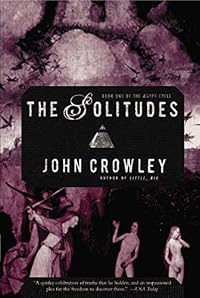
Is there more than one history of the world? This is the question Pierce Moffett is seeking to answer when, jilted and newly jobless, he gets off a bus by chance in the Faraway Hills and steps unawares into a story that has been awaiting him there. His search will bring him into contact with Rosie Rasmussen, another seeker marked by loss. And it will lead them both on a path toward the longed-for country of our oldest dreams and most unanswerable desires, toward a magnificent discovery.Tags
Recommendations











Member Recommendations

lottpoet Possession reminded me quite strongly of the intellectual joys I experienced from page one of The Solitudes. I think both books deal with questions of knowledge (what is known, what can be known) and possibility.
Member Reviews
Despite all the awards and claims, this is probably going to be a fundamentally disappointing book to anyone who is not a dedicated literature major.
Admittedly, it is only the first colume of an ambitious tetralogy but such a volume should make you want to read the next in sequence. My instinct was not to waste a mature life by doing so.
So what is wrong here? There is no doubt that it is well crafted (though with all the introspective confusions that seem to be de rigueur with the late twentieth century literary crowd) and it comes alive at moments.
Crowley can write exceptionally well when he wants to write well but the passages of lucidity are often subsumed in something that clearly demands four books, too much concentration and a lot show more of trust on the part of the reader.
In the end, the attraction of the book has to come down to the personality of the reader. It certainly can't be regarded as a classic fantasy but more an elaborate fiction about the concept of literary fantasy.
The literary component is well within the East Coast tradition of baby boomer narcissism and the fantasy element mere wistful posturing based on not having the courage to think the world other than it is without caveats.
It is a case of having one's cake and eat it perhaps - guardedly to embrace the fantasies of the past as if they were new discovered lands and yet embed oneself in a fictional working out of one's own life through literary evasion.
The book suffers from its era. The esoteric material that seems so exciting in 1987 is now widely available and in more interesting form on the 21st century internet. Few educated people now find Bruno or Dee an utter surprise.
Similarly, the gentle naivete of the baby boomer generation with its yearning for safe fantasy now looks more like a self-regarding irresponsibility whose effects have been dumped on their children and grand-children.
We start with Esalen and (at our best) with Martin Luther King and we end up with Hillary Clinton, perpetual warfare and low level economic gloom. This was the world the evasive fantastics made.
Wistful esotericism is the wrong sort of fantasy, an evasion based on words, instead of a deep insanely existential engagement with the other or a pragmatic facing off of the world geared to action.
Still, those of a literary cast of mind who have no sense of the fantastic - though every fiction is no more than a mental projection masquerading more or less as the 'real' - might find this an easy path to some otherkin thinking.
Personally, I would not dabble around the edges - I would leap straight into the radical fantastic and give up 'raffine' literary quality for more direct immersion in subversive thoughts and experiences. show less
Admittedly, it is only the first colume of an ambitious tetralogy but such a volume should make you want to read the next in sequence. My instinct was not to waste a mature life by doing so.
So what is wrong here? There is no doubt that it is well crafted (though with all the introspective confusions that seem to be de rigueur with the late twentieth century literary crowd) and it comes alive at moments.
Crowley can write exceptionally well when he wants to write well but the passages of lucidity are often subsumed in something that clearly demands four books, too much concentration and a lot show more of trust on the part of the reader.
In the end, the attraction of the book has to come down to the personality of the reader. It certainly can't be regarded as a classic fantasy but more an elaborate fiction about the concept of literary fantasy.
The literary component is well within the East Coast tradition of baby boomer narcissism and the fantasy element mere wistful posturing based on not having the courage to think the world other than it is without caveats.
It is a case of having one's cake and eat it perhaps - guardedly to embrace the fantasies of the past as if they were new discovered lands and yet embed oneself in a fictional working out of one's own life through literary evasion.
The book suffers from its era. The esoteric material that seems so exciting in 1987 is now widely available and in more interesting form on the 21st century internet. Few educated people now find Bruno or Dee an utter surprise.
Similarly, the gentle naivete of the baby boomer generation with its yearning for safe fantasy now looks more like a self-regarding irresponsibility whose effects have been dumped on their children and grand-children.
We start with Esalen and (at our best) with Martin Luther King and we end up with Hillary Clinton, perpetual warfare and low level economic gloom. This was the world the evasive fantastics made.
Wistful esotericism is the wrong sort of fantasy, an evasion based on words, instead of a deep insanely existential engagement with the other or a pragmatic facing off of the world geared to action.
Still, those of a literary cast of mind who have no sense of the fantastic - though every fiction is no more than a mental projection masquerading more or less as the 'real' - might find this an easy path to some otherkin thinking.
Personally, I would not dabble around the edges - I would leap straight into the radical fantastic and give up 'raffine' literary quality for more direct immersion in subversive thoughts and experiences. show less
“From the time of their composition, Soledades inspired a great debate regarding the difficulty of its language and its mythological and erudite references without an apparent didactic purpose.” —from the Wikipedia article on Las Soledades by Luis de Góngora
A strange, distancing sort of book. I think I felt similarly about Little, Big and only upped my rating to 5 stars after quite some time had passed and it had had plenty of time to steep in my mind, so maybe this will be the same. It’s so very philosophical and esoteric, though, that I doubt it.
Large parts of this book are stories within the “main” modern-day story: the story of Giordano Bruno and his hermeticism (which, from the author’s note at the beginning, I show more suspect was largely “borrowed” from Giordano Bruno and the Hermetic Tradition by Frances Yates), the story of Dr. John Dee and his scryer Talbot (a.k.a. Edward Kelley). These are historical people, but there’s also a bit about fictional author Fellowes Kraft (who I suspect may be more than a little a stand-in for real author John Crowley, as the book he’s written is largely the book we’re reading). There’s a cast of present-day characters as well, including another author, Pierce Moffett, who may be another Crowley stand-in. The book is so self-referential, it’s hard not to see everything “as above, so below,” or “as in book, so outside of book.”
This is a very cerebral, erudite book of the sort I usually like, but as I said before, it’s oddly distancing, unlike, say, Foucault’s Pendulum, which also deals with esoteric knowledge but with more engaging characters and more vitality at its heart. On the other hand, it gave me the same sense of anemoia (to borrow from The Dictionary of Obscure Sorrows) as Little, Big, so perhaps with time I’ll feel enough fondness for it to continue with the Aegypt Cycle. But not today.
I should mention that I listened to the audiobook, read by the author. John Crowley had a pensive, melodic way of reading that reminded me of how poetry is often read, so it was pleasant to listen to but may have contributed to that feeling of being distanced from the text. show less
UPDATE May 23th, 2015:
Just re-read this one, almost exactly a year since the first time. Still excellent. My favorite quote:
ORIGINAL REVIEW: May 18th, 2014:
Both a profound meditation on the nature of history and a moving personal story. A balance show more that is almost impossible to get right. Usually, you like the ideas enough that the crappy story doesn't matter, or vice versa. But Crowley delivers both in equal measure. A rare treat.
I wholeheartedly, unreservedly and (a little too) insistently recommend this book to any of my friends who are currently professors in subjects related to the history of ideas. There are one or two of you. ;) NB It's much more about the late medieval/early modern period than anything resembling the Egypt the title suggests. Regardless of your particular area of interest, you'll get a lot out of it. I pinky swear.
I'm going to post some choice quotes in my tumblr shortly: http://untravel.tumblr.com show less
Just re-read this one, almost exactly a year since the first time. Still excellent. My favorite quote:
The last wish: the only wish, in fact. That things could be, not as they are, but in some way different instead. Not better, really, or not better in all ways; a little larger maybe, more full of this and that, but mostly just different. New. That I, Pierce Moffett, could know that it had once been as it was and is that way no longer, that I could know it to have once been remade and so able to be remade again, all new, all other. Then perhaps this grief would at last be lifted from my heart.
ORIGINAL REVIEW: May 18th, 2014:
Both a profound meditation on the nature of history and a moving personal story. A balance show more that is almost impossible to get right. Usually, you like the ideas enough that the crappy story doesn't matter, or vice versa. But Crowley delivers both in equal measure. A rare treat.
I wholeheartedly, unreservedly and (a little too) insistently recommend this book to any of my friends who are currently professors in subjects related to the history of ideas. There are one or two of you. ;) NB It's much more about the late medieval/early modern period than anything resembling the Egypt the title suggests. Regardless of your particular area of interest, you'll get a lot out of it. I pinky swear.
I'm going to post some choice quotes in my tumblr shortly: http://untravel.tumblr.com show less
Like John Crowley’s masterpiece of fantasy, Little Big, I read Aegypt (now called The Solitudes) in my early twenties and my reaction at the time was disappointment rather then wonder. My immature self was under whelmed by what seemed at heart a domestic ‘realistic’ novel about an academic at a loose end and his failed relationships with women. The sort of middle-class respectable writing I despised at the time (and still do). I enjoyed the extracts from the imaginary historical novels within the main text of Aegypt, authored by the writer Fellowes Kraft, but where was The Fantasy, The Weird! When the other novels in the sequence appeared very briefly in Britain and then vanished without trace I hardly noticed.
But I loved Little show more Big, especially on re-reading it in 2002 and as the novels in the Aegypt Cycle have been re-published in America, I thought I would have another go at this acclaimed but sadly obscure book. And what a revelation! This is about a failed lecturer and his relationships in a small American town setting. but it is far more then that. It is also a search (quest) for the magical in both history and the presently mundane. It seems to me (after all this is only the first volume of a series) about nothing less then the roots of the marvellous. It is an elaborate letter of love written by a book lover (John Crowley?) to the object of his affections. It is in other words the quintessential LibraryThing tome; books are everywhere in this novel-books within books. There is very little of the obviously supernatural here unlike Little Big, but if your interest lies with Renaissance magic and such figures as John Dee and Giordano Bruno you will find a lot of material here. Aegypt works brilliantly with detailed, finely drawn characters and setting, but also as a novel of ideas in the Borgeian fashion
And this is only volume one of a four volume story. show less
But I loved Little show more Big, especially on re-reading it in 2002 and as the novels in the Aegypt Cycle have been re-published in America, I thought I would have another go at this acclaimed but sadly obscure book. And what a revelation! This is about a failed lecturer and his relationships in a small American town setting. but it is far more then that. It is also a search (quest) for the magical in both history and the presently mundane. It seems to me (after all this is only the first volume of a series) about nothing less then the roots of the marvellous. It is an elaborate letter of love written by a book lover (John Crowley?) to the object of his affections. It is in other words the quintessential LibraryThing tome; books are everywhere in this novel-books within books. There is very little of the obviously supernatural here unlike Little Big, but if your interest lies with Renaissance magic and such figures as John Dee and Giordano Bruno you will find a lot of material here. Aegypt works brilliantly with detailed, finely drawn characters and setting, but also as a novel of ideas in the Borgeian fashion
And this is only volume one of a four volume story. show less
Aegypt, or as it was renamed in later editions, The Solitudes, the first of four novels, takes us on a philosophical and historical journey back to the Elizabethan Age, when Giordano Bruno and John Dee were skating on dangerous intellectual territory as they sought a kind of truth that was foreign to the ecclesiastical powers that reigned during that time. The Inquisition was in full force, and the conditions that people lived in at that time can only be described as totalitarian. Any uttered deviation from conventional thought could be life-threatening, no matter one's station.
Giordano Bruno became famous as a young Dominican friar for his prodigious memory. At one point he was even summoned by the Pope to explain the "secrets" behind show more his legendary feats of remembering. It is quite probable that Bruno had what we think of today as a photographic memory, but he had been trained in the arts of memory, the rules of which were severely limited by superstitious Church authorities. The process is fully described in the course of this book as well as Bruno's hair-raising journey to escape the grasp of the Inquisition because he was suspected of employing Satanic arts.
John Dee had a burning desire to be a wizard, a mage, and to be able to look in a crystal ball and see angels, or the way to heaven or God himself. We are introduced to Bruno and Dee and the book ends on the threshold of their first meeting.
Framing accounts of these historical figures, however, is the story of a modern-day historian who has botched his fledgling but mediocre career as a college history teacher. As he embarks on the process of retrieving the wreckage of his life, he ruminates extensively about the notion that there is more than one history of the world, that there is more than one kind of history and he begins to think about writing a book that explores these unorthodox ideas. He thinks, "Nowadays history is made of time; but once it was made of something else. . . . the story of that history not made of time; that history which is as different from History yet as symmetrical to it as dream is to waking. "
He keeps asking the question: Why do we believe Gypsies can tell fortunes? Because they came not really from Egypt, but from Aegypt, the country where all magic arts are known. From childhood he has believed that "Aegypt" is a kind of shadow Egypt of the imagination:
. . . there were two different countries, somehow near each other or at right angles to each other. Egypt. And Aegypt. . . The one I dreamt and thought about, it has a history too, as Egypt does, a history just as long but different . . . the same monuments with completely different meanings. . . . Not Egypt but Aegypt. Because there is more than one history of the world."
Why do we believe Gypsies can tell fortunes? Because we thought once they were Egyptians, even though they aren't, and it was natural to suppose they would inherit, in whatever faint degree, the occult wisdom which everybody knows the Egyptians possessed.
He knew why it is that people believe Gypsies can tell fortunes; he knew why that pyramid and that mystic eye appear on every dollar bill, and from what country the New Order of the Ages issued. It was the same country as the country from which the Gypsies came, and it was not Egypt.
Not Egypt but Aegypt: for there is more than one history of the world.
So Aegypt, or The Solitudes, contains within it an extended meditation upon the nature of history:
How history hungers for the shape of myth; how the plots and characters of fable and romance come to inhabit real courts and counting-houses and cathedrals; how old sciences die, and bequeath their myths and magic to their successors; how the heroes of legend pass away, fall asleep, are resurrected, and enter ordinary daylit history, persisting as a dream persists into waking life, altering and transforming it even when the dream itself has been forgotten or repressed.
Culminating in the question: Is meaning in history like the solution to an equation or like a repeated flavor? Is it to be solved for or tasted?
This question is not answered directly, but participating in the conversation is quite satisfying.
It is not easy to classify this book. Is it fantasy? historical fiction? philosophy? It seems to be all of the above, with more than a touch of the occult and esoteric about it. I found this book to be completely enthralling. show less
Giordano Bruno became famous as a young Dominican friar for his prodigious memory. At one point he was even summoned by the Pope to explain the "secrets" behind show more his legendary feats of remembering. It is quite probable that Bruno had what we think of today as a photographic memory, but he had been trained in the arts of memory, the rules of which were severely limited by superstitious Church authorities. The process is fully described in the course of this book as well as Bruno's hair-raising journey to escape the grasp of the Inquisition because he was suspected of employing Satanic arts.
John Dee had a burning desire to be a wizard, a mage, and to be able to look in a crystal ball and see angels, or the way to heaven or God himself. We are introduced to Bruno and Dee and the book ends on the threshold of their first meeting.
Framing accounts of these historical figures, however, is the story of a modern-day historian who has botched his fledgling but mediocre career as a college history teacher. As he embarks on the process of retrieving the wreckage of his life, he ruminates extensively about the notion that there is more than one history of the world, that there is more than one kind of history and he begins to think about writing a book that explores these unorthodox ideas. He thinks, "Nowadays history is made of time; but once it was made of something else. . . . the story of that history not made of time; that history which is as different from History yet as symmetrical to it as dream is to waking. "
He keeps asking the question: Why do we believe Gypsies can tell fortunes? Because they came not really from Egypt, but from Aegypt, the country where all magic arts are known. From childhood he has believed that "Aegypt" is a kind of shadow Egypt of the imagination:
. . . there were two different countries, somehow near each other or at right angles to each other. Egypt. And Aegypt. . . The one I dreamt and thought about, it has a history too, as Egypt does, a history just as long but different . . . the same monuments with completely different meanings. . . . Not Egypt but Aegypt. Because there is more than one history of the world."
Why do we believe Gypsies can tell fortunes? Because we thought once they were Egyptians, even though they aren't, and it was natural to suppose they would inherit, in whatever faint degree, the occult wisdom which everybody knows the Egyptians possessed.
He knew why it is that people believe Gypsies can tell fortunes; he knew why that pyramid and that mystic eye appear on every dollar bill, and from what country the New Order of the Ages issued. It was the same country as the country from which the Gypsies came, and it was not Egypt.
Not Egypt but Aegypt: for there is more than one history of the world.
So Aegypt, or The Solitudes, contains within it an extended meditation upon the nature of history:
How history hungers for the shape of myth; how the plots and characters of fable and romance come to inhabit real courts and counting-houses and cathedrals; how old sciences die, and bequeath their myths and magic to their successors; how the heroes of legend pass away, fall asleep, are resurrected, and enter ordinary daylit history, persisting as a dream persists into waking life, altering and transforming it even when the dream itself has been forgotten or repressed.
Culminating in the question: Is meaning in history like the solution to an equation or like a repeated flavor? Is it to be solved for or tasted?
This question is not answered directly, but participating in the conversation is quite satisfying.
It is not easy to classify this book. Is it fantasy? historical fiction? philosophy? It seems to be all of the above, with more than a touch of the occult and esoteric about it. I found this book to be completely enthralling. show less
(Reprinted from the Chicago Center for Literature and Photography [cclapcenter.com]. I AM THE ORIGINAL AUTHOR OF THIS REVIEW, as well as the owner of CCLaP; I am not reprinting this essay illegally.)
So to even begin understanding today's essay, you need to first understand the following -- that what we now know as modern "science," back when it was invented in the 1500s, was in fact mostly a religious pursuit when it was first created. See, such deep thinkers back then ultimately wanted to be closer to God, and that led them to closely studying the way that God works out in nature; and since they wanted to share these discoveries with other deep thinkers, and be able to reproduce the discoveries in other environments around the world, a show more whole set of systematic rules started getting developed for how to perform and record such observations. And thus did the entire thing start resembling the "scientific process" we know today (form a theory; test it under unbiased conditions that can be reproduced by anyone; share your findings no matter what they are); and thus did such a process have less and less to do with religion over the centuries, with such "scientists" deliberately drubbing out such former mystical elements of their profession as alchemy so as to get the public to take them more seriously.
But was it in fact a mistake to drub out such metaphysical elements from what we now know as science? Did in fact the deep thinkers of humanity before the Renaissance have a different understanding of the way the world works, precisely by combining science with mysticism in the way they did back then, and did the deep thinkers of the Renaissance actually ruin something for humanity by separating the two topics? That's the question at the heart of John Crowley's The Solitudes, part 1 of a four-book cycle known officially as "Ægypt" (or "AEgypt" as I'll be calling it for the remainder of today's essay, to better accommodate those on web devices that cannot display special characters), a book which originally came out in 1987 but just last year received a major reworking and publishing. It is a frustrating book, I'll warn you right off the bat -- a dense, thick, scholarly novel, written in a style meant to sometimes deliberately confuse the reader, with a pacing that can drive you crazy at points and a storyline that is constantly flying at least a little bit right over your head. But it's also one of the most fascinating books I've read in years as well, a book that proposes ideas I've never heard another fantastical author even mention, ideas that literally take a lifetime of academic study to produce in the first place. It's a confusing book that elicits all kinds of shifting emotions in me that are hard to pin down; all of those things are of course going to end up affecting what I have to say about it today.
For example, let's start with just the surface-level plot itself; it is ostensibly the story of Pierce Moffett, a burned-out '60s history professor now muddling through life in the late '70s when our story takes place, who at the beginning of the book is just finishing up a disastrous few years in New York City, teaching at a hipster college in Brooklyn and living with a cunning and beautiful coke dealer in a concrete-lined condo in midtown Manhattan, going deeply into debt to support both the lifestyle the girlfriend brings and to help finance the illegal schemes she's constantly in the middle of cooking up. All of the elements just mentioned have recently blown up in Pierce's face, which is what finds him traveling by bus at the beginning of the novel to attend an interview at a precious private college in the northeast boonies; but right in the middle of the trip the bus breaks down, by complete coincidence in the picturesque upstate New York town of Faraway Hills, where by complete and utter coincidence an old '60s radical friend of his is now living and raising sheep. And thus does Pierce ditch the unmade interview and decide to relocate to Faraway Hills instead; and thus does he attend a series of precious small-town events like annual town-wide croquet matches and hot-air balloon races; and thus does Pierce ring up an ex-girlfriend who's now a literary agent and propose a new job for himself -- as the author of a series of Tolkien-style "Chariot of the Gods" type fantasy novels, so trendily popular in the late '70s, positing a world in which ancient races in mythical cities actually carved out the world we now know, just to fall into obscurity and to be forgotten in modern times.
Ah, but here's the first big complication -- that Pierce isn't kidding about any of the stuff being proposed, and in fact sees himself as writing a nonfiction historical book, simply passing it off as escapist fantasy fluff so that he won't have to go back to being a professor. In fact, Pierce's belief in such a secret past (and subsequent belief in the aforementioned AEgypt, his alternative version of Egypt that like Atlantis has now been lost to modern humans) has been a theory he's been forming since a child, a nerdy and scholarly child in rural Kentucky who used to pore through random books by the boxful because of hating his environment so much. And in this, then, you can see the entire AEgypt cycle as not just a series of highly trippy fantastical novels, just like the literary beard Pierce is using within the book itself, but also as the ultimate romantic ode to scholars and academes, those who nobly devote their lives to arcane ivory-tower pursuits, those who take the time to properly cite sources in an academic style and have all their papers go through a peer review, and all those other highly formal steps of the academic world that have literally been around since the time of monks a thousand years ago. After all, it is only through decades of such a life in the book that Pierce is even able to begin understanding AEgypt in a complex way for the first time; it is his obsessive love for such barely-known Renaissance figures as Giordano Bruno, John Dee, Edward Kelly and more that eventually leads him to the road of enlightenment in the first place.
And this leads us to the next big complication about The Solitudes -- that it's not just a trippy modern fantastical/academic novel speculating on events from the early Renaissance, but half the manuscript is an actual early-Renaissance story unto itself, a fictional look back at all the real people mentioned above, showing the "what actually happened" story of why this secret world of AEgypt was abandoned. And this wouldn't necessarily be that bad, except that Crowley completely switches stylistic gears in these sections; the language itself becomes a lot more obtuse, the sentence structure a lot more flowery, exactly like you would expect from a Renaissance tale but a jarring shift when you happen to be in the middle of a trippy modern one. In fact, Crowley does a similar thing a number of times throughout the book that I just did not care for at all, which is to do jarringly clever things just for the sake of being jarringly clever, just to bring the flow of the story to a complete and utter halt while he takes the time to scream to the reader, "LOOK AT HOW F--KING CLEVER I'M BEING HERE! LOOK, LOOK!" I don't like it when authors do this; I don't like it when they deliberately take me out of the story to remind me of what a delicate little literary genius they are.
But that said, I also know that there are also other ways of looking at the issue, and that there are going to be lots of readers out there who will love Crowley's personal style for the same reasons it sometimes drives me a little batsh-t. Not to mention that I still find the whole thing rather compelling when all is said and done; compelling enough, anyway, that I ended up finishing the novel, and am also now planning on reading the other three books of this tetralogy. Because that's the ultimate thing to emphasize about The Solitudes, the thing most important about the book and is what led Harold Bloom to listing it in his infamous Western canon list; that much like all the best writers in history, Crowley puts all these elements together so that their total is much larger than a mere sum of their parts, a flabbergasting epic that ingeniously manages to tie together such disparate elements as medieval Hermetic cults, hippie astrologers, the east-coast drug scene of the '60s and '70s, Freemasonry and the founding of America, and even (no kidding) the Fifth Dimension hit "Age of Aquarius." (By the way, Bloom also called Crowley's earlier book Little, Big one of the five-best novels on the planet by a living writer...but that's another essay for another day.)
Along the way, though -- and this might be the most interesting thing about The Solitudes of all -- Crowley posits an instantly fascinating theory that I have literally never heard another speculative author ever posit (and I've read a lot of speculative authors); that in a world where there really is this mythical "lost" past of humanity, maybe the most important thing to be lost there is a certain intellectual insight about the world such people had, not any kind of actual "magic" that did or did not exist in such mythical past societies. That like the past mythical stories we can now confirm as naturally-occuring elements of the universe (for example, angry gods actually being solar eclipses), maybe such "magic" in these past tales of Atlantis and the like actually have solid scientific explanations to them too, only that we modern humans no longer have the intellectual capacity to understand them. That maybe the combination of science and alchemy and religion and mysticism during the Middle Ages, for example, was ultimately a good thing, and that the separation of the subjects by proto-scientists during the Renaissance was ultimately detrimental; that if they hadn't done so, maybe by our times we would actually have a scientific explanation behind ESP and telekinesis, maybe we could figure out how to actually travel faster than light. And that things like astrology and people like psychics, these are our last modern connections to that entire plateau of human understanding we've now forgotten, more superstition than real now but sometimes getting it right; and that, Crowley argues, is why people like psychics and astrologers actually do get things sometimes freakishly right, is that they are the last people on the planet even remotely tuned into these insights that everyone used to have thousands and thousands of years ago.
I've heard elements of such a theory put forth by a whole series of interesting authors now, but I've never seen someone put it all together into a grand storyline quite like Crowley does; it ultimately made me forgive his moments of stylistic masturbation, as well as sometimes maddening pace that starts and stops like a 16-year-old learning how to drive. I can honestly say it is a book utterly unlike any other I've ever read, not even close to any other book I've read; and when you're a heavy reader like me, just this simple fact alone is worth noting and celebrating, no matter what your opinion of the work itself. It is a book virtually worshipped by its most passionate fans, a book definitely worth your time, but one that will profoundly challenge all but the most hardcore of academes; all of these things should be kept in mind before picking it up yourself. show less
So to even begin understanding today's essay, you need to first understand the following -- that what we now know as modern "science," back when it was invented in the 1500s, was in fact mostly a religious pursuit when it was first created. See, such deep thinkers back then ultimately wanted to be closer to God, and that led them to closely studying the way that God works out in nature; and since they wanted to share these discoveries with other deep thinkers, and be able to reproduce the discoveries in other environments around the world, a show more whole set of systematic rules started getting developed for how to perform and record such observations. And thus did the entire thing start resembling the "scientific process" we know today (form a theory; test it under unbiased conditions that can be reproduced by anyone; share your findings no matter what they are); and thus did such a process have less and less to do with religion over the centuries, with such "scientists" deliberately drubbing out such former mystical elements of their profession as alchemy so as to get the public to take them more seriously.
But was it in fact a mistake to drub out such metaphysical elements from what we now know as science? Did in fact the deep thinkers of humanity before the Renaissance have a different understanding of the way the world works, precisely by combining science with mysticism in the way they did back then, and did the deep thinkers of the Renaissance actually ruin something for humanity by separating the two topics? That's the question at the heart of John Crowley's The Solitudes, part 1 of a four-book cycle known officially as "Ægypt" (or "AEgypt" as I'll be calling it for the remainder of today's essay, to better accommodate those on web devices that cannot display special characters), a book which originally came out in 1987 but just last year received a major reworking and publishing. It is a frustrating book, I'll warn you right off the bat -- a dense, thick, scholarly novel, written in a style meant to sometimes deliberately confuse the reader, with a pacing that can drive you crazy at points and a storyline that is constantly flying at least a little bit right over your head. But it's also one of the most fascinating books I've read in years as well, a book that proposes ideas I've never heard another fantastical author even mention, ideas that literally take a lifetime of academic study to produce in the first place. It's a confusing book that elicits all kinds of shifting emotions in me that are hard to pin down; all of those things are of course going to end up affecting what I have to say about it today.
For example, let's start with just the surface-level plot itself; it is ostensibly the story of Pierce Moffett, a burned-out '60s history professor now muddling through life in the late '70s when our story takes place, who at the beginning of the book is just finishing up a disastrous few years in New York City, teaching at a hipster college in Brooklyn and living with a cunning and beautiful coke dealer in a concrete-lined condo in midtown Manhattan, going deeply into debt to support both the lifestyle the girlfriend brings and to help finance the illegal schemes she's constantly in the middle of cooking up. All of the elements just mentioned have recently blown up in Pierce's face, which is what finds him traveling by bus at the beginning of the novel to attend an interview at a precious private college in the northeast boonies; but right in the middle of the trip the bus breaks down, by complete coincidence in the picturesque upstate New York town of Faraway Hills, where by complete and utter coincidence an old '60s radical friend of his is now living and raising sheep. And thus does Pierce ditch the unmade interview and decide to relocate to Faraway Hills instead; and thus does he attend a series of precious small-town events like annual town-wide croquet matches and hot-air balloon races; and thus does Pierce ring up an ex-girlfriend who's now a literary agent and propose a new job for himself -- as the author of a series of Tolkien-style "Chariot of the Gods" type fantasy novels, so trendily popular in the late '70s, positing a world in which ancient races in mythical cities actually carved out the world we now know, just to fall into obscurity and to be forgotten in modern times.
Ah, but here's the first big complication -- that Pierce isn't kidding about any of the stuff being proposed, and in fact sees himself as writing a nonfiction historical book, simply passing it off as escapist fantasy fluff so that he won't have to go back to being a professor. In fact, Pierce's belief in such a secret past (and subsequent belief in the aforementioned AEgypt, his alternative version of Egypt that like Atlantis has now been lost to modern humans) has been a theory he's been forming since a child, a nerdy and scholarly child in rural Kentucky who used to pore through random books by the boxful because of hating his environment so much. And in this, then, you can see the entire AEgypt cycle as not just a series of highly trippy fantastical novels, just like the literary beard Pierce is using within the book itself, but also as the ultimate romantic ode to scholars and academes, those who nobly devote their lives to arcane ivory-tower pursuits, those who take the time to properly cite sources in an academic style and have all their papers go through a peer review, and all those other highly formal steps of the academic world that have literally been around since the time of monks a thousand years ago. After all, it is only through decades of such a life in the book that Pierce is even able to begin understanding AEgypt in a complex way for the first time; it is his obsessive love for such barely-known Renaissance figures as Giordano Bruno, John Dee, Edward Kelly and more that eventually leads him to the road of enlightenment in the first place.
And this leads us to the next big complication about The Solitudes -- that it's not just a trippy modern fantastical/academic novel speculating on events from the early Renaissance, but half the manuscript is an actual early-Renaissance story unto itself, a fictional look back at all the real people mentioned above, showing the "what actually happened" story of why this secret world of AEgypt was abandoned. And this wouldn't necessarily be that bad, except that Crowley completely switches stylistic gears in these sections; the language itself becomes a lot more obtuse, the sentence structure a lot more flowery, exactly like you would expect from a Renaissance tale but a jarring shift when you happen to be in the middle of a trippy modern one. In fact, Crowley does a similar thing a number of times throughout the book that I just did not care for at all, which is to do jarringly clever things just for the sake of being jarringly clever, just to bring the flow of the story to a complete and utter halt while he takes the time to scream to the reader, "LOOK AT HOW F--KING CLEVER I'M BEING HERE! LOOK, LOOK!" I don't like it when authors do this; I don't like it when they deliberately take me out of the story to remind me of what a delicate little literary genius they are.
But that said, I also know that there are also other ways of looking at the issue, and that there are going to be lots of readers out there who will love Crowley's personal style for the same reasons it sometimes drives me a little batsh-t. Not to mention that I still find the whole thing rather compelling when all is said and done; compelling enough, anyway, that I ended up finishing the novel, and am also now planning on reading the other three books of this tetralogy. Because that's the ultimate thing to emphasize about The Solitudes, the thing most important about the book and is what led Harold Bloom to listing it in his infamous Western canon list; that much like all the best writers in history, Crowley puts all these elements together so that their total is much larger than a mere sum of their parts, a flabbergasting epic that ingeniously manages to tie together such disparate elements as medieval Hermetic cults, hippie astrologers, the east-coast drug scene of the '60s and '70s, Freemasonry and the founding of America, and even (no kidding) the Fifth Dimension hit "Age of Aquarius." (By the way, Bloom also called Crowley's earlier book Little, Big one of the five-best novels on the planet by a living writer...but that's another essay for another day.)
Along the way, though -- and this might be the most interesting thing about The Solitudes of all -- Crowley posits an instantly fascinating theory that I have literally never heard another speculative author ever posit (and I've read a lot of speculative authors); that in a world where there really is this mythical "lost" past of humanity, maybe the most important thing to be lost there is a certain intellectual insight about the world such people had, not any kind of actual "magic" that did or did not exist in such mythical past societies. That like the past mythical stories we can now confirm as naturally-occuring elements of the universe (for example, angry gods actually being solar eclipses), maybe such "magic" in these past tales of Atlantis and the like actually have solid scientific explanations to them too, only that we modern humans no longer have the intellectual capacity to understand them. That maybe the combination of science and alchemy and religion and mysticism during the Middle Ages, for example, was ultimately a good thing, and that the separation of the subjects by proto-scientists during the Renaissance was ultimately detrimental; that if they hadn't done so, maybe by our times we would actually have a scientific explanation behind ESP and telekinesis, maybe we could figure out how to actually travel faster than light. And that things like astrology and people like psychics, these are our last modern connections to that entire plateau of human understanding we've now forgotten, more superstition than real now but sometimes getting it right; and that, Crowley argues, is why people like psychics and astrologers actually do get things sometimes freakishly right, is that they are the last people on the planet even remotely tuned into these insights that everyone used to have thousands and thousands of years ago.
I've heard elements of such a theory put forth by a whole series of interesting authors now, but I've never seen someone put it all together into a grand storyline quite like Crowley does; it ultimately made me forgive his moments of stylistic masturbation, as well as sometimes maddening pace that starts and stops like a 16-year-old learning how to drive. I can honestly say it is a book utterly unlike any other I've ever read, not even close to any other book I've read; and when you're a heavy reader like me, just this simple fact alone is worth noting and celebrating, no matter what your opinion of the work itself. It is a book virtually worshipped by its most passionate fans, a book definitely worth your time, but one that will profoundly challenge all but the most hardcore of academes; all of these things should be kept in mind before picking it up yourself. show less
A very hard, yet enjoyable book. The prose is beautiful, cerebral, heavenly. The plot recalls to me the Song "The Windmills of Your Mind" for some reason; a riddle I haven't solved yet, though perhaps it does not need to be solved.
Members
- Recently Added By
Published Reviews
ThingScore 100
Affecting, cerebral, surprising and delightful, this extraordinary philosophical romance suggests an unlikely but thriving marriage between a writer like Anne Tyler and one such as Jorge Luis Borges.
added by SandraArdnas
Lists

Speculative Fiction: Slipstream Literature
166 works; 16 members

Jean's Sci Fi/Fantasy Reading list
189 works; 12 members

Arthur C. Clarke Award Winners and Shortlisted Books
219 works; 14 members

Harold Bloom - The Western Canon: D. The Chaotic Age
833 works; 24 members

David Pringle's Modern Fantasy: The 100 Best Novels
100 works; 5 members

Fantasy Masterworks
66 works; 5 members

Books With Our Favorite First Lines
168 works; 104 members

Books We Love to Reread
688 works; 296 members
Author Information

46+ Works 12,780 Members
John Crowley was a recipient of the American Academy & Institute of Arts & Letters Award for Literature. He lives in the hills above the Connecticut River in northern Massachusetts with his wife & twin daughters. (Bowker Author Biography)
Some Editions
Awards and Honors
Awards
Series

Belongs to Publisher Series
Fantasy Masterworks (New design)
Pocket (5679)
Work Relationships
Is contained in
Common Knowledge
- Canonical title*
- Aegypto
- Original title
- Ægypt
- Alternate titles
- The Solitudes
- Original publication date
- 1987-04
- People/Characters
- Pierce Moffett; Rosie Rasmussen; Brent Spofford; Rose Ryder; John Dee; Fellowes Kraft (show all 9); Giordano Bruno; William Shakespeare; Mike Mucho
- Important places
- Blackbury Jambs; Faraway Hills
- First words
- There were angels in the glass, two four six many of them, each one shuffling into his place in line like an alderman at the Lord Mayor's show.
- Last words
- (Click to show. Warning: May contain spoilers.)"Us too," said Rosie; and she hald out for him to see what they had looted from Kraft's garden, huge armfuls of blossoms that would otherwise have fallen unseen, rank poppies and roses, ox-eye daisies, lilies and blue lupines.
- Blurbers
- Chabon, Michael; Dirda, Michael
- Original language
- English
- Disambiguation notice
- This Work, originally published as Ægypt in 1987, was reissued by Overlook Press as The Solitudes (the author's preferred title) in 2007.
*Some information comes from Common Knowledge in other languages. Click "Edit" for more information.
Classifications
Statistics
- Members
- 1,275
- Popularity
- 19,080
- Reviews
- 25
- Rating
- (3.92)
- Languages
- 5 — English, French, German, Polish, Spanish
- Media
- Paper, Audiobook, Ebook
- ISBNs
- 28
- ASINs
- 11