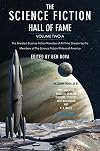
The Science Fiction Hall of Fame, Volume Two A: The Greatest Science Fiction Novellas of All Time
by Ben Bova
The Science Fiction Hall of Fame (2A), SFWA Hall of Fame volumes (2A)
On This Page
Description
Eleven essential classics in one volume This volume is the definitive collection of the best science fiction novellas published between 1929 and 1964, containing 11 great classics. No anthology better captures the birth of science fiction as a literary field. Published in 1973 to honor stories that had appeared before the institution of the Nebula Awards, The Science Fiction Hall of Fame introduced tens of thousands of young readers to the wonders of science fiction and was a favorite of show more libraries across the country. This volume contains the following: Introduction by Ben Bova Call Me Joe by Poul Anderson Who Goes There? by John W. Campbell Jr. (as Don A. Stuart) Nerves by Lester del Rey Universe by Robert A. Heinlein The Marching Morons by C. M. Kornbluth Vintage Season by Henry Kuttner and C. L. Moore (as Lawrence O'Donnell) And Then There Were None by Eric Frank Russell The Ballad of Lost C'Mell by Cordwainer Smith Baby Is Three by Theodore Sturgeon The Time Machine by H. G. Wells With Folded Hands by Jack Williamson. show lessTags
Recommendations


















Member Reviews
I almost wrote "it's hard for me to review this," since this was a treasured volume when I was an sf-devouring teenager, but it really isn't.
In a way, I wish it was. Hard, that is.
The SFWA-generated "Hall of Fame" volumes are good introductions to the whole "Golden Age" (it should really be "Golden Age Plus" since many of the stories post-date the typically-demarcated "Golden Age" of science fiction -- and one, the Wells, significantly pre-dates it) canon of science fiction -- as long as you don't think about it too much.
At this distance, even granting cultural this and historical that, it's hard for me to escape the feeling that the level of writing simply isn't very high. I know, I know: sacrilege! But reading through "Who Goes show more There?", though it proves anew how much more faithful to the source material John Carpenter was than Hawks, et al, really demonstrates that Campbell was a pretty bad writer. It's often difficult to tell exactly what's happening in "Who Goes There?" and although some of this is due to the attempt on the author's part to replicate a certain slangy way of speaking (as far as I can tell he fails miserably at this), most of it is due to the lumpiness of the prose. Cripes, is "tensity" even a word? Don't you mean "tension," Mr. Campbell? And it doesn't help that the author is predictably mired in a "Big Bronzed Men Doing Man Things in a Manly Way" place: boy does this kind of thing become tiresome after a while. It's not hard to see, reading this, where the obnoxious-ness of later Heinlein came from ... it's all here.
More to come. show less
In a way, I wish it was. Hard, that is.
The SFWA-generated "Hall of Fame" volumes are good introductions to the whole "Golden Age" (it should really be "Golden Age Plus" since many of the stories post-date the typically-demarcated "Golden Age" of science fiction -- and one, the Wells, significantly pre-dates it) canon of science fiction -- as long as you don't think about it too much.
At this distance, even granting cultural this and historical that, it's hard for me to escape the feeling that the level of writing simply isn't very high. I know, I know: sacrilege! But reading through "Who Goes show more There?", though it proves anew how much more faithful to the source material John Carpenter was than Hawks, et al, really demonstrates that Campbell was a pretty bad writer. It's often difficult to tell exactly what's happening in "Who Goes There?" and although some of this is due to the attempt on the author's part to replicate a certain slangy way of speaking (as far as I can tell he fails miserably at this), most of it is due to the lumpiness of the prose. Cripes, is "tensity" even a word? Don't you mean "tension," Mr. Campbell? And it doesn't help that the author is predictably mired in a "Big Bronzed Men Doing Man Things in a Manly Way" place: boy does this kind of thing become tiresome after a while. It's not hard to see, reading this, where the obnoxious-ness of later Heinlein came from ... it's all here.
More to come. show less
Many classic science fiction stories have been overtaken by later advances in science. While our understanding of the nature of Jupiter has rendered impossible the scenario presented by Call Me Joe by Poul Anderson, the story still resonates with the modern reader. Edward Anglesey is a psionicst working on a base located on one of Jupiter's moons who uses an esperprojector to control the body of a genetically engineered pseudojovian that has been placed on the inhospitable high-gravity high-pressure surface of the gas giant. Anglesey is disabled, confined to a wheelchair, but as the pseudojovian, dubbed "Joe", he lives as a powerful being in an inhospitable world. Due to persistent problems with the "k tubes" of the esperprojector show more resulting in feedback that destroys them, psionics expert Jan Cornelius is brought from Earth to investigate. Eventually Cornelius concludes that the problem is that Anglesey fears being alone on Jupiter, and the base commander agrees to send down more pseudojovian bodies to keep him company. This turns out to not be the case, and the story ends with what seems like a fairly predictable twist. In fact, the "twist" seems so obvious that one wonders what kind of society would have the technology to create complete genetically engineered alien bodies and project a man's mind into their brains, but wouldn't apply this technology to ameliorating the lives of the handicapped. After all, if one can engineer a body that could survive on the surface of Jupiter, couldn't one engineer an artificial human body that a severely disabled person could then inhabit? Even with the odd (and almost inconceivable) blind spot in the narrative, the story remains interesting and oddly compelling.
A story that has been adapted to film four times, Who Goes There? by John W. Campbell (writing as Don A. Stuart) tells the tale of a group of researchers in an isolated Antarctic Station who find an alien ship and alien embedded in the ice. The alien, whose body had been recovered prior to the start of the story, is the subject of a debate among the group, as they argue over whether to thaw it out and dissect it to study it. Since there wouldn't be a story otherwise, they elect to do so, and the alien turns out to be not quite as dead as they thought. The alien also turns out to be entirely unlike anything they expected, and far more dangerous than they had assumed it could be. The fundamental themes of the story are human hubris and human resourcefulness, as the various characters all arrogantly stumble their way into serious trouble, at times purposefully, and at others merely clumsily. One might note that for an alleged research station full of scientists, the characters are quite sloppy and often woefully unprepared to do actual research. In trying to dislodge the alien ship from the ice, they use dynamite and accidentally drop it into a watery abyss. To dissect the alien, they use the kitchen table normally used to butcher cattle. They take absolutely no steps to prevent contamination of the alien body or the rest of the base. And so on. The fundamental idea of the story, and the insidious nature of the alien threat make the story work despite these weaknesses (hence the four film adaptations), but in the story is feels like many of the troubles faced by the heroic researchers are self-inflicted. Further, even though the story ends on an optimistic note, with the heroes supposedly having defeated the threat, one has to wonder if they are simply displaying more of the hubris that has tripped them up throughout.
One of the persistent problems faced by near-future science fiction stories is that they become dated almost impossibly fast. Nerves by Lester del Rey seems to have fallen victim to this all too common occurrence. The story follows Doc Ferrel, the resident physician at National Atomics, as he and his team deal with the casualties from an accident in one of the plant's reactors. The story is essentially a set of problems to be solved: Every couple of pages a new crisis crops up and the various characters roll up their sleeves and figure out a way to solve it. The story is made somewhat more interesting by the fact that for the bulk of it, the doctors on staff are merely dealing with the various medical issues, and have only a limited idea of what is going on at the reactor, adding a dimension of uncertainty to the plot. The problem with the story is that a lot of the science it contains simply doesn't hold up. One of the most glaring issues is that the primary concern the doctors have about the bulk of their patients is surgically extracting the granules of radioactive material embedded in their bodies and preventing the "jerks" caused by such granules with injections of curare. On the other hand, no one seems at all concerned about the lasting effects of radiation exposure, and the only real issue ever brought up about keeping them men safe while working in the destroyed reactor area is to make sure they have enough armor to shield them from the intense heat. Looking at the story now, it seems pretty clear that everyone, including the medical staff, is likely to die from radiation poisoning within a few weeks of the events described in its pages. On a lesser scale, it seems somewhat quaint that the primary purpose of the reactors at the plant is to produce medical, industrial, and agricultural radioactive isotopes and not energy. Finally, the eventual solution to the problem of the isotopes at the melted reactor blowing up is one that seems almost incomprehensible to the modern reader: Dump all the radioactive material into a nearby wetland wilderness and hope that cools everything down. On the other hand, the sequence in which the doctors perform open-heart surgery and use electric stimulation to restart a patient's heart seems almost prescient. From a certain perspective, the story is still a decent read, as del Rey manages to make things seem tense and moves the plot along fairly well. From another perspective, the ridiculously outdated science undermines the rest of the story.
Stories involving a civilization that has lost knowledge and descended into barbarism are fairly common in science fiction. Stories involving massive star ships that take generations to cross the vast distances between the stars are also fairly common. Universe, by Robert A. Heinlein, combines these two elements and adds in some cautionary notes about the dangers of religious dogmatism and bigotry to boot. Hugh Hoyland lives in the Ship as part of the crew. He lives a fairly ordinary life, punctuated only by jaunts up into the "no-weight" levels to hunt the "muties" that live there until he is taken to become a scientist and learn from the books left by his forefathers. It is in this part of the story that the reader learns that the members of Hoyland's society don't actually understand the science they are reading. Later, after he has been captured by the intellectual mutie Joe-Jim, Hugh is taught the real science, slowly coming to understand how gravity works, what the stars are, and even the true nature of the Ship. This sort of story, in which the reader understand the physics while the character does not, can be handled badly by an inexperienced writer, as the character's "eureka" moment can easily fall flat: After all, the reader isn't surprised when the character grasps some basic concept or realizes what a particular piece of technology is for, so the scene is hard to make seem gripping. Heinlein, however, handles this element quite well, in large part because he goes to great lengths to show just how reasonable the flawed understanding of the crew's scientists is. From their limited perspective, the world doesn't work according to the principles laid out in the texts their ancestors left them, so the only rational interpretation is to regard such passages as metaphors. In short, theory doesn't match observation or experiment, so the theory had been discarded. The real trouble occurs when Hoyland returns, having seen the evidence that proves the texts in question are not metaphors, and attempts to spread this message. Because the accepted wisdom composed of the flawed understanding of the scientists has become an article of faith, Hoyland ends up being condemned as a heretic. What was a simple question of the limitations imposed by one's perspective becomes a warning about the dangers of mixing the fundamentally incompatible thinking of science and religion, but also with the hopeful message that, perhaps, facts and evidence can eventually be used to overcome dogmatism. At the very least, the story ends with Hugh determined to try.
The Marching Morons by Cyril M. Kornbluth
Vintage Season by Henry Kuttner and C.L. Moore (writing as Lawrence O'Donnell)
. . . And Then There Were None by Eric Frank Russell
The Ballad of Lost C'Mell by Cordwainer Smith
Baby Is Three by Theodore Sturgeon
The Time Machine by H.G. Wells
With Folded Hands by Jack Williamson
[More forthcoming] show less
A story that has been adapted to film four times, Who Goes There? by John W. Campbell (writing as Don A. Stuart) tells the tale of a group of researchers in an isolated Antarctic Station who find an alien ship and alien embedded in the ice. The alien, whose body had been recovered prior to the start of the story, is the subject of a debate among the group, as they argue over whether to thaw it out and dissect it to study it. Since there wouldn't be a story otherwise, they elect to do so, and the alien turns out to be not quite as dead as they thought. The alien also turns out to be entirely unlike anything they expected, and far more dangerous than they had assumed it could be. The fundamental themes of the story are human hubris and human resourcefulness, as the various characters all arrogantly stumble their way into serious trouble, at times purposefully, and at others merely clumsily. One might note that for an alleged research station full of scientists, the characters are quite sloppy and often woefully unprepared to do actual research. In trying to dislodge the alien ship from the ice, they use dynamite and accidentally drop it into a watery abyss. To dissect the alien, they use the kitchen table normally used to butcher cattle. They take absolutely no steps to prevent contamination of the alien body or the rest of the base. And so on. The fundamental idea of the story, and the insidious nature of the alien threat make the story work despite these weaknesses (hence the four film adaptations), but in the story is feels like many of the troubles faced by the heroic researchers are self-inflicted. Further, even though the story ends on an optimistic note, with the heroes supposedly having defeated the threat, one has to wonder if they are simply displaying more of the hubris that has tripped them up throughout.
One of the persistent problems faced by near-future science fiction stories is that they become dated almost impossibly fast. Nerves by Lester del Rey seems to have fallen victim to this all too common occurrence. The story follows Doc Ferrel, the resident physician at National Atomics, as he and his team deal with the casualties from an accident in one of the plant's reactors. The story is essentially a set of problems to be solved: Every couple of pages a new crisis crops up and the various characters roll up their sleeves and figure out a way to solve it. The story is made somewhat more interesting by the fact that for the bulk of it, the doctors on staff are merely dealing with the various medical issues, and have only a limited idea of what is going on at the reactor, adding a dimension of uncertainty to the plot. The problem with the story is that a lot of the science it contains simply doesn't hold up. One of the most glaring issues is that the primary concern the doctors have about the bulk of their patients is surgically extracting the granules of radioactive material embedded in their bodies and preventing the "jerks" caused by such granules with injections of curare. On the other hand, no one seems at all concerned about the lasting effects of radiation exposure, and the only real issue ever brought up about keeping them men safe while working in the destroyed reactor area is to make sure they have enough armor to shield them from the intense heat. Looking at the story now, it seems pretty clear that everyone, including the medical staff, is likely to die from radiation poisoning within a few weeks of the events described in its pages. On a lesser scale, it seems somewhat quaint that the primary purpose of the reactors at the plant is to produce medical, industrial, and agricultural radioactive isotopes and not energy. Finally, the eventual solution to the problem of the isotopes at the melted reactor blowing up is one that seems almost incomprehensible to the modern reader: Dump all the radioactive material into a nearby wetland wilderness and hope that cools everything down. On the other hand, the sequence in which the doctors perform open-heart surgery and use electric stimulation to restart a patient's heart seems almost prescient. From a certain perspective, the story is still a decent read, as del Rey manages to make things seem tense and moves the plot along fairly well. From another perspective, the ridiculously outdated science undermines the rest of the story.
Stories involving a civilization that has lost knowledge and descended into barbarism are fairly common in science fiction. Stories involving massive star ships that take generations to cross the vast distances between the stars are also fairly common. Universe, by Robert A. Heinlein, combines these two elements and adds in some cautionary notes about the dangers of religious dogmatism and bigotry to boot. Hugh Hoyland lives in the Ship as part of the crew. He lives a fairly ordinary life, punctuated only by jaunts up into the "no-weight" levels to hunt the "muties" that live there until he is taken to become a scientist and learn from the books left by his forefathers. It is in this part of the story that the reader learns that the members of Hoyland's society don't actually understand the science they are reading. Later, after he has been captured by the intellectual mutie Joe-Jim, Hugh is taught the real science, slowly coming to understand how gravity works, what the stars are, and even the true nature of the Ship. This sort of story, in which the reader understand the physics while the character does not, can be handled badly by an inexperienced writer, as the character's "eureka" moment can easily fall flat: After all, the reader isn't surprised when the character grasps some basic concept or realizes what a particular piece of technology is for, so the scene is hard to make seem gripping. Heinlein, however, handles this element quite well, in large part because he goes to great lengths to show just how reasonable the flawed understanding of the crew's scientists is. From their limited perspective, the world doesn't work according to the principles laid out in the texts their ancestors left them, so the only rational interpretation is to regard such passages as metaphors. In short, theory doesn't match observation or experiment, so the theory had been discarded. The real trouble occurs when Hoyland returns, having seen the evidence that proves the texts in question are not metaphors, and attempts to spread this message. Because the accepted wisdom composed of the flawed understanding of the scientists has become an article of faith, Hoyland ends up being condemned as a heretic. What was a simple question of the limitations imposed by one's perspective becomes a warning about the dangers of mixing the fundamentally incompatible thinking of science and religion, but also with the hopeful message that, perhaps, facts and evidence can eventually be used to overcome dogmatism. At the very least, the story ends with Hugh determined to try.
The Marching Morons by Cyril M. Kornbluth
Vintage Season by Henry Kuttner and C.L. Moore (writing as Lawrence O'Donnell)
. . . And Then There Were None by Eric Frank Russell
The Ballad of Lost C'Mell by Cordwainer Smith
Baby Is Three by Theodore Sturgeon
The Time Machine by H.G. Wells
With Folded Hands by Jack Williamson
[More forthcoming] show less
After really enjoying Volume One of this series, I was all set to enjoy Volume Two, which was divided into two halves because it would have been outrageously big. As it is, Volume Two A is already pretty big. I don't know what it was, though, but Volume Two A didn't impress me anywhere near as much as Volume One, which was filled with stories I thought were excellent-- and rightly so, given that they were supposed to be the definitively best short stories published prior to 1964. But the best novellas of the same time period were pretty average for the most part. There were some standouts, however: I really liked Universe by Robert A. Heinlein even though I thought it felt like half a story. (Wikipedia has informed me that it is half a show more story; Heinlein connected it with another novella later on to make a full novel.) Cyril M. Kornbluth's The Marching Morons was also good fun. My favorite of the book was probably Vintage Season by Henry Kuttner and C.L. Moore, a surprisingly affecting story about tourists from the distant future and their effect on one man. show less
One of the best collections of sci-fi I've ever read (focused on those selected by other writers). Novellas, which is a pretty good length for sci-fi (although I'm also very partial to short stories).
I'd only read a few of these before (most notably H.G. Wells The Time Machine, which was written in 1895 and seems like something which could have started the genre any time in the 20th century; truly before his time). A few were ok to good, most were very good to excellent.
Works particularly well as an audiobook. Looking forward to vol 2-B.
The best:
Call Me Joe (Poul Anderson)(1957)
The Marching Morons (C.M. Kornbluth)(1951)
Who Goes There? (John Campbell)(1938)
With Folded Hands (Jack Williamson)
" . . . And Then There Were None," by Eric show more Frank Russell. show less
I'd only read a few of these before (most notably H.G. Wells The Time Machine, which was written in 1895 and seems like something which could have started the genre any time in the 20th century; truly before his time). A few were ok to good, most were very good to excellent.
Works particularly well as an audiobook. Looking forward to vol 2-B.
The best:
Call Me Joe (Poul Anderson)(1957)
The Marching Morons (C.M. Kornbluth)(1951)
Who Goes There? (John Campbell)(1938)
With Folded Hands (Jack Williamson)
" . . . And Then There Were None," by Eric show more Frank Russell. show less
This review is written with a GPL 4.0 license and the rights contained therein shall supersede all TOS by any and all websites in regards to copying and sharing without proper authorization and permissions. Crossposted at WordPress, Blogspot & Librarything by Bookstooge’s Exalted Permission
Title: The Great Novellas
Series: Science Fiction Hall of Fame #2A
Editor : Ben Bova
Rating: 2 of 5 Stars
Genre: SF
Pages: 790
Words: 216K
Synopsis:
Consists of the following novellas by these authors:
Call Me Joe by Poul Anderson
Who Goes There? By John Campbell Jr
Nerves by Lester Del Rey
Universe by Robert Heinlein
The Marching Morons by C.M Kornbluth
Vintage Season by Kuttner and Moore
...And Then There Were None by Eric Russell
The Ballad of Lost C'Mell by show more Cordwainer Smith
Baby is Three by Theodore Sturgeon
The Time Machine by H.G. Wells
With Folded Hands by Jack Williamson
My Thoughts:
The only reason this volume is getting 2stars instead of 1 is because of the story “Who Goes There?”, which has been turned into the various movies “The Thing” and is the basis for one of the X-Files episodes in Season One.
Part of my disappointment with this book was just how good Volume 1 was, which I read back in '18. That collection of short stories was everything I expected from the Golden Age of SF. These novellas on the other hand are boring, plain and simple.
Take “Nerves” for instance. It is about a Doctor working at an Atomic Plant because he used to be a brain surgeon but an operation went wrong years ago. It wasn't his fault and there was nothing he could do about it, but he couldn't face the fact that he wasn't perfect, so he ran away from his profession to become a “simple” general practitioner. Only something goes terribly wrong at the Plant and the only way to save the whole world is for him to do brain surgery on a wounded engineer. The lead up was too long and the tension just wasn't there. Most of these stories I simply found too long. I kept asking myself “when will this story be over already?!?”
On the other hand, you had some horrific ideas. “The Marching Morons” was about a salesman revived hundreds of years later. The world has become populated by morons because all the smart people stopped having kids a long time ago and the remaining thousand or so people with IQ's above X all live in the North Pole at a secret base. They secretly run the world but are tired of it, as the morons keep on multiplying and nothing the Clever People can do stops them. The Clever People tried to take a hands off approach but the war started by the Morons was too much for them to accept and so they stepped back in and began directing things again. The Salesman tells the Clever People to start a rumor of colonies on Mars or Venus or wherever and to hold a lottery for an entire city to go on rocket ships to this new colony. Then another city would be picked, etc, etc. The salesman puts together the ads and campaign and has the Morons clamoring to go to Venus. Of course, the rockets just go into the Sun and kill all the morons. The Salesman became Dictator of the World (that was what he wanted to give the Clever People his help) and the story ends with all the Morons gone and the Clever People throwing the Salesman into the last rocketship and sending it off. Now, whatever the author was trying to say went over my head, because this was just horrible. The Salesman was horrible, the Morons were horrible and the Clever People were horrible.
There is one more volume, Volume 2B (why they simply didn't call them Vol. 1, 2 and 3 is beyond me) and I'm going to read it. I am desperately hoping it is better than this. It is another collection of novellas though, so I am keeping my DNF gun handy and my finger on the trigger. I won't wade through another crapfest like this.
★★☆☆☆ show less
Title: The Great Novellas
Series: Science Fiction Hall of Fame #2A
Editor : Ben Bova
Rating: 2 of 5 Stars
Genre: SF
Pages: 790
Words: 216K
Synopsis:
Consists of the following novellas by these authors:
Call Me Joe by Poul Anderson
Who Goes There? By John Campbell Jr
Nerves by Lester Del Rey
Universe by Robert Heinlein
The Marching Morons by C.M Kornbluth
Vintage Season by Kuttner and Moore
...And Then There Were None by Eric Russell
The Ballad of Lost C'Mell by show more Cordwainer Smith
Baby is Three by Theodore Sturgeon
The Time Machine by H.G. Wells
With Folded Hands by Jack Williamson
My Thoughts:
The only reason this volume is getting 2stars instead of 1 is because of the story “Who Goes There?”, which has been turned into the various movies “The Thing” and is the basis for one of the X-Files episodes in Season One.
Part of my disappointment with this book was just how good Volume 1 was, which I read back in '18. That collection of short stories was everything I expected from the Golden Age of SF. These novellas on the other hand are boring, plain and simple.
Take “Nerves” for instance. It is about a Doctor working at an Atomic Plant because he used to be a brain surgeon but an operation went wrong years ago. It wasn't his fault and there was nothing he could do about it, but he couldn't face the fact that he wasn't perfect, so he ran away from his profession to become a “simple” general practitioner. Only something goes terribly wrong at the Plant and the only way to save the whole world is for him to do brain surgery on a wounded engineer. The lead up was too long and the tension just wasn't there. Most of these stories I simply found too long. I kept asking myself “when will this story be over already?!?”
On the other hand, you had some horrific ideas. “The Marching Morons” was about a salesman revived hundreds of years later. The world has become populated by morons because all the smart people stopped having kids a long time ago and the remaining thousand or so people with IQ's above X all live in the North Pole at a secret base. They secretly run the world but are tired of it, as the morons keep on multiplying and nothing the Clever People can do stops them. The Clever People tried to take a hands off approach but the war started by the Morons was too much for them to accept and so they stepped back in and began directing things again. The Salesman tells the Clever People to start a rumor of colonies on Mars or Venus or wherever and to hold a lottery for an entire city to go on rocket ships to this new colony. Then another city would be picked, etc, etc. The salesman puts together the ads and campaign and has the Morons clamoring to go to Venus. Of course, the rockets just go into the Sun and kill all the morons. The Salesman became Dictator of the World (that was what he wanted to give the Clever People his help) and the story ends with all the Morons gone and the Clever People throwing the Salesman into the last rocketship and sending it off. Now, whatever the author was trying to say went over my head, because this was just horrible. The Salesman was horrible, the Morons were horrible and the Clever People were horrible.
There is one more volume, Volume 2B (why they simply didn't call them Vol. 1, 2 and 3 is beyond me) and I'm going to read it. I am desperately hoping it is better than this. It is another collection of novellas though, so I am keeping my DNF gun handy and my finger on the trigger. I won't wade through another crapfest like this.
★★☆☆☆ show less
I ought to seek out the other books that are published. I have read this book while healing in the hospital. These stories go beyond science fiction and into classic stories that presented some unique ideas that I found through other media when I was younger. I'd read Baby is Three as a graphic novel: More Human Than Human published by Heavy Metal. Of course "Who Goes There?" was made into a movie but the second incarnation by John Carpenter is what made me seek out the story and read it. "The Marching Morons" was a story I think I found in one of my Father's old scifi magazines. And H.G. Wells' "The Time Machine" has been done so many times I had to read it to make sure nothing was left out. "Call Me Joe" begs the question: whoever show more wrote Avatar, did they read this short story?
This is classic Science Fiction at it's best. I hope to be able to find the other books and read more. show less
This is classic Science Fiction at it's best. I hope to be able to find the other books and read more. show less
Pretty much every story a classic. Would be a great gift for a new science fiction reader. (Along with its companion volume.)
Members
- Recently Added By
Lists

Books Read in 2018
4,360 works; 110 members
Author Information

469+ Works 34,283 Members
Ben Bova, Ben Bova was born in Philadelphia, Pennsylvania. He began writing fiction in the late 1940's and continued to pursue his careers in journalism, aerospace, education and publishing. Bova received a bachelor's degree in journalism from Temple University, 1954, a master of arts degree in communications from the State University of New York, show more 1987, and a doctorate in education from California Coast University, 1996. Dr. Bova worked as a newspaper reporter for several years and then joined Project Vanguard, the first American satellite program, as a technical editor. He was manager of marketing for Avco Everett Research Laboratory and worked with scientists in the fields of high-power lasers, artificial hearts and advanced electrical power generators. Dr. Bova has taught science fiction at Harvard University and at the Hayden Planetarium in New York City, where he also directed film courses. He has written scripts for teaching films with the Physical Sciences Study Committee in association with Nobel Laureates from many universities. Dr. Bova has served on the advisory board of Post College and the Editorial Boards of the World Future Society. He is President Emeritus of the National Space Society and a Fellow of the British Interplanetary Society. He is also a charter member of the Planetary Society and a member of the American Association for the Advancement of Science, the Nature Conservancy, the New York Academy of Sciences and the National Space Club. He is a former President and a charter member of Science Fiction and Fantasy Writers of America. He was honored by Temple University as a Distinguished Alumnus in 1981 and in 1982 was made an Alumni Fellow. In 1994, his short story "Inspiration" was nominated for the Nebula Award. "The Beauty of Light" was voted one of the best science books of the year in 1988 by the American Librarians' Association and they hailed "Moonrise" as best science fiction novel in 1996. Other titles include "Moonwar," "Mars," and "Brothers," which all combine romance and adventure with the scientific aspect of exploring the future of technology and its effect on individuals and society. "Immortality" and "Assured Survival" deal with technology being used to solve economic, social and political problems. "Immortality" goes further in examining biomedical breakthroughs that could extend a person's life by hundreds of years while being able to always remain physically young. His works include The Aftermath, Mars Life, and Leviathans of Jupiter. Ben Bova was a prolific science fiction author. He wrote over a hundred books and short stories. He also was an editor who worked on some of science fiction's best-known publications. He died on November 29, 2020 at the age of 88. (Bowker Author Biography) show less
All Editions
Series


Belongs to Publisher Series
Science Fiction Book Club (5685)
Work Relationships
Is contained in
Contains
Common Knowledge
- Canonical title
- The Science Fiction Hall of Fame, Volume Two A: The Greatest Science Fiction Novellas of All Time
- Original publication date
- 1973
- First words
- The wind came whooping out of eastern darkness, driving a lash of ammonia dust before it.
- Last words
- (Click to show. Warning: May contain spoilers.)There was nothing left to do.
- Disambiguation notice
- Volume 2 of the Science Fiction Hall of Fame is Novellas. There were 24 in total, but 22 are included in the volume. Beause this made it such a large collection, volume 2 was split (and then split again into 3 for the paper... (show all)back edition) with 2A containing:
"Call Me Joe" by Poul Anderson (paperback Book 1)
"Who Goes There?" by John W. Campbell, Jr. (paperback Book 1)
"Nerves" by Lester del Rey (paperback Book 1)
"Universe" by Robert A. Heinlein (paperback Book 2)
"The Marching Morons" by C. M. Kornbluth (paperback Book 3)
"Vintage Season" by Henry Kuttner and C. L. Moore (paperback Book 2)
". . . And Then There Were None" by Eric Frank Russell (paperback Book 3)
"The Ballad of Lost C'Mell" by Cordwainer Smith (paperback Book 2)
"Baby Is Three" by Theodore Sturgeon (paperback Book 3)
"The Time Machine" by H. G. Wells (not in paperback)
"With Folded Hands" by Jack Williamson (paperback Book 2)
Classifications
- Genres
- Science Fiction, Fiction and Literature
- DDC/MDS
- 813.087608 — Literature & rhetoric American literature in English American fiction in English By type Genre fiction Adventure fiction Speculative fiction Collections
- LCC
- PS648 .S3 — Language and Literature American literature American literature Collections of American literature Prose (General)
- BISAC
Statistics
- Members
- 991
- Popularity
- 26,410
- Reviews
- 12
- Rating
- (4.09)
- Languages
- English
- Media
- Paper, Audiobook, Ebook
- ISBNs
- 12
- ASINs
- 18