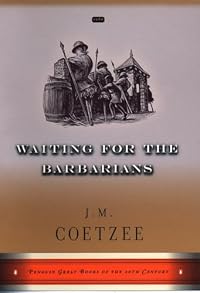
Waiting for the barbarians
by J. M. Coetzee
On This Page
Description
For decades the Magistrate has been a loyal servant of the Empire, running the affairs of a tiny frontier settlement and ignoring the impending war with the barbarians. When interrogation experts arrive, however, he witnesses the Empire's cruel and unjust treatment of prisoners of war. Jolted into sympathy for their victims, he commits a quixotic act of rebellion that brands him an enemy of the state. J. M. Coetzee's prize-winning novel is a startling allegory of the war between opressor and show more opressed. The Magistrate is not simply a man living through a crisis of conscience in an obscure place in remote times; his situation is that of all men living in unbearable complicity with regimes that ignore justice and decency. -- from http://www.powells.com (August 28, 2014). show lessTags
Recommendations


















Member Recommendations

CGlanovsky Frontier outpost of an unnamed state vaguely threatened by an ambiguous enemy living across a vast wasteland.
20




Member Reviews
A disconcerting fable about a Magistrates downfall once he decides to oppose the Empires treatment of captured "barbarians". Far from being one-dimensional the narrative treats complicated themes like justice, guilt, civilisation, identity with which the Magistrate struggles. Coetzee's prose as economical and crystal clear as ever, creating strong character images such as of the colonel Joll and the crippled barbarian girl. This girl, tortured to almost blindness, becomes the Magistrates obsession, as she represents for him his guilt of the violence against her people. He wants to repair this guilt, cure her and at the same time to understand the cause of it. Why does man, even civilized man, resort to violence against his fellow man? show more The magistrate obsessively looks for answers in the girls wounds that he tries to "decipher", like ancient written testimonies, interrogates her, searches his memory of her before she was violated etc. When all fails, he undertakes a sort of cleansing pilgrimage, taking her back to her tribe. Once back he has to undergo the same violence himself.
It is knowledge, self-consciousness that creates guilt. Once you realize what is going on, animalistic passions like unlimited sex or rape and hunting are no longer guilt-free: Adam and Eve revisited. Ironically, the barbarians are the ones without guilt whereas the civilized world cannot escape it. The only remedy for us is to cut ourselves off from the outer world in an encampment and wait, purposly, impotent, disconnected from our true being. And this is precisely the state the civilized people of the poem of Cafavy are in, once they realize that the barbarians are not coming to set them free, to release them from their lethargic state. show less
It is knowledge, self-consciousness that creates guilt. Once you realize what is going on, animalistic passions like unlimited sex or rape and hunting are no longer guilt-free: Adam and Eve revisited. Ironically, the barbarians are the ones without guilt whereas the civilized world cannot escape it. The only remedy for us is to cut ourselves off from the outer world in an encampment and wait, purposly, impotent, disconnected from our true being. And this is precisely the state the civilized people of the poem of Cafavy are in, once they realize that the barbarians are not coming to set them free, to release them from their lethargic state. show less
A Magistrate presides over a small frontier town at the edge of the desert, living in a peaceful coexistence with the indigenous population, until the arrival of Colonel Joll of the Third Bureau, the military arm of the ruling Empire. The Colonel and his troops have been sent to put down an uprising of Barbarians; however, no such uprising is actually occurring. Nevertheless, the troops follow orders by rounding up suspects and detaining them, while the Colonel “questions” them via torture. The Magistrate at first distracts himself to avoid confronting the fact that the detainees are being tortured, but eventually his conscience will not allow him to remain a passive observer and he takes action that puts him at odds with the show more Empire. The story is told in first-person by the Magistrate, so the reader is privy to his thoughts as he muses philosophically on this moral crisis, while not letting himself off the hook for his own involvement as a bureaucrat doing the bidding of the Empire. His thoughts stray into his sexual liaisons, and he develops an unusual relationship with one of the brutalized women.
This slim volume may be read as an allegory condemning imperialism. It is narrated by an unnamed Magistrate in an unspecified country by an unidentified Empire. It shows exploitation and control through incitement of fear, violence against the native populace, and sexual dominance over women. It is graphic in its descriptions of torture, sexual practices, and other bodily functions. The prose is masterful and contains a good amount of Biblical symbolism. The final chapter is not quite as strong as the previous sections. This book provides food for thought on the decision to act in the face of injustice, while recognizing the personal risks. Published in 1980, with obvious allusions to apartheid in South Africa, it remains a timeless statement denouncing the dehumanization of those viewed as “other.” show less
This slim volume may be read as an allegory condemning imperialism. It is narrated by an unnamed Magistrate in an unspecified country by an unidentified Empire. It shows exploitation and control through incitement of fear, violence against the native populace, and sexual dominance over women. It is graphic in its descriptions of torture, sexual practices, and other bodily functions. The prose is masterful and contains a good amount of Biblical symbolism. The final chapter is not quite as strong as the previous sections. This book provides food for thought on the decision to act in the face of injustice, while recognizing the personal risks. Published in 1980, with obvious allusions to apartheid in South Africa, it remains a timeless statement denouncing the dehumanization of those viewed as “other.” show less
This book contains some powerful meditations on sexuality, aging, colonization, torture, shame, and the state. I read this as a parable to the War on Terror, though it would fit with many other conflicts: the proxy wars in Latin America, the colonial wars in Africa, even the Black liberation movements inside the US in the 1970s.
Coetzee demonstrates in the very beginning of the book the ruthlessness of a state apparatus in a community created by the state but living largely outside of it's influence. The occupiers of the land in Waiting for the Barbarians are living in something close to stasis with the indigenous, until the Empire decides to make its mark on history and pull the settlement out of its stasis: torturing and murdering with show more lightning speed, the higher-ups of Empire make a threat out of one particular group of people to garner support for their sadistic treatment: "What has made it impossible to live in time like fish in water[...:]? It is the fault of Empire! Empire has created the time of history. Empire has located its existance [...:] in the jagged time of rise and fall, of beginning and end, of catastrophe."
But the settlement bureaucrat finds it difficult to argue with the logic of Empire: he has been nursed so long on the same assumptions of Empire, that to challenge them would be inimical to his entire worldview: "Easier to lay my head on a block than to defend the cause of justice for the barbarians: for where can that argument lead but to laying down our arms and opening the gates of the town to the people whose land we have raped?" This mirrors the opposition to war in the US: those who hold the assumptions of empire, and who have been raised with those assumptions, cannot reconcile these beliefs and advocate for justice for the colonized. They are stuck in powerless position of upholding the pillars that hold up the institution of war, while merely wishing the war would end.
The narrator witnesses the savagery of torture and interrogation, and then experiences the imprisonment for himself. There is no capacity for the accused, imprisoned, and locked up to be justly given hearing, for: "they will never bring a man to trial while he is healthy and strong enough to confound them. They will shut me away in the dark till I am a muttering idiot, a ghost of myself; then they will haul me before a closed court and in five minutes dispose of the legalities they find so tiresome."
Guantanamo Bay prisoners are held without fair trial and only after having been broken by the prison system are they given the space to defend themselves. It also evokes the experiences of Black Liberation prisoners in the US, like the Angola 3. These men were clear-headed human beings, but have been reduced to much less, their brain turned to jelly after decades kept in solitary confinement, a broken shadow of their former selves. Without reasonable recourse, the prisoner lashes out at his nearest captors physically, "If he comes near me I will hit him with all the strength in my body. I will not disappear into the earth without leaving my mark on them."
The book is powerful in its demonstration of how deeply individuals are affected by torture. The book captures the feeling of powerlessness and stupidity felt by those who are shamed and broken by the state. show less
Coetzee demonstrates in the very beginning of the book the ruthlessness of a state apparatus in a community created by the state but living largely outside of it's influence. The occupiers of the land in Waiting for the Barbarians are living in something close to stasis with the indigenous, until the Empire decides to make its mark on history and pull the settlement out of its stasis: torturing and murdering with show more lightning speed, the higher-ups of Empire make a threat out of one particular group of people to garner support for their sadistic treatment: "What has made it impossible to live in time like fish in water[...:]? It is the fault of Empire! Empire has created the time of history. Empire has located its existance [...:] in the jagged time of rise and fall, of beginning and end, of catastrophe."
But the settlement bureaucrat finds it difficult to argue with the logic of Empire: he has been nursed so long on the same assumptions of Empire, that to challenge them would be inimical to his entire worldview: "Easier to lay my head on a block than to defend the cause of justice for the barbarians: for where can that argument lead but to laying down our arms and opening the gates of the town to the people whose land we have raped?" This mirrors the opposition to war in the US: those who hold the assumptions of empire, and who have been raised with those assumptions, cannot reconcile these beliefs and advocate for justice for the colonized. They are stuck in powerless position of upholding the pillars that hold up the institution of war, while merely wishing the war would end.
The narrator witnesses the savagery of torture and interrogation, and then experiences the imprisonment for himself. There is no capacity for the accused, imprisoned, and locked up to be justly given hearing, for: "they will never bring a man to trial while he is healthy and strong enough to confound them. They will shut me away in the dark till I am a muttering idiot, a ghost of myself; then they will haul me before a closed court and in five minutes dispose of the legalities they find so tiresome."
Guantanamo Bay prisoners are held without fair trial and only after having been broken by the prison system are they given the space to defend themselves. It also evokes the experiences of Black Liberation prisoners in the US, like the Angola 3. These men were clear-headed human beings, but have been reduced to much less, their brain turned to jelly after decades kept in solitary confinement, a broken shadow of their former selves. Without reasonable recourse, the prisoner lashes out at his nearest captors physically, "If he comes near me I will hit him with all the strength in my body. I will not disappear into the earth without leaving my mark on them."
The book is powerful in its demonstration of how deeply individuals are affected by torture. The book captures the feeling of powerlessness and stupidity felt by those who are shamed and broken by the state. show less
"When some men suffer unjustly," I said to myself, "it is the fate of those who witness their suffering to suffer the shame of it."
This book felt weightier than the 150 or so pages it is. Written in vivid prose filled with allegory and irony, it is the kind of novel that leaves with you with so many observations and musings that I'll try to articulate as best as I can.
The protagonist has been serving faithfully as a magistrate in his small frontier settlement for decades. When the Empire perceives that its stability is threatened it sends agents to frontiers, his being one of them, whose methods of torture force the magistrate to try and help the victims and hence work against the oppressive system he has been loyally serving for show more years.
From the very beginning, 'the other' is established (ever since we read the title really). Primarily it is the tribe of herdspeople that are referred to as Barbarians who were once native to the settlement and are constantly pushed off their land by the Empire, but then it changes to fisherfolk tribes and whatever other people that have different ways from the settlers.
Throughout the whole book there is a sense of watchfulness. The settlers watch and at times participate in the torture and dehumanisation that captives from the other tribes suffer at the hands of their oppressors, and the magistrate himself is later watched by those he served as he is abased for his protest against these tortures. I couldn't help but notice that an oppressive system requires its passive participants as much as it does the aggressive ones.
But the single bit that was hardest to get was the magistrate who narrates the story. He is able to see and recognise injustice and act against it yet unable to go further as to place himself on an equal footing with peoples of the other tribes and perceives them to be inferior. Throughout the book I waited for him to come to this realisation. I was so disturbed by this, and it was only later that I became aware that there are so many people like him, those who are able to identify and protest injustice but still believe in tenets rooted in ignorance of their superiority having been part of an oppressive system through the years.
I believe Mr. Coetzee has written a solid work with this book which will always remain relevant as long as an oppressor and the oppressed, in whatever form, exist. show less
This book felt weightier than the 150 or so pages it is. Written in vivid prose filled with allegory and irony, it is the kind of novel that leaves with you with so many observations and musings that I'll try to articulate as best as I can.
The protagonist has been serving faithfully as a magistrate in his small frontier settlement for decades. When the Empire perceives that its stability is threatened it sends agents to frontiers, his being one of them, whose methods of torture force the magistrate to try and help the victims and hence work against the oppressive system he has been loyally serving for show more years.
From the very beginning, 'the other' is established (ever since we read the title really). Primarily it is the tribe of herdspeople that are referred to as Barbarians who were once native to the settlement and are constantly pushed off their land by the Empire, but then it changes to fisherfolk tribes and whatever other people that have different ways from the settlers.
Throughout the whole book there is a sense of watchfulness. The settlers watch and at times participate in the torture and dehumanisation that captives from the other tribes suffer at the hands of their oppressors, and the magistrate himself is later watched by those he served as he is abased for his protest against these tortures. I couldn't help but notice that an oppressive system requires its passive participants as much as it does the aggressive ones.
But the single bit that was hardest to get was the magistrate who narrates the story. He is able to see and recognise injustice and act against it yet unable to go further as to place himself on an equal footing with peoples of the other tribes and perceives them to be inferior. Throughout the book I waited for him to come to this realisation. I was so disturbed by this, and it was only later that I became aware that there are so many people like him, those who are able to identify and protest injustice but still believe in tenets rooted in ignorance of their superiority having been part of an oppressive system through the years.
I believe Mr. Coetzee has written a solid work with this book which will always remain relevant as long as an oppressor and the oppressed, in whatever form, exist. show less
A clear indictment of all nations built on colonial ambition but more broadly the propensity within all of us to characterise and brutalise The Other, Coetzee’s novel pulls no punches.
An anonymous magistrate rules over a small outpost on the edge of the frontier. His political placidity is disturbed by envoys from the capital who bring with them rumours of a Barbarian uprising, rumours he feels are being fomented as an excuse for a roundup. He’s not wrong.
The novel falls into two halves. The first tells of the magistrate’s management of the settlement in the face of outside interference. In particular it details his relationship with one particular indigenous woman.
This relationship is a the wider parable in microcosm. The two show more find their are mutually incomprehensible. One is all powerful, the other crippled and blinded. Attempts at intimacy are one-sided. The solution to all of this is, again, unilateral and it is at this point the book pivots.
The second half sees the magistrate in a very different position from the first. There’s less pschology going on here between reader and writer, I felt as the writing became more matter of fact. The ending is ambiguous and leaves the reader to make their own conclusions about what they have witnessed and what might yet come to pass.
Coetzee’s writing is sparse and perfectly suited to this novel. It doesn’t have the immediacy of Disgrace, and falls far short of the vast ephemeral beauty and tragedy of Islands. But if you’re having trouble getting hold of Islands, this will whet your appetite while you’re waiting. show less
An anonymous magistrate rules over a small outpost on the edge of the frontier. His political placidity is disturbed by envoys from the capital who bring with them rumours of a Barbarian uprising, rumours he feels are being fomented as an excuse for a roundup. He’s not wrong.
The novel falls into two halves. The first tells of the magistrate’s management of the settlement in the face of outside interference. In particular it details his relationship with one particular indigenous woman.
This relationship is a the wider parable in microcosm. The two show more find their are mutually incomprehensible. One is all powerful, the other crippled and blinded. Attempts at intimacy are one-sided. The solution to all of this is, again, unilateral and it is at this point the book pivots.
The second half sees the magistrate in a very different position from the first. There’s less pschology going on here between reader and writer, I felt as the writing became more matter of fact. The ending is ambiguous and leaves the reader to make their own conclusions about what they have witnessed and what might yet come to pass.
Coetzee’s writing is sparse and perfectly suited to this novel. It doesn’t have the immediacy of Disgrace, and falls far short of the vast ephemeral beauty and tragedy of Islands. But if you’re having trouble getting hold of Islands, this will whet your appetite while you’re waiting. show less
In a nonspecific land, at a nonspecific time, the barbarians are coming. They're just over the hill, but you can never quite seem them. You don't know where they are, but you know they are out there. Waiting for the Barbarians depicts a year in the life of the magistrate of a border town of the Empire, a year that sees his town come under some tough trials-- not to mention himself. The magistrate, an anonymous narrator, is one of those characters I love because he reminds me of myself, in that he's utterly fallible and unable to do the right thing, and even when he does, he does it for the wrong reasons. And then he gives up. It's a great book about our relationships to the other, to history, and to ourselves. Utterly bleak, but utterly show more absorbing too. show less
Well, I must say that this book was much better than the other Coetzee that I read. In fact, it was quite profound. I think it will be one of those books that I will think about for a long time. So, thanks marko for the suggestion.
The magistrate of a small outpost in an unnamed empire is quite happy in his life. Nothing much happens but he has his friends and interests and an amenable girl to visit when the urge strikes him. Then Colonel Joll from the Third Bureau in the empire's Civil Guard arrives from the capital. He has captured an old man and a young boy along the way and he tortures them to learn what he can about the barbarians' plans. The magistrate is upset by the torture which results in the old man's death. Colonel Joll show more heads out into the plains and brings back some more prisoners who are also tortured. One of these is a young girl for whom the magistrate feels pity and remorse and perhaps love, as well. He starts by massaging her feet, which were broken at the ankle and healed improperly, and continues to clean and massage her and have her sleep in her bed. However, they do not have intercourse. After a year the magistrate decides to return the girl to her people. It is a long and difficult journey and when he returns Colonel Joll is at the outpost. There is a rumour that the magistrate has been giving the barbarians information and he is thrown in jail. He is left there for months while Joll leads a war party to deal with the barbarians. Terror about the barbarian attack mounts although there is no evidence that the barbarians have any plan to attack. A few soldiers and Colonel Joll eventually make it back just before winter sets in. They were never attacked but the barbarians led them into the desert and then disappeared. The armed men could not survive in the desert. Meanwhile, in the town, the soldiers that were left have terrorized the citizens and then abandoned them. Any private citizen who could manage it has also abandoned the town. Food supplies are diminished and it is doubtful that those who remain can survive the winter. However, the magistrate takes charge again to make what preparations can be made.
So, the question is: just who are the barbarians in this story? Is it the nomadic people who just seem to want to live life as they always have? Or is it the "civilized" people from the empire who torture, kill, maim, lie, cheat, rape etc.? The parallels between this story and the European treatment of aboriginals whether in North America, or in Australia or Africa are obvious. My feeling is that the barbarians are all around us. Some people are worse and some people are better. The magistrate in this book at least had a conscience and thought about his role. After reading this book I think I now believe that Coetzee has a conscience, which is more than I would have given him credit for after reading Disgrace.
This following passage was one that resonated with me:
I think of a young peasant who was once brought before me in the days when I had jurisdiction over the garrison. He had been committed to the army for three years by a magistrate in a far-off town for stealing chickens. After a month here he tried to desert. He was caught and brought before me. He wanted to see his mother and his sisters again, he said. "We cannot just do as we wish," I lectured him. "We are all subject to the law, which is greater than any of us. The magistrate who sent you here, I myself, you--we are all subject to the law." He looked at me with dull eyes, waiting to hear the punishment, his two stolid escorts behind him, his hands manacled behind his back. "You feel that it is unjust, I know, that you should be punished for having the feelings of a good son. You think you know what is just and what is not. I understand. We all think we know." I had no doubt, myself, then that at each moment each one of us, man, woman, child, perhaps even the poor old horse turning the mill-wheel, knew what was just: all creatures come into the world bringing with them the memory of justice. "But we live in a world of laws," I said to my poor prisoner, "a world of the second-best. There is nothing we can do about that. We are fallen creatures. All we can do is to uphold the laws, all of us without allowing the memory of justice to fade." After lecturing him I sentenced him. He accepted the sentence without murmur and his escort marched him away. I remember the uneasy shame I felt on days like that. I would leave the courtroom and return to my apartment and sit in the rocking-chair in the dark all evening, without appetite, until it was time to go to bed. (p. 136)
When I was attending law school I took jurisprudence which is the study of the philosophy of law and the question of what is justice is one that we discussed frequently. Laws are not always just. In fact, depending on your position and point of view, they are often not just. I don't know that I believe we can only uphold the laws. Sometimes I think we have to challenge them. But certainly we can't allow "the memory of justice to fade". show less
The magistrate of a small outpost in an unnamed empire is quite happy in his life. Nothing much happens but he has his friends and interests and an amenable girl to visit when the urge strikes him. Then Colonel Joll from the Third Bureau in the empire's Civil Guard arrives from the capital. He has captured an old man and a young boy along the way and he tortures them to learn what he can about the barbarians' plans. The magistrate is upset by the torture which results in the old man's death. Colonel Joll show more heads out into the plains and brings back some more prisoners who are also tortured. One of these is a young girl for whom the magistrate feels pity and remorse and perhaps love, as well. He starts by massaging her feet, which were broken at the ankle and healed improperly, and continues to clean and massage her and have her sleep in her bed. However, they do not have intercourse. After a year the magistrate decides to return the girl to her people. It is a long and difficult journey and when he returns Colonel Joll is at the outpost. There is a rumour that the magistrate has been giving the barbarians information and he is thrown in jail. He is left there for months while Joll leads a war party to deal with the barbarians. Terror about the barbarian attack mounts although there is no evidence that the barbarians have any plan to attack. A few soldiers and Colonel Joll eventually make it back just before winter sets in. They were never attacked but the barbarians led them into the desert and then disappeared. The armed men could not survive in the desert. Meanwhile, in the town, the soldiers that were left have terrorized the citizens and then abandoned them. Any private citizen who could manage it has also abandoned the town. Food supplies are diminished and it is doubtful that those who remain can survive the winter. However, the magistrate takes charge again to make what preparations can be made.
So, the question is: just who are the barbarians in this story? Is it the nomadic people who just seem to want to live life as they always have? Or is it the "civilized" people from the empire who torture, kill, maim, lie, cheat, rape etc.? The parallels between this story and the European treatment of aboriginals whether in North America, or in Australia or Africa are obvious. My feeling is that the barbarians are all around us. Some people are worse and some people are better. The magistrate in this book at least had a conscience and thought about his role. After reading this book I think I now believe that Coetzee has a conscience, which is more than I would have given him credit for after reading Disgrace.
This following passage was one that resonated with me:
I think of a young peasant who was once brought before me in the days when I had jurisdiction over the garrison. He had been committed to the army for three years by a magistrate in a far-off town for stealing chickens. After a month here he tried to desert. He was caught and brought before me. He wanted to see his mother and his sisters again, he said. "We cannot just do as we wish," I lectured him. "We are all subject to the law, which is greater than any of us. The magistrate who sent you here, I myself, you--we are all subject to the law." He looked at me with dull eyes, waiting to hear the punishment, his two stolid escorts behind him, his hands manacled behind his back. "You feel that it is unjust, I know, that you should be punished for having the feelings of a good son. You think you know what is just and what is not. I understand. We all think we know." I had no doubt, myself, then that at each moment each one of us, man, woman, child, perhaps even the poor old horse turning the mill-wheel, knew what was just: all creatures come into the world bringing with them the memory of justice. "But we live in a world of laws," I said to my poor prisoner, "a world of the second-best. There is nothing we can do about that. We are fallen creatures. All we can do is to uphold the laws, all of us without allowing the memory of justice to fade." After lecturing him I sentenced him. He accepted the sentence without murmur and his escort marched him away. I remember the uneasy shame I felt on days like that. I would leave the courtroom and return to my apartment and sit in the rocking-chair in the dark all evening, without appetite, until it was time to go to bed. (p. 136)
When I was attending law school I took jurisprudence which is the study of the philosophy of law and the question of what is justice is one that we discussed frequently. Laws are not always just. In fact, depending on your position and point of view, they are often not just. I don't know that I believe we can only uphold the laws. Sometimes I think we have to challenge them. But certainly we can't allow "the memory of justice to fade". show less
Members
- Recently Added By
Published Reviews
ThingScore 100
Coetzees Roman ist ... voller Zeichen. Man möchte nicht von ihm lassen, ehe man ihn nicht entziffert hat.
added by Indy133
Lists

1001 Books You Must Read Before You Die
1,448 works; 1,132 members

The Guardian's 1000 Novels Everyone Must Read
1,005 works; 546 members

Best of World Literature
431 works; 51 members

Philosophical Fiction
97 works; 27 members

Larry McCaffery's 20th Century Greatest Hits: 100 English-Language Books
103 works; 12 members

The Top Ten: Writers Pick Their Favorite Books
240 works; 31 members
20th Century Literature
1,161 works; 55 members
Best African Books
126 works; 46 members

The Guardian's 100 greatest novels of all time
100 works; 16 members

1980s
356 works; 22 members
Nobel Price Winners
222 works; 20 members
1,001 BYMRBYD Concensus
723 works; 27 members

My TBR
371 works; 3 members

Books Read in 2021
5,361 works; 114 members
Great Short Books: A Year of Reading-Briefly
59 works; 4 members

Totally Biased List of Tookie’s Favorite Books: Short Perfect Novels
13 works; 1 member

Books Read in 2025
4,090 works; 97 members

LIT - Il Bookclub Della McMusa
47 works; 1 member

1980 great books
63 works; 1 member

Books We Resisted Reading
175 works; 104 members
Author Information

109+ Works 42,100 Members
J.M. Coetzee's full name is John Michael Coetzee. Born in Cape Town, South Africa, in 1940, Coetzee is a writer and critic who uses the political situation in his homeland as a backdrop for many of his novels. Coetzee published his first work of fiction, Dusklands, in 1974. Another book, Boyhood, loosely chronicles an unhappy time in Coetzee's show more childhood when his family moved from Cape Town to the more remote and unenlightened city of Worcester. Other Coetzee novels are In the Heart of the Country and Waiting for the Barbarians. Coetzee's critical works include White Writing and Giving Offense: Essays on Censorship. Coetzee is a two-time recipient of the Booker Prize and in 2003, he won the Nobel Literature Award. (Bowker Author Biography) J. M. Coetzee's books include "Boyhood", "Dusklands", "In the Heart of the Country", "Waiting for the Barbarians", "Life & Times of Michael K", "Foe", & "The Master of Petersburg". A professor of general literature at the University of Cape Town, Coetzee has won many literary awards, including the CNA Prize (South Africa's premier literary award), the Booker Prize (twice), the Prix Etranger Femina, the Jerusalem Prize, the Lannan Literary Award, & The Irish Times International Fiction Prize. (Publisher Provided) show less
Some Editions
Awards and Honors
Awards
Distinctions
Notable Lists
Series
Belongs to Publisher Series
Work Relationships
Common Knowledge
- Canonical title
- Waiting for the barbarians
- Original title
- Waiting for the Barbarians
- Original publication date
- 1980
- People/Characters
- Magistrate; Colonel Joll; barbarian girl; Mandel
- Important places
- The Empire
- Related movies
- Waiting for the Barbarians (2019 | IMDb)
- Dedication
- For Nicolas and Gisela
- First words
- I have never seen anything like it: two little discs of glass suspended in front of his eyes in loops of wire. Is he blind?
- Quotations
- One evening, rubbing her scalp with oil, massaging her temples and forehead, I notice in the corner of one eye a greyish puckering as though a caterpillar lay there with its head under her eyelid, grazing.
[...]
It ... (show all)has been growing more and more clear to me that until the marks on this girl's body are deciphered and understood I cannot let go of her. Between thumb and forefinger I part her eyelids. The caterpillar comes to an end, decapitated, at the pink inner rim of the eyelid. There is no other mark. The eye is whole.
I look into the eye. Am I to believe that gazing back at me she sees nothing--my feet perhaps, parts of the room, a hazy circle of light, but at the centre, where I am, only a blur, a blank? (Penguin Ink 35-36)
When Warrant Officer Mandel and his man first brought me back here and lit the lamp and closed the door, I wondered how much pain a plump comfortable old man would be able to endure in the name of his eccentric notions of how... (show all) the Empire should conduct itself. But my torturers were not interested in degrees of pain. They were interested only in demonstrating to me what it meant to live in a body, as a body, a body which can entertain notions of justice only as long as it is whole and well, which very soon forgets them when its head is gripped and a pipe is pushed down its gullet and pints of salt water are poured into it till it coughs and retches and flails and voids itself. They did not come to force the story out of me of what I had said to the barbarians and what the barbarians had said to me. So I had no chance to throw the high-sounding words I had ready in their faces. They came to my cell to show me the meaning of humanity, and in the space of an hour they showed me a great deal. (Penguin Ink 132-33)
"No, you misunderstand me. I am speaking only of a special situation now, I am speaking of a situation in which I am probing for the truth, in which I have to exert pressure to find it. First I get lies, you see — this is w... (show all)hat happens — first lies, then pressure, then more lies, then more pressure, then the break, then more pressure, then the truth. That is how you get the truth." - Last words
- (Click to show. Warning: May contain spoilers.)This is not the scene I dreamed of. Like much else nowadays I leave it feeling stupid, like a man who lost his way long ago but presses on along a road that may lead nowhere.
- Blurbers
- Gordimer, Nadine; Howe, Irving
- Original language
- English
Classifications
Statistics
- Members
- 4,878
- Popularity
- 2,868
- Reviews
- 83
- Rating
- (3.96)
- Languages
- 26 — Catalan, Czech, Danish, Dutch, English, Estonian, Finnish, French, German, Greek, Hebrew, Hungarian, Indonesian, Italian, Japanese, Lithuanian, Norwegian (Bokmål), Polish, Portuguese, Romanian, Russian, Croatian, Spanish, Swedish, Turkish, Ukrainian
- Media
- Paper, Audiobook, Ebook
- ISBNs
- 88
- ASINs
- 24