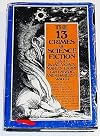
The 13 Crimes of Science Fiction
by Isaac Asimov (Editor), Martin Harry Greenberg (Editor), Charles G. Waugh (Editor)
Isaac Asimov präsentiert
On This Page
Description
Thirteen tales in which detectives of the distant future roam a galaxy riddled with locked-room mysteries, ciphers to be decoded, and unearthly evidence to be sifted, all by the rules of the 13 classic kinds of mystery story--[cover].Tags
Recommendations


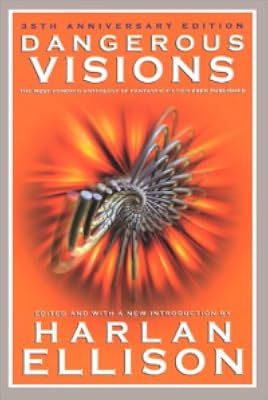


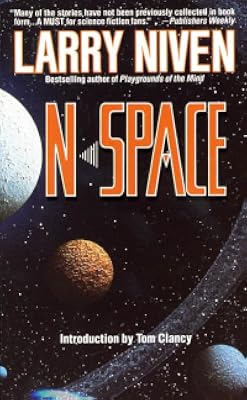




Member Reviews
Interesting combination stories for fans of both mystery and SF. The stories are from the 1950s-70s and are dated in unexpected ways. The concept of a CSI camera that can take pictures into the recent past is still futuristic, but the suspension of disbelief fails when one of the restrictions on it's use is how long it takes to develop the film! A team of robots working with a lawyer to define themselves as independent beings stumbles when the robots are described as writing out, on paper, information they've looked up in law books.
As a teenager I found this anthology fascinating - admittedly, possibly more for the concept than for the stories actually included. Certainly, coming back to it 25 years later, I don't have a lot of memories of these tales, and I think time has worked to distance me (and probably anyone else) from many of them. Several of the stories are written in the rather stark, procedural voice of science fiction that dominated the immediate post-war era, and quite a few of them are laced with misogyny in a way I'm sure I overlooked as a kid but find far more tiring today.
However, having said that, it's not a bad collection if you're in the mood for something definitively of that 1950s-70s era. I do think it's easy to misinterpret the book's show more premise (or at least, I did); it's not thirteen styles of mystery in science fiction, it's literally thirteen styles of crime story, and there's a difference. There are genres here like "spy story," "trial," and so on, which I wasn't expecting alongside the more anticipated "locked room," "whodunit," and "why-done-it," and occasionally a story seems somewhat arbitrarily chosen. But overall, it's not a bad set.
The best stories in the volume - by about a country mile - are Philip K. Dick's "War Game" and Clifford D. Simak's "How-2." These both demonstrate a somewhat sly sense of humor that gives them a bit more reach, and even if they feel almost self-consciously retro, they both land with a pretty good punch in the gut. show less
However, having said that, it's not a bad collection if you're in the mood for something definitively of that 1950s-70s era. I do think it's easy to misinterpret the book's show more premise (or at least, I did); it's not thirteen styles of mystery in science fiction, it's literally thirteen styles of crime story, and there's a difference. There are genres here like "spy story," "trial," and so on, which I wasn't expecting alongside the more anticipated "locked room," "whodunit," and "why-done-it," and occasionally a story seems somewhat arbitrarily chosen. But overall, it's not a bad set.
The best stories in the volume - by about a country mile - are Philip K. Dick's "War Game" and Clifford D. Simak's "How-2." These both demonstrate a somewhat sly sense of humor that gives them a bit more reach, and even if they feel almost self-consciously retro, they both land with a pretty good punch in the gut. show less
Reading through older anthologies of 'classic' science-fiction has not produced the level of awe I expected going into them - this one was no different. Despite featuring stories by Asimov, PK Dick, Niven, and Simak, I just didn't find a consistent enjoyment of the offerings. The best story, from Tom Reamy, features a locked-box mystery solved in discovering a rather unusual witness/suspect who is more than meets the eye. Dick's story, War Game, was good, typical PKD. But the others just didn't fascinate.
3 bones!!!
3 bones!!!
A good collection of science fiction mysteries, along with an explanation of that relatively obscure sub-genre from Isaac Asimov. I've read a fair number of SF mysteries, and had read most of the ones in the book; most of them are excellent examples of the form. The leading story, "The Detweiler Boy" by Tom Reamy, was not particularly good; putting a relatively weak story first in an anthology is an unfortunate flaw.
But there are a number of gems here, including Larry Niven's "Arm". "War Games" by Philip K. Dick, was simply not readable for me; I can take some PKD, but only in mild doses - and not a lot of it. I don't know if it was the mood I was in, or if the story was particularly Dick-ish (sorry, couldn't resist), but after a page show more or two I simply skipped that story altogether.
That said, the vast majority of the book is excellent and well worth reading. show less
But there are a number of gems here, including Larry Niven's "Arm". "War Games" by Philip K. Dick, was simply not readable for me; I can take some PKD, but only in mild doses - and not a lot of it. I don't know if it was the mood I was in, or if the story was particularly Dick-ish (sorry, couldn't resist), but after a page show more or two I simply skipped that story altogether.
That said, the vast majority of the book is excellent and well worth reading. show less
Read for the second time, a couple each night. Fun to finish off the day.
The various authors use science, and certain extrapolations thereof, but almoat always fairly. The reader doesn't have to be an expert to work out the puzzle, but does need to be alert and logical.
Some of the stories are better than others, but overall the quality is high.
The various authors use science, and certain extrapolations thereof, but almoat always fairly. The reader doesn't have to be an expert to work out the puzzle, but does need to be alert and logical.
Some of the stories are better than others, but overall the quality is high.
Contains non-zero amount of fantasy. Tries to shoehorn some stories into a genre in need of a representative. I'd read a handful of these before, too.
I dunno. Skipped the majority of these - but it just might be my personal taste.
Members
- Recently Added By
Author Information

Isaac Asimov was born in Petrovichi, Russia, on January 2, 1920. His family emigrated to the United States in 1923 and settled in Brooklyn, New York, where they owned and operated a candy store. Asimov became a naturalized U.S. citizen at the age of eight. As a youngster he discovered his talent for writing, producing his first original fiction at show more the age of eleven. He went on to become one of the world's most prolific writers, publishing nearly 500 books in his lifetime. Asimov was not only a writer; he also was a biochemist and an educator. He studied chemistry at Columbia University, earning a B.S., M.A. and Ph.D. In 1951, Asimov accepted a position as an instructor of biochemistry at Boston University's School of Medicine even though he had no practical experience in the field. His exceptional intelligence enabled him to master new systems rapidly, and he soon became a successful and distinguished professor at Columbia and even co-authored a biochemistry textbook within a few years. Asimov won numerous awards and honors for his books and stories, and he is considered to be a leading writer of the Golden Age of science fiction. While he did not invent science fiction, he helped to legitimize it by adding the narrative structure that had been missing from the traditional science fiction books of the period. He also introduced several innovative concepts, including the thematic concern for technological progress and its impact on humanity. Asimov is probably best known for his Foundation series, which includes Foundation, Foundation and Empire, and Second Foundation. In 1966, this trilogy won the Hugo award for best all-time science fiction series. In 1983, Asimov wrote an additional Foundation novel, Foundation's Edge, which won the Hugo for best novel of that year. Asimov also wrote a series of robot books that included I, Robot, and eventually he tied the two series together. He won three additional Hugos, including one awarded posthumously for the best non-fiction book of 1995, I. Asimov. "Nightfall" was chosen the best science fiction story of all time by the Science Fiction Writers of America. In 1979, Asimov wrote his autobiography, In Memory Yet Green. He continued writing until just a few years before his death from heart and kidney failure on April 6, 1992. (Bowker Author Biography) show less

Charles Waugh is an associate professor of English at Utah State University and the editor and translator (with Nguyn Lien) of Family of Fallen Leaves: Stories of Agent Orange by Vietnamese Writers. Nguyn Lien was a writer, scholar, and teacher who translated many international works of literature into Vietnamese. Van Gi is the dean of the Faculty show more of Creative Writing at the University of Culture in Hanoi. show less
All Editions
Series

Belongs to Publisher Series
Science Fiction Book Club (3717)
Work Relationships
Contains
Common Knowledge
- Canonical title
- The 13 Crimes of Science Fiction
- Original title
- The 13 Crimes of Science Fiction
- Original publication date
- 1979
- People/Characters
- Albert Cornwell
- Dedication
- Science fiction is a literary universe of no mean size, because science fiction is what it is, not through its content, but through its background. Let me explain the difference that makes.
Classifications
- Genres
- Fiction and Literature, Science Fiction, Mystery
- DDC/MDS
- 813.0876 — Literature & rhetoric American literature in English American fiction in English By type Genre fiction Adventure fiction Speculative fiction
- LCC
- PZ1 — Language and Literature Fiction and juvenile belles lettres Fiction and juvenile belles lettres Fiction in English
Statistics
- Members
- 270
- Popularity
- 119,278
- Reviews
- 8
- Rating
- (3.74)
- Languages
- English, French, German
- Media
- Paper
- ISBNs
- 3
- ASINs
- 8