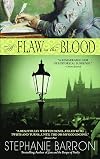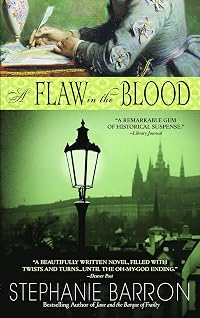
A Flaw in the Blood
by Stephanie Barron
On This Page
Description
Irish barrister Patrick Fitzgerald has been summoned by the Queen, a woman in the grip of fear. Her beloved husband, Prince Albert, lies dying. When the royal coach is violently overturned, nearly killing him and his brilliant young ward, Dr. Georgiana Armistead, niece of the late Dr. Snow, a famed physician who'd attended none other than Her Majesty, he suspects they each may carry within their past hidden clues to a devastating royal secret.--From publisher description.Tags
Recommendations














Member Recommendations

Member Reviews
First Line: When the agony of the state dinner was over and his wife was preoccupied with the other women, he ceased to talk quite so feverishly before the crowd of people who'd come to the Rosenau to see them.
As Prince Albert lies dying in Windsor Castle, his wife, Queen Victoria, summons barrister Patrick Fitzgerald, who helped defend the Queen against an assassination attempt twenty years before. Victoria makes no effort to hide her contempt for the Irishman, especially when he refuses her demand. Within hours he and his ward are almost killed in a carriage accident, his chambers at the Inns of Court are ransacked, and a girl is dead. It takes no great stretch of Fitzgerald's imagination to think that all this is somehow connected to show more his command appearance at Windsor Castle. What will strain his credulity is why it's all connected.
I had the pleasure of meeting Stephanie Barron earlier this year, and she mentioned this book. She loves to find small historical nuggets of information that just don't add up and then create a story that incorporates them. That's what she's done-- very elegantly-- in A Flaw in the Blood.
What little historical nuggets did she come across? It is widely believed that Prince Albert died of typhoid due to the bad drains at Windsor Castle. The truth is that he did not. So... what killed him? It's also well known that Victoria passed hemophilia along to her children-- but what geneticists and genealogists want to know is how did she come to be a carrier of the disease in the first place? These are the historical facts upon which Barron based her novel.
Barron's story paints quite a different portrait of Victoria than the one we're used to, and it's a delicious portrait indeed. Here is a woman of passions and appetites, a woman who thinks nothing of showing contempt for her own children, a woman who will stop at nothing to keep her secrets, a woman who is more like her hated mother than she'd ever admit. Part of the novel is told by Victoria through entries in her secret diary. Much of what she tells of herself fits historical record very closely, but Barron has added that delicious twist of evil that made me smile. (Although I doubt that Victoria herself would be amused.)
Patrick Fitzgerald and his ward, Dr. Georgiana Armistead, tell their part of the story as does Count Wolfgang von Stülen, a ruthless German who's chasing the pair. These multiple viewpoints mean that the action hops around from place to place, and although I didn't find it confusing, I did find that those three characters weren't as finely drawn as Victoria.
There were a couple of other points that didn't sit well with me: Prince Albert consulting Armistead (a woman!) about disease and sewage, and a crucial character in the plot being both a hemophiliac and a military officer, but on the whole, I loved the fiction that Barron wove around the facts. If you don't like fact and fiction blended in this manner, and if you don't like seeing royalty portrayed in a less than flattering light, I would suggest that you stay miles away from this book. However, if you do like the occasional well written and imagined blend of fact and fantasy, by all means get a copy of A Flaw in the Blood and read it. If, like me, you want to know more after you turn the last page, Barron has supplied the titles of several non-fiction books to read. show less
As Prince Albert lies dying in Windsor Castle, his wife, Queen Victoria, summons barrister Patrick Fitzgerald, who helped defend the Queen against an assassination attempt twenty years before. Victoria makes no effort to hide her contempt for the Irishman, especially when he refuses her demand. Within hours he and his ward are almost killed in a carriage accident, his chambers at the Inns of Court are ransacked, and a girl is dead. It takes no great stretch of Fitzgerald's imagination to think that all this is somehow connected to show more his command appearance at Windsor Castle. What will strain his credulity is why it's all connected.
I had the pleasure of meeting Stephanie Barron earlier this year, and she mentioned this book. She loves to find small historical nuggets of information that just don't add up and then create a story that incorporates them. That's what she's done-- very elegantly-- in A Flaw in the Blood.
What little historical nuggets did she come across? It is widely believed that Prince Albert died of typhoid due to the bad drains at Windsor Castle. The truth is that he did not. So... what killed him? It's also well known that Victoria passed hemophilia along to her children-- but what geneticists and genealogists want to know is how did she come to be a carrier of the disease in the first place? These are the historical facts upon which Barron based her novel.
Barron's story paints quite a different portrait of Victoria than the one we're used to, and it's a delicious portrait indeed. Here is a woman of passions and appetites, a woman who thinks nothing of showing contempt for her own children, a woman who will stop at nothing to keep her secrets, a woman who is more like her hated mother than she'd ever admit. Part of the novel is told by Victoria through entries in her secret diary. Much of what she tells of herself fits historical record very closely, but Barron has added that delicious twist of evil that made me smile. (Although I doubt that Victoria herself would be amused.)
Patrick Fitzgerald and his ward, Dr. Georgiana Armistead, tell their part of the story as does Count Wolfgang von Stülen, a ruthless German who's chasing the pair. These multiple viewpoints mean that the action hops around from place to place, and although I didn't find it confusing, I did find that those three characters weren't as finely drawn as Victoria.
There were a couple of other points that didn't sit well with me: Prince Albert consulting Armistead (a woman!) about disease and sewage, and a crucial character in the plot being both a hemophiliac and a military officer, but on the whole, I loved the fiction that Barron wove around the facts. If you don't like fact and fiction blended in this manner, and if you don't like seeing royalty portrayed in a less than flattering light, I would suggest that you stay miles away from this book. However, if you do like the occasional well written and imagined blend of fact and fantasy, by all means get a copy of A Flaw in the Blood and read it. If, like me, you want to know more after you turn the last page, Barron has supplied the titles of several non-fiction books to read. show less
The implications in this work of fiction angered and disgusted me. I'm so disappointed in this author whom I've previously enjoyed reading and whom I assumed had a love and respect for British history. It seems her purpose here was to defame the memory of Queen Victoria and Prince Albert and she did so ruthlessly.
Don't get me wrong, everything I've ever heard or read about Queen Victoria does not cast her in a good light. She seemed to be a self-centered, controlling woman and didn't appear to be very sentimental or compassionate toward her children. However, an older English friend of mine says differently and, being how it's her actual history in question, I try to give her the benefit of the doubt.
****Spoilers ahead****
The idea that show more Victoria being an illegitimate child offers the best reason for her son's hemophilia is a 19th century rumor that has long been dispelled by those who have thought it through logically and scientifically. A quote from Wikipedia states:
"Although an individual's haemophilia can usually be traced in the ancestry, in about 30% of cases there is no family history of the disorder, and the condition is speculated to be the result of spontaneous mutation in an ancestor.[2] Victoria's appears to have been a spontaneous or de novo mutation and she is usually considered the source of the disease in modern cases of haemophilia among her descendants. Queen Victoria's father, Prince Edward, Duke of Kent, was not a haemophiliac, and the probability of her mother having had a lover who suffered from haemophilia is minuscule given the low life expectancy of 19th-century haemophiliacs. Her mother, Victoria, Duchess of Kent, was not known to have a family history of the disease, although it is possible that she was a carrier but among her children only Victoria received the mutated copy. The rate of spontaneous mutation is known to increase with paternal age, and Victoria's father was 51 at her birth."
Furthermore, to suggest that Albert was suicidal is preposterous. There's nothing in history to legitimately suggest this, and the author has skewed history in an even more disgusting way by further "revealing" whom was actually (fictionally) to blame for his death. I just couldn't believe it when I read this one implicating line: "I had to put him down like a sick dog."
I'm all for a great historical mystery but to besmirch the names of respected people from history is low. How much greater it would have been to write a story line in which these characters shine brighter than history records. That would have been a story worth reading. show less
Don't get me wrong, everything I've ever heard or read about Queen Victoria does not cast her in a good light. She seemed to be a self-centered, controlling woman and didn't appear to be very sentimental or compassionate toward her children. However, an older English friend of mine says differently and, being how it's her actual history in question, I try to give her the benefit of the doubt.
****Spoilers ahead****
The idea that show more Victoria being an illegitimate child offers the best reason for her son's hemophilia is a 19th century rumor that has long been dispelled by those who have thought it through logically and scientifically. A quote from Wikipedia states:
"Although an individual's haemophilia can usually be traced in the ancestry, in about 30% of cases there is no family history of the disorder, and the condition is speculated to be the result of spontaneous mutation in an ancestor.[2] Victoria's appears to have been a spontaneous or de novo mutation and she is usually considered the source of the disease in modern cases of haemophilia among her descendants. Queen Victoria's father, Prince Edward, Duke of Kent, was not a haemophiliac, and the probability of her mother having had a lover who suffered from haemophilia is minuscule given the low life expectancy of 19th-century haemophiliacs. Her mother, Victoria, Duchess of Kent, was not known to have a family history of the disease, although it is possible that she was a carrier but among her children only Victoria received the mutated copy. The rate of spontaneous mutation is known to increase with paternal age, and Victoria's father was 51 at her birth."
Furthermore, to suggest that Albert was suicidal is preposterous. There's nothing in history to legitimately suggest this, and the author has skewed history in an even more disgusting way by further "revealing" whom was actually (fictionally) to blame for his death. I just couldn't believe it when I read this one implicating line: "I had to put him down like a sick dog."
I'm all for a great historical mystery but to besmirch the names of respected people from history is low. How much greater it would have been to write a story line in which these characters shine brighter than history records. That would have been a story worth reading. show less
The novel opens with a newly-widowed Queen Victoria who has a secret she is desperate to hide. Now Irish barrister, Patrick Fitzgerald, and his young ward, Dr. Georgiana Armistead, both of whom had some dealings in the past with the royal family, are running for their lives and the question is why? Barron skillfully blurs the line between historical fact and fiction in creating this mystery. Her take on Queen V. might throw you for a loop, but it worked for me. Also, she inserts first person fictional diary accounts from Queen Victoria, which has some insightful biographical details, as the mystery unravels. The ending seems to stumble then rush a little as the loose ends come together, but all in all, it's a fine effort. I like when an show more historical fiction makes me curious to know more about a time, a place, or a person - and this did just that! show less
Barron's prose gets away from her at times, but all in all this was a very interesting book. Patrick and Georgiana were sympathetic, and the plot was certainly exciting. The chapters alternate from a 3rd-person description of Patrick and Georgie to a 1st-person narration from Queen Victoria. That was jarring at first, but after a while I got used to it. Victoria's character was loathsome in this book, which made it all the more fascinating. If you like books about conspiracies, I'd definitely recommend this!
When Queen Victoria lost her beloved Prince Albert in 1861 the world was told that he died of typhoid fever. Although that is almost certainly not what killed him, the exact cause of Albert’s death is not likely to ever be determined. A Flaw in the Blood, Stephanie Barron’s Victorian thriller, speculates that something much more sinister than mere disease was the cause of death.
Irishman, Patrick Fitzgerald, who had defended Victoria’s would-be assassin in court some two decades earlier, could not imagine why he was being summoned to meet with the Queen at Windsor Castle in the middle of the night, the very night that Albert died there. But after refusing to sign a written statement demanded of him by the Queen and barely escaping show more death along with his ward, Georgiana Amistead, on the coach ride back to London, Fitzgerald slowly came to realize that the Queen feared both him and Georgiana for reasons of her own and wanted desperately to see them dead.
Georgiana Amistead is an unusual young woman, one of the few women of her time to have received medical training, and someone who has gained the respect and trust of Prince Albert himself. In fact, Albert has secretly consulted with her about the strange medical condition of his young son, Leo, a youngster who is constant danger of bleeding to death from the most minor of physical injuries. Unfortunately, Queen Victoria who is aware of correspondence between Georgiana and her husband resents the access that Georgiana had to royal secrets through her relationship with Albert.
So obviously neither Patrick nor Georgiana had any reason to expect that Victoria thought kindly of them. What they could not figure out, however, was why she saw them as enough of a threat to her that she was willing to send a one-eyed German count, Wolfgang von Stuhlen, on a mission to see them dead. As von Stuhlen chased the pair around Europe, and Patrick started to lose some of the people closest to him, he and Georgiana finally uncovered the secret that Victoria was so desperate to keep hidden away forever.
Most of this story is told in the third person but, by having Victoria narrate whole chapters in her own voice, Stephanie Barron places the reader inside the head of the very person making the choices that cost innocent lives and keep Georgiana and Patrick on the run. It is an inside look at a ruthless personality that I sincerely hope does not resemble that of the real Queen Victoria.
A Flaw in the Blood is enjoyable historical fiction and the world that Barron describes is one in which readers will gladly lose themselves for a few hours. But, first and foremost, it is a good mystery, one with just the right mixture of fact and fiction to keep its readers guessing and turning pages. I was a bit surprised that I did not feel more empathy for the two main characters than I did, however, and have to blame that on the author’s failure to quite get me to see Georgiana and Patrick, much less the villain chasing them, as real people.
Rated at: 3.5 show less
Irishman, Patrick Fitzgerald, who had defended Victoria’s would-be assassin in court some two decades earlier, could not imagine why he was being summoned to meet with the Queen at Windsor Castle in the middle of the night, the very night that Albert died there. But after refusing to sign a written statement demanded of him by the Queen and barely escaping show more death along with his ward, Georgiana Amistead, on the coach ride back to London, Fitzgerald slowly came to realize that the Queen feared both him and Georgiana for reasons of her own and wanted desperately to see them dead.
Georgiana Amistead is an unusual young woman, one of the few women of her time to have received medical training, and someone who has gained the respect and trust of Prince Albert himself. In fact, Albert has secretly consulted with her about the strange medical condition of his young son, Leo, a youngster who is constant danger of bleeding to death from the most minor of physical injuries. Unfortunately, Queen Victoria who is aware of correspondence between Georgiana and her husband resents the access that Georgiana had to royal secrets through her relationship with Albert.
So obviously neither Patrick nor Georgiana had any reason to expect that Victoria thought kindly of them. What they could not figure out, however, was why she saw them as enough of a threat to her that she was willing to send a one-eyed German count, Wolfgang von Stuhlen, on a mission to see them dead. As von Stuhlen chased the pair around Europe, and Patrick started to lose some of the people closest to him, he and Georgiana finally uncovered the secret that Victoria was so desperate to keep hidden away forever.
Most of this story is told in the third person but, by having Victoria narrate whole chapters in her own voice, Stephanie Barron places the reader inside the head of the very person making the choices that cost innocent lives and keep Georgiana and Patrick on the run. It is an inside look at a ruthless personality that I sincerely hope does not resemble that of the real Queen Victoria.
A Flaw in the Blood is enjoyable historical fiction and the world that Barron describes is one in which readers will gladly lose themselves for a few hours. But, first and foremost, it is a good mystery, one with just the right mixture of fact and fiction to keep its readers guessing and turning pages. I was a bit surprised that I did not feel more empathy for the two main characters than I did, however, and have to blame that on the author’s failure to quite get me to see Georgiana and Patrick, much less the villain chasing them, as real people.
Rated at: 3.5 show less
In A Flaw in the Blood, Stephanie Barron weaves a historical thriller around the December 1861 death of Prince Albert, the Consort of England's Queen Victoria. What do Irish barrister Patrick Fitzgerald and his ward, physician Georgiana Armistead, have to do with the event that plunged all of England into mourning? That's what they're desperate to find out as they are pursued through London and beyond.
This novel is definitely a departure from Barron's Jane Austen mystery series. Although historical figures are featured in both this novel and in the Jane Austen series, the Jane Austen novels are much lighter, more in keeping with the cozy genre. A Flaw in the Blood has a darker tone, with more violence and a little more emphasis on the show more seamier aspects of mid-19th century Europe. Not all fans of Barron's earlier series will enjoy her latest novel. The book is much more like Anne Perry's William Monk series, and readers who like that series will probably enjoy it. show less
This novel is definitely a departure from Barron's Jane Austen mystery series. Although historical figures are featured in both this novel and in the Jane Austen series, the Jane Austen novels are much lighter, more in keeping with the cozy genre. A Flaw in the Blood has a darker tone, with more violence and a little more emphasis on the show more seamier aspects of mid-19th century Europe. Not all fans of Barron's earlier series will enjoy her latest novel. The book is much more like Anne Perry's William Monk series, and readers who like that series will probably enjoy it. show less
In A Flaw in the Blood, Stephanie Barron of Jane-Austen-mystery fame explores the pattern of hemophilia in the royal families of Europe... and how far royalty will go to protect itself. Miss Georgiana Armistead, ward and student of the late celebrated doctor John Snow, finds herself and her guardian Patrick Fitzgerald caught up in an old secret that is so dangerous that it could — as the back of my paperback copy assures me — "topple thrones." Indeed.
From a purely cerebral perspective, I suppose this is a good sample of suspenseful historical fiction. It is told from two different points of view, the third person omniscient focusing on Patrick Fitzgerald, and the first person by Queen Victoria. The historical details are good and show more it's clear that Barron did her research. I can see how the characters could be compelling to many readers. But I don't read books from a purely cerebral point of view, and something about this one left me wanting to get its taste out of my mouth.
Maybe it was partly the predictability. The big shocker of an ending that all the critics rave about really wasn't surprising to me at all; in fact, I had started expecting it about halfway through the book. It certainly presents a very unflattering portrait of Queen Victoria, to say the least. And I really could have done without all the sex; the rape scene in particular was not something I would have chosen to read. And that's not even taking into the account the utter improbability of the rapist's identity. I won't say more for fear of spoilers, but if you've read the book you probably know what I mean.
The characters left me cold; Georgiana was a little too perfect of a tough-gal feminist doctor struggling for acceptance (though apparently the first female doctor in Britain received the title in 1867, so it isn't too far-fetched). She just didn't strike me as a particularly interesting or likable character for some reason. I did like Patrick Fitzgerald, her Irish guardian, a little better; he is drawn with more complexity. But ultimately I felt a disconnect there too. The whirl of events and places moves too quickly; we get to know Fitzgerald a bit, but Georgiana and the others barely at all.
Perhaps it was the constantly shifting narrative that prevented me from really caring about any of the characters. I didn't care for the every-other-chapter switch. Another reviewer has written that this story is "strangely uninvolving," and I find that the perfect description of how I felt about it. Let me just hurry up and get through it, I thought as I read.
I will say that the writing was above average and I enjoyed Barron's deft phrasing. "He wore his fundamental loneliness like a well-cut coat, and the world mistook it for elegance" (74). I have not yet read any of Barron's Jane Austen mysteries, and Barron's skill is probably the only reason I am still planning to try them. This somewhat banal story would not, in itself, cause me to seek out any more of her work. Meh. show less
From a purely cerebral perspective, I suppose this is a good sample of suspenseful historical fiction. It is told from two different points of view, the third person omniscient focusing on Patrick Fitzgerald, and the first person by Queen Victoria. The historical details are good and show more it's clear that Barron did her research. I can see how the characters could be compelling to many readers. But I don't read books from a purely cerebral point of view, and something about this one left me wanting to get its taste out of my mouth.
Maybe it was partly the predictability. The big shocker of an ending that all the critics rave about really wasn't surprising to me at all; in fact, I had started expecting it about halfway through the book. It certainly presents a very unflattering portrait of Queen Victoria, to say the least. And I really could have done without all the sex; the rape scene in particular was not something I would have chosen to read. And that's not even taking into the account the utter improbability of the rapist's identity. I won't say more for fear of spoilers, but if you've read the book you probably know what I mean.
The characters left me cold; Georgiana was a little too perfect of a tough-gal feminist doctor struggling for acceptance (though apparently the first female doctor in Britain received the title in 1867, so it isn't too far-fetched). She just didn't strike me as a particularly interesting or likable character for some reason. I did like Patrick Fitzgerald, her Irish guardian, a little better; he is drawn with more complexity. But ultimately I felt a disconnect there too. The whirl of events and places moves too quickly; we get to know Fitzgerald a bit, but Georgiana and the others barely at all.
Perhaps it was the constantly shifting narrative that prevented me from really caring about any of the characters. I didn't care for the every-other-chapter switch. Another reviewer has written that this story is "strangely uninvolving," and I find that the perfect description of how I felt about it. Let me just hurry up and get through it, I thought as I read.
I will say that the writing was above average and I enjoyed Barron's deft phrasing. "He wore his fundamental loneliness like a well-cut coat, and the world mistook it for elegance" (74). I have not yet read any of Barron's Jane Austen mysteries, and Barron's skill is probably the only reason I am still planning to try them. This somewhat banal story would not, in itself, cause me to seek out any more of her work. Meh. show less
Members
- Recently Added By
Author Information

21+ Works 8,418 Members
Common Knowledge
- Canonical title
- A Flaw in the Blood
- Original publication date
- 2008
- People/Characters
- Victoria, Queen of the United Kingdom; Patrick Fitzgerald; Georgiana Armistead
- Important places
- London, England, UK; Windsor Castle, Windsor, Berkshire, England, UK
- Dedication
- Dedicated to the strongest women I know -
Jo, Pat, Liz, and Cathy.
Love you. - First words
- Prologue: When the agony of the state dinner was over and his wife was preoccupied with the other women, he ceased to talk quite so feverishly before the crowd of people who'd come to the Rosenau to see them.
Chapter One: The carriage made little sound as it rolled beneath the iron portcullis of Windsor; the harness and wheels were wrapped in flannel, the paving stones three inches deep in sawdust. - Last words
- (Click to show. Warning: May contain spoilers.)But I confess I hate the very name of Patrick Fitzgerald.
Classifications
Statistics
- Members
- 356
- Popularity
- 88,808
- Reviews
- 18
- Rating
- (3.05)
- Languages
- English
- Media
- Paper, Ebook
- ISBNs
- 4
- ASINs
- 3