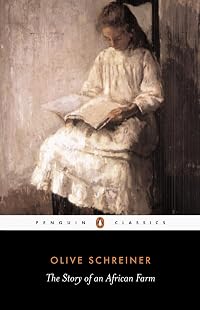
The Story of an African Farm
by Olive Schreiner
On This Page
Description
The Story of an African Farm is the story of three children who grow up on a farm in South Africa, and their journey into adulthood. The narrative is complex, with fluid chronology and narrative point of view. The novel was a bestseller when it was first published, though it was also controversial, dealing with themes of feminism, pre-marital sex, free thought and transvestitism..
Tags
Recommendations






















Member Recommendations

Member Reviews
Anyone reading this in hopes of learning something about 19th century colonial agronomy will be sorely disappointed: apart from the occasional mention of goats and sheep, this book is a farming-free zone. Maybe crops are being grown off-stage by indentured natives (or "woolly Kaffers" to use the author's terminology), but the Karoo farmstead where Schreiner lays her scene is a venue for delvings and harrowings of the philosophical rather than the agricultural sort.
The story, such as it is, concerns the growing-up of Waldo, Em and Lyndall. Em, nice but dim, is the stepdaughter of the twice-widowed but still ebullient farm proprietress Tant Sannie (or "the Boer woman" as the text prefers to call her). The precocious Lyndall, also an show more orphan, is Em's cousin. Waldo, a spiritual seeker, is the son of the German overseer. In part one their lives, hardly blissful to begin with, take a turn for the worse when one of the most preposterous baddies in all of literature shows up in the form of Bonaparte Blenkins, a sadistic conman who makes your average Dickens villain look like a Proustian character study. He wheedles his way into Tant Sannie's affections and proceeds to be utterly beastly to the kids, while Waldo grapples with the contradictions of religion and Lyndall with her awakening feminism.
Finally Blenkins comes unstuck and Tant Sannie kicks him out. Then it's time for Schreiner to lay it on thick with a section called "Times and Seasons", a rudely interpolated Ted Talk on the stages of (Waldo's, but also every thinking man's) religious development. There's an even more nauseating excursus a bit later, when a stranger passes through the farm and narrates a Bunyanesque allegory to Waldo ("then the hunter took from his breast the shuttle of Imagination, and wound on it the thread of his Wishes; and all night he sat and wove a net.") I think the phrase "show, don't tell" is very overused, but every writer should keep it in mind to avoid producing deadly stuff like this.
I suppose this is why people read the book today, for its atheist and feminist themes (the feminism comes later as we see what became of Lyndall). Fair enough, but I found it torturous. Schreiner's prose, not what you'd call subtle, veers wildly between mawkish (any description of Lyndall), archaic (three uses of "ever and anon", "Em needed not to send for him", "next morning the Bible we kiss") and unintentionally hilarious ("the hypocrite is rare as icebergs in the tropics"). Sometimes she comes up with glutinous gems like "he fixed his seething eyes upon her" and "the beautiful eyes looked into the depths of her soul".
There was one scene that I didn't have to force myself through like a wagon driver lashing his oxen up a muddy kopje: Tant Sannie eventually remarries and we're treated to a Boer wedding. Of course, being a Boer wedding it's not as much fun as a Greek wedding for example or an Armenian or a Hindu one. But there is still dancing, and a better spread than the usual roaster-cakes and mealies, and some people at least (go Em) enjoy themselves. The other incident that piqued my interest was when Gregory (another random who shows up at the farm later on and falls in love with first Em and then Lyndall) suddenly puts on womenswear and seems quite pleased with himself. But it turns out his transvestism is only the act of a lovesick mooncalf: by disguising himself as a woman, he hopes to get closer to little Lyndall and her little head, face, lips, hands, fingers...
This brings me to my last point. Schreiner's feminism is powerfully and clearly expressed through the character of Lyndall. But in proportion as she draws Lyndall's personality as independent, rational, and generally by contemporary standards unwomanly, she seems to feel the need to describe her physically as dainty, delicate, the image of womanly weakness. Perhaps this is ironic or a spoonful of treacle to help her controversial message go down. But she isn't terribly creative in how she does it. I did some textual analysis and it turns out the word "little" appears 508 times in The Story of an African Farm, accounting for one in every 200 words — five times its frequency in English as a whole. By my count 74 of these usages are in reference to Lyndall. They break down as follows:
Lyndall generally — 18
Parts of Lyndall — 56:
Hand(s) — 12
Foot/feet/footmarks — 11
Face — 5
Mouth — 4
Finger(s) — 4
Lip(s) — 3
Laugh — 3
Head — 3 (of which 1 indirect)
Chin — 2
Body — 2
Limbs, fingernail, arms, cheek, teeth, neck, life, toe, elbows, voice, soul — 1 each
That is, the only parts of Lyndall that aren't little are her nose, ears, eyes, jaw, tongue, shoulders, hips, knees, calves, ankles. We are told that she is "beautiful" three times, and that her eyes are "beautiful" no fewer than eight times. It's absolutely mad. Someone please enroll Olive in a creative writing class or just buy her a bloody thesaurus! show less
The story, such as it is, concerns the growing-up of Waldo, Em and Lyndall. Em, nice but dim, is the stepdaughter of the twice-widowed but still ebullient farm proprietress Tant Sannie (or "the Boer woman" as the text prefers to call her). The precocious Lyndall, also an show more orphan, is Em's cousin. Waldo, a spiritual seeker, is the son of the German overseer. In part one their lives, hardly blissful to begin with, take a turn for the worse when one of the most preposterous baddies in all of literature shows up in the form of Bonaparte Blenkins, a sadistic conman who makes your average Dickens villain look like a Proustian character study. He wheedles his way into Tant Sannie's affections and proceeds to be utterly beastly to the kids, while Waldo grapples with the contradictions of religion and Lyndall with her awakening feminism.
Finally Blenkins comes unstuck and Tant Sannie kicks him out. Then it's time for Schreiner to lay it on thick with a section called "Times and Seasons", a rudely interpolated Ted Talk on the stages of (Waldo's, but also every thinking man's) religious development. There's an even more nauseating excursus a bit later, when a stranger passes through the farm and narrates a Bunyanesque allegory to Waldo ("then the hunter took from his breast the shuttle of Imagination, and wound on it the thread of his Wishes; and all night he sat and wove a net.") I think the phrase "show, don't tell" is very overused, but every writer should keep it in mind to avoid producing deadly stuff like this.
I suppose this is why people read the book today, for its atheist and feminist themes (the feminism comes later as we see what became of Lyndall). Fair enough, but I found it torturous. Schreiner's prose, not what you'd call subtle, veers wildly between mawkish (any description of Lyndall), archaic (three uses of "ever and anon", "Em needed not to send for him", "next morning the Bible we kiss") and unintentionally hilarious ("the hypocrite is rare as icebergs in the tropics"). Sometimes she comes up with glutinous gems like "he fixed his seething eyes upon her" and "the beautiful eyes looked into the depths of her soul".
There was one scene that I didn't have to force myself through like a wagon driver lashing his oxen up a muddy kopje: Tant Sannie eventually remarries and we're treated to a Boer wedding. Of course, being a Boer wedding it's not as much fun as a Greek wedding for example or an Armenian or a Hindu one. But there is still dancing, and a better spread than the usual roaster-cakes and mealies, and some people at least (go Em) enjoy themselves. The other incident that piqued my interest was when Gregory (another random who shows up at the farm later on and falls in love with first Em and then Lyndall) suddenly puts on womenswear and seems quite pleased with himself. But it turns out his transvestism is only the act of a lovesick mooncalf: by disguising himself as a woman, he hopes to get closer to little Lyndall and her little head, face, lips, hands, fingers...
This brings me to my last point. Schreiner's feminism is powerfully and clearly expressed through the character of Lyndall. But in proportion as she draws Lyndall's personality as independent, rational, and generally by contemporary standards unwomanly, she seems to feel the need to describe her physically as dainty, delicate, the image of womanly weakness. Perhaps this is ironic or a spoonful of treacle to help her controversial message go down. But she isn't terribly creative in how she does it. I did some textual analysis and it turns out the word "little" appears 508 times in The Story of an African Farm, accounting for one in every 200 words — five times its frequency in English as a whole. By my count 74 of these usages are in reference to Lyndall. They break down as follows:
Lyndall generally — 18
Parts of Lyndall — 56:
Hand(s) — 12
Foot/feet/footmarks — 11
Face — 5
Mouth — 4
Finger(s) — 4
Lip(s) — 3
Laugh — 3
Head — 3 (of which 1 indirect)
Chin — 2
Body — 2
Limbs, fingernail, arms, cheek, teeth, neck, life, toe, elbows, voice, soul — 1 each
That is, the only parts of Lyndall that aren't little are her nose, ears, eyes, jaw, tongue, shoulders, hips, knees, calves, ankles. We are told that she is "beautiful" three times, and that her eyes are "beautiful" no fewer than eight times. It's absolutely mad. Someone please enroll Olive in a creative writing class or just buy her a bloody thesaurus! show less
Elaine Showalter sums up Schreiner as "A freethinker marked to the marrow of her bones with the Calvinism of her missionary parents; a disciple of Darwin, Mill and Spencer who floated in a sea of sentimentality; a dedicated writer who could never finish a book; a feminist who hated being a woman; a maternal spirit who never became a mother — everything about her life is a paradox." Not totally straightforward then!
This is really exactly the kind of book you would expect from a complicated, clever young person who grew up in the arch-conservative back of beyond in a time seething with exciting new ideas. It's about a couple of sisters, the wild and progressive Lyndall and the placid and domesticated Em, growing up on a remote farm in show more the Eastern Cape together with young Waldo, the overseer's son, working as a farmhand but looking as though he is going to turn into a brilliant engineer, or possibly a poet, or a sculptor, or none of the above. Throw in an Afrikaans stepmother, an Irish con-man, a cross-dressing farm-manager, and a trunk full of our late father's radical books, and tragedy is just about inevitable.
There are glorious chapter-long feminist rants, endless agonising about what it really means to live in a world where you can't seriously believe in God any more, more symbolism than you can shake an elaborately-carved stick at, lots of lovely African scenery and weather, a bizarrely complicated series of emotional and sexual entanglements, and a large supporting cast of nameless black people treated with a curious mixture of late-Victorian "scientific" racism and semi-enlightened humanity. A book so hopelessly messy that you can pull just about anything you like out of it, but a great account of growing up in confusing times, all the same. show less
This is really exactly the kind of book you would expect from a complicated, clever young person who grew up in the arch-conservative back of beyond in a time seething with exciting new ideas. It's about a couple of sisters, the wild and progressive Lyndall and the placid and domesticated Em, growing up on a remote farm in show more the Eastern Cape together with young Waldo, the overseer's son, working as a farmhand but looking as though he is going to turn into a brilliant engineer, or possibly a poet, or a sculptor, or none of the above. Throw in an Afrikaans stepmother, an Irish con-man, a cross-dressing farm-manager, and a trunk full of our late father's radical books, and tragedy is just about inevitable.
There are glorious chapter-long feminist rants, endless agonising about what it really means to live in a world where you can't seriously believe in God any more, more symbolism than you can shake an elaborately-carved stick at, lots of lovely African scenery and weather, a bizarrely complicated series of emotional and sexual entanglements, and a large supporting cast of nameless black people treated with a curious mixture of late-Victorian "scientific" racism and semi-enlightened humanity. A book so hopelessly messy that you can pull just about anything you like out of it, but a great account of growing up in confusing times, all the same. show less
I was a bit surprised at this novel: it's published in 1883, so the same year Wilkie Collins finished Heart and Science, and the year after Thomas Hardy wrote Two on a Tower. Yet its much more prescient of modernism than either of those late Victorian works, reminding me more of early James Joyce or E. M. Forster than Schreiner's actual contemporaries. It has a fragmented, difficult style, but one appropriate to its subject matters, about the difficulties of coping with massive complex systems like religion and patriarchy while living on the fringe of the massive complex system that is empire-- though Schreiner is seemingly way less interested in interrogating its complications than she is those of gender and religion. I liked it, but I show more wanted to love it; I frequently enjoyed the detached narrative voice, but sometimes found it more difficult than I felt was necessary. There was some engrossing stuff (the horrific victimization of children by Bonaparte Blenkins), some funny stuff (Bonaparte's more comedic escapades) some great stuff (Bonaparte's final comeuppance), some intriguing stuff (young Waldo's adventures in the world), some startling stuff ("'Waldo,' she said, 'Lyndall is dead'" is such a powerful sentence), and some weird and offputting stuff (most of the last couple chapters). Probably worth another read someday, and I would certainly teach it; I don't think I've read another book quite like it. show less
Imagine growing up in isolation: no school, no radio or television let alone electronic devices, few neighbours and those few distant. If you were lucky, there would be books, but none selected with you in mind. Hard as it is to picture such an existence now, it was not an uncommon situation for children whose parents had colonized the vast prairies of Canada, Australia and South Africa one hundred and fifty years ago. What is unusual, is that there was so little contemporary writing about it.
Olive Schreiner grew up in such a world in the Cape Colony, part of what is now South Africa. While she had no great affection for her fellow white South Africans, calling them "... a whole nation of lower middle class philistines, without... show more intellect or muscular labourers to save them", she did have sympathy for the children who had to grow up in such an environment.
The Story of an African Farm has three such children, brought together by circumstance. Lyndall was an orphan sent to live with her uncle. She had been provided for financially and would be able to go away to school when the time came. Em was also an orphan, daughter of the uncle to whom Lyndall had been sent, a man who had since died. This left the care of these two little English girls to Tant' Sannie, a Boer woman. As Lyndall explained it to Em: Tant' Sannie is a miserable old woman... Your father married her when he was dying, because he thought she would take better care of the farm, and us, than an Englishwoman. He said we should be taught and sent to school. Now she saves every farthing for herself, buys us not even one old book. She does not ill-use us. Why? Because she is afraid of your father's ghost.... three nights ago she heard a rustling and a grunting behind the pantry door, and knew it was your father coming to 'spook' her. The third child was Waldo, son of the German overseer, Waldo was a tormented child, obsessed by the idea that everything must die, terrified of God and the hereafter.
In the summer of 1862, the year of the great drought, a stranger entered their world. Bonaparte Blenkins was an Irishman who quickly insinuated himself into their lives, soon overthrowing the established order of their world. By the time Blenkins had finished with the farm, the whole structure of the children's lives was destroyed. Older now, it was time for them to embark on the next stage of their lives.
Lyndall, determined to find wealth and fame, went off to finishing school, a place she later scathingly described. "They finish everything but imbecility and weakness, and that they cultivate." Em stayed on the farm, learning all the domestic duties entailed in its proper running, along with its actual management. Waldo wandered, simultaneously fleeing and seeking his God.
Lyndall's return to the farm three years later turned life upside down once more. Schreiner has taken a wilful child and turned her into a strong determined woman, albeit a tragic one. Her forward looking feminist views were considered radical by the Victorian reading public. At the same time, the book was an instant success, perhaps because it was published under the pseudonym Ralph Iron. Had Lyndall's views been acknowledged as written by a woman, it is likely they would have been rejected outright.
Schreiner introduced a new character in this second part of her book. Gregory Rose quickly became engaged to Em. Upon Lyndall's return however, Em realized he was smitten with Lyndall and broke the engagement. Lyndall did not share his feelings. She described him as
While many see Lyndall as the primary protagonist of the novel, this does Em a disservice. While she could be dismissed as a mere pretend housewife, lacking only a husband, she is far more than this. She is the foil to Lyndall and in many ways has more inner strength than her cousin, allowing the two girls to break out of the conventional stereotypes of their time.
The title of the book suggests not a story of children though, but the story of the farm itself. It is always there, changing with the seasons, but never changing in its essence. Schreiner's connections to such a world are obvious in the love Lyndall, Em and Waldo have for their home, the constant in their lives, and in their links to each other. Schreiner would go on to write other books, but she never recreated the success of this one, perhaps because she herself was uprooted from her veld. show less
Olive Schreiner grew up in such a world in the Cape Colony, part of what is now South Africa. While she had no great affection for her fellow white South Africans, calling them "... a whole nation of lower middle class philistines, without... show more intellect or muscular labourers to save them", she did have sympathy for the children who had to grow up in such an environment.
The Story of an African Farm has three such children, brought together by circumstance. Lyndall was an orphan sent to live with her uncle. She had been provided for financially and would be able to go away to school when the time came. Em was also an orphan, daughter of the uncle to whom Lyndall had been sent, a man who had since died. This left the care of these two little English girls to Tant' Sannie, a Boer woman. As Lyndall explained it to Em: Tant' Sannie is a miserable old woman... Your father married her when he was dying, because he thought she would take better care of the farm, and us, than an Englishwoman. He said we should be taught and sent to school. Now she saves every farthing for herself, buys us not even one old book. She does not ill-use us. Why? Because she is afraid of your father's ghost.... three nights ago she heard a rustling and a grunting behind the pantry door, and knew it was your father coming to 'spook' her. The third child was Waldo, son of the German overseer, Waldo was a tormented child, obsessed by the idea that everything must die, terrified of God and the hereafter.
In the summer of 1862, the year of the great drought, a stranger entered their world. Bonaparte Blenkins was an Irishman who quickly insinuated himself into their lives, soon overthrowing the established order of their world. By the time Blenkins had finished with the farm, the whole structure of the children's lives was destroyed. Older now, it was time for them to embark on the next stage of their lives.
Lyndall, determined to find wealth and fame, went off to finishing school, a place she later scathingly described. "They finish everything but imbecility and weakness, and that they cultivate." Em stayed on the farm, learning all the domestic duties entailed in its proper running, along with its actual management. Waldo wandered, simultaneously fleeing and seeking his God.
Lyndall's return to the farm three years later turned life upside down once more. Schreiner has taken a wilful child and turned her into a strong determined woman, albeit a tragic one. Her forward looking feminist views were considered radical by the Victorian reading public. At the same time, the book was an instant success, perhaps because it was published under the pseudonym Ralph Iron. Had Lyndall's views been acknowledged as written by a woman, it is likely they would have been rejected outright.
Schreiner introduced a new character in this second part of her book. Gregory Rose quickly became engaged to Em. Upon Lyndall's return however, Em realized he was smitten with Lyndall and broke the engagement. Lyndall did not share his feelings. She described him as
...a true woman - one born for the sphere that some women have to fill without being born for it. How happy he would be sewing frills into his little girls' frocks, and how pretty he would look sitting in a parlour, with a rough man making love to him!Toward the end of the book, there will be a role reversal, as Lyndall will dominate Greg, now disguised as a woman, a person she does not recognize.
While many see Lyndall as the primary protagonist of the novel, this does Em a disservice. While she could be dismissed as a mere pretend housewife, lacking only a husband, she is far more than this. She is the foil to Lyndall and in many ways has more inner strength than her cousin, allowing the two girls to break out of the conventional stereotypes of their time.
The title of the book suggests not a story of children though, but the story of the farm itself. It is always there, changing with the seasons, but never changing in its essence. Schreiner's connections to such a world are obvious in the love Lyndall, Em and Waldo have for their home, the constant in their lives, and in their links to each other. Schreiner would go on to write other books, but she never recreated the success of this one, perhaps because she herself was uprooted from her veld. show less
I bought this book on a trip to Africa and was led to believe, by the title and blurb, that it was a conventional Victorian novel set in Africa. Wrong. The title is a total misdirection. While the beauty of the bleak desert landscape is a regular backdrop in the book, this is most definitely not the story of an African farm. It is hardly a story. It is a wonderful book of ideas, seemingly 100 years too modern for its era. The book starts reasonably conventionally, introducing the main characters and the farm as backdrop. There is some beautiful writing here and I was immediately hooked. But the characters are not standard Victorian era characters, and the issues that concern them - atheism, feminism, mental development, are not the show more standard Victorian era issues.
The mid-section of the book heads off in a totally different style with an analysis of the development of a personal philosophy, starting from received religious dogma, and ending with a free-thinking atheism. This is followed by the narrative (or as close to narrative as Schriener gets) of the tragic ends for the key characters.
This is one of the most memorable books I have read in years. I can't believe that it is not better known.
Read July 2015. show less
The mid-section of the book heads off in a totally different style with an analysis of the development of a personal philosophy, starting from received religious dogma, and ending with a free-thinking atheism. This is followed by the narrative (or as close to narrative as Schriener gets) of the tragic ends for the key characters.
This is one of the most memorable books I have read in years. I can't believe that it is not better known.
Read July 2015. show less
Very beautiful writing, and empathic treatment of the characters, delving into their hearts and souls.
Still, it's hard to care so much for those characters, being European and descendent's of those who committed genocide on true Africans. The author also seems to be a sizist, making "good women" tiny, and much emphasis put on "tiny hands, tiny feet."
I did like the treatment of how we feel when death steals a beloved, and our struggles to try to believe in the hereafter, because we can't bear the thought of never seeing that dear one again, in whatever form.
Still, it's hard to care so much for those characters, being European and descendent's of those who committed genocide on true Africans. The author also seems to be a sizist, making "good women" tiny, and much emphasis put on "tiny hands, tiny feet."
I did like the treatment of how we feel when death steals a beloved, and our struggles to try to believe in the hereafter, because we can't bear the thought of never seeing that dear one again, in whatever form.
Olive Schreiner’s The Story Of An African Farm is an early classic of 19th century white South African literature. Born in 1855 to missionary parents, Schreiner had no formal education and spent her adolescence and early adult years working as a housekeeper and governess on farms in the Karoo region. Schreiner, who is known for her rejection of traditional Christian thinking and her strong feminism, ironically published in London under the pseudonym Ralph Iron. I was led to this first of Schreiner’s novels by a talk on South African women writers. It is a strange but somehow compelling book, addressing then controversial themes that resonated with its late-Victorian British readers.
Focusing on three young people living on a sheep show more farm in the Karoo region of South Africa, the storyline progresses in a somewhat fractured manner, interrupted by lengthy philosophical discourse, and moving forward in great leaps of time. Em is the cheerful, compliant stepdaughter of Tant (Aunt) Sannie, a twice widowed Boer-woman and owner of the farm. Her orphaned cousin, Lyndall, is her opposite – precocious, rebellious and independent. Waldo, son of the farm’s German overseer, has a probing intellectual curiosity, yet is introverted and socially reticent. Tant Sannie is raising Em and Lyndall, not from any true sense of devotion, but out of fear of being haunted by Em’s father. An obese woman, her primary interest in life is marriage. The overseer, Otto, is a kind and extremely religious man, generous to a fault and devoted to the three children. He changes the course of their lives when he welcomes a destitute traveler, Bonaparte Blenkins - a deceitful, greedy, cruel man who attempts to obtain the farm by winning Tant Sannie’s affections and repays Otto’s generosity by having him fired. Bonaparte’s true nature is eventually revealed and Tant Sannie happily marries a 19-year-old albino widower, leaving the farm to Em’s care.
The heart of the story emerges as Em, Lyndall and Waldo mature into adolescence, and become absorbed with finding the meaning of life. Lyndall leaves the farm for boarding-school, believing that “There is nothing helps in this world…but to be very wise and to know everything—to be clever.” Waldo adopts a rationalist perspective, embracing the natural world, while thirsting for knowledge and wrestling with strong religious doubts. Em follows her stepmother’s advice that “If a woman’s old enough to marry, and doesn’t, she’s sinning against the Lord…”, and accepts a marriage proposal from Gregory Rose, the new farm overseer. However, he proves to be a fickle suitor and falls in love with the disinterested Lyndall, who has had an affair and become pregnant. Although adamantly opposed to marriage as an institution that entraps women, Lyndall agrees to marry Gregory for his name. Before this can occur, she is visited by her lover and agrees to leave with him, on the condition that they remain unmarried and part when they no longer love. But Lyndall’s deepest affections will always be for Waldo.
The novel’s plot is simple in comparison to its less straightforward structure and philosophical ramblings. Part I introduces the main characters and takes us through their childhood. Part II begins with a lengthy section devoted to Waldo’s spiritual struggles and memories, before returning to the closing of the storyline. Schreiner lacks any shred of subtlety in sharing the thoughts and feelings of her protagonists, which often seem far too sophisticated for their young ages. Her writing is full of philosophical statements and she makes extensive use of allegory, most notably the Hunter’s story as told to Waldo by a mysterious stranger, asserting ‘And no man liveth to himself and no man dieth to himself.’
The tone throughout this novel is one of heaviness and emotional suffering. I found it difficult to stay with the book through the lengthiest of Waldo’s musings on religion, but was drawn to the richness of the characters and the expressiveness of Schreiner’s language. The author’s anti-racism is notably absent from this early work, where the farm’s black workers are only infrequently referenced, and then while almost affectionately, with the commonly used offensive terms of the period. And despite Schreiner’s unmistakably feminist views, it is only Tant Sannie who emerges unscathed, fulfilled once more by marriage and pregnancy. Otto dies of a heart attack. Em settles for marrying Gregory Rose, who returns remorsefully to her after pursuing Lyndall, who has lost her child within hours of its birth, falls ill and dies while trying to return to the farm. Learning of Lyndall’s fate, Waldo suddenly succumbs to an unexplained, premature, but seemingly peaceful death.
For all of Waldo and Lyndall’s idealistic searching, the best summary of their lives seems found in a simple description of a dog playing with a black beetle.
Focusing on three young people living on a sheep show more farm in the Karoo region of South Africa, the storyline progresses in a somewhat fractured manner, interrupted by lengthy philosophical discourse, and moving forward in great leaps of time. Em is the cheerful, compliant stepdaughter of Tant (Aunt) Sannie, a twice widowed Boer-woman and owner of the farm. Her orphaned cousin, Lyndall, is her opposite – precocious, rebellious and independent. Waldo, son of the farm’s German overseer, has a probing intellectual curiosity, yet is introverted and socially reticent. Tant Sannie is raising Em and Lyndall, not from any true sense of devotion, but out of fear of being haunted by Em’s father. An obese woman, her primary interest in life is marriage. The overseer, Otto, is a kind and extremely religious man, generous to a fault and devoted to the three children. He changes the course of their lives when he welcomes a destitute traveler, Bonaparte Blenkins - a deceitful, greedy, cruel man who attempts to obtain the farm by winning Tant Sannie’s affections and repays Otto’s generosity by having him fired. Bonaparte’s true nature is eventually revealed and Tant Sannie happily marries a 19-year-old albino widower, leaving the farm to Em’s care.
The heart of the story emerges as Em, Lyndall and Waldo mature into adolescence, and become absorbed with finding the meaning of life. Lyndall leaves the farm for boarding-school, believing that “There is nothing helps in this world…but to be very wise and to know everything—to be clever.” Waldo adopts a rationalist perspective, embracing the natural world, while thirsting for knowledge and wrestling with strong religious doubts. Em follows her stepmother’s advice that “If a woman’s old enough to marry, and doesn’t, she’s sinning against the Lord…”, and accepts a marriage proposal from Gregory Rose, the new farm overseer. However, he proves to be a fickle suitor and falls in love with the disinterested Lyndall, who has had an affair and become pregnant. Although adamantly opposed to marriage as an institution that entraps women, Lyndall agrees to marry Gregory for his name. Before this can occur, she is visited by her lover and agrees to leave with him, on the condition that they remain unmarried and part when they no longer love. But Lyndall’s deepest affections will always be for Waldo.
I like you so much, I love you. She rested her cheek softly against his shoulder. When I am with you I never know that I am a woman and you are a man; I only know that we are both things that think. Other men when I am with them, whether I love them or not, they are mere bodies to me; but you are a spirit; I like you.
The novel’s plot is simple in comparison to its less straightforward structure and philosophical ramblings. Part I introduces the main characters and takes us through their childhood. Part II begins with a lengthy section devoted to Waldo’s spiritual struggles and memories, before returning to the closing of the storyline. Schreiner lacks any shred of subtlety in sharing the thoughts and feelings of her protagonists, which often seem far too sophisticated for their young ages. Her writing is full of philosophical statements and she makes extensive use of allegory, most notably the Hunter’s story as told to Waldo by a mysterious stranger, asserting ‘And no man liveth to himself and no man dieth to himself.’
The tone throughout this novel is one of heaviness and emotional suffering. I found it difficult to stay with the book through the lengthiest of Waldo’s musings on religion, but was drawn to the richness of the characters and the expressiveness of Schreiner’s language. The author’s anti-racism is notably absent from this early work, where the farm’s black workers are only infrequently referenced, and then while almost affectionately, with the commonly used offensive terms of the period. And despite Schreiner’s unmistakably feminist views, it is only Tant Sannie who emerges unscathed, fulfilled once more by marriage and pregnancy. Otto dies of a heart attack. Em settles for marrying Gregory Rose, who returns remorsefully to her after pursuing Lyndall, who has lost her child within hours of its birth, falls ill and dies while trying to return to the farm. Learning of Lyndall’s fate, Waldo suddenly succumbs to an unexplained, premature, but seemingly peaceful death.
For all of Waldo and Lyndall’s idealistic searching, the best summary of their lives seems found in a simple description of a dog playing with a black beetle.
The beetle was hard at work trying to roll home a great ball of dung that it had been collecting all the morning: but Doss broke the ball, and ate the beetle’s hind legs, and then bit off its head. And it was all play, and no one could tell what it had lived and worked for. A striving, and a striving, and an ending in nothing.show less
Members
- Recently Added By
Lists

Best African Books
126 works; 46 members

500 Great Books by Women
507 works; 60 members
Ten Books That Have Stayed With Me
160 works; 29 members

Books Set In Africa
81 works; 4 members

Books referenced in A Very Great Profession: The Woman's Novel 1914-39
199 works; 6 members
Trinity College Booklist (1951): Class Ten, English Literature
358 works; 5 members
Author Information

38+ Works 1,642 Members
Some Editions
Awards and Honors
Series
Belongs to Publisher Series
Work Relationships
Is contained in
Has the (non-series) prequel
Common Knowledge
- Canonical title
- The Story of an African Farm
- Original title
- The Story of an African Farm
- Original publication date
- 1883
- People/Characters
- Waldo Farber; Em; Lyndall; Bonaparte Blenkins; Tant Sannie; Gregory Rose (show all 7); Otto Farber
- Important places
- Natal, South Africa; Grahamstown, South Africa; Bloemfontein, South Africa; South Africa; Africa
- Related movies
- The Story of an African Farm (2004 | IMDb)
- Epigraph
- We must see the first images which the external world casts upon the dark mirror of his mind; or must hear the first words which awaken the sleeping powers of thought, and stand by his earliest efforts, if we would understand... (show all) the prejudices, the habits, and the passions that will rule his life. The entire man is, so to speak, to be found in the cradle of the child. - Alexis de Tocqueville
- Dedication
- To my friend MRS JOHN BROWN of Burnley This little firstling of my pen is lovingly inscribed
RALPH IRON
South Kensington, London
June, 1883 - First words
- The full African moon poured down its light from the blue sky into the wide, lonely plain.
I have to thank cordially the public and my critics for the reception they have given this little book. (Preface)
From a remotely-placed farm near Cradock in the southern part of South Africa, which was the only kind of environment she had known, Olive Schreiner began writing The Story of an African Farm when she was barely twenty... (show all) years old. (Afterword) - Last words
- (Click to show. Warning: May contain spoilers.)But the chickens were wiser.
(Click to show. Warning: May contain spoilers.)He must paint what lies before him. (Preface)
(Click to show. Warning: May contain spoilers.)She herself, possessing not quite enough of Em's resignation and just too much of Lyndall's insatiability, found compromise impossible. (Afterword)
Classifications
Statistics
- Members
- 1,192
- Popularity
- 20,891
- Reviews
- 29
- Rating
- (3.36)
- Languages
- 9 — Danish, Dutch, English, Esperanto, French, German, Italian, Norwegian, Spanish
- Media
- Paper, Ebook
- ISBNs
- 88
- UPCs
- 1
- ASINs
- 51