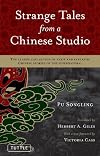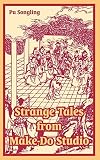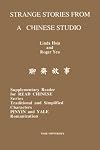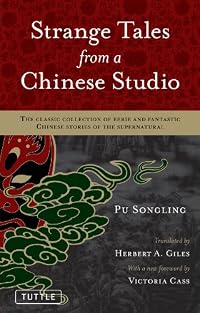
Strange Stories from a Chinese Studio
by Songling Pu
On This Page
Description
Written during the early Qing Dynasty, "Strange Tales from a Chinese Studio" is a collection of nearly 500 mostly supernatural tales by Chinese author Pu Songling. The work, which was published posthumously sometime between 1740 and 1766, is comprised of stories varying in length. While the main characters of this book apparently are ghosts, foxes, immortals, and demons, Pu Songling is more focused on the real lives of common folk of his time. Four main themes run throughout the book. The show more first is the author's complaint with the existing feudal system, which he finds to be unjust and skewed towards the elite. Secondly the author is concerned with the corruption that exists in the Imperial examination system. Thirdly the author shows his admiration of pure, faithful love between poor scholars and powerless women. And lastly is the overarching theme of morality for which Pu Songling intended "Strange Tales from a Chinese Studio" to be instructive towards bettering. This work of classical Chinese literature is presented here in a translation by Herbert A. Giles. show lessTags
Recommendations















Member Recommendations
CGlanovsky Short supernatural stories from 18th Century East Asia


Member Reviews
Classical Chinese literature obviously does not consist solely of the Six Great Novels, and I wanted my reading project to also include some shorter (but not necessarily minor) books. Strange Tales from a Chinese Studio was my first attempt at a canonized work which is not a several thousand pages long, and overall I enjoyed it, if not quite as much as the novels, which I strongly suspect is due to more getting lost in translation.
Pu Songling’s work is written in “classical” Chinese as opposed to the “vernacular” of the novels. Not knowing any Chinese at all, I have not the faintest clue what the implies, but according to the translator of the edition I have read, John Minford, the former is highly elliptical and allusive, show more while the latter is much more straightforward. The tales in this volume often rely heavily on references to other works, and are often oblique in their allusions – a Chinese gentleman reader of the 17th century would probably have caught them easily, but a modern day Western reader is quite lost and has to rely on annotations. John Minford thankfully supplies a generous amount of those (as well as a highly informative introduction), but it still is not quite the same – the whole situation is rather reminiscent of Plum in a Golden Vase – and in fact, Strange Tales shares another trait with that novel, namely that it is very frank about sexuality; the sex is not as explicit, but it occurs rather more often.
When I was starting with this, I was expecting a Chinese version of Sei Shonagon’s Pillow Book, but what I got instead was a Chinese version of Hebel’s Kalendergeschichten with added supernatural elements (and more sex). Which, as I hasten to add, is not a bad thing at all. The stories in this volume (104 in all, a selection from the original) are all short to very short (I don’t think there is a single one above twenty pages) and vary in nature, from didactic morality tales over ghost stories to reports of strange occurrences like you’d find them in the Miscellaneous section of your newspaper (if it was published in 17th century China, that is). And there is, of course, cannibalism – I guess no piece of Classical Chinese literature would be complete without it. Some tales I found delightful, some left me scratching my head, some were amazing, some plain bizarre, some I got, some left me baffled – in short, this collection is very much like the notorious box of chocolates, you never know what you will get.
Strange Tales from a Chinese Studio is best read one or two tales at a time, so that each piece has space and time to unfold its own peculiar charm. Another trait this collection shares with chocolates is that too many ingested at once will spoil your stomach, and that while they are delicious, they are not particularly nourishing. Only maybe half a dozen stories felt like they’d make any lasting impact, the rest, while a pleasant diversion, also seemed somewhat shallow. Which may be because of the shortness of the tales, but I’m more inclined to blame it on them being translations. John Minford’s translation does appear to be a good one (as far as i can tell not knowing the original), but translations can only do so much; and if a work which depends as much on nuances and wordplay (not to mention the occasional double entendre) as Strange Tales from a Chinese Studio appears to do, then it will unfailingly be bound in its original language and any translation, no matter how good, will only give a blurry, washed-out reproduction of the original’s splendour. Even so, just for the glimpse it grants us, it is well worth reading translations. And who knows, readers might find themselves motivated to actually learn the language of the original… show less
Pu Songling’s work is written in “classical” Chinese as opposed to the “vernacular” of the novels. Not knowing any Chinese at all, I have not the faintest clue what the implies, but according to the translator of the edition I have read, John Minford, the former is highly elliptical and allusive, show more while the latter is much more straightforward. The tales in this volume often rely heavily on references to other works, and are often oblique in their allusions – a Chinese gentleman reader of the 17th century would probably have caught them easily, but a modern day Western reader is quite lost and has to rely on annotations. John Minford thankfully supplies a generous amount of those (as well as a highly informative introduction), but it still is not quite the same – the whole situation is rather reminiscent of Plum in a Golden Vase – and in fact, Strange Tales shares another trait with that novel, namely that it is very frank about sexuality; the sex is not as explicit, but it occurs rather more often.
When I was starting with this, I was expecting a Chinese version of Sei Shonagon’s Pillow Book, but what I got instead was a Chinese version of Hebel’s Kalendergeschichten with added supernatural elements (and more sex). Which, as I hasten to add, is not a bad thing at all. The stories in this volume (104 in all, a selection from the original) are all short to very short (I don’t think there is a single one above twenty pages) and vary in nature, from didactic morality tales over ghost stories to reports of strange occurrences like you’d find them in the Miscellaneous section of your newspaper (if it was published in 17th century China, that is). And there is, of course, cannibalism – I guess no piece of Classical Chinese literature would be complete without it. Some tales I found delightful, some left me scratching my head, some were amazing, some plain bizarre, some I got, some left me baffled – in short, this collection is very much like the notorious box of chocolates, you never know what you will get.
Strange Tales from a Chinese Studio is best read one or two tales at a time, so that each piece has space and time to unfold its own peculiar charm. Another trait this collection shares with chocolates is that too many ingested at once will spoil your stomach, and that while they are delicious, they are not particularly nourishing. Only maybe half a dozen stories felt like they’d make any lasting impact, the rest, while a pleasant diversion, also seemed somewhat shallow. Which may be because of the shortness of the tales, but I’m more inclined to blame it on them being translations. John Minford’s translation does appear to be a good one (as far as i can tell not knowing the original), but translations can only do so much; and if a work which depends as much on nuances and wordplay (not to mention the occasional double entendre) as Strange Tales from a Chinese Studio appears to do, then it will unfailingly be bound in its original language and any translation, no matter how good, will only give a blurry, washed-out reproduction of the original’s splendour. Even so, just for the glimpse it grants us, it is well worth reading translations. And who knows, readers might find themselves motivated to actually learn the language of the original… show less
Pu Songling (1640 - 1715) collected folk tales and published 491 of them under the title Strange Tales of Liaozhai (aka Strange Tales from a Chinese Studio). This book contains 50 tales of human contact with supernatural creatures, including gods, ghosts, fox fairies, flower nymphs, crocodile princesses and bee spirits. There are stories about the iniquity of the feudal system, others about the corruption involved in the imperial examination system, and lots of love stories. Unfortunately it's a rather clumsy translation, but the stories are still fascinating and there are some good illustrations, with my favourite being the picture of the fox fairy facing page 50.
I thought the introduction was rather strange until I realised that show more although this book was printed in Hong Kong, the translators were all academics working at universities in the People's Republic of China, hence the apologetic tone and insistence that although Pu Songling was from a landowning family, he had great sympathy for the hardship suffered by the peasants. show less
I thought the introduction was rather strange until I realised that show more although this book was printed in Hong Kong, the translators were all academics working at universities in the People's Republic of China, hence the apologetic tone and insistence that although Pu Songling was from a landowning family, he had great sympathy for the hardship suffered by the peasants. show less
Herbert Giles’ translation of Strange Tales from a Chinese Studio. These ghost stories and wonder tales were collected by Pu Songling, a 17th century failed academic “constrained by poverty and modest in manner,” according to Victoria Cass in the Foreword. “[H]e was a private, deeply ethical man of conservative accomplishments who was both dedicated to his family and decidedly provincial.” Pu failed 14 times at the Examinations that were the key to a comfortable “book-learning” life. As a result, he worked 46 years as a lowly, poorly paid school teacher, the “fall back position for failed candidates.” Fifty years after his death, his grandson finally scraped together the money to publish Pu’s manuscript. It was, and show more continues to be, a great literary success.
https://maryoverton.wikispaces.com/Celestial+Gifts+for+a+Book-Lover show less
https://maryoverton.wikispaces.com/Celestial+Gifts+for+a+Book-Lover show less
Chinese Reader
Ratings
Members
- Recently Added By
Lists

Classics you know you should have read but probably haven't
421 works; 406 members

100 Books to Read in a Lifetime (That Are Older Than 200 Years)
415 works; 175 members

Chinese Literature
12 works; 4 members

Speculative Fiction from around the World
610 works; 17 members

Books Read in 2016
4,666 works; 199 members

Hayao Miyazaki's 50 Recommended Children's Books
48 works; 6 members

Philip Ward's Lifetime Reading Plan
592 works; 22 members
Talk Discussions
Past Discussions
Read-along: Strange Tales from a Chinese Studio in Ancient China (October 2015)
Author Information

102+ Works 1,407 Members
According to the man who wrote P'u's epitaph, on their first meeting, he was expecting someone as brilliant and charming as his stories, only to find an old man who was very precise in his habits and low in his speech, and who found it rather difficult to say what was on his mind. The writer goes on to say, however, that, after knowing P'u a show more while, he came to appreciate the breadth and depth of his knowledge and the boldness and daring of his ideas. In his own preface to his Strange Tales from Make-do Studio, a work that is now considered one of the great achievements of Chinese fantastic narrative, P'u writes in moving terms what that narrative represents to him, the only vent for his feelings in a world where he feels totally alone and surrounded by poverty and contempt, where he is "a bird terrified by the winter frosts and nestling against the tree which can afford him no warmth." And yet, in his miserable little room with its smoky lamp and table "cold as a sheet of ice," he spins marvelous tales and through them vents his indignation against the arrogance of the rich, the subjugation of women, and the plight of the poor peasants, from whom he was distinguished by education but not by condition. Though P'u writes in a classical and highly artificial style, studded with literary allusions, there is something disconcertingly modern about his view of the world, with all its cruelties and carefully chosen and subtly realistic detail, and yet illuminated by an unspoken set of very untraditional principles that shines through the supernatural story lines. In P'u's imaginary world, the ideal woman is not a captive, but a bold and independent actor who, unfettered by convention, is free to love a man as her equal. And, although corruption spreads beyond earthly bounds all the way to the underworld, the God of War himself punishes an evil office seeker after his death, so that justice eventually does prevail. P'u had a hard life and wrote out of his own experience. As the youngest son, he was left with little when family frictions necessitated the division of property, and, having been unsuccessful in the examinations, he was forced to eke out a living as a tutor to various prominent gentry families who treated him as contemptuously as they did their servants. It was only in later years, after his book of tales was completed, that he finally found a comfortable position in a wealthy family who treated him with respect and friendly intimacy. But by that time he was already well into middle age. It is a great testament to the human imagination that a man in such a setting could weave such unusual tales. Unlike many Chinese writers of fiction P'u did not borrow heavily from tradition, but instead made fairy tales out of real life, where, as Jaroslav Prusek, the great Czech Sinologist has written, "the frontiers between the world of man and the world of other creatures of nature disappeared, . . . and he hinted at something mysterious behind every apparently natural and simple phenomenon, and . . . he flooded the whole of life with an air of inexplicable but unlimited possibilities." (Bowker Author Biography) show less
Some Editions
Awards and Honors
Work Relationships
Contains
Has the adaptation
Common Knowledge
- Original title
- 聊齋誌異
- Original publication date
- 1765; 1740
- Important places
- China
- Disambiguation notice
- This is a complete edition of 500 tales; please DON'T combine with Penguin Classics and other selections.
Classifications
- Genres
- Fiction and Literature, General Fiction
- DDC/MDS
- 895.1 — Literature & rhetoric Asian Literature Literatures of East and Southeast Asia Chinese
- LCC
- PL2722 .U2 .L513 — Language and Literature Languages and literatures of Eastern Asia, Africa, Oceania Languages of Eastern Asia, Africa, Oceania Chinese language and literature Chinese literature Individual authors and works
- BISAC
Statistics
- Members
- 299
- Popularity
- 106,925
- Reviews
- 4
- Rating
- (3.92)
- Languages
- 6 — Chinese, English, French, Italian, Russian, Spanish
- Media
- Paper, Ebook
- ISBNs
- 51
- ASINs
- 8