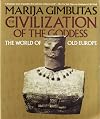
The Civilization of the Goddess: The World of Old Europe
by Marija Gimbutas
On This Page
Description
Presents evidence for the existence of an agrarian earth goddess- worshiping civilization in Old Europe that was destroyed by horse-riding, patriarchal, sky-god-worshiping warriors from the east. A panoramic survey of the Neolithic culture of Europe before the Indo-Europeans. With over 600 photographs, drawings, maps, and charts.Tags
Recommendations


































Member Recommendations

Member Reviews
By developing a more penetrating but just as rigorous methodology, Gimbutas fills in the "story" of the transition from the Neolithic to the Bronze Age in European antiquity. She combined excavation archeology with Linguistics and the study of Myth, coining the terms "archeomythology", "Old Europe" (gynocentric pre-androcratic communities), and "Kurgan".
She brings light to the very concept of "civilization". Not only 600+ pictures of the artifacts, not only charts and timelines showing perspective and flows, but scaled drawings of structures and communities clarified by the extensive excavations.
Abundant irrefutable evidence that "civilization" flourished in Old Europe between 6500 and 3500 BC (and in Crete until 1450 BC), and this show more period was characterized by art, refinement, cleanliness, trade, and No War.
Widespread fighting and fortification building became a way of life from the Bronze Age up until now, but this is "not the case in the Paleolithic and Neolithic". There are NO depictions of arms or torture in the Cave Paintings. Gimbutas shows that the Neolithic period with large towns and peace was not "pre-civilization".
Also, compare the agricultural site at Catal Huyuk, in Anatolia (hog domestication), with hundreds of temples and paintings in all of them and not one scene of warfare or torture [xi].
The book is written as a tool to "refocus our collective memory. The necessity for this has never been greater as we discover that the path of 'progress' is extinguishing the very conditions for life on earth." {In case anyone asks why we study the past. Why we look for our present and future potential.} show less
She brings light to the very concept of "civilization". Not only 600+ pictures of the artifacts, not only charts and timelines showing perspective and flows, but scaled drawings of structures and communities clarified by the extensive excavations.
Abundant irrefutable evidence that "civilization" flourished in Old Europe between 6500 and 3500 BC (and in Crete until 1450 BC), and this show more period was characterized by art, refinement, cleanliness, trade, and No War.
Widespread fighting and fortification building became a way of life from the Bronze Age up until now, but this is "not the case in the Paleolithic and Neolithic". There are NO depictions of arms or torture in the Cave Paintings. Gimbutas shows that the Neolithic period with large towns and peace was not "pre-civilization".
Also, compare the agricultural site at Catal Huyuk, in Anatolia (hog domestication), with hundreds of temples and paintings in all of them and not one scene of warfare or torture [xi].
The book is written as a tool to "refocus our collective memory. The necessity for this has never been greater as we discover that the path of 'progress' is extinguishing the very conditions for life on earth." {In case anyone asks why we study the past. Why we look for our present and future potential.} show less
Masses of evidence for Old Europe's first agrarian civilization being one whose peace and egalitarianism and generalized well-being have never been equaled there since. Which is somehow inspiring, even if we've all taken a big long wrong-turn-at-Albuquerque in the intervening millennia.
Ratings
Members
- Recently Added By
Author Information

26+ Works 1,550 Members
Awards and Honors
Awards
Common Knowledge
- Important places
- Europe
- Original language
- English
Classifications
- Genres
- Anthropology, Nonfiction, History, Religion & Spirituality, General Nonfiction, Art & Design
- DDC/MDS
- 936 — History & geography History of ancient world (to ca. 499) Europe north and west of Italian Peninsula to ca. 499
- LCC
- GN799 .R4 .G54 — Geography, Anthropology and Recreation Anthropology Anthropology Prehistoric archaeology
Statistics
- Members
- 205
- Popularity
- 157,847
- Reviews
- 2
- Rating
- (4.14)
- Languages
- English, German
- Media
- Paper, Audiobook
- ISBNs
- 6