On This Page
Description
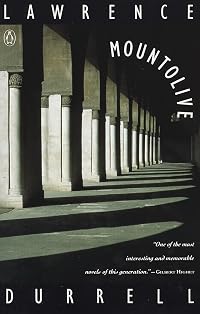
'With the open sesame of language ready to hand, he suddenly began to find himself really penetrating a foreign country' In Mountolive the third volume in Durrell's Alexandria Quartet, the events surrounding the interwoven community of Nessim, Justine, Narouz, Pursewarden and the other major characters are given a very different perspective. The intrigues and complex relationships are seen through the political prism of a world plunging towards war. David Mountolive, once emotionally show more involved with Nessim's set, now returns to Egypt as the British ambassador... show lessTags
Recommendations






































Member Reviews
As we gradually realise the scope of Durrell's literary experiment, in this, the third of the Alexandria novels, it becomes clear how no one human can ever truly know any other human, and it's heartbreaking. Durrell's prose is often too rich, veering into a purple so rich Caesar wouldn't wear it, but for every shot that misses, three hit their mark. Mountolive's drive through the storm is rivaled for beauty only by the dust-storm sequence in "Justine", and the final chapter is a slow, pulsing, vivid depiction of the last moments before death. I'll probably give myself a few weeks to cleanse the palate before reading the final volume in the series, but I'm a Durrell convert for life, I can tell.
The conflict between duty and personal relationships. Mountolive does what the second book could not: freed from Darley's narration and shifted to a third person perspective, it casts the first book in a new light rather than merely adding to its layers. It has the power to stand on its own, although anyone skipping the first two novels would cost this one its ability to surprise. Even Balthazar, it seems, was often treading in the dark. At first it reads only like the next link in a chain as Mountolive's story builds on our introduction to Nessim's family. Then as Pursewarden, Nessim and Justine receive further illumination, it folds back in on itself.
At the same time as the puzzle box reveals its extra facets, however, in bringing show more clarity to vagueness it also brings the prosaic to the artful. Darley is largely dismissed behind his back, but for the reader to do the same would be to brush away the slick presentation that Durrell brought to his first novel and (to a lesser degree) the second. This third is more fun and easy to read, but it is also more conventional and lacks the same depth. I regret Durrell had the casual propensity of tossing the "N" word into the mix. It disturbed my easy enjoyment of what's otherwise the best entertainment value of the quartet so far, if not the most skillful. show less
At the same time as the puzzle box reveals its extra facets, however, in bringing show more clarity to vagueness it also brings the prosaic to the artful. Darley is largely dismissed behind his back, but for the reader to do the same would be to brush away the slick presentation that Durrell brought to his first novel and (to a lesser degree) the second. This third is more fun and easy to read, but it is also more conventional and lacks the same depth. I regret Durrell had the casual propensity of tossing the "N" word into the mix. It disturbed my easy enjoyment of what's otherwise the best entertainment value of the quartet so far, if not the most skillful. show less
I am slowly making my way through Lawrence Durrell’s Alexandria Quartet, four books originally published 1957-1960. I still have to read Clea, but so far, Mountolive is my favorite. It is a more straightforward and linear narrative than the first two books, Justine and Balthazar.
David Mountolive is a British diplomat who gets promoted and moves back to Alexandria. The storyline covers his initial life in Egypt, and his relationship with the Hosnani family, particularly Leila and her grown sons, Nessim, and Narouz. It covers Mountolive’s rise in the administrative ranks and sheds light on the nefarious events that have earlier occurred, such that the reader understands why one of the characters was murdered.
After the first two show more installments, I have gotten used to Durrell’s elaborate writing style, and after initially not liking it all that much, I am now enjoying it. I think it helped that this third book in the series is written in third person. I do not think any of these books stands alone very well, so if you are planning to read this classic set, start with Justine. show less
David Mountolive is a British diplomat who gets promoted and moves back to Alexandria. The storyline covers his initial life in Egypt, and his relationship with the Hosnani family, particularly Leila and her grown sons, Nessim, and Narouz. It covers Mountolive’s rise in the administrative ranks and sheds light on the nefarious events that have earlier occurred, such that the reader understands why one of the characters was murdered.
After the first two show more installments, I have gotten used to Durrell’s elaborate writing style, and after initially not liking it all that much, I am now enjoying it. I think it helped that this third book in the series is written in third person. I do not think any of these books stands alone very well, so if you are planning to read this classic set, start with Justine. show less
I enjoyed this chapter of the Alexandria quartet, and can see how the layering of the narrative was successful in carrying the spirit of the overall work. Here we get a political angle to the motivations, and a showing of the steel teeth that lay not so far beneath the surface of pre-war Alexandria, and by extension, through the British Empire as a whole. It wasn't any work to press on to the next volume.
The third book of The Alexandria Quartet is different from the first two-- since Durrell wanted to discuss the subject/object distinction, it becomes an "objective" novel, written in a wide third-person point-of-view, rather than the first-person perspective of the first two. It makes for a very different novel from the first two-- while Balthazar wouldn't make sense if you hadn't read Justine (or at least it wouldn't have much of a point), Mountolive could stand entirely on its own. Its perspective is very removed from that of the first two-- its protagonist, David Mountolive, only has a couple fleeting mentions in the second book, whereas the narrator of the first two (finally given a name here) is barely in this one, and usually show more disparaged when he is mentioned, much to my amusement. The continuous revision of the information we received in the first book is very interesting-- Mountolive presents an entirely new set of reasons for the events of Justine yet again, so that it would seem old Balthazar didn't know what he was talking about after all. Or did he? Even though this book is written in the third person, allegedly more reliable, I never felt inclined to trust it. I think I would prefer it if the version of events given in the first book was true, but I'll wait to talk more about that once I read the last book in the series. Hopefully soon. show less
This won't be easy for me. If you happened to have read my reviews of the previous two volumes in this Quartet, you will understand. I have the greatest respect for the author's talent, the beauty of his prose, and the depth of his characters. In that sense, "Mountolive" appropriately takes its place in the Quartet.
My struggle is with the overall theme and continuity of the Quartet as a whole. I was overwhelmed by the first volume, "Justine". I found it powerful, beautiful, sad and mysterious. The entire experience touched me deeply. The succeeding volumes seemed to attempt to turn all this around. The series seemed to have lost its semi-existential dimension. Now, we were directed to political intrigue and interpersonal (gossipy?) show more machinations. Some characters lost what dignity they possessed in "Justine".
In retrospect, I wish I had stopped after "Justine". Or, further selfish pipedreams, the author had presented the following three works as a separate series. Both works, "Justine" and the Alexandria Trilogy (separately titled and published) would be immensely valuable (yet distinctly different) works.
No need to make me aware of the hubris my words entail. show less
My struggle is with the overall theme and continuity of the Quartet as a whole. I was overwhelmed by the first volume, "Justine". I found it powerful, beautiful, sad and mysterious. The entire experience touched me deeply. The succeeding volumes seemed to attempt to turn all this around. The series seemed to have lost its semi-existential dimension. Now, we were directed to political intrigue and interpersonal (gossipy?) show more machinations. Some characters lost what dignity they possessed in "Justine".
In retrospect, I wish I had stopped after "Justine". Or, further selfish pipedreams, the author had presented the following three works as a separate series. Both works, "Justine" and the Alexandria Trilogy (separately titled and published) would be immensely valuable (yet distinctly different) works.
No need to make me aware of the hubris my words entail. show less
This third novel in the Alexandria Quartet switches to a different narrator from the previous two and changes quite dramatically in style. Durrell's prose is still beautiful and engaging, but I didn't find this novel nearly as enjoyable as the previous two.
Of the three books I've read so far in the quartet, all of them have a layer of dismissive colonial racism in them and a similar current of misogyny. The first two books were good enough for this to spoil but not break them, whereas this novel seems more offensive more frequently, and combined with the change in style it just isn't an enjoyable or recommendable book.
Of the three books I've read so far in the quartet, all of them have a layer of dismissive colonial racism in them and a similar current of misogyny. The first two books were good enough for this to spoil but not break them, whereas this novel seems more offensive more frequently, and combined with the change in style it just isn't an enjoyable or recommendable book.
Members
- Recently Added By
Lists

20th Century Literature
1,161 works; 55 members

Recommended Reading : 600 Classics Reviewed, Editors of Salem Press, 2015
634 works; 6 members
Author Information

152+ Works 18,693 Members
Lawrence Durrell was born on February 27, 1912 in Jullundur, India to British parents. During World War II, he served as a British press officer. His first novel, Pied Piper of Lovers, was published in 1935, but was considered a failure. Some of his other works include The Black Book, The Alexandria Quartet, The Avignon Quintet, and Caesar's Vast show more Ghost: A Portrait of Provence. Bitter Lemons won the Duff Cooper Prize in 1959. He died on November 7, 1990 at the age of 78. (Bowker Author Biography) show less

Lawrence Durrell has a Legacy Library. Legacy libraries are the personal libraries of famous readers, entered by LibraryThing members from the Legacy Libraries group.
Some Editions
Awards and Honors
Distinctions
Notable Lists
Series

Belongs to Publisher Series
Work Relationships
Is contained in
Is abridged in
Common Knowledge
- Canonical title
- Mountolive;
- Original title
- Mountolive
- Alternate titles
- Alexandria Quartet
- Original publication date
- 1958
- People/Characters
- David Mountolive
- Important places
- Alexandria, Egypt; Egypt
- Epigraph
- The dream dissipated, were one to recover one's commonsense mood, the thing would be of but mediocre import -- 'tis the story of mental wrongdoing. Everyone knows very well and it offends no one. But alas! one sometimes carri... (show all)es the thing a little further. What, one dares wonder, what would not be the idea's realization if its mere abstract shape thus exalted has just so profoundly moved one? The accursed reverie is vivified and its existence is a crime.
D.A.F. de Sade: Justine
Il faut que le roman raconte.
Stendahl - First words
- As a junior of exceptional promise, he had been sent to Egypt for a year in order to improve his Arabic and found himself attached to the High Commission as a sort of scribe to await his first diplomatic posting; but he was a... (show all)lready conducting himself as a young secretary of legation, fully aware of the responsibilities of future office.
- Original language*
- Inglés
*Some information comes from Common Knowledge in other languages. Click "Edit" for more information.
Classifications
Statistics
- Members
- 1,632
- Popularity
- 13,858
- Reviews
- 28
- Rating
- (3.96)
- Languages
- 13 — Catalan, Danish, English, French, German, Greek, Hungarian, Italian, Japanese, Polish, Spanish, Turkish, Portuguese (Portugal)
- Media
- Paper, Audiobook, Ebook
- ISBNs
- 63
- UPCs
- 1
- ASINs
- 62