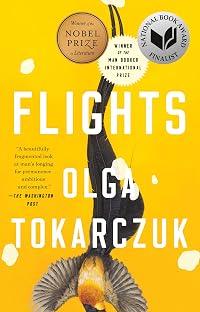
Flights
by Olga Tokarczuk
On This Page
Description
A seventeenth-century Dutch anatomist discovers the Achilles tendon by dissecting his own amputated leg. Chopin's heart is carried back to Warsaw in secret by his adoring sister. A woman must return to her native Poland in order to poison her terminally ill high school sweetheart, and a young man slowly descends into madness when his wife and child mysteriously vanish during a vacation and just as suddenly reappear. Through these brilliantly imagined characters and stories, interwoven with show more haunting, playful, and revelatory meditations, Flights explores what it means to be a traveler, a wanderer, a body in motion not only through space but through time. Where are you from? Where are you coming in from? Where are you going? we call to the traveler. Enchanting, unsettling, and wholly original, Flights is a master storyteller's answer. show lessTags
Recommendations



















Member Recommendations

MM_Jones Both are nonlinear works of fiction. One won the Man Booker International prize, the other by an unknown author.



Member Reviews
Someone came up with a name for this sort of memoir-but-also-fiction but I've forgotten. By ordinary standards the book is indescribable. There are short 'essays' on various subjects of interest to the 'narrator' (who is and isn't fictional?) but almost all of these share a common theme: movement, travel, be it in your head or time spent in an airport, or walking somewhere, or staring at a map thinking about going somewhere. In between these are longer 'stories', one about a man whose wife and child walk into a field and disappear while the three are on holiday, about Chopin's heart traveling home from Paris to Warsaw, about Philip Verleyen, who lost a leg in his twenties, and which loss led him to become a foremost anatomist, about the show more wife of an aging and failing historian on a final cruise in the Aegean. These stories also connect to the theme of movement and perhaps illustrate and deepen the idea attaching them to ways humans experience motion while alive: life/death, body/soul, presence/absence and so forth. Tokarczuk is fearless and I was utterly absorbed. ***** show less
There are so many ideas that can be associated with the idea of 'flights'. After reading Olga Tokarczuk's Flights, my association would be flights of fancy.
Tokarczuk has the gift of being able to set her readers careening along: up, down, around, sometimes at great speeds, other times pausing, always leading them to the unexpected.
There are real flights here, on earth and in the air. There are metaphorical ones too, as people move through time, some right up the their very end. Some stories are taken up at intervals, appearing like a leitmotif as an idea flies in and out of our consciousness.
Elsewhere, there are penseés, dreams, and brief essays as Tokarczuk considers life and history in her own way. A delightful feature is the show more presentation of idiosyncratic maps, like the one of Nova Zembla in 1855, with a coastline full of whales and seals. Accompanying it is the tale of Peter the Great's purchase of a collection of anatomical specimens, and its ill fated sea voyage from Holland to Petersburg. The unfortunate captain for his failure to take care of the transport, was sent along with his family to the Far North, where for the rest of his life he organized little fishing expeditions and contributed to the drawing up of more detailed maps of Nova Zembla.
Flight can result in strange time shifts for the traveller. Are they gaps in time, time warps, or is time standing still? Consider:
IRKUTSK - MOSCOW
Flight from Irkutsk to Moscow. It takes off at 8:00 a.m. and lands in Moscow at the same time - at eight o'clock in the morning on the same day. It turns out to be right at sunrise, which means the whole flight takes place during dawn. Passengers remain in this one moment, a great, peaceful Now, vast as Siberia itself.
So there should be time enough for confessions of a whole lifetime. Time elapses inside the plane, but doesn't trickle out of it.
This may all sound disjointed, but there is a flow here that carries the reader along. Conversations with strangers who travel with you for brief moments, digressions to museums and conferences, fact and fiction, but throughout the underlying questions: Who am I? Where am I ?
Tokarczuk didn't make it to Newfoundland, but there they would have asked her "Where do you belong?" There they know we all belong somewhere, are rooted body and soul in our own particular world, no matter how far we have flown. For the rest of us, there's flight. show less
Tokarczuk has the gift of being able to set her readers careening along: up, down, around, sometimes at great speeds, other times pausing, always leading them to the unexpected.
There are real flights here, on earth and in the air. There are metaphorical ones too, as people move through time, some right up the their very end. Some stories are taken up at intervals, appearing like a leitmotif as an idea flies in and out of our consciousness.
Elsewhere, there are penseés, dreams, and brief essays as Tokarczuk considers life and history in her own way. A delightful feature is the show more presentation of idiosyncratic maps, like the one of Nova Zembla in 1855, with a coastline full of whales and seals. Accompanying it is the tale of Peter the Great's purchase of a collection of anatomical specimens, and its ill fated sea voyage from Holland to Petersburg. The unfortunate captain for his failure to take care of the transport, was sent along with his family to the Far North, where for the rest of his life he organized little fishing expeditions and contributed to the drawing up of more detailed maps of Nova Zembla.
Flight can result in strange time shifts for the traveller. Are they gaps in time, time warps, or is time standing still? Consider:
IRKUTSK - MOSCOW
Flight from Irkutsk to Moscow. It takes off at 8:00 a.m. and lands in Moscow at the same time - at eight o'clock in the morning on the same day. It turns out to be right at sunrise, which means the whole flight takes place during dawn. Passengers remain in this one moment, a great, peaceful Now, vast as Siberia itself.
So there should be time enough for confessions of a whole lifetime. Time elapses inside the plane, but doesn't trickle out of it.
This may all sound disjointed, but there is a flow here that carries the reader along. Conversations with strangers who travel with you for brief moments, digressions to museums and conferences, fact and fiction, but throughout the underlying questions: Who am I? Where am I ?
Tokarczuk didn't make it to Newfoundland, but there they would have asked her "Where do you belong?" There they know we all belong somewhere, are rooted body and soul in our own particular world, no matter how far we have flown. For the rest of us, there's flight. show less
At first sight, this is an idea for a book so crazy that you are inclined to suspect that it could have been the result of a silly party game — after the third bottle of wine has gone round the writer gets her friends to write down things that could be subjects for a parody of the postmodern novel, and, suitably blindfolded, she draws out "air travel", "museums of anatomical specimens" and "old maps"...
...but of course that's unfair. Whatever the method that led her to pick these particular themes, Tokarczuk knows what she's doing, and she stitches them into a complex but very satisfying whole, using a mixture of first-person observation in the persona of the author, fragments of fictional stories, and historical anecdotes, show more illustrated in a pleasingly incoherent way by a selection of old and slightly offbeat maps of places that mostly don't have anything obvious to do with the text.
Some things work better than others: the whole flight=fugue, arrival=death, aircraft=womb (etc.) thing has been done by so many other people, and the last part of the book almost reads like a rehash of Tennyson's "Ulysses". But she does manage to keep our attention, even there, and she does a lot of unexpected things with the other major thread about anatomical exhibitions and tissue-preservation (parts of which are also quite well-trodden ground for postmodern writers). And she's simply such a good writer in detail as well: wherever we are in the book there are unexpected images and pieces of observation to make us go back and read a passage again, with even more pleasure than the first time. show less
...but of course that's unfair. Whatever the method that led her to pick these particular themes, Tokarczuk knows what she's doing, and she stitches them into a complex but very satisfying whole, using a mixture of first-person observation in the persona of the author, fragments of fictional stories, and historical anecdotes, show more illustrated in a pleasingly incoherent way by a selection of old and slightly offbeat maps of places that mostly don't have anything obvious to do with the text.
Some things work better than others: the whole flight=fugue, arrival=death, aircraft=womb (etc.) thing has been done by so many other people, and the last part of the book almost reads like a rehash of Tennyson's "Ulysses". But she does manage to keep our attention, even there, and she does a lot of unexpected things with the other major thread about anatomical exhibitions and tissue-preservation (parts of which are also quite well-trodden ground for postmodern writers). And she's simply such a good writer in detail as well: wherever we are in the book there are unexpected images and pieces of observation to make us go back and read a passage again, with even more pleasure than the first time. show less
Small PSA: most of the book's short essays are written in an easy academic style which might make them boring for those who despise that fashion. If you crave pure narratives à la generic/standard English fiction this book might not be a good fit.
This work of distilled art took me almost two years to complete, despite possessing a clear narrative, and a lone lucent theme—what stays in motion is alive, the settled are as good as embalmed cadavers out for display. I read many books and short stories in between—many from Olga Tokarczuk herself—and her fascinated, sometimes frantic, sketches of traveling and motion in perpetuity began to take the shape of a behemoth in my subconscious. I have read and reread several of the show more narratives, once going back to the very start from somewhere in the middle because the behemoth (then just a small kitten, perhaps) demanded that I soak it all in, remember it, cherish it, before I venture further. After finishing a strong narrative I have closed the book for weeks, which is an odd behaviour since I usually gulp down such a book in one long sitting.
Perhaps the structure of the book - several intertwined stories interspersed with numerous short essays, had made such pauses possible in practice.
Leaving all that apart, the short essays are incisive and their topics are diverse, as if a jack of all trades mind with superior ability to pluck out threads of questions out of an academic talk aimed at laypeople has jotted these essays down (this is a borrowed analogy from this work itself.) Take for example her essay on the museum of human deformities. In it, while looking at deformed foetuses that couldn't complete their genesis, she wonders how the embryo knew where to grow arms and legs and lungs, how the body's structure comes out of a small round cell! It's a striking observation that she just mentions matter-of-factly in two lines and moves on, but it's a genuine research question without a complete answer still!
The fictional stories have complex themes with only one common denominator between them. The travellers find their fixed friends and acquaintances slowly decaying, the stench of it becoming a gale for the traveller soul, carrying them further and further away even as they half-heartedly wish to stay for love's sake. Even when the protagonists are at home, majority of the narrative takes place when they're in motion - while driving, in lifts, on long walks, in chariots, on boats, or circling around in rooms. She does not spare her protagonists even in bed - they should either be taking rest between travels, or they're doomed to insomnia and plagued by nightmares. Staying still is the most abhorrent and deteriorating activity her characters can engage in.
She also seems to place an awful lot of emphasis on islands, or places near water. The number is irrationally high for me to consider it just coincidence or preference. Maybe waterways are a quicker way for escape from settling down, who knows.
I'll probably need to reread this multiple times before my review can begin to do this book justice. show less
This work of distilled art took me almost two years to complete, despite possessing a clear narrative, and a lone lucent theme—what stays in motion is alive, the settled are as good as embalmed cadavers out for display. I read many books and short stories in between—many from Olga Tokarczuk herself—and her fascinated, sometimes frantic, sketches of traveling and motion in perpetuity began to take the shape of a behemoth in my subconscious. I have read and reread several of the show more narratives, once going back to the very start from somewhere in the middle because the behemoth (then just a small kitten, perhaps) demanded that I soak it all in, remember it, cherish it, before I venture further. After finishing a strong narrative I have closed the book for weeks, which is an odd behaviour since I usually gulp down such a book in one long sitting.
Perhaps the structure of the book - several intertwined stories interspersed with numerous short essays, had made such pauses possible in practice.
Leaving all that apart, the short essays are incisive and their topics are diverse, as if a jack of all trades mind with superior ability to pluck out threads of questions out of an academic talk aimed at laypeople has jotted these essays down (this is a borrowed analogy from this work itself.) Take for example her essay on the museum of human deformities. In it, while looking at deformed foetuses that couldn't complete their genesis, she wonders how the embryo knew where to grow arms and legs and lungs, how the body's structure comes out of a small round cell! It's a striking observation that she just mentions matter-of-factly in two lines and moves on, but it's a genuine research question without a complete answer still!
The fictional stories have complex themes with only one common denominator between them. The travellers find their fixed friends and acquaintances slowly decaying, the stench of it becoming a gale for the traveller soul, carrying them further and further away even as they half-heartedly wish to stay for love's sake. Even when the protagonists are at home, majority of the narrative takes place when they're in motion - while driving, in lifts, on long walks, in chariots, on boats, or circling around in rooms. She does not spare her protagonists even in bed - they should either be taking rest between travels, or they're doomed to insomnia and plagued by nightmares. Staying still is the most abhorrent and deteriorating activity her characters can engage in.
She also seems to place an awful lot of emphasis on islands, or places near water. The number is irrationally high for me to consider it just coincidence or preference. Maybe waterways are a quicker way for escape from settling down, who knows.
I'll probably need to reread this multiple times before my review can begin to do this book justice. show less
A double review: 'House of Day, House of Night' and 'Flights.'
I finally got around to reading 'House of Day, House of Night' on a friend's recommendation, after reading Tokarczuk 'Flights,' which is somehow even better. I'm baffled as to why this kind of form hasn't made its way into English-language writing, except in the most self-important and portentous way: a compendium of memoir (whether actual or purely formal), short stories, essays, research, tall tales, local history and so on, all of which is actually connected together in pretty obvious ways (here, by locality) rather than being aggressively meaningless, as in most fragmented anglo novels.
The center-piece to this book is the story of St. Uncumber (Wilgefortis in German), show more who repelled a rapey would-be fiance by assuming the face of Jesus, beard and all, and thus became the patron of all women in horrible relationships (until her cult was suppressed fifty odd years ago)--and, more importantly, Uncumber's hagiographer (I'm pretty sure Tokarczuk make him up). This tale was inspired by the narrator's trip to the local church, which featured a pamphlet life of the saint; much of the rest of the book details the relationship between our narrator and her neighbor, Marta, which veers between standard small town comedy and fairy-tale airiness. Usually I would roll my eyes at the latter, but here it works, because Tokarczuk presents it so modestly--no "look at me undermining paradigms!" stuff here.
Perhaps the gender-bending, localism and fairy-tale aspects will date this book in a few years; perhaps not. But it works wonderfully with the later 'Flights.' 'Flights' is tied together by the narrator's travels in the world of bodily preservation, which she refers to as her 'pilgrimages.' The narratives here are more resolutely contemporary: families go on holiday, only for disaster to strike, and so on. The past is just as important as it is in 'House,' but the stories are more--if this is the right word--mainstream. As a special bonus, there are fabulous illustrations.
While 'House' is about one place, about the immobility of history and God and so on, and how all that immobility relies on motion and change, 'Flights' is more or less the exact opposite: same form, with science (in the form plastination) taking the place of God (if not religion) and tourism taking the place of localism: it turns out that the ever changing world of the human body and tourism and love relies on some fixity, as well.
Intelligent, beautifully translated, endlessly interesting, and blessedly non-self-important, I can only hope these two novels exert some influence over writers outside of Poland as well as inside it. show less
I finally got around to reading 'House of Day, House of Night' on a friend's recommendation, after reading Tokarczuk 'Flights,' which is somehow even better. I'm baffled as to why this kind of form hasn't made its way into English-language writing, except in the most self-important and portentous way: a compendium of memoir (whether actual or purely formal), short stories, essays, research, tall tales, local history and so on, all of which is actually connected together in pretty obvious ways (here, by locality) rather than being aggressively meaningless, as in most fragmented anglo novels.
The center-piece to this book is the story of St. Uncumber (Wilgefortis in German), show more who repelled a rapey would-be fiance by assuming the face of Jesus, beard and all, and thus became the patron of all women in horrible relationships (until her cult was suppressed fifty odd years ago)--and, more importantly, Uncumber's hagiographer (I'm pretty sure Tokarczuk make him up). This tale was inspired by the narrator's trip to the local church, which featured a pamphlet life of the saint; much of the rest of the book details the relationship between our narrator and her neighbor, Marta, which veers between standard small town comedy and fairy-tale airiness. Usually I would roll my eyes at the latter, but here it works, because Tokarczuk presents it so modestly--no "look at me undermining paradigms!" stuff here.
Perhaps the gender-bending, localism and fairy-tale aspects will date this book in a few years; perhaps not. But it works wonderfully with the later 'Flights.' 'Flights' is tied together by the narrator's travels in the world of bodily preservation, which she refers to as her 'pilgrimages.' The narratives here are more resolutely contemporary: families go on holiday, only for disaster to strike, and so on. The past is just as important as it is in 'House,' but the stories are more--if this is the right word--mainstream. As a special bonus, there are fabulous illustrations.
While 'House' is about one place, about the immobility of history and God and so on, and how all that immobility relies on motion and change, 'Flights' is more or less the exact opposite: same form, with science (in the form plastination) taking the place of God (if not religion) and tourism taking the place of localism: it turns out that the ever changing world of the human body and tourism and love relies on some fixity, as well.
Intelligent, beautifully translated, endlessly interesting, and blessedly non-self-important, I can only hope these two novels exert some influence over writers outside of Poland as well as inside it. show less
I've been meaning to read this book for about four years now. I was worried that it would be too fragmented or heady and there'd be nothing to carry me along. (Actually I'm pretty sure I tried reading the first few pages a few years ago but couldn't get into it then). But in my current state -- which is a state of irritation at what books readers are choosing to read and what defines popular literature currently -- Flights was the perfect read. It's now one of my favorite books and one that I hope to come back to every few years. It's not a book to read (or listen to) when one is tired, or distracted, or multi-tasking, meaning it does require the reader to be paying attention. And it's not entertaining in the way that a TV show or a show more mystery/thriller novel is entertaining. But it's a reminder that literature --and novels -- can be so much more than entertainment. When I was able to make time for it, I looked forward to reading it and learning more about how Olga Tokarczuk sees the world. I like to think this book is an argument about what the novel form (and humanity) could be, essentially interconnected parts that help us understand (or experience) (or sense) the whole. show less
‘’Each of my pilgrimages aims at some other pilgrim. In this case the pilgrim is in pieces, broken down.’’
This might very well be the first time that I have no clear ‘’picture’’ in my head regarding this review. Flights is the winner of the 2018 Man Booker International Prize and it is one of those cases where the verb ‘’like’’ and its negative form can’t retain any significant meaning. So be patient with me while I am trying to -clumsily- explain the impact Flights had on me.
In a magnificent translation by Jennifer Croft, Flights is a modern Odyssey of the human being amidst eternal journeys from country to country but, most importantly, within ourselves. Anatomy and transportation are combined to demonstrate show more the continuous search, the change, the fight for self-discovery. Individual stories, taking place over different eras, born out of curiosity and despair. Tokarczuk’s work is a hymn to human emotions, to independence, to unfulfilled wishes.
‘’He said that death marks places like a dog marking its territory.’’
Flights is a novel featuring characteristics of essays, biography and non-fiction, where the voice of the writer reflects the feelings and thoughts of characters in a distant and, at times, clinically sharp way. Tokarczuk’s writing brings to mind great authors of Balkan and East European Literature. I found similarities to Daša Drndic and Dubravka Ugrešic although, in my opinion, Tokarczuk lacks the darkness and impact of the two Croatian writers. She focuses on issues that reflect the strangest aspects of traveling and searching for the destination that would mean the end of a fulfilling journey. Or not. What happens when you don’t want to reach the end? When you feel that you can’t settle, that you don’t need a permanent basis?
‘’The apartment doesn’t understand what’s happened. The apartment thinks its owner has died.’’
There is a plethora of information in this beautiful book. Tokarczuk refers to the Recurrent Detoxification Syndrome, the need of the human mind to return to certain images no matter how disturbing or repulsive they may be. It’s what makes us freeze, unable to take our eyes off images that make our stomach turn. Another interesting point has to do with the apartment that is left behind, locked and dark, when we depart for a journey, leaving our shelter silent and lifeless. And what about the images that come to mind at the sound of a country’s name? What do we recall when we think of China, Russia, Spain, Lithuania, Serbia, Ireland and every other country of our planet? Each one of us forms a unique, personal picture based on experience, education and various cultural influences.
The richness and power of Flights lie in the characters and their journeys. I was confused, moved and horrified by the story of Kunicki, a Polish businessman, whose wife and son disappear for three days and for unknown reasons while vacationing in a Croatian island. The story of a Russian woman, a mother in the most difficult position imaginable, who tries to relieve the pain of people who have no destination anymore made me think of loneliness and the horrible feeling that you’re slowly drifting away when you aren’t strong enough to fight. Nebojša’s thoughts on what war leaves behind and the moving journey of Chopin’s heart from Paris to Warsaw are outstanding moments.
I don’t particularly agree with a few of the writer’s views on people and God. They seemed too detached, almost nihilistic, but this is of little importance. Flights should be an undisputed reading choice, a book that can be read while on a journey, in an airport while the night is falling, in a hotel room overlooking the distant glimpses of the city lights. And if you don’t travel, do not worry. Olga Tokarczuk and Jennifer Croft are here to be your powerful guides.
‘’I’m a few years old, I’m sitting on the window sill, and I’m looking out onto the chilled courtyard. The lights in the school’s kitchen are extinguished; everyone has left. All the doors are closed, hatched down, blinds lowered. I’d like to leave, but there’s nowhere to go. My own presence is the only thing with a distinct outline now, an outline that quivers and undulates, and in so doing, hurts. And all of a sudden I know: there’s nothing anyone can do now, here I am.’’
My reviews can also be found on https://theopinionatedreaderblog.wordpress.com show less
This might very well be the first time that I have no clear ‘’picture’’ in my head regarding this review. Flights is the winner of the 2018 Man Booker International Prize and it is one of those cases where the verb ‘’like’’ and its negative form can’t retain any significant meaning. So be patient with me while I am trying to -clumsily- explain the impact Flights had on me.
In a magnificent translation by Jennifer Croft, Flights is a modern Odyssey of the human being amidst eternal journeys from country to country but, most importantly, within ourselves. Anatomy and transportation are combined to demonstrate show more the continuous search, the change, the fight for self-discovery. Individual stories, taking place over different eras, born out of curiosity and despair. Tokarczuk’s work is a hymn to human emotions, to independence, to unfulfilled wishes.
‘’He said that death marks places like a dog marking its territory.’’
Flights is a novel featuring characteristics of essays, biography and non-fiction, where the voice of the writer reflects the feelings and thoughts of characters in a distant and, at times, clinically sharp way. Tokarczuk’s writing brings to mind great authors of Balkan and East European Literature. I found similarities to Daša Drndic and Dubravka Ugrešic although, in my opinion, Tokarczuk lacks the darkness and impact of the two Croatian writers. She focuses on issues that reflect the strangest aspects of traveling and searching for the destination that would mean the end of a fulfilling journey. Or not. What happens when you don’t want to reach the end? When you feel that you can’t settle, that you don’t need a permanent basis?
‘’The apartment doesn’t understand what’s happened. The apartment thinks its owner has died.’’
There is a plethora of information in this beautiful book. Tokarczuk refers to the Recurrent Detoxification Syndrome, the need of the human mind to return to certain images no matter how disturbing or repulsive they may be. It’s what makes us freeze, unable to take our eyes off images that make our stomach turn. Another interesting point has to do with the apartment that is left behind, locked and dark, when we depart for a journey, leaving our shelter silent and lifeless. And what about the images that come to mind at the sound of a country’s name? What do we recall when we think of China, Russia, Spain, Lithuania, Serbia, Ireland and every other country of our planet? Each one of us forms a unique, personal picture based on experience, education and various cultural influences.
The richness and power of Flights lie in the characters and their journeys. I was confused, moved and horrified by the story of Kunicki, a Polish businessman, whose wife and son disappear for three days and for unknown reasons while vacationing in a Croatian island. The story of a Russian woman, a mother in the most difficult position imaginable, who tries to relieve the pain of people who have no destination anymore made me think of loneliness and the horrible feeling that you’re slowly drifting away when you aren’t strong enough to fight. Nebojša’s thoughts on what war leaves behind and the moving journey of Chopin’s heart from Paris to Warsaw are outstanding moments.
I don’t particularly agree with a few of the writer’s views on people and God. They seemed too detached, almost nihilistic, but this is of little importance. Flights should be an undisputed reading choice, a book that can be read while on a journey, in an airport while the night is falling, in a hotel room overlooking the distant glimpses of the city lights. And if you don’t travel, do not worry. Olga Tokarczuk and Jennifer Croft are here to be your powerful guides.
‘’I’m a few years old, I’m sitting on the window sill, and I’m looking out onto the chilled courtyard. The lights in the school’s kitchen are extinguished; everyone has left. All the doors are closed, hatched down, blinds lowered. I’d like to leave, but there’s nowhere to go. My own presence is the only thing with a distinct outline now, an outline that quivers and undulates, and in so doing, hurts. And all of a sudden I know: there’s nothing anyone can do now, here I am.’’
My reviews can also be found on https://theopinionatedreaderblog.wordpress.com show less
Members
- Recently Added By
Lists

Female Author
1,234 works; 65 members

EU Fiction: 1950-2022
223 works; 68 members
Female Protagonist
1,056 works; 57 members

Greatest Books
40 works; 3 members

Books Read in 2018
4,360 works; 110 members

Books Read in 2021
5,361 works; 114 members

.
184 works; 1 member

Physical TBR List
68 works; 1 member

contemporary literary fiction list to check out
47 works; 1 member

Wishlist
48 works; 1 member
Author Information

36+ Works 11,486 Members
Some Editions
Awards and Honors
Awards
Distinctions
Notable Lists
Series
Belongs to Publisher Series
Otavan kirjasto (232)
Common Knowledge
- Canonical title*
- Бегуны
- Original title
- Bieguni
- Alternate titles
- Runners
- Original publication date
- 2007 (Pools) (Pools); 2011 (Nederlands) (Nederlands)
- People/Characters
- Kunicki; Jagoda; Dr Blau; Philip Verheyen; Charlotta Ruysch; Annushku (show all 7); Frédéric Chopin
- Important places
- Poland
- First words
- I'm a few years old. I'm sitting on the windowsill, surrounded by strewn toys and toppled-over block towers and dolls with bulging eyes. It's dark in the house, and the air in the rooms slowly cools, dims. There's no one else... (show all) here; they've left, they're gone, though you can still hear their voices dying down, that shuffling, the echoes of their footsteps, some distant laughter. Out the window the courtyard is empty. Darkness spreads softly from the sky, settling on everything like black dew. -Here I Am
- Last words
- (Click to show. Warning: May contain spoilers.)That smile of theirs holds - or so it strikes us - a kind of promise that perhaps we will be born anew now, this time in the right time and the right place.
- Blurbers
- Annie Proulx; Marlon James; Alexievich, Svetlana
- Original language
- Polish
- Canonical DDC/MDS
- 891.8
- Canonical LCC
- PG7179.O37 B5413
*Some information comes from Common Knowledge in other languages. Click "Edit" for more information.
Classifications
- Genres
- General Fiction, Fiction and Literature
- DDC/MDS
- 891.8 — Literature & rhetoric Literatures of other languages East Indo-European and Celtic literatures West and South Slavic languages (Bulgarian, Slovene, Polish, Czech, Slovak, Serbo-Croatian, and Macedonian)
- LCC
- PG7179 .O37 .B5413 — Language and Literature Slavic languages and literatures. Baltic languages. Albanian language Slavic. Baltic. Albanian Slavic Polish
- BISAC
Statistics
- Members
- 2,317
- Popularity
- 8,607
- Reviews
- 55
- Rating
- (3.60)
- Languages
- 24 — Arabic, Bosnian, Czech, Danish, Dutch, English, Finnish, French, German, Greek, Hungarian, Italian, Japanese, Korean, Malayalam, Norwegian (Bokmål), Polish, Romanian, Russian, Serbian, Spanish, Swedish, Turkish, Portuguese (Portugal)
- Media
- Paper, Audiobook, Ebook
- ISBNs
- 68
- ASINs
- 13