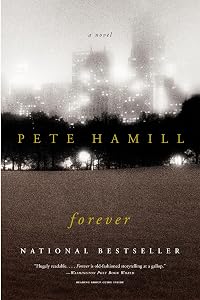
Forever
by Pete Hamill
On This Page
Description
Cormac O'Connor, who arrives in New York City from Ireland in 1741, has been given the gift of immortality--but only on the condition that he never leave the island of Manhattan. Through his eyes, this magical epic follows the city's transformation from a burgeoning settlement to the thriving metropolis of the present day. But this is also Cormac's story as he explores the mysteries of time and immortality, death and loss, sex and love.Tags
Recommendations




Member Recommendations

Manthepark Another great historical novel about New York, when a bunch of bawdy Dutchmen ruled the place. Imaginative and authentic.
Member Reviews
I have just finished reading this book for the second time and I have to increase my rating of it. The first time I read it, I didn't like it too much, but now, I found myself enjoying parts of it quite well. I especially enjoyed the first part of the book, in which we meet Cormac and his parents, living in Ireland. As Cormac grows up, he learns more about his family, but also ends up losing them. In New York, to where he traveled to pursue his father's killer, he gets offered immortality, on the condition that he never leaves Manhattan. This plot device felt strange in an otherwise not so fantastical book, but was very necessary for the story. So, on this second read, I decided to ignore this part of the story a bit, and focus on the show more rich descriptions of the growing city of New York. These descriptions are what makes the book worth reading. We see New York transform in amazing ways, written in beautiful prose. Cormac never becomes a great main character, but if you're interested in New York's history, this is a nice book to read. show less
Pete Hamill knows New York. As editor of both the New York Post and the New York Daily News and frequent contributor to the New York Times and The New Yorker, there's little doubt his passion for and knowledge of the city and its people runs deep. Cut his veins, he probably bleeds apple juice.
In his latest novel, Forever, Hamill takes that love and understanding and wraps NYC in a big, smothery embrace. Emphasis on the smothering part.
Forever is ambitious—and frequently unsuccessful—as it tries to chart a huge chunk of Gotham history in 600 tedious pages.
The novel is essentially a time-travel fantasy where instead of going back in time, the central character comes forward, living each day of American history from show more pre-Revolutionary War to September 11. We first meet Cormac O’Connor as a five-year-old living in eighteenth-century Ireland. He’s called Robert Carson because his family has tried to keep its Celtic beliefs hidden from Protestant persecutors roaming the land—embodied in the cruel character of the Earl of Warren. Cormac adopts his real name after his parents are killed by the earl and he vows to seek revenge. Before he died, Cormac’s father told him, “In our tribe, the murderer must be pursued to the ends of the earth. And his male children, too.âÂ? And so, Cormac follows Warren to the American colonies, chasing him through the dirt streets of New York (then little more than a colony of Dutch farmers).
On the passage to America, Cormac befriended some of the African slaves; that friendship is later rewarded when a shaman gives Cormac the âÂÂgiftâÂ? of eternal life so that he can wreak his revenge on future generations of Warrens. One stipulation: Cormac cannot set foot off Manhattan Island (or, I imagine, heâÂÂll turn into a pillar of salt).
The book requires readers to check their disbelief at the front door. If you cannot accept the fact that a little voodoo can give a twentysomething Irish lad unblemished eternal lifeâÂÂsort of like a centuries-old Dick ClarkâÂÂthen you wonâÂÂt be able to squeeze even the smallest pleasure from this novel.
As might be expected of someone who has a couple hundred years to spare, Cormac drifts between a variety of professions: printerâÂÂs apprentice, journalist (for Horace Greeley, no less!), grocer, artist, dockyard worker, dime novelist, and so on. We watch as he argues with George Washington in a tavern, he brings Boss Tweed ice cream in jail, heâÂÂs there at the Great Fire of 1835 and the Draft Riots of 1863, and he bumps into Wordsworth, Mahler, Madonna and Lauren BacallâÂÂbut through it all, heâÂÂs like one of those figures cut from flannel we used to stick on panoramas in Sunday School. Hamill moves Cormac through the tableaux of time like a wafer-thin object whose main job is to be there.
Forever is slow to start, sagging with exposition in its early pages. The book languishes along in Auld Eire until around page 100 when it suddenly rouses and comes alive with a burst of violence and vengeance. HamillâÂÂs action scenesâÂÂwhere Cormac does more than sit around gawking at historyâÂÂs passing paradeâÂÂare written with breathtaking urgency and bloody detail. Unfortunately, they donâÂÂt come around often enough.
Neither does any prose worth writing home about. This is particularly disappointing for a wordsmith like Hamill who has spent the majority of his life with hands stained by printerâÂÂs ink. The bookâÂÂs characters, like early revolutionary Mr. Partridge, are given to great speeches sodden with cliché:
âÂÂWe might have something in our hands thatâÂÂs not been seen in hundreds of years, maybe never, lad. For the King and his hired hands canâÂÂt forever impose their will on us here, can they? Not with an ocean between them and us. We might have the chance to build a country. Not a colony. A country! Imagine that! And not just a country, a republic!âÂ?
Any minute, you expect Ben Franklin, Tom Jefferson and John Adams to enter, stage left, arms linked and start singing about piddle, twiddle and resolve.
Eventually, Cormac starts to fade into the woodwork. The revenge subplot is all but forgotten as are the interesting possibilities which might arise from CormacâÂÂs unique curse. Soon, those plot devices become just that: artificial means to justify the novelâÂÂs real reason for existenceâÂÂa panoramic love letter to HamillâÂÂs beloved city.
ThereâÂÂs really only one character the author cares about, and thatâÂÂs Mr. CityâÂÂfirst name, New; middle name, York. He charts its growth bit by bit, like a sped-up time-lapse movie of buildings rising, falling, rising, spreading, teeming. As we flip through the pages, the city comes alive in pungent, odiferous detail, from CormacâÂÂs first glimpse of America:
Manhattan grew larger and more clear. A fort at the tip. Four squat cannon aimed at the bay. Or at the Fury. Low houses behind the fort, and the steeple of a church, and away off to the north, ridged green forests.
to 1834 when the city still lacked running water:
Garbage was piled in the streets to be gathered later, and the mounds served as wormy meals for pigs and dogs and goats and rats. Rain turned the mounds to a vile gray paste; cold froze the mounds; snow buried them. And the animals burrowed noses and snouts and teeth into the mounds, and in summer Cormac saw flies the size of butterflies buzzing above them.
to the finale which takes place in the rubble of September 11, 2001:
The high floor, above the crack, above the flames, right themselves, and then they all come down in a straight line. Floor hitting floor hitting floor, like pancakes from a machine. ThereâÂÂs the sound of an avalanche. A glass and steel avalanche. With some high-pitched sound that must be the meshed screams of a thousand human beings.
September 11, historyâÂÂs new line of demarcation, hangs like a finish-line banner over the last 200 pages of the book. We know itâÂÂs comingâÂÂHamill drops clues along the way (ominous planes flying overhead, talk of immigrants and terrorists)âÂÂbut, as in any marathon, that finish line seems to retreat for every step forward step we marathon-readers take. It feels like forever until we can cross the line and break the tape. show less
In his latest novel, Forever, Hamill takes that love and understanding and wraps NYC in a big, smothery embrace. Emphasis on the smothering part.
Forever is ambitious—and frequently unsuccessful—as it tries to chart a huge chunk of Gotham history in 600 tedious pages.
The novel is essentially a time-travel fantasy where instead of going back in time, the central character comes forward, living each day of American history from show more pre-Revolutionary War to September 11. We first meet Cormac O’Connor as a five-year-old living in eighteenth-century Ireland. He’s called Robert Carson because his family has tried to keep its Celtic beliefs hidden from Protestant persecutors roaming the land—embodied in the cruel character of the Earl of Warren. Cormac adopts his real name after his parents are killed by the earl and he vows to seek revenge. Before he died, Cormac’s father told him, “In our tribe, the murderer must be pursued to the ends of the earth. And his male children, too.âÂ? And so, Cormac follows Warren to the American colonies, chasing him through the dirt streets of New York (then little more than a colony of Dutch farmers).
On the passage to America, Cormac befriended some of the African slaves; that friendship is later rewarded when a shaman gives Cormac the âÂÂgiftâÂ? of eternal life so that he can wreak his revenge on future generations of Warrens. One stipulation: Cormac cannot set foot off Manhattan Island (or, I imagine, heâÂÂll turn into a pillar of salt).
The book requires readers to check their disbelief at the front door. If you cannot accept the fact that a little voodoo can give a twentysomething Irish lad unblemished eternal lifeâÂÂsort of like a centuries-old Dick ClarkâÂÂthen you wonâÂÂt be able to squeeze even the smallest pleasure from this novel.
As might be expected of someone who has a couple hundred years to spare, Cormac drifts between a variety of professions: printerâÂÂs apprentice, journalist (for Horace Greeley, no less!), grocer, artist, dockyard worker, dime novelist, and so on. We watch as he argues with George Washington in a tavern, he brings Boss Tweed ice cream in jail, heâÂÂs there at the Great Fire of 1835 and the Draft Riots of 1863, and he bumps into Wordsworth, Mahler, Madonna and Lauren BacallâÂÂbut through it all, heâÂÂs like one of those figures cut from flannel we used to stick on panoramas in Sunday School. Hamill moves Cormac through the tableaux of time like a wafer-thin object whose main job is to be there.
Forever is slow to start, sagging with exposition in its early pages. The book languishes along in Auld Eire until around page 100 when it suddenly rouses and comes alive with a burst of violence and vengeance. HamillâÂÂs action scenesâÂÂwhere Cormac does more than sit around gawking at historyâÂÂs passing paradeâÂÂare written with breathtaking urgency and bloody detail. Unfortunately, they donâÂÂt come around often enough.
Neither does any prose worth writing home about. This is particularly disappointing for a wordsmith like Hamill who has spent the majority of his life with hands stained by printerâÂÂs ink. The bookâÂÂs characters, like early revolutionary Mr. Partridge, are given to great speeches sodden with cliché:
âÂÂWe might have something in our hands thatâÂÂs not been seen in hundreds of years, maybe never, lad. For the King and his hired hands canâÂÂt forever impose their will on us here, can they? Not with an ocean between them and us. We might have the chance to build a country. Not a colony. A country! Imagine that! And not just a country, a republic!âÂ?
Any minute, you expect Ben Franklin, Tom Jefferson and John Adams to enter, stage left, arms linked and start singing about piddle, twiddle and resolve.
Eventually, Cormac starts to fade into the woodwork. The revenge subplot is all but forgotten as are the interesting possibilities which might arise from CormacâÂÂs unique curse. Soon, those plot devices become just that: artificial means to justify the novelâÂÂs real reason for existenceâÂÂa panoramic love letter to HamillâÂÂs beloved city.
ThereâÂÂs really only one character the author cares about, and thatâÂÂs Mr. CityâÂÂfirst name, New; middle name, York. He charts its growth bit by bit, like a sped-up time-lapse movie of buildings rising, falling, rising, spreading, teeming. As we flip through the pages, the city comes alive in pungent, odiferous detail, from CormacâÂÂs first glimpse of America:
Manhattan grew larger and more clear. A fort at the tip. Four squat cannon aimed at the bay. Or at the Fury. Low houses behind the fort, and the steeple of a church, and away off to the north, ridged green forests.
to 1834 when the city still lacked running water:
Garbage was piled in the streets to be gathered later, and the mounds served as wormy meals for pigs and dogs and goats and rats. Rain turned the mounds to a vile gray paste; cold froze the mounds; snow buried them. And the animals burrowed noses and snouts and teeth into the mounds, and in summer Cormac saw flies the size of butterflies buzzing above them.
to the finale which takes place in the rubble of September 11, 2001:
The high floor, above the crack, above the flames, right themselves, and then they all come down in a straight line. Floor hitting floor hitting floor, like pancakes from a machine. ThereâÂÂs the sound of an avalanche. A glass and steel avalanche. With some high-pitched sound that must be the meshed screams of a thousand human beings.
September 11, historyâÂÂs new line of demarcation, hangs like a finish-line banner over the last 200 pages of the book. We know itâÂÂs comingâÂÂHamill drops clues along the way (ominous planes flying overhead, talk of immigrants and terrorists)âÂÂbut, as in any marathon, that finish line seems to retreat for every step forward step we marathon-readers take. It feels like forever until we can cross the line and break the tape. show less
About a week ago, The New Yorker's Page Turner blog featured a post by Joan Acocella that discussed the reasons behind books ending badly. Not sadly or routinely (as deaths and things that might occur at the ends of many books are in fact appropriate and moving and cause you to cry for hours - see: The Musketeer Trilogy) but, as Acocella says, "inartistic—a betrayal of what came before."
Acocella goes on to cite Wuthering Heights, David Copperfield and Huckleberry Finn as perfect examples where a large chunk right at the end of these previously outstanding novels, the authors have chosen to switch gears and tell stories that no one wants to hear (specifically here, the plight of Catherine and Heathcliff's children, a boring marriage, show more and Huck resuming stupid antics as directed by the comically inappropriate Tom Sawyer).
The two novels I want to talk about today are very different in tone, complexity and literary appeal. But, when boiled down, they're actually pretty similar. And both of them have terrible, awful, no good, very bad endings that, I think, they should be called out on.
The first of these is Pete Hamill's 2002 best-seller Forever.
From the publisher's website:
"From the bestselling author of Snow in August and A Drinking Life comes this magical, epic tale of an extraordinary man who arrives in New York City in 1740 and remains...forever.
From the shores of Ireland, Cormac O'Connor sets out on a fateful journey to avenge the deaths of his parents and honor the code of his ancestors. His quest brings him to the settlement of New York, seething with tensions between English and Irish, whites and blacks, British and "Americans," where he is swept up in a tide of conspiracy and violence. In return for aiding an African shaman who was brought to America in chains, Cormac is given an otherworldly gift: He will live forever -- as long as he never leaves the island of Manhattan.
Cormac comes to know all the buried secrets of Manhattan -- the way it has been shaped by greed, race, and waves of immigration, by the unleashing of enormous human energies, and above all, by hope.
Through it all, Cormac must fight a force of evil that returns relentlessly in the scions of a single family whose path first crossed his in Ireland. As he searches out these blood enemies, he must watch everyone he touches slip away. And so he seeks the one who can change his fate, the mysterious dark lady who alone can free him from the blessing and the curse of his long life
Drawing on Pete Hamill's bone-deep knowledge of New York City, Forever is his long-awaited masterpiece, a Shakespearean evocation of the mysteries of time and death, sex and love, character and place. It is both an unforgettable drama and a timeless triumph of storytelling."
Sounds pretty good, right? It is. It's a fantastic novel. And I mean novel. It's over 600 pages long. It's dense. It's beautiful. I loved....almost every second of it. Because if there's one thing I love more than a novel that is just plain beautiful, it's one that's impeccably researched and just plain beautiful. And this is a prime example. Until the end.
You see, according to Hamill (I think it's in the interview in the back of the edition I have) he lets us know that he completed his final draft on September 10th, 2001. The next day, the world changed. He spent the next nine days working for the Daily News and requested an extension from his publisher, which was granted, and he spent the next year changing a huge chunk at the end. Because, as he says, you can't have "a New York novel that ha[s] the 1835 fire and the cholera and smallpox epidemics, and not include September 11." And while I agree with that, I have to wonder at Cormac's decision making in a post-9/11 world.
In the very end, he has a choice: he's been on a journey for centuries now, everything has led up to this moment at the very end when he can either follow his loved ones on the path to the afterlife that awaits him, or he can hang out for the next fifty or so years with his baby mama until everyone he knows this century dies and he has to start all over, still never leaving the island of Manhattan, and still never being reunited with his parents. One is a beautiful and cathartic ending, the other is the let-down to let all let-downs down. Guess which one he chooses. Think Juliet waking up and deciding to marry Paris.
And you can bet that those last hundred words or so that totally ruin the entire book were something that Hamill wrote in the original draft. That's the worst part. Even with the re-writes and the terror of 9/11, he always intended to let everyone down.
The other novel I want to talk about is S. G. Browne's 2010 novel Fated.
From the author's website:
Over the past few thousand years, Fabio has come to hate his job. As Fate, he’s in charge of assigning the fortunes and misfortunes that befall most of the human race—the 83% who keep screwing things up. And with the steady rise in population since the first Neanderthal set himself on fire, he can’t exactly take a vacation.
Frustrated with his endless parade of drug addicts and career politicians, it doesn’t help watching Destiny guide her people to Nobel Peace Prizes and Super Bowl MVPs. To make matters worse, he has a five hundred year old feud with Death, and his best friends are Sloth and Gluttony. And worst of all? He’s just fallen in love with a human.
Sara Griffen might be on Destiny’s path, but Fabio keeps bumping into her—by accident at first, and then on purpose. Getting involved with her breaks Rule #1, and about ten others, setting off some cosmic-sized repercussions that could strip him of his immortality–or lead to a fate worse than death.
I almost don't want to even talk about this book. That's how much of a disappointment it was. The first 95% of it was great. And then Browne pulled what the Buffy fan in me would like to call an IWRY.
Fabio has completely screwed up. Jerry (God) decrees that Fabio will no longer be immortal. Fabio can't bring himself to tell Sara what's about to happen. Next day, Sara remembers nothing: not who he is, not what he was, not what they were to each other. The ensuing chapter is unfortunate and pretty pathetic. Fabio, now as a mortal, ruins his human life, makes Sara hate him, and then kills himself. All so that Browne can have him become, wait for it, the next Messiah.
And wait, it gets worse, Sara is the mother of the Messiah. So when Fabio, after he kills himself, regains consciousness within the womb, he's inside the love of his life. In the grossest way possible. Sure, when he's "born" again, he will lose all his memories and will have no consciousness of having ruined everything with Sara, etc. But...seriously? This is how you want to end this book?
It was a good book. It was enjoyable. It had some annoying stylistic problems, but I glossed over every single one of them because I was enjoying myself. But then this happened. Also, I was cool with the weird religious implications of that first 95% of the novel. And then it got a little too preachy right there at the end, losing all secular appeal.
Hamill's offense was greater. Clearly, this was the ending he'd always intended and, clearly, it was very rude for him to make us sit through over 600 pages of gorgeousness just to do that. But Browne's is more annoying, possibly because the book isn't as good and I was hoping the end would redeem itself a little. Instead it's just got a creep factor of 9 and a boring factor of 11. Both endings were pre-meditated and, unlike Wuthering Heights and David Copperfield where I think the authors kind of felt like they had to keep writing just so that they could eventually find the ending, they make the stories feel kind of cheap.
Alternately, there is Don Winslow's Savages which got a Hollywood treatment this summer. The novel itself isn't much. Winslow writes like a screenwriter for the most part and he keeps both the dialogue
and the prose pretty sparse. There's not a whole lot in the way of character development. But it's an insanely quick read if you get the chance. It's not Forever in its size or density or beauty, but the ending is such a great piece on its own, and it's so gorgeously written. It's the kind of ending that I would have wanted Forever to have. It's the kind of ending that Fated should have had. And if Don Winslow could have cobbled that together just for the end of his book, Pete Hamill and S. G. Browne have absolutely no excuse.
www.theliterarygothamite.com show less
Acocella goes on to cite Wuthering Heights, David Copperfield and Huckleberry Finn as perfect examples where a large chunk right at the end of these previously outstanding novels, the authors have chosen to switch gears and tell stories that no one wants to hear (specifically here, the plight of Catherine and Heathcliff's children, a boring marriage, show more and Huck resuming stupid antics as directed by the comically inappropriate Tom Sawyer).
The two novels I want to talk about today are very different in tone, complexity and literary appeal. But, when boiled down, they're actually pretty similar. And both of them have terrible, awful, no good, very bad endings that, I think, they should be called out on.
The first of these is Pete Hamill's 2002 best-seller Forever.
From the publisher's website:
"From the bestselling author of Snow in August and A Drinking Life comes this magical, epic tale of an extraordinary man who arrives in New York City in 1740 and remains...forever.
From the shores of Ireland, Cormac O'Connor sets out on a fateful journey to avenge the deaths of his parents and honor the code of his ancestors. His quest brings him to the settlement of New York, seething with tensions between English and Irish, whites and blacks, British and "Americans," where he is swept up in a tide of conspiracy and violence. In return for aiding an African shaman who was brought to America in chains, Cormac is given an otherworldly gift: He will live forever -- as long as he never leaves the island of Manhattan.
Cormac comes to know all the buried secrets of Manhattan -- the way it has been shaped by greed, race, and waves of immigration, by the unleashing of enormous human energies, and above all, by hope.
Through it all, Cormac must fight a force of evil that returns relentlessly in the scions of a single family whose path first crossed his in Ireland. As he searches out these blood enemies, he must watch everyone he touches slip away. And so he seeks the one who can change his fate, the mysterious dark lady who alone can free him from the blessing and the curse of his long life
Drawing on Pete Hamill's bone-deep knowledge of New York City, Forever is his long-awaited masterpiece, a Shakespearean evocation of the mysteries of time and death, sex and love, character and place. It is both an unforgettable drama and a timeless triumph of storytelling."
Sounds pretty good, right? It is. It's a fantastic novel. And I mean novel. It's over 600 pages long. It's dense. It's beautiful. I loved....almost every second of it. Because if there's one thing I love more than a novel that is just plain beautiful, it's one that's impeccably researched and just plain beautiful. And this is a prime example. Until the end.
You see, according to Hamill (I think it's in the interview in the back of the edition I have) he lets us know that he completed his final draft on September 10th, 2001. The next day, the world changed. He spent the next nine days working for the Daily News and requested an extension from his publisher, which was granted, and he spent the next year changing a huge chunk at the end. Because, as he says, you can't have "a New York novel that ha[s] the 1835 fire and the cholera and smallpox epidemics, and not include September 11." And while I agree with that, I have to wonder at Cormac's decision making in a post-9/11 world.
In the very end, he has a choice: he's been on a journey for centuries now, everything has led up to this moment at the very end when he can either follow his loved ones on the path to the afterlife that awaits him, or he can hang out for the next fifty or so years with his baby mama until everyone he knows this century dies and he has to start all over, still never leaving the island of Manhattan, and still never being reunited with his parents. One is a beautiful and cathartic ending, the other is the let-down to let all let-downs down. Guess which one he chooses. Think Juliet waking up and deciding to marry Paris.
And you can bet that those last hundred words or so that totally ruin the entire book were something that Hamill wrote in the original draft. That's the worst part. Even with the re-writes and the terror of 9/11, he always intended to let everyone down.
The other novel I want to talk about is S. G. Browne's 2010 novel Fated.
From the author's website:
Over the past few thousand years, Fabio has come to hate his job. As Fate, he’s in charge of assigning the fortunes and misfortunes that befall most of the human race—the 83% who keep screwing things up. And with the steady rise in population since the first Neanderthal set himself on fire, he can’t exactly take a vacation.
Frustrated with his endless parade of drug addicts and career politicians, it doesn’t help watching Destiny guide her people to Nobel Peace Prizes and Super Bowl MVPs. To make matters worse, he has a five hundred year old feud with Death, and his best friends are Sloth and Gluttony. And worst of all? He’s just fallen in love with a human.
Sara Griffen might be on Destiny’s path, but Fabio keeps bumping into her—by accident at first, and then on purpose. Getting involved with her breaks Rule #1, and about ten others, setting off some cosmic-sized repercussions that could strip him of his immortality–or lead to a fate worse than death.
I almost don't want to even talk about this book. That's how much of a disappointment it was. The first 95% of it was great. And then Browne pulled what the Buffy fan in me would like to call an IWRY.
Fabio has completely screwed up. Jerry (God) decrees that Fabio will no longer be immortal. Fabio can't bring himself to tell Sara what's about to happen. Next day, Sara remembers nothing: not who he is, not what he was, not what they were to each other. The ensuing chapter is unfortunate and pretty pathetic. Fabio, now as a mortal, ruins his human life, makes Sara hate him, and then kills himself. All so that Browne can have him become, wait for it, the next Messiah.
And wait, it gets worse, Sara is the mother of the Messiah. So when Fabio, after he kills himself, regains consciousness within the womb, he's inside the love of his life. In the grossest way possible. Sure, when he's "born" again, he will lose all his memories and will have no consciousness of having ruined everything with Sara, etc. But...seriously? This is how you want to end this book?
It was a good book. It was enjoyable. It had some annoying stylistic problems, but I glossed over every single one of them because I was enjoying myself. But then this happened. Also, I was cool with the weird religious implications of that first 95% of the novel. And then it got a little too preachy right there at the end, losing all secular appeal.
Hamill's offense was greater. Clearly, this was the ending he'd always intended and, clearly, it was very rude for him to make us sit through over 600 pages of gorgeousness just to do that. But Browne's is more annoying, possibly because the book isn't as good and I was hoping the end would redeem itself a little. Instead it's just got a creep factor of 9 and a boring factor of 11. Both endings were pre-meditated and, unlike Wuthering Heights and David Copperfield where I think the authors kind of felt like they had to keep writing just so that they could eventually find the ending, they make the stories feel kind of cheap.
Alternately, there is Don Winslow's Savages which got a Hollywood treatment this summer. The novel itself isn't much. Winslow writes like a screenwriter for the most part and he keeps both the dialogue
and the prose pretty sparse. There's not a whole lot in the way of character development. But it's an insanely quick read if you get the chance. It's not Forever in its size or density or beauty, but the ending is such a great piece on its own, and it's so gorgeously written. It's the kind of ending that I would have wanted Forever to have. It's the kind of ending that Fated should have had. And if Don Winslow could have cobbled that together just for the end of his book, Pete Hamill and S. G. Browne have absolutely no excuse.
www.theliterarygothamite.com show less
Book Description: "This widely acclaimed bestseller is the magical, epic tale of an extraordinary man who arrives in New York in 1740 and remains ... forever. Through the eyes of Cormac O'Connor - granted immortality as long as he never leaves the island of Manhattan - we watch New York grow from a tiny settlement on the tip of an untamed wilderness to the thriving metropolis of today. And through Cormac's remarkable adventures in both love and war, we come to know the city's buried secrets - the way it has been shaped by greed, race, and waves of immigration, by the unleashing of enormous human energies, and, above all, by hope."
I can't say enough how very much I enjoyed this story. The development of Cormac's maturity and insight show more over time is outstanding. The author took him from a sensitive and devoted preteen to an innocent, curious, and brave teen, to a point where his age becomes fixed but his character growth and maturity is not. His character traits in each phase of his life were believable and sensible. That, above all else, really stood out to me.
I've skimmed through this book several times over the years but always decided against it because of the excessive language and sexual content. It is not at all the kind of book I normally read---but I'm not willing to not recommend it based on that. The story is fun, heartbreaking, amazing, and informative, all in turns. It's not at all what I usually read, but I'm glad I did. Just be aware---strong language and explicit sex run rampant from cover to cover. (Knocking off two stars for sex and language...and I'm pretty stingy with my five star ratings!)
There were some very interesting comparisons between Irish and African traditions and tribal rituals. I also gained some new insight on George Washington that will cause me to never see him the same again. A very fascinating history that I was not ready to tell goodbye...even after over 600 pages.
A couple things bugged me throughout---namely the "fight scenes". Cormac is not yet fully grown when his age is fixed, yet he manages to brutally massacre several armed men much bigger than him. Even in his early teens, he takes out a grown man with several "body guards". These scenes were laughable to me. I mean, I get it that it's a fantasy but... Also, the last few pages when he busts someone out of the hospital without knowing the extent of their injuries and then hauls them up a rock face in a makeshift sling? Um. Please. I even laughed at the ending---pretty abrupt and sort of a let down after 600 pages. Still, there was so much awesome in the rest of the book that I just have to take it as a whole and love it. show less
I can't say enough how very much I enjoyed this story. The development of Cormac's maturity and insight show more over time is outstanding. The author took him from a sensitive and devoted preteen to an innocent, curious, and brave teen, to a point where his age becomes fixed but his character growth and maturity is not. His character traits in each phase of his life were believable and sensible. That, above all else, really stood out to me.
I've skimmed through this book several times over the years but always decided against it because of the excessive language and sexual content. It is not at all the kind of book I normally read---but I'm not willing to not recommend it based on that. The story is fun, heartbreaking, amazing, and informative, all in turns. It's not at all what I usually read, but I'm glad I did. Just be aware---strong language and explicit sex run rampant from cover to cover. (Knocking off two stars for sex and language...and I'm pretty stingy with my five star ratings!)
There were some very interesting comparisons between Irish and African traditions and tribal rituals. I also gained some new insight on George Washington that will cause me to never see him the same again. A very fascinating history that I was not ready to tell goodbye...even after over 600 pages.
A couple things bugged me throughout---namely the "fight scenes". Cormac is not yet fully grown when his age is fixed, yet he manages to brutally massacre several armed men much bigger than him. Even in his early teens, he takes out a grown man with several "body guards". These scenes were laughable to me. I mean, I get it that it's a fantasy but... Also, the last few pages when he busts someone out of the hospital without knowing the extent of their injuries and then hauls them up a rock face in a makeshift sling? Um. Please. I even laughed at the ending---pretty abrupt and sort of a let down after 600 pages. Still, there was so much awesome in the rest of the book that I just have to take it as a whole and love it. show less
i just finished reading one of the best books i have ever read, and one of the best fiction tales i have ever come across. the story itself could have been a hokey pretense but hamill is a master. the jacket copy does not do this book credit (really? fans of harry potter? ok...) but no matter. there are at least three books in one here: a supernatural thriller, a centuries-long history of new york city and a tender love story. but even then there is so much more...the lead character is inspiring and well-drawn. i do not read a lot of fiction but this is one of my two favourites of the form. please read this book.
Though it took me forever to read, I loved every moment. Even though Hamill's narrative was a bit more removed than I usually prefer, I truly felt like I knew Cormac and all the wonderful characters with whom he came in contact. Cormac's torment and desires, obsessions and experiences all came alive. If I'd do anything differently, I'd want this to be a series, following Cormac through various eras in NYC. I adored each section as a mini-novel and simply wanted more from each of them.
I have to say I wasn't all that surprised with the ending, but it was beautifully done and I certainly would have done the same if I were Cormac.
I have to say I wasn't all that surprised with the ending, but it was beautifully done and I certainly would have done the same if I were Cormac.
Forever is how long it took to read this book and Forever never again. This book started out with all the promise in the world. In the 1700's an Irish boy vows to avenge the death of his parents by killing the Englishman who killed them. He pursues the man from Northern Ireland to New York.
On the way, he shows kindness to slaves in the hold of the ship. He saves the lives of one of then who is an African priest. The man saves him in return and grants him eternal life. He accepts on condition that once he kills the Englishman and all his offspring, that he can return to the Celtic
otherworld. Until then, he cannot leave the confines of Manhattan or else he will die.
What begins as an interesting history of New York, turns into a bloated, show more long winded and boring list of things that happened in that city. Long lists of street names, names of bars and names of historic figures. It skips major parts of history and touches only on what the author deems significant. That may interest those New Yorkers or New York-philes but for many of us who don't consider New York mecca, it is tedious and boring. Woody Allen does a better job of evoking the essence of the city than this book.
In the last 100 pages of this 600 page slog, Cormac finally gets the opportunity to kill the last Warren and return to the Otherworld. Instead, he forgoes the killing and the whole end of the book involves the events of 9/11, Cormac finding the Dominican woman he loves and then deciding to live eternally with her in New York. After 9/11, I would have run toward that Emerald light as fast as my legs would carry me and get the hell out of New York, America and this book.
This is yet another book that reminds me that New York and its denizens are largely self-involved. More so than your average self-involved American. Straight to the trade-in pile for this one. No regrets. show less
On the way, he shows kindness to slaves in the hold of the ship. He saves the lives of one of then who is an African priest. The man saves him in return and grants him eternal life. He accepts on condition that once he kills the Englishman and all his offspring, that he can return to the Celtic
otherworld. Until then, he cannot leave the confines of Manhattan or else he will die.
What begins as an interesting history of New York, turns into a bloated, show more long winded and boring list of things that happened in that city. Long lists of street names, names of bars and names of historic figures. It skips major parts of history and touches only on what the author deems significant. That may interest those New Yorkers or New York-philes but for many of us who don't consider New York mecca, it is tedious and boring. Woody Allen does a better job of evoking the essence of the city than this book.
In the last 100 pages of this 600 page slog, Cormac finally gets the opportunity to kill the last Warren and return to the Otherworld. Instead, he forgoes the killing and the whole end of the book involves the events of 9/11, Cormac finding the Dominican woman he loves and then deciding to live eternally with her in New York. After 9/11, I would have run toward that Emerald light as fast as my legs would carry me and get the hell out of New York, America and this book.
This is yet another book that reminds me that New York and its denizens are largely self-involved. More so than your average self-involved American. Straight to the trade-in pile for this one. No regrets. show less
Members
- Recently Added By
Published Reviews
ThingScore 25
Is ''Forever'' fundamentally a story of the Irish immigrant experience, a history of New York, the story of a son's mythic quest for vengeance across many generations or a fable about the spiritual kinship of the oppressed peoples of the earth? The answer, unfortunately, is that it tries to be all those things simultaneously, which means that despite its honorable intentions and its moments of show more grandeur and elegiac sweetness, it can't finally be any of them. show less
added by SimoneA
Lists

The Immortal Wanderer
23 works; 1 member

Same Title
115 works; 3 members

History in the long view
55 works; 3 members
Author Information

42+ Works 6,860 Members
Awards and Honors
Distinctions
Notable Lists
Common Knowledge
- Canonical title
- Forever
- Original publication date
- 2002
- People/Characters
- Cormac O'Connor; Earl of Warren
- Important places
- New York, New York, USA
- Epigraph
- And what a people loves it will defend. We took their temples from them and forbade them, for many years, to worship their strange idols. They gathered in secret, deep in the dripping glens, Chanting their prayers before a ... (show all)lichened rock. -John Hewitt, "The Colony" 1950
- Dedication
- This book is for Fukiko Aoki Hamill who let me count the ways.
- First words
- There he is, three days after his fifth birthday, standing barefoot upon wet summer grass.
- Last words
- (Click to show. Warning: May contain spoilers.)"Forever," he says, and they start to climb together toward the rain-drowned city.
- Blurbers
- Walker, Tom; Taliaferro, Frances; Daynard, Jody; Patterson, Troy
Classifications
- Genres
- Fiction and Literature, General Fiction, Historical Fiction, Fantasy
- DDC/MDS
- 813.54 — Literature & rhetoric American literature in English American fiction in English 1900-1999 1945-1999
- LCC
- PS3558 .A423 .F67 — Language and Literature American literature American literature Individual authors 1961-
- BISAC
Statistics
- Members
- 2,003
- Popularity
- 10,484
- Reviews
- 43
- Rating
- (3.82)
- Languages
- English, German
- Media
- Paper, Audiobook, Ebook
- ISBNs
- 17
- ASINs
- 8