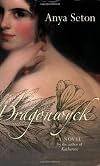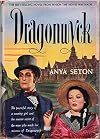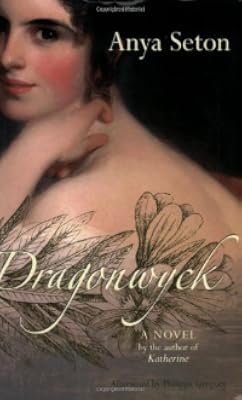
Dragonwyck
by Anya Seton
On This Page
Description
A novel of seduction, mystery, and danger set in New York's Hudson Valley in the nineteenth century, by the author of Foxfire. There was, on the Hudson, a way of life such as this, and there was a house not unlike Dragonwyck . . . In the spring of 1844, the Wells family receives a letter from a distant relative, the wealthy landowner Nicholas Van Ryn. He has invited one of their daughters for an extended visit at his Hudson Valley estate, Dragonwyck. Eighteen-year-old Miranda, bored with her show more local suitors and commonplace life on the farm, leaps at the chance for an escape. She immediately falls under the spell of both the master and his mansion, mesmerized by the Gothic towers, flowering gardens, and luxurious lifestyle-but unaware of the dark, terrible secrets that await. Anya Seton masterfully tells the heart-stopping story of a remarkable woman, her remarkable passions, and the mystery that resides in the magnificent hallways of Dragonwyck. show lessTags
Recommendations

















Member Recommendations
Member Reviews
Miranda Wells is too dainty and flighty to fit in with her hard working, puritanical farming family. When a distant cousin invites her to act as companion to his young daughter, she leaps at the chance and soon arrives at the beautiful gothic mansion of Dragonwyck. It is ruled by the autocratic Nicholas Van Ryn, who is so handsome, powerful, cultured that Miranda falls for him immediately. Nicholas is haunted by his first wife, who cannot give him the son he craves, and by Miranda's beauty. After Johanna dies, he immediately proposes to Miranda. And it is here that the story takes a turn, because far from a meeting of minds or a storybook ending, Miranda's triumphant wedding rapidly becomes a nightmare.
This is like a wonderfully dark show more and twisted version of Jane Eyre or Rebecca, in which the remote older gentleman the heroine falls in love with is actually a terrifying villain. And yet, he is still as powerful and handsome as ever, and he's still quite attractive to the heroine, which makes the story all the more horrifying. Miranda is no Jane Eyre--she is silly, selfish, and bends to Nicholas's every whim. But she is an engrossing main character, perhaps in part because she is so unlike the smarter, wiser, less shallow heroines of better novels. I was rooting for her to get what she wanted from the very first. Miranda has to change in order to find happiness with the true hero of the book (the selfless Dr. Jeff Turner), but I never felt like this was a morality tale*.
*Actually, there is one very annoying bit: after her husband brutalizes her body and spirit for years, Miranda finally breaks free of him but nearly dies in the effort. She recovers, but her shining golden hair is shaven off during her fever, and she has unobtrusive brown hair ever after. I've seen this trope before, and it's bullshit every time. show less
This is like a wonderfully dark
*Actually, there is one very annoying bit: after her husband brutalizes her body and spirit for years, Miranda finally breaks free of him but nearly dies in the effort. She recovers, but her shining golden hair is shaven off during her fever, and she has unobtrusive brown hair ever after. I've seen this trope before, and it's bullshit every time.
4.0 stars
This book isn't a gothic romance, it's a character study that just happens to have a gothic backdrop. And the character it's studying isn't Miranda, it's Nicholas: a raging psychopath, a textbook abuser. The fairytale of the farm girl become (America's version of a) princess--including delightful descriptions of a fashionable wardrobe--interweave with the growing awareness of Nicholas's darkness. The tension mounts very slowly, seems to dissolve a few times, but comes rising back before it reaches its climax.
And it's damn readable too.
There are definitely a lot of weaknesses to this book.Jeff just doesn't really work as a character imo, the fatphobia directed at Johanna is just gross, there's a Puritanical distrust of luxury show more even while reveling in descriptions of that luxury, and the ending reads too much like Miranda has Learned Her Lesson and will be content to be Good and Virtuous and Work Hard and Never Wish for Fine Things Ever Again that's more than a little off-putting. But the characterization of Nicholas and the atmosphere of the oppression at Dragonwyck is so strongly drawn that the weaknesses are almost irrelevant. It's no surprise to me that, like in Rebecca, the house has to be destroyed in the end. The house is everything. That's one of my favorite tropes, and it's put to great use in this book. show less
This book isn't a gothic romance, it's a character study that just happens to have a gothic backdrop. And the character it's studying isn't Miranda, it's Nicholas: a raging psychopath, a textbook abuser. The fairytale of the farm girl become (America's version of a) princess--including delightful descriptions of a fashionable wardrobe--interweave with the growing awareness of Nicholas's darkness. The tension mounts very slowly, seems to dissolve a few times, but comes rising back before it reaches its climax.
And it's damn readable too.
There are definitely a lot of weaknesses to this book.
On the most part, ‘Dragonwyck’ is an engaging novel with plenty of conflict, intrigue, suspense, and tension.
Country girl Miranda dreams of a better life than one of toil and prayer. She jumps at the chance to live with relatives in the magnificent home of Dragonwyck. Here, she meets the charming Nicholas van Ryn, and another dream begins, but this man has unseen depths.
I liked Miranda a lot. She’s a bit irresponsible and materialistic but her heart’s in the right place. She faces many challenges along the way, mainly emotional ones, but some physical ones as well.
While I liked the plot and found the characters vivid, two things in particular spoiled the story for me. First, certain sections break off from the main storyline show more and, like the quote below, which has little relevance to the plot and could've been cut, read like a textbook:
‘On September twentieth, Worth had arrived at his position and the city of Monterrey lay between the pincers which inexorably narrowed down on it. One after another the Mexican forts fell; Federación, Independencia, and the Bishop's Palace on the west; Tenería and Libertad on the east. On the morning of the twenty-third the Americans advanced into the bewildered city from both sides. But instead of risking life in the streets, which were raked by artillery fire and covered by snipers from shuttered windows, the American soldiers were ordered into the houses, where they tunneled their way through the interior walls, progressing through a cloud of plaster and falling rubble toward the grand plaza.’
Second, foreign language. While I’m pro-language learning, the use of foreign words in an English book is my ultimate pet hate in literature. Any author who does this either assumes that because they understand the language, so must all their readers, or they consider their audience to be inferior for not understanding, or the authors are showing off their knowledge. Whatever the reason, if the reader fails to understand a word or phrase, they’re locked out of the story, and I can’t understand why any author would want this. It badly disrupts the narrative flow if your faced with words, and especially long sentences, that you can't understand.
The overuse of French in this novel is unforgivable. Certain words I recognise, but not every reader will do. Sometimes the context makes the meaning clear, but it’s still annoying. I’ve no clue what ‘Ça marche tout seul' means, for example, and I can’t pronounce a lot of words like ‘gnädige’, which makes it all the more frustrating.
If not for the complaints above, I would’ve rated this otherwise engaging novel five stars. show less
Country girl Miranda dreams of a better life than one of toil and prayer. She jumps at the chance to live with relatives in the magnificent home of Dragonwyck. Here, she meets the charming Nicholas van Ryn, and another dream begins, but this man has unseen depths.
I liked Miranda a lot. She’s a bit irresponsible and materialistic but her heart’s in the right place. She faces many challenges along the way, mainly emotional ones, but some physical ones as well.
While I liked the plot and found the characters vivid, two things in particular spoiled the story for me. First, certain sections break off from the main storyline show more and, like the quote below, which has little relevance to the plot and could've been cut, read like a textbook:
‘On September twentieth, Worth had arrived at his position and the city of Monterrey lay between the pincers which inexorably narrowed down on it. One after another the Mexican forts fell; Federación, Independencia, and the Bishop's Palace on the west; Tenería and Libertad on the east. On the morning of the twenty-third the Americans advanced into the bewildered city from both sides. But instead of risking life in the streets, which were raked by artillery fire and covered by snipers from shuttered windows, the American soldiers were ordered into the houses, where they tunneled their way through the interior walls, progressing through a cloud of plaster and falling rubble toward the grand plaza.’
Second, foreign language. While I’m pro-language learning, the use of foreign words in an English book is my ultimate pet hate in literature. Any author who does this either assumes that because they understand the language, so must all their readers, or they consider their audience to be inferior for not understanding, or the authors are showing off their knowledge. Whatever the reason, if the reader fails to understand a word or phrase, they’re locked out of the story, and I can’t understand why any author would want this. It badly disrupts the narrative flow if your faced with words, and especially long sentences, that you can't understand.
The overuse of French in this novel is unforgivable. Certain words I recognise, but not every reader will do. Sometimes the context makes the meaning clear, but it’s still annoying. I’ve no clue what ‘Ça marche tout seul' means, for example, and I can’t pronounce a lot of words like ‘gnädige’, which makes it all the more frustrating.
If not for the complaints above, I would’ve rated this otherwise engaging novel five stars. show less
Dragonwyck is a classic 19th century gothic romance written in understandable 20th century prose. It has all the essential gothic elements: the gloomy castle, the darkly conflicted lord of the manor, the beautiful but naïve maiden, and just a hint of the occult. Although the modern writing style makes the story more accessible somehow it lessens the air of mystery and terror. At about the halfway point it’s pretty clear where the plot is going but it’s still an interesting read to see how it gets there.
I kept the lights on till 3 in the morning to finish Dragonwyck by Anya Seton. This novel felt like a delightful guilty pleasure. To set the tone, it opens on the famous poem by Edgar Allan Poe, Alone:
From childhood's hour I have not been
As others were; I have not seen
As others saw; I could not bring
My passions from a common spring.
From the same source I have not taken
My sorrow; I could not awaken
My heart to joy at the same tone;
And all I loved, I loved alone.
Then- in my childhood, in the dawn
Of a most stormy life- was drawn
From every depth of good and ill
The mystery which binds me still:
From the torrent, or the fountain,
From the red cliff of the mountain,
From the sun that round me rolled
In its autumn tint of gold,
From the lightning in show more the sky
As it passed me flying by,
From the thunder and the storm,
And the cloud that took the form
(When the rest of Heaven was blue)
Of a demon in my view.
This is an unabashedly romantic, creepy story set in the 1840s with overblown characters who are almost parodies of themselves, including a Byronic male anti-hero in the form of Nicholas Van Ryn; a male paragon of dark good looks with disconcertingly piercing cerulean eyes, and descendant of a long line of immensely wealthy Dutch landowners, who is the current 'patroon' of a large tract of land along the Hudson river and the developing city of New York. Nicholas, the archetypal control freak, fully occupies the role of domineering master and self-contained enigma who keeps all around him in a state of fear and dread of his ever shifting moods. The innocent and unsophisticated Miranda is the submissive heroine who falls into her distant cousin Nicholas' clutches when he invites the young maiden to Dragonwyck manor with a view to form the erstwhile farm girl into a proper society lady. She leaves her strictly devout father and hardworking mother and siblings to their small farm and poverty to fully embrace the kind of lifestyle she has so far only read about in novels. She eagerly takes to the life of splendour and luxury in the capacity of nanny to Nicholas' little girl and falls under his spell the moment she meets him, unable to resist his physical beauty combined with irreproachable courtly manner, but there is also the not small matter of keeping the good favour of his wife, the morbidly obese Joanna who insists on treating the girl like a servant. There are of course macabre secrets contained in this vast gothic mansion, though (tiny spoiler, which any observing reader will have figured out early on:) Nicholas himself is the novel's dangerous enigma. Some of the core events which provide the framework for the novel are based on historical facts, such as the anti-rent wars, the Astor Place massacre and a a great steamboat race closely modelled on a competition undertook by Cornelius Vanderbilt and his eponymous steamship.
My edition (Chicago Review Press, 2005) contains an afterword by Philippa Gregory, who claims Seton probably didn't realize how strongly influenced by Jane Eyre she was in this, her second novel, but I beg to differ. Surely it can't be an accident that her heroine—just as innocent and meek as Jane Eyre—, comes to live in a great gothic house complete with what may be a haunted Red Room and a repulsive first wife in the capacity of governess. There are other parallels with Charlotte Brontë's novel I cannot mention without revealing spoilers, but while I don't mean to imply Dragonwyck is in the order of masterpieces such as Jane Eyre is, it definitely makes for a good helping of chills and frissons, delivering a hearty dose of unabashedly Gothic horror and romance (not to mention a visit to Edgar Allan Poe and his dying wife's impoverished household). For all these reasons, I count this novel among the most entertaining I've read this year. show less
From childhood's hour I have not been
As others were; I have not seen
As others saw; I could not bring
My passions from a common spring.
From the same source I have not taken
My sorrow; I could not awaken
My heart to joy at the same tone;
And all I loved, I loved alone.
Then- in my childhood, in the dawn
Of a most stormy life- was drawn
From every depth of good and ill
The mystery which binds me still:
From the torrent, or the fountain,
From the red cliff of the mountain,
From the sun that round me rolled
In its autumn tint of gold,
From the lightning in show more the sky
As it passed me flying by,
From the thunder and the storm,
And the cloud that took the form
(When the rest of Heaven was blue)
Of a demon in my view.
This is an unabashedly romantic, creepy story set in the 1840s with overblown characters who are almost parodies of themselves, including a Byronic male anti-hero in the form of Nicholas Van Ryn; a male paragon of dark good looks with disconcertingly piercing cerulean eyes, and descendant of a long line of immensely wealthy Dutch landowners, who is the current 'patroon' of a large tract of land along the Hudson river and the developing city of New York. Nicholas, the archetypal control freak, fully occupies the role of domineering master and self-contained enigma who keeps all around him in a state of fear and dread of his ever shifting moods. The innocent and unsophisticated Miranda is the submissive heroine who falls into her distant cousin Nicholas' clutches when he invites the young maiden to Dragonwyck manor with a view to form the erstwhile farm girl into a proper society lady. She leaves her strictly devout father and hardworking mother and siblings to their small farm and poverty to fully embrace the kind of lifestyle she has so far only read about in novels. She eagerly takes to the life of splendour and luxury in the capacity of nanny to Nicholas' little girl and falls under his spell the moment she meets him, unable to resist his physical beauty combined with irreproachable courtly manner, but there is also the not small matter of keeping the good favour of his wife, the morbidly obese Joanna who insists on treating the girl like a servant. There are of course macabre secrets contained in this vast gothic mansion, though (tiny spoiler, which any observing reader will have figured out early on:) Nicholas himself is the novel's dangerous enigma. Some of the core events which provide the framework for the novel are based on historical facts, such as the anti-rent wars, the Astor Place massacre and a a great steamboat race closely modelled on a competition undertook by Cornelius Vanderbilt and his eponymous steamship.
My edition (Chicago Review Press, 2005) contains an afterword by Philippa Gregory, who claims Seton probably didn't realize how strongly influenced by Jane Eyre she was in this, her second novel, but I beg to differ. Surely it can't be an accident that her heroine—just as innocent and meek as Jane Eyre—, comes to live in a great gothic house complete with what may be a haunted Red Room and a repulsive first wife in the capacity of governess. There are other parallels with Charlotte Brontë's novel I cannot mention without revealing spoilers, but while I don't mean to imply Dragonwyck is in the order of masterpieces such as Jane Eyre is, it definitely makes for a good helping of chills and frissons, delivering a hearty dose of unabashedly Gothic horror and romance (not to mention a visit to Edgar Allan Poe and his dying wife's impoverished household). For all these reasons, I count this novel among the most entertaining I've read this year. show less
I liked this book enough to finish it but not more. The descriptions of the setting were evocative and enjoyable. The sketches of the minor characters were witty and perceptive, though the frequent jumps in point-of-view that sketched these characters were off-putting. Unfortunately, the major characters and relationships fell flat for me. The only character I liked at any point was Nicholas, and as his character deteriorated, no one else filled his place. Even at the end, when he was fully the villain, I still cared more about him than about the sketchily drawn hero and heroine whose only good traits were the wholesomeness, rejection of materialism, and willingness to work that were supposed to win my loyalty simply because I was told show more of them. Miranda's entire character arc was to move from dreamy hopefulness to pragmatic usefulness, and that message is too simplistic and moralistic for me to enjoy it. Miranda's obsessive fascination with Nicholas is the only convincing relationship in the book. His interest in her, her friendship with her maid, and her eventual relationship with Jeff are unconvincing. The setting, the premise, and Nicholas had great potential that kept me reading, but the book didn't live up to its potential. show less
A fairly weak entry in the Seton collection. Miranda is really the only fully formed character as the story is mostly told from her point of view. She comes as poor cousin to the manor house of Dragonwyck, an estate on the Hudson, remnant of the wealthy Dutch feudal they tried to create in the USA. Nicholas van Ryn is the patroon and a thoroughly creepy one. It soon becomes clear he has no moral code except his own dominance but that is where the novel really falls apart. We really only see him through Miranda, who is utterly smitten. Besides a few sentences, he never really gets a full character, he is mostly a classic villian. I saw the plot coming a mile away and the heavy foreshadowing didn't do much to help that. I think I show more appreciate her later novels a bit more now. show less
Members
- Recently Added By
Lists

Best Gothic Fiction
110 works; 31 members

1940s
221 works; 25 members

Houses and Buildings as Characters in Fiction
182 works; 29 members

New York
8 works; 2 members

KayStJ's to-read list
1,616 works; 11 members

Guilty Pleasures
223 works; 86 members

Books Read in 2026
1,962 works; 66 members
Author Information

25+ Works 8,960 Members
Some Editions
Awards and Honors
Distinctions
Series
Belongs to Publisher Series
Armed Services Edition (P-27)
Work Relationships
Has the adaptation
Common Knowledge
- Canonical title
- Dragonwyck
- Original title
- Dragonwyck
- Original publication date
- 1944
- People/Characters
- Miranda Wells; Ephraim Wells; Abigail Wells; Tabitha Wells; Tom Wells; Nicholas Van Ryn (show all 16); Johanna Van Ryn; Katrine Van Ryn; Zelie; Magda; Dr. Jeff Turner; Dr. Smith Broughton; Martin van Buren; John van Buren; James Fenimore Cooper; Count deGreniers
- Important places
- Greenwich, Connecticut, USA; New York, New York, USA; Dragonwyck
- Related movies
- Dragonwyck (1946 | IMDb)
- Epigraph
- From childhood's hour I have not been
As others were; I have not seen
As others saw; I could not bring
My passions from a common spring.
From the same source I have not taken
My sorrow; I co... (show all)uld not awaken
My heart to joy at the same tone;
And all I loved, I loved alone.
Then- in my childhood, in the dawn
Of a most stormy life- was drawn
From every depth of good and ill
The mystery which binds me still:
From the torrent, or the fountain,
From the red cliff of the mountain,
From the sun that round me rolled
In its autumn tint of gold,
From the lightning in the sky
As it passed me flying by,
From the thunder and the storm,
And the cloud that took the form
(When the rest of Heaven was blue)
Of a demon in my view.
"Alone" by Edgar Allan Poe - First words
- It was on an afternoon in May of 1844 that the letter came from Dragonwyck.
- Last words
- (Click to show. Warning: May contain spoilers.)She shut her eyes and rested her head against his shoulder.
Classifications
- Genres
- Fiction and Literature, General Fiction, Romance, Historical Fiction
- DDC/MDS
- 813.52 — Literature & rhetoric American literature in English American fiction in English 1900-1999 1900-1945
- LCC
- PS3537 .E787 .D7 — Language and Literature American literature American literature Individual authors 1900-1960
- BISAC
Statistics
- Members
- 933
- Popularity
- 28,603
- Reviews
- 20
- Rating
- (3.57)
- Languages
- 5 — English, French, German, Spanish, Swedish
- Media
- Paper, Audiobook, Ebook
- ISBNs
- 23
- ASINs
- 33