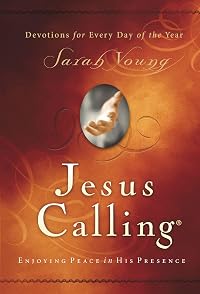
Jesus Calling: Enjoying Peace in His Presence
by Sarah Young
On This Page
Description
Experience a deeper relationship with Jesus as you savor the presence of the One who understands you perfectly and loves you forever. With Scripture and personal reflections, New York Times bestselling author Sarah Young brings Jesus' message of peace—for today and every day.Jesus Calling is your yearlong guide to living a more peaceful life. The Jesus Calling® brand has impacted over 40 million lives.
By spending time in the presence of the Savior with the much-loved devotions in Jesus show more Calling, you will:
Written as if Jesus Himself is speaking directly to you, Jesus Calling invites you to experience peace in the presence of the Savior who is always with you.
. show less
Tags
Recommendations









Member Reviews
Jesus Calling by Sarah Young is a difficult book for me to review, not only because of its complex issues but also because I have many dear friends who love it deeply. I want to communicate my thoughts graciously yet without compromise. Forgive me if I fail on either account.
Jesus Calling is written in the first person, as if Jesus were speaking directly to the reader using personal pronouns to refer to Himself. This is more than just stylistic; it is a very deliberate choice based on how Young perceives her book's inspiration. The introduction is very telling. Young writes, "I knew that God communicated with me through the Bible, but I yearned for more" (xii). She explains, "I decided to listen to God with pen in hand, writing down show more whatever I believed He was saying. I felt awkward the first time I tried this, but I received a message... I have continued to receive personal messages from God as I meditate on Him" (xii). While she acknowledges that "I knew these writings were not inspired as Scripture is" (xii), she still desired "to share some of the messages I have received" (xiii). There is simply no way around it: Sarah Young is claiming to have received these messages directly from God. Whether or not you formally place those messages in the same category of Scripture, she is claiming to be a modern prophetess, receiving the Lord's word and transmitting it to others.
Friends, this is dangerous. We cannot say "thus saith the Lord" without considering the incredible weight of that responsibility, the closed canon of Scripture, and the fearful judgment promised to those who falsely claim to speak for God and/or add to His Word (Jeremiah 23:25–32; Revelation 22:18). All other considerations aside, we know that if God *does* send a message to someone, it will be completely without theological error. By this test alone Young's claims of divine revelation fail, as I'll demonstrate.
Whether reworded Scripture or Young's own statements as from Jesus, everything in the book must be seen in the light of her staggering claim that it's directly from God. Whether or not the content is benign in itself, the claim of divine revelation remains. And much of it is benign, like "I am able to do far more than you ask or imagine" (p. 7). Okay, that is true and based on Ephesians 3:20–21. But did Jesus really speak this message directly to her? I know that Young includes Scripture references at the end of each reading that correlate to the theme of that day's message, but this does not make those messages divinely inspired. How does she know, really know that she was not making up these messages out of her own head? Short answer: she doesn't. It's all subjective. I can sit with a pen in hand and write down thoughts that align doctrinally with Scripture, but that doesn't make those thoughts inspired by God.
One thing I noticed very early on was how odd it was that a book claiming to help readers enter and enjoy Jesus's presence should say so very little about sin—the true barrier between us and Christ—and repentance, the only way that barrier can be removed. The gospel is never given at all. Young's emphasis is not on our sin, but on our tendency to worry and take on too many of life's burdens ourselves. In 365 readings, I counted only two that mention the word "repent" (p. 59 and 119). "Sin" is mentioned seven times, I believe (p. 54, 88, 278, 296, 297, 336, and 374). At first I wasn't sure the words would be used at all. Whey they did finally crop up, they were mentioned infrequently and in passing. According to this book, our biggest problem is worry and stress—not treason against our Creator.
In some ways the devotionals remind me of fortune cookies: they are vague enough that I can see how many readers would exclaim, "wow, this fits my situation perfectly!" The main adjectives that kept coming to mind as I read were "New-Agey" and "mystic." Young speaks of "shimmering hues of radiance [that] tap gently at your consciousness" (p. 9), about finding Jesus "in your surroundings" and "present in your spirit" (p. 35). We need to overcome our "negative feelings" (p. 146)—not our sin. On page 136, Jesus supposedly urges us, "Don't be so hard on yourself." On page 56, self-pity is called a "pitfall" and a "demonic trap," but not a sin. On page 356, Jesus supposedly says, "Like a luminous veil of Light, I hover over you and everything around you." Friends, Jesus didn't talk like this in the Bible—and He doesn't change. These are not His words.
Consider this excerpt from page 381: "I am leading you along a way that is uniquely right for you. The closer to Me you grow, the more fully you become your true self—the one I designed you to be. Because you are one of a kind, the path you are traveling with Me diverges increasingly from that of other people" (emphasis added). There is quite a bit wrong with these few sentences. The Jesus of the Bible spoke of one path: the straight and narrow road (Matthew 7:14). Scripture testifies not to our individuality and special uniqueness, but to our common temptations and common needs (1 Corinthians 10:13). Rhetoric about "the path that's right for you" and how special/different you are from other people (and how that justifies you taking a "divergent road") is not Scriptural, but owes its origin much more to our self-absorbed, self-glorifying culture.
Sadly, the entire book reads like a secular work on self-empowerment. The Jesus of this book could just as easily be the voice of someone's positive self-consciousness or some such New-Age construct. He's not the one I know from the Bible. This Jesus comes across as very needy, simply begging His children to come spend time in His presence. It's like we have to fill up His leaky love tank.
Problematic also is Young's view of God's sovereign control and rule over every aspect of His creation. It's more a reactive sovereignty than a proactive, preordained rule of the universe: as if He must respond to our choices and make the best He can of our messes, as if He did not ordain every choice and circumstance ahead of time. Young often has Jesus saying things like, "My infinite creativity can weave both good choices and bad into a lovely design" (p. 136, emphasis added). On page 68 she implies that Jesus is only sovereign to the extent that we trust Him. On page 152 Young writes that Jesus says, "I will not violate your freedom." How does that jibe with Romans 9, where God very properly puts us in our place as the clay and He the Potter, who has every right to do with the clay as He will?
Tied to the unbiblical view of God's sovereignty is an unbiblical view of His omniscience, in the claim that God can risk something. On page 116, Young has Jesus saying, "I risked all by granting you freedom to think for yourself." John Eldredge also promotes this unbiblical concept in his popular book Wild at Heart, in which he urges men to take risks because God does. But the definition of risk is taking a chance without knowing what the outcome will be. If God knows everything like the Bible says He does, He is incapable of taking risks. He knows all outcomes and is not at the mercy of circumstances—because He rules them in divine wisdom and power. We can take risks because we are finite beings. But He is not finite like us. To me, this alone proves that Young's claims of receiving these messages directly from God are false.
From a purely literary standpoint I have a couple comments. Young does demonstrate an engaging writing style, both in the introduction and throughout her messages. However (and this is probably partly because I read the book condensed over the course of a month rather than over a year), I found it incredibly repetitive and really had to force myself to finish. Toward the end, I started wondering if some of the messages had been recycled from earlier dates.
So why? Why has Jesus Calling found an apt audience in so many Christian circles? First, we do not hold a high view of Scripture. Sure, it has authority, but it isn't the *only* source of truth... God must have more for us. Second, we are used to having things personalized just for us—so why not God Himself? Third, the themes of this book address one of our greatest felt needs (worry) and that is attractive to us. Please, please let us think about the motives for these reasons. Do they honor the Lord? Sure, there are true things in this book, but once we open the door to accepting new divine revelation outside of Scripture, we've taken a big step down a slippery slope.
Because of Young's claims to have received these messages directly from God, this is not a devotional in the usual sense of the word. This isn't a Christian author sharing his or her thoughts on a particular passage or summarizing a biblical idea. This book is claiming to add to the written revelation we have already received in the Word of God. I know I keep emphasizing this, but it's so dangerous. No, I don't think Young is proposing to add the book of Young after Revelation. But that is, in effect, what her writings are claiming. I keep coming back to that one telling statement in the introduction... "I knew that God communicated with me through the Bible, but I yearned for more" (xii).
Friends, have we considered the problem with acknowledging God speaks to us in His Word but "yearning for more" than that? Isn't this saying that the Bible is not enough? That what He has spoken is somehow lacking? Have we considered that our wise God knows best how to communicate with us in His Word and if something would have been more effective written in the first person, that's how He would have written it in the first place? Are we functionally believing that His Word is authoritative but not sufficient? That it has taken us 2,000 years to find "this new way of communicating with God" (xii), that was unknown to the countless believers who have walked with Jesus before us? Have we thought about the danger of blindly accepting what Young writes as coming from the very tongue of Christ?
I say this because love and truth compel: do not give this book your time or your affection. Pray for Sarah Young to see the dangerous path she has taken, and that the Lord would protect His elect from being deceived. show less
Jesus Calling is written in the first person, as if Jesus were speaking directly to the reader using personal pronouns to refer to Himself. This is more than just stylistic; it is a very deliberate choice based on how Young perceives her book's inspiration. The introduction is very telling. Young writes, "I knew that God communicated with me through the Bible, but I yearned for more" (xii). She explains, "I decided to listen to God with pen in hand, writing down show more whatever I believed He was saying. I felt awkward the first time I tried this, but I received a message... I have continued to receive personal messages from God as I meditate on Him" (xii). While she acknowledges that "I knew these writings were not inspired as Scripture is" (xii), she still desired "to share some of the messages I have received" (xiii). There is simply no way around it: Sarah Young is claiming to have received these messages directly from God. Whether or not you formally place those messages in the same category of Scripture, she is claiming to be a modern prophetess, receiving the Lord's word and transmitting it to others.
Friends, this is dangerous. We cannot say "thus saith the Lord" without considering the incredible weight of that responsibility, the closed canon of Scripture, and the fearful judgment promised to those who falsely claim to speak for God and/or add to His Word (Jeremiah 23:25–32; Revelation 22:18). All other considerations aside, we know that if God *does* send a message to someone, it will be completely without theological error. By this test alone Young's claims of divine revelation fail, as I'll demonstrate.
Whether reworded Scripture or Young's own statements as from Jesus, everything in the book must be seen in the light of her staggering claim that it's directly from God. Whether or not the content is benign in itself, the claim of divine revelation remains. And much of it is benign, like "I am able to do far more than you ask or imagine" (p. 7). Okay, that is true and based on Ephesians 3:20–21. But did Jesus really speak this message directly to her? I know that Young includes Scripture references at the end of each reading that correlate to the theme of that day's message, but this does not make those messages divinely inspired. How does she know, really know that she was not making up these messages out of her own head? Short answer: she doesn't. It's all subjective. I can sit with a pen in hand and write down thoughts that align doctrinally with Scripture, but that doesn't make those thoughts inspired by God.
One thing I noticed very early on was how odd it was that a book claiming to help readers enter and enjoy Jesus's presence should say so very little about sin—the true barrier between us and Christ—and repentance, the only way that barrier can be removed. The gospel is never given at all. Young's emphasis is not on our sin, but on our tendency to worry and take on too many of life's burdens ourselves. In 365 readings, I counted only two that mention the word "repent" (p. 59 and 119). "Sin" is mentioned seven times, I believe (p. 54, 88, 278, 296, 297, 336, and 374). At first I wasn't sure the words would be used at all. Whey they did finally crop up, they were mentioned infrequently and in passing. According to this book, our biggest problem is worry and stress—not treason against our Creator.
In some ways the devotionals remind me of fortune cookies: they are vague enough that I can see how many readers would exclaim, "wow, this fits my situation perfectly!" The main adjectives that kept coming to mind as I read were "New-Agey" and "mystic." Young speaks of "shimmering hues of radiance [that] tap gently at your consciousness" (p. 9), about finding Jesus "in your surroundings" and "present in your spirit" (p. 35). We need to overcome our "negative feelings" (p. 146)—not our sin. On page 136, Jesus supposedly urges us, "Don't be so hard on yourself." On page 56, self-pity is called a "pitfall" and a "demonic trap," but not a sin. On page 356, Jesus supposedly says, "Like a luminous veil of Light, I hover over you and everything around you." Friends, Jesus didn't talk like this in the Bible—and He doesn't change. These are not His words.
Consider this excerpt from page 381: "I am leading you along a way that is uniquely right for you. The closer to Me you grow, the more fully you become your true self—the one I designed you to be. Because you are one of a kind, the path you are traveling with Me diverges increasingly from that of other people" (emphasis added). There is quite a bit wrong with these few sentences. The Jesus of the Bible spoke of one path: the straight and narrow road (Matthew 7:14). Scripture testifies not to our individuality and special uniqueness, but to our common temptations and common needs (1 Corinthians 10:13). Rhetoric about "the path that's right for you" and how special/different you are from other people (and how that justifies you taking a "divergent road") is not Scriptural, but owes its origin much more to our self-absorbed, self-glorifying culture.
Sadly, the entire book reads like a secular work on self-empowerment. The Jesus of this book could just as easily be the voice of someone's positive self-consciousness or some such New-Age construct. He's not the one I know from the Bible. This Jesus comes across as very needy, simply begging His children to come spend time in His presence. It's like we have to fill up His leaky love tank.
Problematic also is Young's view of God's sovereign control and rule over every aspect of His creation. It's more a reactive sovereignty than a proactive, preordained rule of the universe: as if He must respond to our choices and make the best He can of our messes, as if He did not ordain every choice and circumstance ahead of time. Young often has Jesus saying things like, "My infinite creativity can weave both good choices and bad into a lovely design" (p. 136, emphasis added). On page 68 she implies that Jesus is only sovereign to the extent that we trust Him. On page 152 Young writes that Jesus says, "I will not violate your freedom." How does that jibe with Romans 9, where God very properly puts us in our place as the clay and He the Potter, who has every right to do with the clay as He will?
Tied to the unbiblical view of God's sovereignty is an unbiblical view of His omniscience, in the claim that God can risk something. On page 116, Young has Jesus saying, "I risked all by granting you freedom to think for yourself." John Eldredge also promotes this unbiblical concept in his popular book Wild at Heart, in which he urges men to take risks because God does. But the definition of risk is taking a chance without knowing what the outcome will be. If God knows everything like the Bible says He does, He is incapable of taking risks. He knows all outcomes and is not at the mercy of circumstances—because He rules them in divine wisdom and power. We can take risks because we are finite beings. But He is not finite like us. To me, this alone proves that Young's claims of receiving these messages directly from God are false.
From a purely literary standpoint I have a couple comments. Young does demonstrate an engaging writing style, both in the introduction and throughout her messages. However (and this is probably partly because I read the book condensed over the course of a month rather than over a year), I found it incredibly repetitive and really had to force myself to finish. Toward the end, I started wondering if some of the messages had been recycled from earlier dates.
So why? Why has Jesus Calling found an apt audience in so many Christian circles? First, we do not hold a high view of Scripture. Sure, it has authority, but it isn't the *only* source of truth... God must have more for us. Second, we are used to having things personalized just for us—so why not God Himself? Third, the themes of this book address one of our greatest felt needs (worry) and that is attractive to us. Please, please let us think about the motives for these reasons. Do they honor the Lord? Sure, there are true things in this book, but once we open the door to accepting new divine revelation outside of Scripture, we've taken a big step down a slippery slope.
Because of Young's claims to have received these messages directly from God, this is not a devotional in the usual sense of the word. This isn't a Christian author sharing his or her thoughts on a particular passage or summarizing a biblical idea. This book is claiming to add to the written revelation we have already received in the Word of God. I know I keep emphasizing this, but it's so dangerous. No, I don't think Young is proposing to add the book of Young after Revelation. But that is, in effect, what her writings are claiming. I keep coming back to that one telling statement in the introduction... "I knew that God communicated with me through the Bible, but I yearned for more" (xii).
Friends, have we considered the problem with acknowledging God speaks to us in His Word but "yearning for more" than that? Isn't this saying that the Bible is not enough? That what He has spoken is somehow lacking? Have we considered that our wise God knows best how to communicate with us in His Word and if something would have been more effective written in the first person, that's how He would have written it in the first place? Are we functionally believing that His Word is authoritative but not sufficient? That it has taken us 2,000 years to find "this new way of communicating with God" (xii), that was unknown to the countless believers who have walked with Jesus before us? Have we thought about the danger of blindly accepting what Young writes as coming from the very tongue of Christ?
I say this because love and truth compel: do not give this book your time or your affection. Pray for Sarah Young to see the dangerous path she has taken, and that the Lord would protect His elect from being deceived. show less
This is the second 2 star review i've written in years and years and it happened just 1 week after my previous 2 star review. I very rarely rate any book 2 stars (or 1 star) because my normal practice is to abandon a book as soon as i consider it to be a 1 or 2 star book, and i don't review any books which i don't finish.
I did finish this book even though i knew it was a problematic book, because it is significantly different than anything i had ever read. The reason it is problematic is the same reason that it is very different. The author, who is a missionary, believes that an essential element of praying is to listen so that God can communicate back to us. This belief that prayer is two way communication, and not just the show more presentation of requests to God, has been practiced by believers for thousands of years and is clearly demonstrated throughout both the Old and New Testaments. I agree with this practice and it is a part of my prayer life. Here is what makes the book problematic: the author has taken the things God has communicated to her in her prayer time and that she has recorded in her prayer journal, and made those communications the essence of this book, and does it in the first person as if Jesus is speaking directly to not just her, but to everyone. This moves God's communication from the personal realm into a public realm which actually seems very much like the author is writing a book of scripture for public use. I have a problem with this. If the book had been written in the third person and just expressed the idea that these are things God had communicated to her personally, i would give this a book a higher rating.
The book has one more problem, though this problem is not at all unique to this book, but is common in far too many (in fact, in most) Christian non-fiction books. After giving us a "word from Jesus" the author then lists several Bible references. Not the actual verses themselves, but rather the location of verses. i.e. Rom 12:1, I Cor 13:5 etc. I consider this to be the very worst aspect of most Christian non-fiction books. I feel that if a passage of scripture actually adds to the points being made, then the actual scripture should be quoted, not just alluded to by reference. It's bad writing as well as bad theology. The scriptures as originally written, were NOT divided into chapters and verses. The scriptures were written as books (with the exception of Psalms which actually were individual Psalms as written and then were collected into the book). The divisions into chapters and verses were done by men long after the books of the Bible were actually written. The purpose was to make it easier to find specific passages. However, the result of these divisions into chapters and verses is often to destroy the context and flow, and by extension, the thought being expressed in the passage by removing it from its context. The use by authors of just tacking on a list of references instead of quoting a passage further exacerbates the problem by further decontextualizing the passage because it makes the actual text unimportant to the book by not quoting the text. show less
I did finish this book even though i knew it was a problematic book, because it is significantly different than anything i had ever read. The reason it is problematic is the same reason that it is very different. The author, who is a missionary, believes that an essential element of praying is to listen so that God can communicate back to us. This belief that prayer is two way communication, and not just the show more presentation of requests to God, has been practiced by believers for thousands of years and is clearly demonstrated throughout both the Old and New Testaments. I agree with this practice and it is a part of my prayer life. Here is what makes the book problematic: the author has taken the things God has communicated to her in her prayer time and that she has recorded in her prayer journal, and made those communications the essence of this book, and does it in the first person as if Jesus is speaking directly to not just her, but to everyone. This moves God's communication from the personal realm into a public realm which actually seems very much like the author is writing a book of scripture for public use. I have a problem with this. If the book had been written in the third person and just expressed the idea that these are things God had communicated to her personally, i would give this a book a higher rating.
The book has one more problem, though this problem is not at all unique to this book, but is common in far too many (in fact, in most) Christian non-fiction books. After giving us a "word from Jesus" the author then lists several Bible references. Not the actual verses themselves, but rather the location of verses. i.e. Rom 12:1, I Cor 13:5 etc. I consider this to be the very worst aspect of most Christian non-fiction books. I feel that if a passage of scripture actually adds to the points being made, then the actual scripture should be quoted, not just alluded to by reference. It's bad writing as well as bad theology. The scriptures as originally written, were NOT divided into chapters and verses. The scriptures were written as books (with the exception of Psalms which actually were individual Psalms as written and then were collected into the book). The divisions into chapters and verses were done by men long after the books of the Bible were actually written. The purpose was to make it easier to find specific passages. However, the result of these divisions into chapters and verses is often to destroy the context and flow, and by extension, the thought being expressed in the passage by removing it from its context. The use by authors of just tacking on a list of references instead of quoting a passage further exacerbates the problem by further decontextualizing the passage because it makes the actual text unimportant to the book by not quoting the text. show less
This is a wonderful devotional told in first person as if Jesus, Himself, is speaking directly to you. Reading this devotional daily over the past several years has really been a blessing in my life. I really feel that the devotional message and corresponding Bible verses are often meant precisely for me for exactly what I am going through in life at the moment. I have purchased many copies of this wonderful devotional and I give them to family, friends, coworkers, and anyone who I think may benefit from it. One recipient told me that it is the greatest gift they have ever been given.
Jesus, Your ways are perfect; they are past finding out.
..........................
I became interested because of its devotional character and its distance from excessively rational judgment and attacking people, but I think that the way it influenced me was in making me see Jesus as the Father—I don’t know if it quotes the line an unusual number of times, but it’s a very “I and the Father are one” kind of book— and I think it deals with the divinity and authority of Jesus to a degree unusual for a book not set on excessively rational judgment and proving people wrong, taking them down. So I was willing to be changed at the same time that I was reassured that my concerns were valid in show more part.
................................
Jesus does not think like I do.... There isn’t any change I need that he can’t give me. show less
..........................
I became interested because of its devotional character and its distance from excessively rational judgment and attacking people, but I think that the way it influenced me was in making me see Jesus as the Father—I don’t know if it quotes the line an unusual number of times, but it’s a very “I and the Father are one” kind of book— and I think it deals with the divinity and authority of Jesus to a degree unusual for a book not set on excessively rational judgment and proving people wrong, taking them down. So I was willing to be changed at the same time that I was reassured that my concerns were valid in show more part.
................................
Jesus does not think like I do.... There isn’t any change I need that he can’t give me. show less
At first I was a little hesitant to read this book. Daily devotionals, told in the first person voice of Jesus, even if written by a woman who had been a missionary, didn't really appeal to me. I was also concerned about how far from the biblical message it would stray.
I ended up with an audiobook version of this anyway, so I decided to give it a try. I found the devotions to be very well done, built from the Scriptures themselves, and providing the Scripture references after each day. Hearing it in audiobook was also a great way to read the book.
As an audiobook, I didn't do this over an entire year, but I did take 3 months to go through it. The contents aren't a deep theological study, but a personal and clear reminder of the basics of show more our relationship with Christ. I found it a good addition to my day and a helpful reminder of important truths. show less
I ended up with an audiobook version of this anyway, so I decided to give it a try. I found the devotions to be very well done, built from the Scriptures themselves, and providing the Scripture references after each day. Hearing it in audiobook was also a great way to read the book.
As an audiobook, I didn't do this over an entire year, but I did take 3 months to go through it. The contents aren't a deep theological study, but a personal and clear reminder of the basics of show more our relationship with Christ. I found it a good addition to my day and a helpful reminder of important truths. show less
I am aware that there is some controversy over this author, mostly based on a friend stating that she threw the book out without reading it after reading about the book or author. By that point, I was already partway through the book--I have not personally read any other sources about the book.
After reading the introduction (and before I knew anything of the controversy surrounding it), I do admit to a bit of trepidation and considered if I would read the book at all. The premise is that the author sat as a "listener" in the presence of God and recorded what she felt the Holy Spirit conveyed to her. After thinking about it, I decided that it was similar to reading a Bible verse and meditating on the meaning and then deciding how to show more apply that verse and meaning to your own life. I decided that I would read the book but with a discerning eye and that if I suspected anything did not agree with what I knew of the Bible, I would do further research on that passage or topic. And I would remember that this book is this author's interpretation and is not canon. I decided that if I found ideas that did not jive with the Bible too often then I would stop reading the book then and there.
I would caution anyone who decides to attempt something similar to approach it with much prayer and much petition for protection, because opening oneself to the spirit world can also invite in demonic spirits and leave one open to demonic possession or demonic manipulation.
For the most part, I did not find anything overtly odd until I reached the end of December. (And yes, it did take me a bit longer than a year to read the book because I was not always on the ball and reading that day's devotion--sometimes I would read two days at once to catch up.)
I gave it three stars because I don't really want to endorse the author's method. show less
After reading the introduction (and before I knew anything of the controversy surrounding it), I do admit to a bit of trepidation and considered if I would read the book at all. The premise is that the author sat as a "listener" in the presence of God and recorded what she felt the Holy Spirit conveyed to her. After thinking about it, I decided that it was similar to reading a Bible verse and meditating on the meaning and then deciding how to show more apply that verse and meaning to your own life. I decided that I would read the book but with a discerning eye and that if I suspected anything did not agree with what I knew of the Bible, I would do further research on that passage or topic. And I would remember that this book is this author's interpretation and is not canon. I decided that if I found ideas that did not jive with the Bible too often then I would stop reading the book then and there.
I would caution anyone who decides to attempt something similar to approach it with much prayer and much petition for protection, because opening oneself to the spirit world can also invite in demonic spirits and leave one open to demonic possession or demonic manipulation.
For the most part, I did not find anything overtly odd until I reached the end of December. (And yes, it did take me a bit longer than a year to read the book because I was not always on the ball and reading that day's devotion--sometimes I would read two days at once to catch up.)
I gave it three stars because I don't really want to endorse the author's method. show less
I enjoyed this little devotional book. It is written in the voice of Jesus which is a little annoying so it was not my cup of tea. I could not help but thinking that if the believer prays and meditates on the scriptures they too will recive their own interpretation of the scriptures directly from Jesus if they want it. If, however, they are not prone to pray in this manner then someone else's message from the Lord will have to do. Personally I prefer to get my messages directly from the Lord; that way as I know His message is specifically meant for me.
Members
- Recently Added By
Lists

Google Play purchase
7 works; 1 member

Top Five Books of 2014
1,064 works; 397 members
Author Information

101 Works 6,702 Members
Sarah Young's devotional writings are personal reflections from her daily quiet time of Bible reading, praying, and writing in prayer journals. With sales of more than 16 million books worldwide, Jesus Calling has appeared on all major bestseller lists. Sarah's writings include Jesus Calling, Jesus Today, Jesus Lives, Dear Jesus, Jesus Calling for show more Little Ones, Jesus Calling Bible Storybook, Jesus Calling: 365 Devotions for Kids, and Peace in His Presence--each encouraging readers in their journey toward intimacy with Christ. (Bowker Author Biography) show less
Awards and Honors
Work Relationships
Has the adaptation
Common Knowledge
- Canonical title
- Jesus Calling: Enjoying Peace in His Presence
- Original publication date
- 2004
- People/Characters
- Jesus
- Important events
- Birth of Jesus Christ; Crucifixion of Jesus of Nazareth
- Dedication
- I dedicate Jesus Calling to my mother, whose encouragement inspired me to persevere in writing this book. She demonstrated her appreciation of my writing in poignant ways. She kept my manuscript beside her bed, so she could r... (show all)ead it every morning. Once, while away from her home, she even asked me to fax her the readings day by day. After she died from cancer, I found portions of my writings that she had hand-copied into a journal. This mother who had prayed me through thick and thin, including years of rebellion, opened her heart fully to my devotional writing. Her oft-expressed desire to write children's books never came to fruition. But there is a sense in which she has written--through me--this bok. Thank you, Nani! Your legacy lives on.
- First words
- January: "For I know the plans I have for you," declares the Lord, "plans to propsper you and not to harm you, plans to give you a hope and a future." Jeremiah 29:11
- Last words
- (Click to show. Warning: May contain spoilers.)My Peace, which lives continually in your spirit, will gradually work its way through your entire being. Isaiah 9:6; 2 Corinthians 4:7; John 14:26-27
- Original language
- English
Classifications
- Genres
- Religion & Spirituality, Nonfiction
- DDC/MDS
- 242.2 — Religion Christian practice & observance Devotional literature Daily Devotions
- LCC
- BV4811 .Y646 — Philosophy, Psychology and Religion Practical Theology Practical Theology Practical religion. The Christian life Works of meditation and devotion
- BISAC
Statistics
- Members
- 3,040
- Popularity
- 5,821
- Reviews
- 29
- Rating
- (4.34)
- Languages
- 7 — Chinese, Dutch, English, German, Icelandic, Spanish, Swedish
- Media
- Paper, Audiobook, Ebook
- ISBNs
- 85
- ASINs
- 16