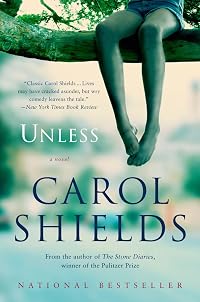
Unless
by Carol Shields
On This Page
Description
For all of her days, Reta Winters has enjoyed the useful monotony of happiness: a loving family, good friends, growing success as a writer of light fiction, novels 'for summertime.' This placid existence cracks open one fearful day when her beloved oldest daughter, Norah, drops out of life to sit on a gritty street corner, silent but for the sign around her neck that reads 'GOODNESS.' Reta's search for what drove her daughter to such a desperate statement turns into an unflinching and show more surprisingly funny meditation on where we find meaning and hope. Warmth, passion and wisdom come together in Carol Shields' remarkably supple prose. Unless, a harrowing but ultimately consoling story of one family's anguish and healing, proves her mastery of extraordinary fictions about ordinary life. show lessTags
Recommendations










Member Recommendations


Member Reviews
I have been a poor reader lately, finding it hard to finish anything, yet Carol Shields’ final novel, Unless, hooked me. It is the story of a woman in her forties, the writer of ‘light’ fiction and translations, Reta, whose daughter, Norah, suddenly leaves home and sits on the same street each day begging for money. The situation is breaking Reta’s heart even as life insists on going on and she attempts to write the sequel to her first novel.It is deceptively ‘domestic’, almost ‘light fiction’, with the trappings of a middle-aged woman with a circle of good friends trying to hold her family together, and a (sort of) conventional ending. Yet as a reader I sensed more and more that Shields was playing sophisticated games show more with me.It is a passionately yet somehow gently feminist novel (perhaps I say gently because of its subtlety). The chapters are interspersed with letters to various public figures or critics or writer who have ignored or silenced women in their articles or books. The whole novel seems to be a protest about the dismissal of domestic/ family concerns as ‘light’ women’s fiction. Tellingly, an editor is trying to rewrite Reta’s new novel, to turn it into a man’s quest for greatness, rather than a woman’s quest for goodness. Perhaps Shields’ response is to silence Reta’s husband, Tom, who is never more than a background character. I might be tempted to call his lack of involvement a weakness, if I wasn’t so suspicious it was a ploy of Shields’ that I was falling into.It is an uneasy novel. Every criticism I am tempted to make of it could be read as a deliberate protest against my assumptions. I felt that it moved too slowly, with too little happening and too long spent thinking about the situation; yet maybe I’m trying to ‘edit’ Shields’ novel just like the nasty editor is trying to edit Reta’s.I was hooked by its pearls of insight into life and its elegant enigmas. I was sad all the way through, knowing that Shields died of breast cancer soon after it was published. show less
I came to know Shields’s writing very late, but I am a fan now and very sad she died at a relatively young age. This book reminded me a bit of Roth’s American Pastoral, but without the whining and self-aggrandizement. The narrative is about a parent looking for answers as to why her child has gone off the rails. Reta, our narrator, doesn’t wear the blame hairshirt like Roth’s parent does.
The crux of the story is Norah’s behavior - is she crazy or just happy and why is it that people’s happiness has to take a form that’s acceptable to the rest of us, even if it does no harm? We see this sort of thing a lot in the severe judgement of people who live a freer life, away from the restraints of dutiful society. If we don’t show more envy or aspire to it, they must be nuts or shirking some kind of responsibility. The way it wrapped was very neat and I didn’t catch the hint of it even though I recognized it when it was revealed.
In between internal wrangling with how to live life and accept Norah’s self-inflicted homelessness, Reta writes letters to people who have done something publicly to denigrate women or a single woman. The thing that was interesting about the device was that after the 2nd or 3rd one, I began to be a little exasperated by them; knowing that each letter was going to bring a complaint about sexism. I want to believe this was deliberate. Did Shields feel the same way over her own exclusion as a writer? Do we tire of always having to point out the fact that women are ignored, short-changed or worse? Who tires of it more, the men who are the bad guys in most scenarios, or the women who constantly have to face down this behavior? It’s an interesting point.
There’s also a thread of commentary about Reta’s output as a writer and translator. Her Thyme novels sound pretty horrible though, nothing like what Shields wrote herself and I’m not sure what to make of that? Did she feel railroaded at some point? Expected to write certain books? Edited into some more acceptable form of “women’s writing?”. Here’s a great paragraph that feels almost too personal for a novel -
“I too am aware of being in incestuous waters, a woman writer who is writing about a woman writer who is writing. I know perfectly well that I ought to be writing about dentists and bus drivers and manicurists and those folks who design the drainage beds for eight-lane highways. But no, I am focusing on the stirrings of the writerly impulse, or the “long littleness,” to use Frances Cornford’s phrase, of a life spent affixing small words to large, empty pages. We may pretend otherwise, but to many novelists who go to the trouble of cloaking their heroes in loose crossover garments, turning them into painters or architects, but no one’s fooled. This matters, the remaking of an untenable world through the nib of a pen; it matters so much I can’t stop doing it.”
There’s more where that came from, too -
“...a lash of sentimental static that was not quite elaborated into a thought.” p 34
“I won’t - not now - tuck the ends of my sentences into little licks of favour…” p 20
“...my two lost children, and their separate branches of selfishness.” p 76
I have a feeling this book will end up on my best of 2017 list. Bold statement given it’s only February as of this writing, but when I make statements like that I’m usually right. Get thee to a Carol Shields novel, stat! show less
The crux of the story is Norah’s behavior - is she crazy or just happy and why is it that people’s happiness has to take a form that’s acceptable to the rest of us, even if it does no harm? We see this sort of thing a lot in the severe judgement of people who live a freer life, away from the restraints of dutiful society. If we don’t show more envy or aspire to it, they must be nuts or shirking some kind of responsibility. The way it wrapped was very neat and I didn’t catch the hint of it even though I recognized it when it was revealed.
In between internal wrangling with how to live life and accept Norah’s self-inflicted homelessness, Reta writes letters to people who have done something publicly to denigrate women or a single woman. The thing that was interesting about the device was that after the 2nd or 3rd one, I began to be a little exasperated by them; knowing that each letter was going to bring a complaint about sexism. I want to believe this was deliberate. Did Shields feel the same way over her own exclusion as a writer? Do we tire of always having to point out the fact that women are ignored, short-changed or worse? Who tires of it more, the men who are the bad guys in most scenarios, or the women who constantly have to face down this behavior? It’s an interesting point.
There’s also a thread of commentary about Reta’s output as a writer and translator. Her Thyme novels sound pretty horrible though, nothing like what Shields wrote herself and I’m not sure what to make of that? Did she feel railroaded at some point? Expected to write certain books? Edited into some more acceptable form of “women’s writing?”. Here’s a great paragraph that feels almost too personal for a novel -
“I too am aware of being in incestuous waters, a woman writer who is writing about a woman writer who is writing. I know perfectly well that I ought to be writing about dentists and bus drivers and manicurists and those folks who design the drainage beds for eight-lane highways. But no, I am focusing on the stirrings of the writerly impulse, or the “long littleness,” to use Frances Cornford’s phrase, of a life spent affixing small words to large, empty pages. We may pretend otherwise, but to many novelists who go to the trouble of cloaking their heroes in loose crossover garments, turning them into painters or architects, but no one’s fooled. This matters, the remaking of an untenable world through the nib of a pen; it matters so much I can’t stop doing it.”
There’s more where that came from, too -
“...a lash of sentimental static that was not quite elaborated into a thought.” p 34
“I won’t - not now - tuck the ends of my sentences into little licks of favour…” p 20
“...my two lost children, and their separate branches of selfishness.” p 76
I have a feeling this book will end up on my best of 2017 list. Bold statement given it’s only February as of this writing, but when I make statements like that I’m usually right. Get thee to a Carol Shields novel, stat! show less
How do you carry on with your life when one of your children is mentally ill and choosing to live on the streets for no apparent reason? I read a review where someone called Unless whiney and self-indulgent. I'm sorry but if I had a loved one "lost" like that, I too would be fixated on their wellbeing. Are they getting enough food to eat? Where are they going to go when the temperatures are minus ten degrees (not including wind chill factor) or one hundred and two (in the shade)? Reta Winters is trying to be a mother to her two other teenage daughters while thinking these things about a third, her eldest. She is a wife going through the motions with her trilobite-obsessed husband. She is a translator while trying to write her own second show more novel. She is an aging woman, trying to stay relevant in the youth-obsessed world around her.
There is a little trickery going on with Unless. Like mirrors angled so images are reflected to infinity, Unless is a story about a woman writing about a woman writer who is writing about a woman writer. The nesting dolls of feminism. Then there is the carefully disguised biography of her mentor, Danielle. Danielle is at once a strong holocaust survivor and a fragile French woman who relies on Reta for writing support. Finally, there is the mystery of why eldest daughter, Nora, insists on sitting out on a street corner with a sign that simply reads "Goodness." show less
There is a little trickery going on with Unless. Like mirrors angled so images are reflected to infinity, Unless is a story about a woman writing about a woman writer who is writing about a woman writer. The nesting dolls of feminism. Then there is the carefully disguised biography of her mentor, Danielle. Danielle is at once a strong holocaust survivor and a fragile French woman who relies on Reta for writing support. Finally, there is the mystery of why eldest daughter, Nora, insists on sitting out on a street corner with a sign that simply reads "Goodness." show less
I read the Pulitzer-winning THE STONE DIARIES years ago and MARY SWANN just last year, so UNLESS (2002) is the third Carol Shields novel I've had the pleasure of reading. It was also her last, as, sadly, she died the following year.
UNLESS is an eloquent testament to the awful predicament of women as perpetual second class citizens in every culture, even in modern day Canada, where this Shields story is set. Protagonist Reta Winters, a doctor's wife and mother of three teenage girls, is a moderately successful novelist and translator whose eldest daughter, Norah, has suddenly dropped out of college and left her boyfriend, and now sits on a Toronto street corner every day with a begging bowl and a simply scrawled sign around her neck show more saying, GOODNESS. Reta is devastated and deeply disturbed by this and struggles to understand, even as she continues to go through the motions of everyday life, including working on her second novel, which itself takes a turn away from the light, comic romance it had been. She begins to see signs everywhere of how women's accomplishments -
"... have been impeded by their generative responsibility ... Women were busy bearing children ... it comes down to biology and destiny. Women have been hampered by their biology."
In trying to understand why her daughter has shut down, Reta comes to see, to believe -
"... that the world is split in two, between those who are handed power at birth, at gestation ... and those like Norah ... like me, like all of us, who fall into the uncoded otherness in which the power to assert ourselves and claim our lives has been displaced by a compulsion to shut down our bodies and seal our mouths and be as nothing ... That's the problem."
In fact, UNLESS, is every bit as powerful a statement of how women have been subjugated by men as is THE HANDMAID'S TALE, by Margaret Atwood (who is even mentioned briefly). There is also a rather tongue-in-cheek nod to the importance of writing, that "writerly impulse," or -
" ... a life spent affixing small words to large, empty pages ... This matters, the remaking of an untenable world through the nib of a pen; it matters so much I can't stop doing it. "
It would be too easy to simply file this novel alongside Atwood's under feminist fiction, and it would also be a tremendous disservice to Shields. There is just so much more to consider here. UNLESS is a complex and beautifully written novel on mothers and daughters, on marriage, on writing and the creative impulse itself. I was completely caught up in the life of this woman, Reta Winters. She was that real. My highest recommendation.
- Tim Bazzett, author of the memoir, BOOKLOVER show less
UNLESS is an eloquent testament to the awful predicament of women as perpetual second class citizens in every culture, even in modern day Canada, where this Shields story is set. Protagonist Reta Winters, a doctor's wife and mother of three teenage girls, is a moderately successful novelist and translator whose eldest daughter, Norah, has suddenly dropped out of college and left her boyfriend, and now sits on a Toronto street corner every day with a begging bowl and a simply scrawled sign around her neck show more saying, GOODNESS. Reta is devastated and deeply disturbed by this and struggles to understand, even as she continues to go through the motions of everyday life, including working on her second novel, which itself takes a turn away from the light, comic romance it had been. She begins to see signs everywhere of how women's accomplishments -
"... have been impeded by their generative responsibility ... Women were busy bearing children ... it comes down to biology and destiny. Women have been hampered by their biology."
In trying to understand why her daughter has shut down, Reta comes to see, to believe -
"... that the world is split in two, between those who are handed power at birth, at gestation ... and those like Norah ... like me, like all of us, who fall into the uncoded otherness in which the power to assert ourselves and claim our lives has been displaced by a compulsion to shut down our bodies and seal our mouths and be as nothing ... That's the problem."
In fact, UNLESS, is every bit as powerful a statement of how women have been subjugated by men as is THE HANDMAID'S TALE, by Margaret Atwood (who is even mentioned briefly). There is also a rather tongue-in-cheek nod to the importance of writing, that "writerly impulse," or -
" ... a life spent affixing small words to large, empty pages ... This matters, the remaking of an untenable world through the nib of a pen; it matters so much I can't stop doing it. "
It would be too easy to simply file this novel alongside Atwood's under feminist fiction, and it would also be a tremendous disservice to Shields. There is just so much more to consider here. UNLESS is a complex and beautifully written novel on mothers and daughters, on marriage, on writing and the creative impulse itself. I was completely caught up in the life of this woman, Reta Winters. She was that real. My highest recommendation.
- Tim Bazzett, author of the memoir, BOOKLOVER show less
This was Shields' last novel, a wonderfully clever, witty, complicated book about what it's like when one absolutely major thing in your life has gone seriously and inexplicably wrong, but everything else seems to be just fine. And about belonging to a gender that's continually overlooked by people of the other gender, and about being a writer trying to write about writing, and about how it's OK for women to interrupt each other but not for men to interrupt women, and about imaginary letters of complaint, and about what happens if you're afraid to ask the obvious question and try to explain things out of your own imagination, and about many other things.
Such a shame that Shields' career as a novelist was cut short so early.
Such a shame that Shields' career as a novelist was cut short so early.
“Norah had dropped out of university, she had parted from her boyfriend, she was pursuing a path to spiritual goodness, which the family couldn’t quite understand, she was detaching herself from the rest of us, sleeping in a hostel, and yes, begging money at the corner of Bathurst and Bloor in downtown Toronto – but everyone held out hopes that she would return to being the Norah we knew and loved.”
Protagonist Reta Winters is a translator and novelist with three teenage daughters. She is in a happy long-term relationship with the father of her children, though they never married. She has written one novel and started a sequel. Life has been going well for Reta when her eldest daughter, Norah, suddenly and significantly changes show more her behavior. She starts sitting near a busy intersection in Toronto, holding up a sign that reads “Goodness.” We follow Reta’s inner dialogue as she tries to figure out what has happened to derail her daughter’s life. As Reta puts it:
“I am going through some bleak days…. I, too, am hungry for the comfort of the ‘entire universe,’ but I don’t know how to assemble it and neither does [Norah]. I sense something incomplete about the whole arrangement, like a bronze casting that’s split open in the foundry, an artifact destined by some invisible flaw to break apart.”
This book is quiet but poignant. It is filled with beautifully crafted prose. Shields drives the narrative forward through Reta’s inner dialogue, as she tries to make sense of what has happened, while also carrying out the routines of daily living and writing her novel. The interactions of the characters provide an insightful look at the process of publishing, writing, translating, and editing. These scenes are often witty and humorous. By the end, I felt I knew Reta and would love to spend time with her.
Sometimes an author comes along that feels like she is speaking directly to me. Carol Shields is such an author. I plan to read all of her work. I simply love her writing and this book will be in my top ten books of the year. show less
Protagonist Reta Winters is a translator and novelist with three teenage daughters. She is in a happy long-term relationship with the father of her children, though they never married. She has written one novel and started a sequel. Life has been going well for Reta when her eldest daughter, Norah, suddenly and significantly changes show more her behavior. She starts sitting near a busy intersection in Toronto, holding up a sign that reads “Goodness.” We follow Reta’s inner dialogue as she tries to figure out what has happened to derail her daughter’s life. As Reta puts it:
“I am going through some bleak days…. I, too, am hungry for the comfort of the ‘entire universe,’ but I don’t know how to assemble it and neither does [Norah]. I sense something incomplete about the whole arrangement, like a bronze casting that’s split open in the foundry, an artifact destined by some invisible flaw to break apart.”
This book is quiet but poignant. It is filled with beautifully crafted prose. Shields drives the narrative forward through Reta’s inner dialogue, as she tries to make sense of what has happened, while also carrying out the routines of daily living and writing her novel. The interactions of the characters provide an insightful look at the process of publishing, writing, translating, and editing. These scenes are often witty and humorous. By the end, I felt I knew Reta and would love to spend time with her.
Sometimes an author comes along that feels like she is speaking directly to me. Carol Shields is such an author. I plan to read all of her work. I simply love her writing and this book will be in my top ten books of the year. show less
Unless is the story of a woman trying to raise three daughters while living on the surface of things without doing any deep dives into what she is for or against. This changes when her eldest daughter withdraws from university and takes up living on the street, refusing to explain her actions. Everyone has an opinion on why this happened, which Reta sifts through in search of her own reasoning. Shaken out of happy contentment by worry over her daughter, Reta arrives at some realizations of her own about her moral centre and what she stands for.
This novel is accused of wandering about and, in terms of the variety of subject matter that Reta sorts through, that critique has some merit. But what's observable is that no matter what subject show more she takes up to explore, it all leads her back to her daughter's plight and there is never any escape for long. It's about the search for outlets, and the search for reasons when there are no easy answers at hand. Reta herself is an author, and Carol Shields does some good meta-bits about this that make it work. I loved the ending, even though it felt a bit convenient timing-wise. A story that moves quickly but also hides considerable depth like this is an always welcome combination. show less
This novel is accused of wandering about and, in terms of the variety of subject matter that Reta sorts through, that critique has some merit. But what's observable is that no matter what subject show more she takes up to explore, it all leads her back to her daughter's plight and there is never any escape for long. It's about the search for outlets, and the search for reasons when there are no easy answers at hand. Reta herself is an author, and Carol Shields does some good meta-bits about this that make it work. I loved the ending, even though it felt a bit convenient timing-wise. A story that moves quickly but also hides considerable depth like this is an always welcome combination. show less
Members
- Recently Added By
Published Reviews
ThingScore 75
You hear Iris Murdoch at the back of this book somewhere, or at least Shields has ingrained Murdoch's faith in love, and pursues her stringent inquisition into hope. The result is as poised and wise a novel as any you will read this year.
added by lkernagh
There is a sense of wintry urgency about Unless - of any pretence of charm being dropped in order to get things said. But the charm is still there, and it shouldn't be belittled.
added by lkernagh
But Unless is her angriest book to date - a study in awakening and the belated loss of innocence...Unless could be classified as a novel about a woman writing a novel about a woman who writes. But this would suggest something claustrophobic, which it isn't. Though only 200 pages long, it finds room to digress on friendship, shopping, marital sex, relativity theory, hair ("I consider coiffure show more one of my major life accomplishments. I really mean this"), graffiti and much besides....There is a sense of wintry urgency about Unless - of any pretence of charm being dropped in order to get things said. But the charm is still there, and it shouldn't be belittled. Bard of the banal? No, elegist of the everyday. We should celebrate her achievement while we can. show less
added by vancouverdeb
Lists

1001 Books You Must Read Before You Die
1,448 works; 1,137 members

The Guardian's 1000 Novels Everyone Must Read
1,005 works; 552 members

Favourite Women's Prize for Fiction, Orange & Bailey's Prize contenders
132 works; 52 members

The Best of Canadian Literature
235 works; 33 members
501 Must-Read Books
529 works; 71 members
Best Contemporary Literary Fiction (Around the Last 30 Years)
400 works; 124 members
Booker Prize
491 works; 62 members

BBC's 100 Novels That Shaped Our World
100 works; 22 members

Female Author
1,234 works; 66 members

Books Set in Canada
80 works; 16 members

Best 21st Century Books (So Far)
679 works; 86 members
Favourite Books
1,820 works; 316 members
Booker Prize Shortlist: Titles Read
103 works; 10 members

Top Five Books of 2017
757 works; 231 members

Five star books
1,767 works; 110 members

Canada Reads Winners and Nominees
129 works; 9 members

CBC's Great Canadian Reading List
149 works; 5 members

Books Read in 2017
4,249 works; 130 members

Most Popular Books Tagged Ontario
35 works; 2 members
Man Booker Prize Longlist 2002
20 works; 2 members

Llibres que he llegit el 2022
32 works; 1 member

A's favorite novels
100 works; 3 members

to get
244 works; 2 members

Most Popular Books Tagged Canada
34 works; 1 member

Biggest Disappointments
606 works; 168 members

Books Read in 2021
5,361 works; 114 members

Books tagged "feel good"
129 works; 20 members

Books Featured on Gilmore Girls
307 works; 21 members
The Complete Rory Gilmore Reading List
506 works; 5 members
Author Information

36+ Works 17,682 Members
Carol Shields is a writer and critic who was born on June 2, 1935 in Chicago and grew up in Illinois. Shields resided in Canada, where she was the Chancellor of the University of Winnipeg, and a professor at the University of Manitoba. Shields's first novel, Small Ceremonies, was published the week of her 40th birthday. Her other works of fiction show more include The Orange Fish, Larry's Party, Various Miracles, and The Stone Diaries, which received the Governor's General Award and the Pulitzer Prize for Fiction. Shields has also been awarded the Canadian Bookseller's Prize, the National Book Critics Circle Award, and the CBC Prize for Drama. She died on July 16, 2003. (Bowker Author Biography) show less
Some Editions
Awards and Honors
Awards
Distinctions
Notable Lists
Series
Belongs to Publisher Series
Otavan kirjasto (155)
Common Knowledge
- Canonical title
- Unless
- Original title
- Unless
- Original publication date
- 2002
- People/Characters
- Reta Winters; Norah Winters; Tom Winters; Arthur Springer; Danielle Westerman
- Important places
- Toronto, Ontario, Canada
- Epigraph
- If we had a keen vision and feeling of all ordinary human life, it would be like hearing the grass grow and the squirrel's heart beat, and we should die of that roar which lies on the other side of silence.
George Elio... (show all)t - Dedication
- For Ezra and Jay
- First words
- It happens that I am going through a period of great unhappiness and loss just now.
- Quotations
- "The examined life has had altogether too much good publicity. Introversion is piercingly dull in its circularity and lack of air."
- Last words
- (Click to show. Warning: May contain spoilers.)It is after midnight, late in the month of March.
- Blurbers
- Ciabattari, Jane; Shreve, Anita; Harris, Joann
- Original language
- English
- Disambiguation notice
- English title: Unless
Classifications
Statistics
- Members
- 3,243
- Popularity
- 5,325
- Reviews
- 98
- Rating
- (3.63)
- Languages
- 12 — Catalan, Dutch, English, Finnish, French, German, Italian, Norwegian (Bokmål), Norwegian, Portuguese, Spanish, Swedish
- Media
- Paper, Audiobook, Ebook
- ISBNs
- 51
- UPCs
- 1
- ASINs
- 12