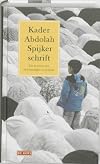
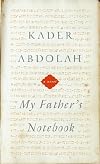
My Father's Notebook
by Kader Abdolah
On This Page
Description
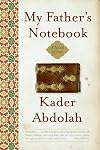
Aga Akbar, the youngest of seven children and the illegitimate son of a Persian nobleman, is a deaf-mute. He makes use of a rudimentary sign language to get by in the world, but his deepest thoughts and feelings go unexpressed. Hoping to free the boy from his emotional confinement, his uncle asks him to visit a cave on nearby Saffron Mountain and to copy a three-thousand-year-old cuneiform inscription -- an order of the first king of Persia and the destination of many pilgrimages. Aga Akbar show more uses these cuneiform characters to fill his notebook with writings only he can understand. Years later, his political-dissident son, Ishmael, has been forced to flee Iran. From his new home in the Netherlands, he attempts to translate the notebook, and in the process he tells his father's story, his own story, and the story of twentieth-century Iran -- from the building of the first railroad to the struggles for power among the shah, the communists, and the mullahs, and ending with the revolution. show lessTags
Recommendations












Member Recommendations

Member Reviews
Spijkerschrift, Abdolah's second novel, is more-or-less autobiographical in theme. The narrator, a refugee living in the Netherlands, examines his relationship with his father, the deaf-and-dumb carpet repairer Aga Akbar, living in a village in the north-east of Iran, against the background of 20th century Iranian history. Aga Akbar's disability is central to the way the novel develops - it gives Abdolah a way to explore the way that language defines your perception of the world, since Aga Akbar can normally communicate only in a private sign-language developed within the family and the village. His eccentric uncle, the poet Kazem Gan, has encouraged him to write his thoughts down, but since Kazem Gan can't be bothered to teach him how show more to write in Persian, he ends up developing his own private and personal writing system, inspired by a cuneiform inscription from the time of Cyrus the Great on the wall of a local cave. And of course he still can't read, so he remains dependent for his knowledge of the wider world on what the people around him are able to translate into sign language. Now the narrator, sitting in his attic in the Flevopolder, is trying to reconstruct what his father must have written in the notebook, without any means to decode the cuneiform other than his memory of his father's life, and of course realising how little we can know of what goes on inside someone else's head unless they have an effective way of communicating it.
Another big theme of the book is the odd way in which having a disabled parent introduces a partial role-reversal into the parent-child relationship, giving the narrator an unusually intimate relationship with his father - and an unusually heavy load of the usual filial guilt when he becomes involved in the underground resistance to the Shah, and later to the clerics, and is forced to separate himself from his parents to avoid implicating them in his political activities.
The book ticks most of the boxes you would expect from the "refugee novel" genre - there is more local colour than you can shake a stick at, there are attractive descriptions of the idyllic-but-tough life-before-the-political-horror, there are arrests, beatings, and disappearances, there is the wear-and-tear of being constantly on the lookout for the secret police. But what makes it special and uniquely attractive is the charming, modest, but sure-footed way Abdolah navigates between the two cultures and picks up echoes in their ways of imagining the world in poetic terms (even the idea of deciphering the notebook gets tied into the framing narrative of the Dutch classic Max Havelaar). show less
Another big theme of the book is the odd way in which having a disabled parent introduces a partial role-reversal into the parent-child relationship, giving the narrator an unusually intimate relationship with his father - and an unusually heavy load of the usual filial guilt when he becomes involved in the underground resistance to the Shah, and later to the clerics, and is forced to separate himself from his parents to avoid implicating them in his political activities.
The book ticks most of the boxes you would expect from the "refugee novel" genre - there is more local colour than you can shake a stick at, there are attractive descriptions of the idyllic-but-tough life-before-the-political-horror, there are arrests, beatings, and disappearances, there is the wear-and-tear of being constantly on the lookout for the secret police. But what makes it special and uniquely attractive is the charming, modest, but sure-footed way Abdolah navigates between the two cultures and picks up echoes in their ways of imagining the world in poetic terms (even the idea of deciphering the notebook gets tied into the framing narrative of the Dutch classic Max Havelaar). show less
Full of poetry, tragedy, political upheaval and heartbreak, this novel has scenes that seem to be painted, rather than written. It's been such a long time since I read Persian poetry, now I long to do it again. Highly recommended.
The main character in this book is a deafmute man, Aga Akbar, living in a small village in the mountains of Iran. He can't write, but he teaches himself to write in a fashion only he can read. His son goes to university and gets involved in resistance against the shah. When at the revolution it turns out that the mullahs are even worse than the shah, he has to flee. Akbar doesn't seem to be fully aware of the politics going on, but despite the love of the son for his father, Akbar gradually gets involved. He loves his son, what his son does must be ok. Also,the deafmute may be deaf and mute, but he's not stupid.
The book is intriguing, catching, emotional. Abdolah went through a similar phase in his life, so i can't imagine that much of show more the book is autobiographic. Abdolah's father was a deafmute.
I find it remarkable that a person who has started to learn Dutch only years ago, is capable not only to speak and write the language fluently, but also to write good novels. show less
The book is intriguing, catching, emotional. Abdolah went through a similar phase in his life, so i can't imagine that much of show more the book is autobiographic. Abdolah's father was a deafmute.
I find it remarkable that a person who has started to learn Dutch only years ago, is capable not only to speak and write the language fluently, but also to write good novels. show less
Tra passato e presente, tra Persia e Olanda, riconciliarsi col passato per poter vivere più pienamente il presente. Ismail, rifugiato politico iraniano, fuggito dalla presa del potere degli ayathollah, che hanno precipitato l'Iran dalla dittatura alla fanatica teocrazia, cerca di adattarsi al suo nuovo paese ricostruendo la figura paterna e i suoi appunti scritti in una inventata scrittura cuneiforme.
Bellissimo.
Bellissimo.
This was a lovely, moving, very well-written story. The writing style is simple but very powerful. The sense of being right there, in Iran or in the Netherlands, is really strong.
I have been to a reading given by this writer and loved it. So when someone suggested we read this book for our bookclub I was immediately for it. And I wanted to like it, but I didn't.... I don't know why I didn't like it, maybe it was just the wrong book at that time, but I just couldn't get into it. All the other people in my bookgroup liked it a lot, so it must be me ;-))
My best book this year. Beautiful story, gently written in haunting prose. A novel to increase understanding of one way of life in the middle east.
Members
- Recently Added By
Published Reviews
ThingScore 75
Abdolah writes in staccato sentences using a simple vocabulary, and the narration is often heavy-handed. The use of tapestry as a structuring metaphor is too familiar a convention for Abdolah to make it fresh. But he doesn't need to: the reader is skilfully wrapped up in the fabric of semi-autobiographical stories. My Father's Notebook reads like a detective story: information is withheld so show more that we gradually discover the background to Ishmael's exile.
Like Orhan Pamuk's Snow, the novel portrays the sense of rootlessness in the secular west and the religious oppression of Islamic countries. But unlike Pamuk's unrelentingly dark brooding, Abdolah leaves pockets of cheerfulness, such as a hilarious anecdote about Ishmael dressed up and dancing like a Parisian schoolboy, mocking the westernising shah. show less
Like Orhan Pamuk's Snow, the novel portrays the sense of rootlessness in the secular west and the religious oppression of Islamic countries. But unlike Pamuk's unrelentingly dark brooding, Abdolah leaves pockets of cheerfulness, such as a hilarious anecdote about Ishmael dressed up and dancing like a Parisian schoolboy, mocking the westernising shah. show less
added by souloftherose
Author Information

52+ Works 4,050 Members
Awards and Honors
Awards
Notable Lists
Series
Belongs to Publisher Series
Grote lijsters (2008)
Work Relationships
Has as a student's study guide
Common Knowledge
- Canonical title
- My Father's Notebook
- Original title
- Spijkerschrift
- Original publication date
- 2000
- People/Characters
- Aga Akbar; Ismaiel Akbar; Tina Akbar; Golden Bell
- Important places*
- Perzië/Iran
- Important events*
- Islamitische revolutie o.l.v. Khomeini (1978); Afzetten van de Sjah van Perzië (1978)
- First words
- And so it went until the men of Kahaf finally sought refuge in the cave.
- Last words
- (Click to show. Warning: May contain spoilers.)And when she reaches the city, she will notice that everything has changed.
- Blurbers
- Guppy, Shusha; Neilan, Catherine; McVey, David
- Original language*
- Nederlands
*Some information comes from Common Knowledge in other languages. Click "Edit" for more information.
Classifications
- Genres
- General Fiction, Fiction and Literature
- DDC/MDS
- 839.31364 — Literature & rhetoric German & related literatures Other Germanic literatures Netherlandish literatures Dutch Dutch fiction 20th Century 1945-1999
- LCC
- PT5881.1 .B36 .S65 — Language and Literature German, Dutch and Scandinavian literatures Dutch literature Individual authors or works 1961-2000
- BISAC
Statistics
- Members
- 637
- Popularity
- 45,560
- Reviews
- 26
- Rating
- (3.81)
- Languages
- 8 — Danish, Dutch, English, French, German, Italian, Norwegian (Bokmål), Spanish
- Media
- Paper, Ebook
- ISBNs
- 38
- ASINs
- 4