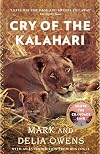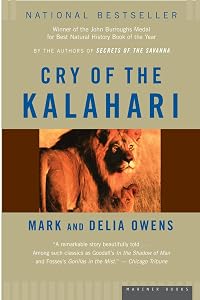
Cry of the Kalahari: Seven Years in Africa's Last Great Wilderness
by Mark Owens, Delia Owens
On This Page
Description
This is the story of the Owens' travel and life in the Kalahari Desert. Here they met and studied unique animals and were confronted with danger from drought, fire, storms, and the animals they loved. This bestselling book is for both travelers and animal lovers.Tags
Recommendations



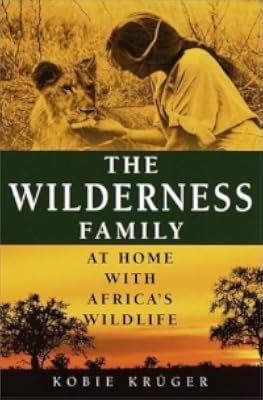
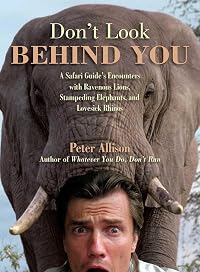
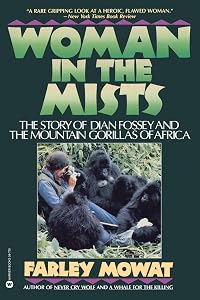
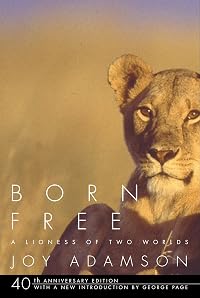








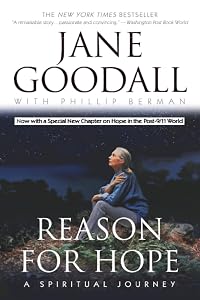

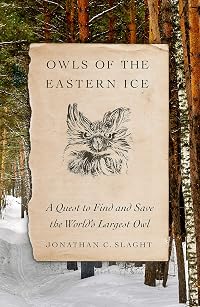
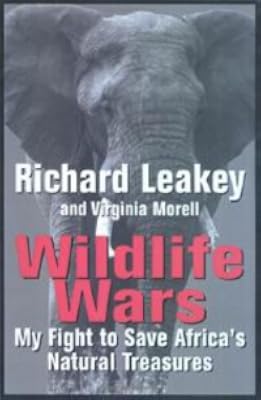

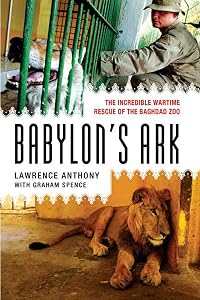
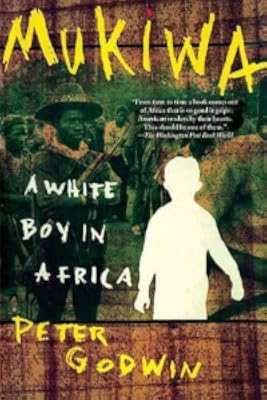
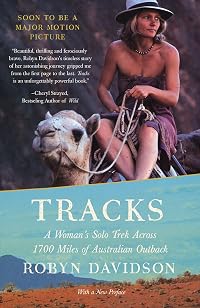
Member Recommendations
Member Reviews
In 1974 Mark and Delia headed to Africa to start a research project just one year after their wedding day. Cry of the Kalahari is the story of their seven years in the Kalahari Desert. Taking turns, they share their experiences living with brown hyenas, lion prides, and unpredictable jackals, among many other animals. Because most of the animals have never seen humans before they are neither threatened or antagonized by Mark and Delia’s presence. At face value, Cry of the Kalahari is romantic and idealistic.
Admittedly, I have a few issues with Cry of the Kalahari, beginning with the trivial. One, how many times they mentioned the temperatures being 120 degrees in the shade. You are in the Kalahari desert! What did you expect?
Two, show more their so-called research. They went to Kalahari not really sure what they wanted to work on. When they discovered there was little known about the brown hyena they set about to learn all they could about the species, then they added jackals, and yet after Bones, a male lion, was murdered by hunters they changed their focus to protecting all wildlife of the Kalahari. By the end of the book their focus had widened to include wildebeest. How they received funding for such vague and vast research is beyond me. However, the couple is quick to point out Cry of the Kalahari is not detailed report of their research. That will show up elsewhere they promised.
My third issue is probably the most personal. They claimed over and over they didn’t want to interfere with the wildlife because it would change the validity of their research. They cried as animals starved to death outside their food-laden tent. Yet they had no problem performing a makeshift surgery on Bones, a lion who had broken his leg, or smearing motor oil on Blue, another lion who suffered from parasites. Most likely both of these animals would have died without human intervention. Essentially, the Owenes actions disrupted the circle of life in the Kalahari. show less
Admittedly, I have a few issues with Cry of the Kalahari, beginning with the trivial. One, how many times they mentioned the temperatures being 120 degrees in the shade. You are in the Kalahari desert! What did you expect?
Two, show more their so-called research. They went to Kalahari not really sure what they wanted to work on. When they discovered there was little known about the brown hyena they set about to learn all they could about the species, then they added jackals, and yet after Bones, a male lion, was murdered by hunters they changed their focus to protecting all wildlife of the Kalahari. By the end of the book their focus had widened to include wildebeest. How they received funding for such vague and vast research is beyond me. However, the couple is quick to point out Cry of the Kalahari is not detailed report of their research. That will show up elsewhere they promised.
My third issue is probably the most personal. They claimed over and over they didn’t want to interfere with the wildlife because it would change the validity of their research. They cried as animals starved to death outside their food-laden tent. Yet they had no problem performing a makeshift surgery on Bones, a lion who had broken his leg, or smearing motor oil on Blue, another lion who suffered from parasites. Most likely both of these animals would have died without human intervention. Essentially, the Owenes actions disrupted the circle of life in the Kalahari. show less
A truly amazing and sometimes dumbfounding travelogue about two idealistic rookie survivalists who decide to traipse out into the deep bush with a rickety plane and few supplies. She barely scrambles into the truck to escape being eaten lions in one chilling nighttime vignette. He gets the aforementioned little plane to start just in the nick of time in another. Their trusted African guide deserts them one day on a trip to town and never returns; they espy him later, but don't say anything to him (if I remember correctly) and walk away, realizing he simply got tired of the lonely and perilous grind that is wilderness study. They sometimes sleep on the bare ground of the savannah under the wing of their plane at night. Yes, in an area show more teeming with lions, hyenas and leopards. Talk about a wing and a prayer... They become some of the first humans to make detailed observations of the intricate social behavior of brown hyenas, including underground in their burrows. There are photos of them cuddling with adult hyenas (the land predators with the strongest bite force on earth) in their campsite, which is unbelievably foolish in my opinion, as hyenas sometimes prey on lions and leopards. They eventually get more grant money and are able to set up a more official, scientifically-capable campsite in which to do their research. How this has not been made into a Hollywood movie is beyond me, as is how they managed to not to become dinner à la Grizzly Man. Some of the photos, such as one of a hornbill scavenging inside their cooking pot, provide comic relief. The best way to read this book is to occasionally put it down and go watch some videos of predation in Kruger National Park on YouTube. That's in nearby South Africa, not Botswana (where this book takes place), but it has a larger concentration of these beasts and hence more blood-curdling action to behold.
Too bad the photos are in black & white; do later editions possibly have color photos? show less
Too bad the photos are in black & white; do later editions possibly have color photos? show less
I picked this up for $1 at a book sale and didn't expect much given its age but was really surprised how good it is, I felt transported to Africa and slowed down reading to make it last. There is something iconic about lions and the 1970s (Born Free) and this is one of those stories. But it's more than a period piece, it still reads fresh and exciting. I was most amazed at the do it yourself accomplishments of Mark and Delia Owens, they are able to do anything in the bush using the most rudimentary equipment. After they performed surgery on a wild lion it nearly jumped the shark into an uncanny valley of incredibility - but all true, the Deception Valley where they studied really is "incredible". The book has a lot to offer and should show more be a classic of its type. The book is not unknown (was a best-seller), but it hasn't been canonized, and like the animals risks slipping into obscurity which would be unfortunate. show less
I do envy lots of what Mark and Delia Owens experienced living in the Kalahari.The up and personal with lions thrilled me as did getting so close to the den of the brown hyenas. However, pythons and cobras and rats in my sleeping bag ... not so much. What an amazing couple. It was also interesting how differently written the chapters were. If it was Mark's chapter, it was more fact, detailed, research oriented. If Delia wrote it was more emotional and more the day to day realities. I enjoyed both styles.
Cry of the Kalahari is a remarkable book and what it has to say about conservation is important.
Cry of the Kalahari is a remarkable book and what it has to say about conservation is important.
What an incredibly difficult and admirable undertaking! I was left awestruck by their dedication to their science and the magnificent carnivores of the arid Kalahari. The photographs were a very welcome addition too. A highly recommended read for anyone considering field research in the natural sciences.
I first read this book nearly 25 years ago when first published in paperback. The story has not aged and still enthralls. Two young American graduate students sell everything they own to purchase a round-trip ticket to South Africa. They board the plane with about $6,000, and buy train tickets in Johannesburg for Gaberone, Botswana. Arriving there, they burn through quite a bit of their money waiting for permits to study the wildlife on a game preserve. A few months later, they buy what supplies they can, including a beat up Land Rover, and set off for the Kalahari Desert with the idea of finding some unstudied animal life. No experience in the desert and nothing more to guide them than their love and enthusiasm for wildlife speak of show more tremendous courage and dedication.
When their adventure began, in the middle 70s, they had great respect for the animals and the environment. They carefully observed lions, leopards, jackals, and brown hyenas, along with the myriad ungulates, birds, rodents, reptiles, and insects, while trying not to intrude or disturb them in the least.
The area of the desert they chose had never been visited by humans. They made friends with lions and much of the other wild life they encountered. At first, surrounded by a pride of curious lions, Mark and Delia, seem scared but calm. Gradually, the lions accepted them as part of the landscape. Numerous photos depict the close contact between the Owens and the big cats, as well as hyenas, which became one of the principle foci of their work.
The couple shared the writing of the book, and the chapters written by Delia display a somewhat more technical style, while those by Mark are more concerned with observing the landscape, the wild life, and the climate.
Today the couple runs the Owens Foundation for Wildlife Conservation based in Stone Mountain, GA. Their website is http://www.owens-foundation.org/ . Donations are welcome. Their story is also the struggle for preservation of the predators of the Kalahari, as well as a constant struggle for funding to continue their work.
If you love animals, adventure, courage, with funny moments mixed in, this book is a must-read. Five stars.
--Jim, 2/10/09 show less
When their adventure began, in the middle 70s, they had great respect for the animals and the environment. They carefully observed lions, leopards, jackals, and brown hyenas, along with the myriad ungulates, birds, rodents, reptiles, and insects, while trying not to intrude or disturb them in the least.
The area of the desert they chose had never been visited by humans. They made friends with lions and much of the other wild life they encountered. At first, surrounded by a pride of curious lions, Mark and Delia, seem scared but calm. Gradually, the lions accepted them as part of the landscape. Numerous photos depict the close contact between the Owens and the big cats, as well as hyenas, which became one of the principle foci of their work.
The couple shared the writing of the book, and the chapters written by Delia display a somewhat more technical style, while those by Mark are more concerned with observing the landscape, the wild life, and the climate.
Today the couple runs the Owens Foundation for Wildlife Conservation based in Stone Mountain, GA. Their website is http://www.owens-foundation.org/ . Donations are welcome. Their story is also the struggle for preservation of the predators of the Kalahari, as well as a constant struggle for funding to continue their work.
If you love animals, adventure, courage, with funny moments mixed in, this book is a must-read. Five stars.
--Jim, 2/10/09 show less
I first read this book nearly 25 years ago when first published in paperback. The story has not aged and still enthralls. Two young American graduate students sell everything they own to purchase a round-trip ticket to South Africa. They board the plane with about $6,000, and buy train tickets in Johannesburg for Gaberone, Botswana. Arriving there, they burn through quite a bit of their money waiting for permits to study the wildlife on a game preserve. A few months later, they buy what supplies they can, including a beat up Land Rover, and set off for the Kalahari Desert with the idea of finding some unstudied animal life. No experience in the desert and nothing more to guide them than their love and enthusiasm for wildlife speak of show more tremendous courage and dedication.
When their adventure began, in the middle 70s, they had great respect for the animals and the environment. They carefully observed lions, leopards, jackals, and brown hyenas, along with the myriad ungulates, birds, rodents, reptiles, and insects, while trying not to intrude or disturb them in the least.
The area of the desert they chose had never been visited by humans. They made friends with lions and much of the other wild life they encountered. At first, surrounded by a pride of curious lions, Mark and Delia, seem scared but calm. Gradually, the lions accepted them as part of the landscape. Numerous photos depict the close contact between the Owens and the big cats, as well as hyenas, which became one of the principle foci of their work.
The couple shared the writing of the book, and the chapters written by Delia display a somewhat more technical style, while those by Mark are more concerned with observing the landscape, the wild life, and the climate.
Today the couple runs the Owens Foundation for Wildlife Conservation based in Stone Mountain, GA. Their website is http://www.owens-foundation.org/ . Donations are welcome. Their story is also the struggle for preservation of the predators of the Kalahari, as well as a constant struggle for funding to continue their work.
If you love animals, adventure, courage, with funny moments mixed in, this book is a must-read. Five stars.
--Jim, 2/10/09 show less
When their adventure began, in the middle 70s, they had great respect for the animals and the environment. They carefully observed lions, leopards, jackals, and brown hyenas, along with the myriad ungulates, birds, rodents, reptiles, and insects, while trying not to intrude or disturb them in the least.
The area of the desert they chose had never been visited by humans. They made friends with lions and much of the other wild life they encountered. At first, surrounded by a pride of curious lions, Mark and Delia, seem scared but calm. Gradually, the lions accepted them as part of the landscape. Numerous photos depict the close contact between the Owens and the big cats, as well as hyenas, which became one of the principle foci of their work.
The couple shared the writing of the book, and the chapters written by Delia display a somewhat more technical style, while those by Mark are more concerned with observing the landscape, the wild life, and the climate.
Today the couple runs the Owens Foundation for Wildlife Conservation based in Stone Mountain, GA. Their website is http://www.owens-foundation.org/ . Donations are welcome. Their story is also the struggle for preservation of the predators of the Kalahari, as well as a constant struggle for funding to continue their work.
If you love animals, adventure, courage, with funny moments mixed in, this book is a must-read. Five stars.
--Jim, 2/10/09 show less
Members
- Recently Added By
Lists

Books about Animals
86 works; 4 members

Books Set In Africa
81 works; 4 members

Allie's Favourite 150 Books
145 works; 3 members

Favorite Animal Non-Fiction
293 works; 144 members
Author Information
4 Works 981 Members

7+ Works 22,007 Members
Delia Owens is a wildlife scientist and writer, based in Idaho. Her work has been published in numerous journals, including Nature, and The African Journal of Ecology. Her awards include the John Burroughs Award for Nature Writing. She is the author of several nonfiction books about her work as a wildlife scientist in Africa, Cry of the Kalahari, show more The Eye of the Elephant, and Secrets of the Savanna. Her debut novel is entitled Where the Crawdads Sing (2018). (Bowker Author Biography) show less
Some Editions
Awards and Honors
Awards
Distinctions
Series
Belongs to Publisher Series
Maailm ja mõnda (138)
Work Relationships
Is contained in
Common Knowledge
- Canonical title
- Cry of the Kalahari: Seven Years in Africa's Last Great Wilderness
- Original title
- Cry of the Kalahari
- Original publication date
- 1984
- People/Characters
- Mark Owens; Delia Owens; Mox
- Important places
- Botswana; Kalahari Desert, Africa; Kgalagadi Transfrontier Park
- Dedication
- We dedicate this book to Dr. Richard Faust and to Ingrid Koberstein of the Frankfurt Zoological Society for all they have done for the animals of this earth.
And to Christopher, who could not be with us. - First words
- My left shoulder and hip ached from the hard ground.
Classifications
Statistics
- Members
- 657
- Popularity
- 44,125
- Reviews
- 15
- Rating
- (4.10)
- Languages
- 6 — English, Estonian, French, German, Italian, Polish
- Media
- Paper, Audiobook, Ebook
- ISBNs
- 23
- UPCs
- 1
- ASINs
- 11