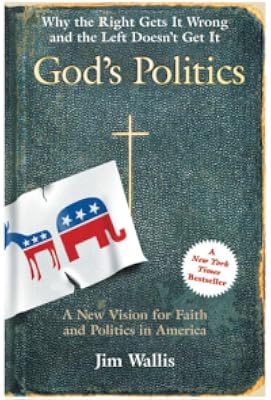
God's Politics: Why the Right Gets It Wrong and the Left Doesn’t Get It
by Jim Wallis
On This Page
Description
Since when did believing in God and having moral values make you pro-war, pro-rich, and solely pro-Republican? And since when did promoting and pursuing a progressive social agenda with a concern for economic security, health care, and educational opportunity mean you had to put faith in God aside? God's Politics offers a clarion call to make both our religious communities and our government more accountable to key values of the prophetic religious tradition -- that is, make them show more pro-justice, pro-peace, pro-environment, pro-equality, and pro-family (without making scapegoats of single mothers or gays). Our biblical faith and religious traditions simply do not allow us as a nation to continue to ignore the poor and marginalized, deny racial justice, tolerate the ravages of war, or turn away from the human rights of those made in the image of God. These are the values of love and justice, reconciliation, and community that Jesus taught and that are at the core of what many of us believe, Christian or not. Jim Wallis inspires us to hold our political leaders and policies accountable by integrating our deepest moral convictions into our nation's public life. Read by Sam Freed show lessTags
Recommendations















Member Reviews
Someone had brought Jim Wallis to my attention before I read this book, but I didn't remember. (You can Google him yourself to find out his historical support for problematic causes.) Nor was I familiar with Sojourners. I'd like to think this gave me an objective stance in reading this book.
I find Wallis to be a Leftish version of what he criticizes on the Right -- someone who wants to impose his interpretation of Scripture on everyone else in America. Wallis criticizes the evangelical church for forgetting Jesus' words about providing for the poor and making peace. But rather than focus on changing the American church, Wallis devotes his attention to changing American government. He attacks the Pat Robertsons and G.W. Bushes of the show more Right for confusing the American Church with America the nation, but doesn't see that he does the exact same thing by calling for government policies to essentially replace and emulate the church's traditional role of supporting family, peace, and helping the poor.
Wallis argues that faith-based non-profits can't do their jobs unless better funded by taxpayers. The shortcoming of Bush's Faith-Based Initiative was its lack of taxpayer funding. Rather than focus on increasing the voluntary giving of American Christians, Wallis wants to increase the forced redistribution from all Americans to non-profits through taxes.
Wallis doesn't argue from a historical theological or philosophical perspective. Abraham Lincoln is about the oldest source as he draws from. Martin Luther King is held up as an ideal at least a dozen times because "He held his Constitution in one hand and his Bible in the other," we are told at least three times. Wallis rather annoyingly repeats his talking points over and again, making many pages superfluous.
Wallis argues that the government should keep policies in line with what the majority of Christian denominations put out official stances on. The Iraq war was immoral because every denomination (except Southern Baptists) spoke out against it. Budgets are "moral documents," and all legislation should follow the prescription of the ecumenical Church-- increased taxes on the wealthy, increased transfers to the poor, higher minimum wage laws, "fair trade" instead of "free trade," funding "real education," debt forgiveness to poor countries, more environmental regulations, and a two-state solution for Israel and Palestine, etc. Not as much ink is given to why those causes are correct scripturally or what the historical stances of the Church has been. Jim Wallis agrees with it, therefore it's right.
He accuses the Religious Right of "prooftexting," twisting Scripture out of context to support their ideals. But Wallis engages in his own prooftexting. For example, he uses quotes from prophets like Micah to argue for debt relief for poor countries. But in the very next chapter in dealing with capital punishment, which Wallis opposes as immoral, he ignores that the same prophets both advocated and carried out capital punishment as God's will. (I'm not saying we should interpret OT Israel as prescriptive for today, just pointing out that Wallis wants to use some prescriptions for today while ignoring others-- prooftexting.)
In a chapter dealing with the global economy, Wallis decries "free trade" practices of the West/North as putting undue restrictions on the South. Any trade agreement that includes restrictions shouldn't be called or understood as "free trade." The best thing America could do for trade with the poor countries Wallis wants to help would be to immediately unilaterally eliminate all tariffs and quotas to give them unfettered access to U.S. markets. But Wallis doesn't point this out. Probably because it would be heavily opposed by the trade unions Wallis ironically supports as many American workers in those formerly protected industries would eventually lose their jobs. While painful for those workers who must find new occupations, the truly poor people-- those earning $2 a day or less-- would greatly benefit. Wallis wants to have it both ways.
There are some really vague prescriptions, like promoting "real education." What is "real" education? Wallis never says, just decries the American government for not supporting it better. On trade and labor economics, Wallis seems really ignorant of the data. He prescribes raising the minimum wage as a poverty-reduction strategy without pointing out that most minimum wage workers aren't trying to support a family on it, a large number are teenagers and college students who are still dependents on their fairly well-off parents. How high should minimum wage be? Why not just raise the minimum wage to $1,000 an hour? Wallis doesn't think about it.
Wallis spends much of the book arguing for Jubilee-style income redistribution and decrying how the highest-income Americans have seen incomes rise much higher and faster than everyone else. But rather than encouraging Christians to give more and spend less, or to be more conscientious of what products they are buying and lifestyles they are supporting, he simply advocates for government to tackle the problem. Wallis' shallow thinking shows up disappointingly in one of the final chapters, where he talks of his love for the NBA. Wallis doesn't point out that most NBA players are among the top 1% of the American income earners who have seen disproportionate income increases. It's apparently okay if an NBA player makes $10 million a year, so long as he is a "nice guy," and isn't a "slasher" or a "thug" like "Allen Iverson." Wallis apparently doesn't see any contradiction in supporting those salaries by purchasing tickets to NBA games or merchandise, nor does he call on the church to reevaluate its thinking about why entertainers and athletes are among the highest-paid in America. Because we need "fun and diversions." This is hypocrisy.
I give this book 1 star out of 5. I was hoping for M. Douglas Meeks and got the Left's version of Jerry Falwell. I'm not sure who is more dangerous to have advising a President. show less
Focused on the 2004 presidential election, God’s Politics is a sweeping commentary on the two-party American political system. Jim Wallis believes that American leaders have a vision problem: a basic lack of vision. Therefore, Wallis recommends adopting a vision of justice borrowed from the pages of the Old Testament prophets. He believes, as I do, that our political system spends too much time, energy, and money on partisan bickering, acknowledging that every important social movement in American history (abolition, suffrage, civil rights) has started with a cause and vision capable of unifying diverse community and political leaders. Moreover, these movements were led by godly men and women who sought to live out the biblical show more mandate for justice in all areas of life. Wallis calls for “a new vision for the common good that could inspire us all to live lives of service and to a whole new set of public…priorities” (pg. 28).
In answering the question of how our faith should influence our political activities, Wallis writes that neither the Democrats nor the Republicans, the left or the right, have embraced a holistic vision for domestic or international justice and morality. While often focusing justly on social issues, too many Democrats have espoused a faith that is separate from their private lives and shy away from using moral or spiritual terminology. On the other side of the aisle, Republicans have often attempted to co-opt religious issues for political gain. This was particularly evident in George W. Bush’s campaigns, during which the religious right was heavily courted through appeals to a very narrow spectrum of morality issues (abortion and gay rights). Christians on the Right have many healthy things to say about personal morality, but their social decisions show a lack of commitment to the common good in terms of economics and international diplomacy. Wallis calls for a new option that would combine the more conservative moral values of the Right with the social concerns of the Left. (I would like to see this as well.)
Recently, I have been thinking about the continued disenfranchisement of America’s poor, so I am particularly interested in Wallis’ discussion of poverty and the “Burger King Mom” (pg.. 221), who is working hard and still struggling to pay rent each month. I must admit that I had never considered the context of Mark 14.7 in the way he describes it – the disciples have the poor precisely because they are followers of Christ. Concern for the poor must be a plank (or several planks) in the platform of each Christian politician, for true religion is to help the needy and powerless (James 1.27). Wallis challenges both conservatives and liberals to stop placing blame, start developing creative solutions, and take leadership responsibility for the poverty-perpetuating policies they create. Similar to Paul Marshall in Thine Is the Kingdom, Wallis calls on large corporations to move away from simple profit toward the idea of common good and highlights the connection between racial prejudice and poverty. I agree that our country has a very long way to go toward economic righteousness and that we have a great deal to learn from the legacy of leaders such as Martin Luther King, Jr. about how we can unite our diverse politic under a common banner of integrity and justice.
While I found God’s Politics to be a bit self-indulgent at times, I basically resonated with much of Wallis’ critique of the American political system. Many of my peers share my sense of disillusionment with our current two-party system, which seems to so often present a choice between the lesser of two evils instead of a choice for the common good. I am a bit uncomfortable with the way in which Wallis sometimes places the ideals of democracy side-by-side with God’s mandates, but I do believe that we have a useful system by which we can affect a great deal of positive change through a vision of holistic justice. show less
In answering the question of how our faith should influence our political activities, Wallis writes that neither the Democrats nor the Republicans, the left or the right, have embraced a holistic vision for domestic or international justice and morality. While often focusing justly on social issues, too many Democrats have espoused a faith that is separate from their private lives and shy away from using moral or spiritual terminology. On the other side of the aisle, Republicans have often attempted to co-opt religious issues for political gain. This was particularly evident in George W. Bush’s campaigns, during which the religious right was heavily courted through appeals to a very narrow spectrum of morality issues (abortion and gay rights). Christians on the Right have many healthy things to say about personal morality, but their social decisions show a lack of commitment to the common good in terms of economics and international diplomacy. Wallis calls for a new option that would combine the more conservative moral values of the Right with the social concerns of the Left. (I would like to see this as well.)
Recently, I have been thinking about the continued disenfranchisement of America’s poor, so I am particularly interested in Wallis’ discussion of poverty and the “Burger King Mom” (pg.. 221), who is working hard and still struggling to pay rent each month. I must admit that I had never considered the context of Mark 14.7 in the way he describes it – the disciples have the poor precisely because they are followers of Christ. Concern for the poor must be a plank (or several planks) in the platform of each Christian politician, for true religion is to help the needy and powerless (James 1.27). Wallis challenges both conservatives and liberals to stop placing blame, start developing creative solutions, and take leadership responsibility for the poverty-perpetuating policies they create. Similar to Paul Marshall in Thine Is the Kingdom, Wallis calls on large corporations to move away from simple profit toward the idea of common good and highlights the connection between racial prejudice and poverty. I agree that our country has a very long way to go toward economic righteousness and that we have a great deal to learn from the legacy of leaders such as Martin Luther King, Jr. about how we can unite our diverse politic under a common banner of integrity and justice.
While I found God’s Politics to be a bit self-indulgent at times, I basically resonated with much of Wallis’ critique of the American political system. Many of my peers share my sense of disillusionment with our current two-party system, which seems to so often present a choice between the lesser of two evils instead of a choice for the common good. I am a bit uncomfortable with the way in which Wallis sometimes places the ideals of democracy side-by-side with God’s mandates, but I do believe that we have a useful system by which we can affect a great deal of positive change through a vision of holistic justice. show less
Jim Wallis' major new book is a scathing indictment of the way that conservative evangelicals in the US have self-righteously attempted to co-opt any discussion of religion and politics. And, while the Right argues that God's way is their way, the Left pursues an unrealistic separation of religious values from morally grounded political leadership. God's Politics offers a clarion call to make America's religious communities and its government more accountable to key values of the prophetic religious tradition - pro-justice, pro-peace, pro-environment, pro-equality, pro-consistent ethic of life and pro-family. These are the values of love and justice, reconciliation, and community at the core of what many people believe, whether show more Christian or not. show less
Brilliant. This book raised two good questions for me.
Firstly, why do people have to fit in to the media stereotypes of left and right? Can we not be wildly radical in some areas, and conservative in others in a way that defies pigeon-holing?
Secondly why the blazes are secular humanists allowed to bring their secular values onto the public political stage, but people of faith are not permitted to bring their faith-based values? The cry "religion and politics don't mix" is very unhelpful, and ignores the example of people like Desmond Tutu and Martin Luther King.
The book is an easy read in the sense that it flows and the language is accessible - but it is a salutary (if uncomfortable) read for someone like me who is instinctively show more conservative.
It also gives the lie to the asinine one-dimensional characterisation of American Christianity in books like "The God Delusion". Real life is more complex than that. show less
Firstly, why do people have to fit in to the media stereotypes of left and right? Can we not be wildly radical in some areas, and conservative in others in a way that defies pigeon-holing?
Secondly why the blazes are secular humanists allowed to bring their secular values onto the public political stage, but people of faith are not permitted to bring their faith-based values? The cry "religion and politics don't mix" is very unhelpful, and ignores the example of people like Desmond Tutu and Martin Luther King.
The book is an easy read in the sense that it flows and the language is accessible - but it is a salutary (if uncomfortable) read for someone like me who is instinctively show more conservative.
It also gives the lie to the asinine one-dimensional characterisation of American Christianity in books like "The God Delusion". Real life is more complex than that. show less
This is a book stuffed full of common sense and good Christian, and I am sure all other religious groupings', sentiment.
The book is,mainly, about America but so much of what Mr. Wallis says is true of Britain too. The right have high-jacked Christianity as a weapon to attack Gay people and to justify war against non-Christian countries whilst, the left declare religion to be the opiate of the people. This latter point is particularly interesting in the British context, as the church played a great part in setting up the Labour Party.
I particularly like Mr Wallis' definition of religious politics (borrowed from Abraham Lincoln); " Our task should not be to invoke religion and the name of God by claiming God's blessing and endorsement show more for all our national policies and practices - saying, in effect, that God is on our side. Rather, we should pray and worry earnestly whether we are on God's side." This seems to, in a couple of short sentences, cut the ground from the 'Bible-bashers' and set a clear delineated path for all men, of whatever, religious and political persuasion. I shall try to bear it in mind.
The saddest part of this book is that it was updated, with a new forward, for sale in Britain, following the re-election of George W Bush, in 2005. Jim Wallis is optimistic that the rational religious people of America will take back the Bible for the people: since then, of course, we have had the rise of what I can only describe as the religious nutters (aka the Tea Party). At the moment, this is an American entity but, what our transatlantic cousins do today, we Brits will follow a fortnight next Tuesday. I am not looking forward to this trend coming here! show less
The book is,mainly, about America but so much of what Mr. Wallis says is true of Britain too. The right have high-jacked Christianity as a weapon to attack Gay people and to justify war against non-Christian countries whilst, the left declare religion to be the opiate of the people. This latter point is particularly interesting in the British context, as the church played a great part in setting up the Labour Party.
I particularly like Mr Wallis' definition of religious politics (borrowed from Abraham Lincoln); " Our task should not be to invoke religion and the name of God by claiming God's blessing and endorsement show more for all our national policies and practices - saying, in effect, that God is on our side. Rather, we should pray and worry earnestly whether we are on God's side." This seems to, in a couple of short sentences, cut the ground from the 'Bible-bashers' and set a clear delineated path for all men, of whatever, religious and political persuasion. I shall try to bear it in mind.
The saddest part of this book is that it was updated, with a new forward, for sale in Britain, following the re-election of George W Bush, in 2005. Jim Wallis is optimistic that the rational religious people of America will take back the Bible for the people: since then, of course, we have had the rise of what I can only describe as the religious nutters (aka the Tea Party). At the moment, this is an American entity but, what our transatlantic cousins do today, we Brits will follow a fortnight next Tuesday. I am not looking forward to this trend coming here! show less
Religion and politics seem to be highly polarised in America. Anyone who has spoken at length with American Christians will be familiar with the way that all too often political thought seems to seep into the Christian dialogue, and from the perspective of an outsider, it seems that these notions are frequently unchallenged, and often at odds with the message of the gospel.
This book is then a timely call to Christians to re-evaluate their unchallenged assumptions, and to realise that so much of politics is anti Christian, that they do the church a dis-service in not taking a stand against it. The book has practical ideas of how to make a stand, and is a wake up call for anyone who thinks God would vote for a certain political show more party!
There is less here for non Americans. The context of the book is clearly America and its politics, and an outsider would be wrong to read this book to feel smug about their own politics. In the UK religion is much less polarised, but the policies of the parties are no more moral for this. Non US readers should read the book with humility, wondering how the lessons and ideas here can be applied in their own context. show less
This book is then a timely call to Christians to re-evaluate their unchallenged assumptions, and to realise that so much of politics is anti Christian, that they do the church a dis-service in not taking a stand against it. The book has practical ideas of how to make a stand, and is a wake up call for anyone who thinks God would vote for a certain political show more party!
There is less here for non Americans. The context of the book is clearly America and its politics, and an outsider would be wrong to read this book to feel smug about their own politics. In the UK religion is much less polarised, but the policies of the parties are no more moral for this. Non US readers should read the book with humility, wondering how the lessons and ideas here can be applied in their own context. show less
I like Jim Wallis' stories. The stories illustrate his efforts to create a shared vision. In the past few weeks since the election, I've been repeating, like a mantra, the title of Chapter 21, "The Critical Choice: Hope versus Cynicism." It's essentially a spiritual choice, but one with some structure, so let's call that religious, because unless we do this together, there is nothing left. We do this in community, with a certain shared vocabulary; it is not possible in a private spiritual bubble. I'm grateful for his persistent prophetic voice, calling us together.
Members
- Recently Added By
Author Information

47+ Works 5,963 Members
Jim Wallis was born in Detroit, Michigan on June 4, 1948. He graduated from Michigan State University and Trinity Evangelical Divinity School. He is an evangelical Christian writer and political activist, best known as the founder and editor of Sojourners Magazine and of the Washington, D.C.-based Christian community of the same name. He has show more written numerous books including The Great Awakening; Reviving Faith and Politics in a Post-Religious Right America (2008), God's Politics: Why the Right Gets It Wrong and the Left Doesn't Get It (2005), Faith Works: How Faith Based Organizations Are Changing Lives, Neighborhoods, and America (2000), The Soul of Politics: Beyond Religious Right and Secular Left (1995) and The Call to Conversion (1981). (Bowker Author Biography) show less
Awards and Honors
Distinctions
Common Knowledge
- Canonical title
- God's Politics: Why the Right Gets It Wrong and the Left Doesn’t Get It
- Original title
- God's Politics
- Original publication date
- 2005-01-01
- Quotations
- The real enemy here isn't sex, but rather the commodification of everything—turning all values into market values, gutting the world of genuine love, caring, compassion, connection, and commitment for what will sell, for ex... (show all)ample, on a television show.
Perhaps the best place to discuss theology is in jail, after you have all been arrested for acting on your faith. - Blurbers
- Bono (Paul David Hewson) (Paul David Hewson); Moyers, Bill
- Original language*
- Englisch
*Some information comes from Common Knowledge in other languages. Click "Edit" for more information.
Classifications
- Genres
- Religion & Spirituality, General Nonfiction, Nonfiction, Politics and Government
- DDC/MDS
- 261.70973 — Religion Christian organization, social work & worship Social theology and interreligious relations and attitudes Christianity and political affairs
- LCC
- BR526 .W265 — Philosophy, Psychology and Religion Christianity Christianity History By region or country
- BISAC
Statistics
- Members
- 2,326
- Popularity
- 8,529
- Reviews
- 30
- Rating
- (3.69)
- Languages
- English, German, Japanese
- Media
- Paper, Audiobook, Ebook
- ISBNs
- 13
- UPCs
- 1
- ASINs
- 7