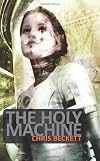
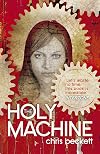
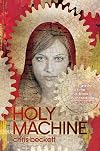
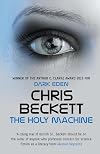
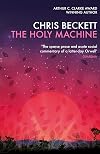
The Holy Machine
by Chris Beckett
On This Page
Description
George Simling has grown up in the city-state of Illyria in the Eastern Mediterranean, an enclave of logic and reason founded as a refuge from the Reaction, a wave of religious fundamentalism that swept away the nations of the twenty-first century. Yet to George, Illyria's militant rationalism is as close-minded and stifling as the faith-based superstition that dominates the world outside its walls.Tags
Recommendations



















Member Recommendations
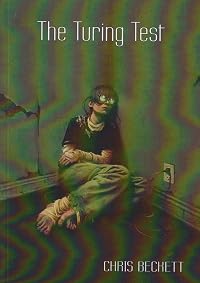
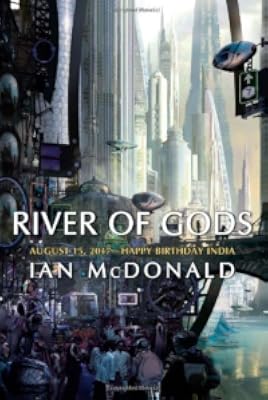
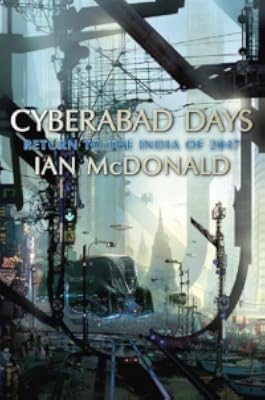
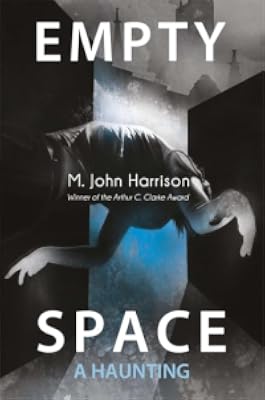
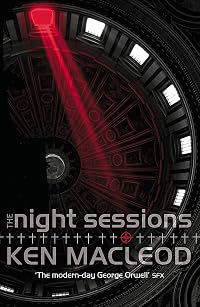
AlanPoulter Both are quirky novels that address the clash between religion and science, people and robots.
Member Reviews
http://www.infinityplus.co.uk/nonfiction/holymachine.htm
This is Beckett's first published novel, and it is a promising start. George Simling is a translator in the near-future city of Illyria, one of the few parts of the world that has not succumbed to the religious Reaction against all forms of technology. He falls in love with a sex robot which has started to develop autonomous intelligence beyond its programming, but ends up getting much more than he bargained for.
I normally hate "cute robot" stories with a deep deep loathing. This is not one of those stories. Although Lucy the robot's sluttish software is what George falls in love with, it becomes clear to us (and to him, though he has difficulty in facing up to it) that her show more emerging consciousness is something very different indeed. And at the same time as Lucy is making a transition from program to personality, George's mother, addicted to virtual reality, is going in the other direction.
Illyria, George's home, is no utopia; where many an author would have automatically wanted us to side with the scientists against the wild-eyed fundamentalists, Beckett has taken a more subtle approach. Surrounded by religious statelets, the city has elevated rationalism to the point of a state cult; discussions of religion and spirituality are forbidden, and George gets sucked into the subversive Army of the Human Spirit. When the authorities start to brain-wipe the most advanced of their robots, George and Lucy flee across a fractured Balkan landscape to a destiny that includes transformation and destruction.
The story is set in a part of the world I know fairly well, and I thought I picked up nods towards the national stereotypes of the isolated Macedonians, the laid-back Montenegrins, and so on. The fictional future city-state of Illyria obviously owes a certain debt of inspiration to the historical city-state of Dubrovnik, though it is two countries further south. A reference to "Lake Shkroda" is presumably a misprint for "Shkodra". My one serious cavil is that the oppressively hot Balkan climate is barely mentioned--indeed one character wears an unlikely "floppy white jumper".
A couple of touches I liked: the Illyrian subversives meet under the cover of the "Mountain Club" which sounds rather like the "Sierra Club" in the infamous role-playing game "Paranoia". Lucy the robot's gaffes as she tries to be human are reminiscent of the Buffy-bot in Buffy the Vampire Slayer. I did feel that Beckett over-egged the pudding at one or two points: perhaps it's believable that George has never been kissed before he encounters Lucy, but it seems most implausible that his conception was the only sexual act of his mother's life.
But in general, this is an interesting tale well told in Beckett's sparse prose, and nicely presented by Wildside Press. Recommended. show less
This is Beckett's first published novel, and it is a promising start. George Simling is a translator in the near-future city of Illyria, one of the few parts of the world that has not succumbed to the religious Reaction against all forms of technology. He falls in love with a sex robot which has started to develop autonomous intelligence beyond its programming, but ends up getting much more than he bargained for.
I normally hate "cute robot" stories with a deep deep loathing. This is not one of those stories. Although Lucy the robot's sluttish software is what George falls in love with, it becomes clear to us (and to him, though he has difficulty in facing up to it) that her show more emerging consciousness is something very different indeed. And at the same time as Lucy is making a transition from program to personality, George's mother, addicted to virtual reality, is going in the other direction.
Illyria, George's home, is no utopia; where many an author would have automatically wanted us to side with the scientists against the wild-eyed fundamentalists, Beckett has taken a more subtle approach. Surrounded by religious statelets, the city has elevated rationalism to the point of a state cult; discussions of religion and spirituality are forbidden, and George gets sucked into the subversive Army of the Human Spirit. When the authorities start to brain-wipe the most advanced of their robots, George and Lucy flee across a fractured Balkan landscape to a destiny that includes transformation and destruction.
The story is set in a part of the world I know fairly well, and I thought I picked up nods towards the national stereotypes of the isolated Macedonians, the laid-back Montenegrins, and so on. The fictional future city-state of Illyria obviously owes a certain debt of inspiration to the historical city-state of Dubrovnik, though it is two countries further south. A reference to "Lake Shkroda" is presumably a misprint for "Shkodra". My one serious cavil is that the oppressively hot Balkan climate is barely mentioned--indeed one character wears an unlikely "floppy white jumper".
A couple of touches I liked: the Illyrian subversives meet under the cover of the "Mountain Club" which sounds rather like the "Sierra Club" in the infamous role-playing game "Paranoia". Lucy the robot's gaffes as she tries to be human are reminiscent of the Buffy-bot in Buffy the Vampire Slayer. I did feel that Beckett over-egged the pudding at one or two points: perhaps it's believable that George has never been kissed before he encounters Lucy, but it seems most implausible that his conception was the only sexual act of his mother's life.
But in general, this is an interesting tale well told in Beckett's sparse prose, and nicely presented by Wildside Press. Recommended. show less
In a phenomenon known as The Reaction, governments worldwide have become theocracies. The religious stripe varies from place to place, Protestant fundamentalist in the US, Roman Catholic in South West Europe, Orthodox in most of the Balkans, Muslim in the Middle East. Even Japan has succumbed, though whether to Shintoism or something else is not stated. The only outpost of rationalism left is the scientists’ state of Illyria, carved out of a small part of the Balkans opposite Corfu. There, all the developments of technology are given free reign; domestic robots and other syntech abound. Even prostitution is provided by androids. (Far less trouble than real women, apparently, and so more highly prized.)
Illyria is of course the most show more powerful state in the region, hated and feared by its neighbours - who are nevertheless fascinated by it - but it is not an idyll. Despite a large number of guest workers carrying out those mundane tasks not yet performed by syntech, only people with scientific training are allowed to vote and the disenfranchised are restive. The most advanced robots are able to learn by experience but the odd one is prone to breakdown, either wandering off into neighbouring states or at worst killing people. There are proposals to wipe these self-evolving robots every six months to prevent this sort of thing.
The narrator, George Simling, is a relationship inadequate, bound to his mother Ruth by her dependence on SenSpace, a virtual environment she enters to try to escape her fear of persecution due to the memories she has of her suffering in the former US when The Reaction took over. George has fallen for the android prostitute, Lucy, and the novel follows their adventures outside Illyria after he has spirited her away from the brothel. The inevitable consequences of this - Lucy’s uncovering as a syntech creature - drive George to a life spent as a tramp in the southern Balkans, his only aim a desire to meet the Holy Machine of the title, a robot which is the focal point of a new religion.
A front cover quote from Interzone describes this book as incredible, which is perhaps too hyperbolic. But even though George Simling’s narrative voice does not always strike the correct note The Holy Machine is certainly readable - despite a blizzard of typos and omitted words - and goes down relatively smoothly.
With its close attention on George, the world events that might have been the focus of a different author’s take on this scenario happen off stage, a reminder that in a crazy world the troubles and activities of little people are worth a hill of beans.
The Holy Machine was first published in the US in 2004 but only in 2010 in the UK. Its discussions of religion and illustration of the irrationalities that give rise to it, not to mention the closed-mindedness of many of its adherents, might suggest that order would have been reversed.
While the characterisation of a self-evolving AI is always going to be somewhat flat, Beckett does well enough. Some of the humans could also have been more rounded though. Nevertheless Beckett is one to seek out. show less
Illyria is of course the most show more powerful state in the region, hated and feared by its neighbours - who are nevertheless fascinated by it - but it is not an idyll. Despite a large number of guest workers carrying out those mundane tasks not yet performed by syntech, only people with scientific training are allowed to vote and the disenfranchised are restive. The most advanced robots are able to learn by experience but the odd one is prone to breakdown, either wandering off into neighbouring states or at worst killing people. There are proposals to wipe these self-evolving robots every six months to prevent this sort of thing.
The narrator, George Simling, is a relationship inadequate, bound to his mother Ruth by her dependence on SenSpace, a virtual environment she enters to try to escape her fear of persecution due to the memories she has of her suffering in the former US when The Reaction took over. George has fallen for the android prostitute, Lucy, and the novel follows their adventures outside Illyria after he has spirited her away from the brothel. The inevitable consequences of this - Lucy’s uncovering as a syntech creature - drive George to a life spent as a tramp in the southern Balkans, his only aim a desire to meet the Holy Machine of the title, a robot which is the focal point of a new religion.
A front cover quote from Interzone describes this book as incredible, which is perhaps too hyperbolic. But even though George Simling’s narrative voice does not always strike the correct note The Holy Machine is certainly readable - despite a blizzard of typos and omitted words - and goes down relatively smoothly.
With its close attention on George, the world events that might have been the focus of a different author’s take on this scenario happen off stage, a reminder that in a crazy world the troubles and activities of little people are worth a hill of beans.
The Holy Machine was first published in the US in 2004 but only in 2010 in the UK. Its discussions of religion and illustration of the irrationalities that give rise to it, not to mention the closed-mindedness of many of its adherents, might suggest that order would have been reversed.
While the characterisation of a self-evolving AI is always going to be somewhat flat, Beckett does well enough. Some of the humans could also have been more rounded though. Nevertheless Beckett is one to seek out. show less
An easy read, with not very much character development and perhaps a few too many coincidences. But I enjoyed the unusual setting in the Balkans. The strength of this debut novel is in the themes of what it is to be alive, to be conscious and to be human or not. The main protagonists all travel on different journeys of discovery.
I read this on a recommendation from WorldCon and really enjoyed it. Religious fundamentalists have taken over most of the world, and the rational scientists have retreated to their city, where anything spiritual is banned. The two stories are about a man who thinks he's fallen in love with a sexbot, and his mother, who wants to find a place that is Safe. It's definitely a book for adults (with some stomach-turningly gross bits) but has a warm conclusion.
This is a first novel and feels like it. At first things are described in detail but later more and more short 'chapters' appear which move the story forward but with minimal detail. It takes on big themes. The world has split into two, the majority of countries being ruled by squabbling religious regimes of various types which ruthlessly impose their own orthodoxies. One country stands out, Illyria, a refuge for science and those of a rational outlook. It uses androids to perform a range of mundane tasks, because Illyrians themselves do not want to do them and importing workers from the religious regimes is not popular: they are known as 'squiffies' and regularly riot over conditions and lack of access to their religions. The central show more characters are the Illyrians George, a software engineer, and his mother Ruth, who spends all her time in virtual reality. George does try to interact with the real world but is painfully gauche. He eventually flees Illyria with an android prostitute he has fallen in love with and most of the story is about his adventures. Ironies abound. Illyria is no less repressive than its religious neighbours. Its concentration on rationality implies losing contact with reality. Outside Illyria, life appears to be dull, brutish and short, albeit tempered by faith. In Freudian terms Illyria is the ego, the others the id. Both fear the development of intelligence in androids, but for different reasons. The title reveals this irony: an intelligent machine may be more rational that its makers and more able than its detractors to see God. show less
It's a good book. Great as a first novel, to be sure.
I felt that while I could see where Chris was going with many of the ideas he presented, in the end most of the key ones were left under developed or only ever explored on a superficial basis.
But again, as a first novel it was great - I look forward to reading more from him as his writing abilities progress.
I felt that while I could see where Chris was going with many of the ideas he presented, in the end most of the key ones were left under developed or only ever explored on a superficial basis.
But again, as a first novel it was great - I look forward to reading more from him as his writing abilities progress.
The premise: this is just one of those books I have trouble summarizing, so here's what Barnes & Noble.com has to say, which is also the back-cover blurb: Illyria is a scientific utopia, an enclave of logic and reason founded off the Greek coast in the mid-21st century as a refuge from the Reaction, a wave of religious fundamentalism sweeping the planet. Yet to George Simling, first generation son of a former geneticist who was left emotionally and psychically crippled by the persecution she encountered in her native Chicago, science-dominated Illyria is becoming as closed-minded and stifling as the religion-dominated world outside...
My Rating
Wish I'd Borrowed It: while I still stand by my claim that this book has the potential to be a show more classic--or at least, it's author has the potential to pen one--I had too many problems with it to truly embrace the book as a whole. The stuff that bothered me far outweighs the stuff that didn't, though that won't stop me from trying Beckett's work in the future, perhaps short stories (a print anthology, please) since I hear so much good stuff about them, and it'd allow me to see what kind of variety there is to his work when I have several shorts to compare side to side. This book is . . . interesting. Worth reading for how it treats virtual reality and people's addiction to it, but that's no the point of the book. No, the point of the book is ultimately the battle between science and religion, and what happens when the countries and peoples of this world take definitive, black-or-white sides. By the end, though, I could care less for the main character (I border on hating the guy, actually, though that may have been the author's intent), and by the end, I'm not sure what the message is that Beckett wants the reader to walk away with. The book's gotten very positive reviews on Amazon, but I feel the world-building is weak, and the characterization alone is something that really hinders the overall enjoyment of the book. It's one of the most passive first-person voices I've read, and if anything is strong in this book, it's the discussion of science versus religion, and truly, that's what it is: a discussion. Various viewpoints and a character's search for truth. Worth reading through the end, despite the fact I wish I could take a red pen to the text, but after it's all said and done, I wish I'd found this sucker in the library.
Review style: Two sections: Likes and Dislikes, with MASSIVE SPOILERS. Also, actual citations from the text (you know you're in trouble when I actually QUOTE FROM THE TEXT). So, if you want the full review (again, SPOILER WARNING), feel free to hop over to my LJ to check it out. As always, comments and discussion are most welcome. :)
REVIEW: Chris Beckett's THE HOLY MACHINE
Happy Reading! :) show less
My Rating
Wish I'd Borrowed It: while I still stand by my claim that this book has the potential to be a show more classic--or at least, it's author has the potential to pen one--I had too many problems with it to truly embrace the book as a whole. The stuff that bothered me far outweighs the stuff that didn't, though that won't stop me from trying Beckett's work in the future, perhaps short stories (a print anthology, please) since I hear so much good stuff about them, and it'd allow me to see what kind of variety there is to his work when I have several shorts to compare side to side. This book is . . . interesting. Worth reading for how it treats virtual reality and people's addiction to it, but that's no the point of the book. No, the point of the book is ultimately the battle between science and religion, and what happens when the countries and peoples of this world take definitive, black-or-white sides. By the end, though, I could care less for the main character (I border on hating the guy, actually, though that may have been the author's intent), and by the end, I'm not sure what the message is that Beckett wants the reader to walk away with. The book's gotten very positive reviews on Amazon, but I feel the world-building is weak, and the characterization alone is something that really hinders the overall enjoyment of the book. It's one of the most passive first-person voices I've read, and if anything is strong in this book, it's the discussion of science versus religion, and truly, that's what it is: a discussion. Various viewpoints and a character's search for truth. Worth reading through the end, despite the fact I wish I could take a red pen to the text, but after it's all said and done, I wish I'd found this sucker in the library.
Review style: Two sections: Likes and Dislikes, with MASSIVE SPOILERS. Also, actual citations from the text (you know you're in trouble when I actually QUOTE FROM THE TEXT). So, if you want the full review (again, SPOILER WARNING), feel free to hop over to my LJ to check it out. As always, comments and discussion are most welcome. :)
REVIEW: Chris Beckett's THE HOLY MACHINE
Happy Reading! :) show less
Members
- Recently Added By
Lists

Religious Science Fiction
70 works; 20 members
Author Information

54+ Works 2,055 Members
Chris Beckett is lecturer in Social Work at Anglia Polytechnic University, Cambridge
Common Knowledge
- Canonical title
- The Holy Machine
- Dedication
- For my dear parents, with much love
- First words
- Perhaps I should start this story with my escape across the border in the company of a beautiful woman?
- Last words
- (Click to show. Warning: May contain spoilers.)Below us the towers of Illyria stood clear and bright in the autumn sunshine, and the distant mountains of the Outlands stretched away on every side, North and South and East, until they gradually disappeared into the haze.
Classifications
Statistics
- Members
- 175
- Popularity
- 187,032
- Reviews
- 7
- Rating
- (3.24)
- Languages
- English, German
- Media
- Paper, Ebook
- ISBNs
- 10
- ASINs
- 4