On This Page
Tags
Recommendations






Member Reviews
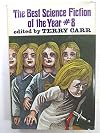
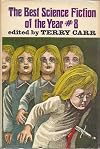
To my mind, the very best “Annual Best of…” series for science fiction was that edited by Donald A. Wollheim. The last of the series was published at the end of the 80s (he passed away in 1990), so you can see my search to find a suitable replacement has been going on for a very long time.
I have yet to find such a replacement.
And, with that as background, I stumbled across this collection at the used book store. Yes, 1978 was a long time ago. However, Terry Carr has always been interesting. (Don’t think so? Have you seen the collections he edited in his Universe books?) So, I decided to give it a go.
To be honest, I was surprised by how mundane many of the stories were. Based on my previous experiences with Carr’s editing work show more (see the Universe comment above) I expected something very different. What I got, at least for the first few stories (and, actually, throughout most of the collection), was quite…well, my first word choice was the right one…mundane. Oh, it wasn’t that the stories were bad. No, they were perfectly serviceable. It is just that I have trouble believing they were, indeed, the best. Not until I got to Ian Watson’s “The Very Slow Time Machine” (one I recall reading years ago where current viewers watch a man travel back in time) did I really care. Some more forgettable reading, then Harlan Ellison’s “Count the Clock that Tells the Time” and Joan Vinge’s “View from a Height”. (If you are a science fiction fan, you already know about both of these.) Then a complete unknown (to me), Hilbert Schenck’s “The Morphology of the Kirkham Wreck” in which powers struggle to keep the flow of time steady. And then into another I didn’t remember, but was excellent – Thomas Disch’s “The Man Who Had No Idea” in which licenses are needed before you can actually converse with other people.
The stories I have listed above are good, but a collection of the year’s best should have much more going for it than five stories. I wondered if it was Carr or it was just a bad year. I looked up the awards for the year (Hugo/Nebula), and, to be honest, there wasn’t much there to recommend the year (and it included some that Carr included.)
So, I went to Wollheim for that year. And there wasn’t a single story duplicated. There was Frank Herbert and Ursula K. LeGuin and Gregory Benford and John Varley and C. J. Cherryh and Jack Chalker and F. M. Busby and James Tiptree, Jr. I recognize a couple of the titles (been a long time since I read this particular collection) so I can do little more than quote the pedigrees. But that alone is the proof of why I keep looking, 20 plus years later, for a worthy successor. show less
I have yet to find such a replacement.
And, with that as background, I stumbled across this collection at the used book store. Yes, 1978 was a long time ago. However, Terry Carr has always been interesting. (Don’t think so? Have you seen the collections he edited in his Universe books?) So, I decided to give it a go.
To be honest, I was surprised by how mundane many of the stories were. Based on my previous experiences with Carr’s editing work show more (see the Universe comment above) I expected something very different. What I got, at least for the first few stories (and, actually, throughout most of the collection), was quite…well, my first word choice was the right one…mundane. Oh, it wasn’t that the stories were bad. No, they were perfectly serviceable. It is just that I have trouble believing they were, indeed, the best. Not until I got to Ian Watson’s “The Very Slow Time Machine” (one I recall reading years ago where current viewers watch a man travel back in time) did I really care. Some more forgettable reading, then Harlan Ellison’s “Count the Clock that Tells the Time” and Joan Vinge’s “View from a Height”. (If you are a science fiction fan, you already know about both of these.) Then a complete unknown (to me), Hilbert Schenck’s “The Morphology of the Kirkham Wreck” in which powers struggle to keep the flow of time steady. And then into another I didn’t remember, but was excellent – Thomas Disch’s “The Man Who Had No Idea” in which licenses are needed before you can actually converse with other people.
The stories I have listed above are good, but a collection of the year’s best should have much more going for it than five stories. I wondered if it was Carr or it was just a bad year. I looked up the awards for the year (Hugo/Nebula), and, to be honest, there wasn’t much there to recommend the year (and it included some that Carr included.)
So, I went to Wollheim for that year. And there wasn’t a single story duplicated. There was Frank Herbert and Ursula K. LeGuin and Gregory Benford and John Varley and C. J. Cherryh and Jack Chalker and F. M. Busby and James Tiptree, Jr. I recognize a couple of the titles (been a long time since I read this particular collection) so I can do little more than quote the pedigrees. But that alone is the proof of why I keep looking, 20 plus years later, for a worthy successor. show less
Ratings
Members
- Recently Added By
Author Information

All Editions
Some Editions
Series

Belongs to Publisher Series
Science Fiction Book Club (3355)
Work Relationships
Contains
Common Knowledge
- Canonical title
- The Best Science Fiction of the Year #8
Classifications
- Genres
- Fiction and Literature, Science Fiction
- DDC/MDS
- 813.0876 — Literature & rhetoric American literature in English American fiction in English By type Genre fiction Adventure fiction Speculative fiction
- LCC
- PS648 .S3 — Language and Literature American literature American literature Collections of American literature Prose (General)
Statistics
- Members
- 217
- Popularity
- 150,819
- Reviews
- 3
- Rating
- (3.58)
- Languages
- Dutch, English
- Media
- Paper
- ISBNs
- 3
- ASINs
- 4