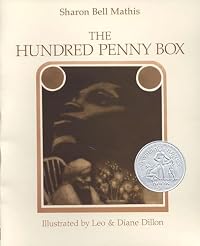
The Hundred Penny Box
by Sharon Bell Mathis
On This Page
Description
Michael's love for his great-great-aunt who lives with them leads him to intercede with his mother who wants to toss out all her old things.Tags
Recommendations







































Member Reviews
A poignant story about a boy and his great aunt, and the power of memory, family, and loss and oppression. Three generations of African Americans are living under one roof after Michael's parents take in Aunt Dew, his father's aunt. Aunt Dew raised Michael's father after the tragic early death of his parents, and she is almost as much a mother as she is a grandmother to Michael. Now she is too infirm to care for herself, so the family has moved her to their house so Michael's mother can tend to Aunt Dew. Unfortunately, his mother and his aunt don't mix well. His mother doesn't understand Aunt Dew's sadness, her frustration at not being able to take care of herself, and thinks that Aunt Dew dislikes her. Most importantly, Michael's show more mother doesn't understand the hundred penny box.
Aunt Dew began her collection when her husband gave her thirty-one pennies on her birthday, to represent each year of her life. From then on, Aunt Dew's husband or she herself added one new penny to her box on each birthday, and as Michael pulls them from the box, she can recount the significant events connected to that year and that penny. The hundred penny box is the secret to Aunt Dew's very identity, but Michael's mom doesn't know that. She wants to get rid of the box and replace it with a new, smaller one. Michael can't bear letting that happen. He will do anything to save the box, even defy his parents and hide it.
The book doesn't give us resolution on the fate of the penny box. Rather, it ends with Michael comforting a tearful Aunt Dew in her room, after his mother forced her to take a nap. He lays his head on her chest and listens to her sing her favorite song. The ending shows that the importance of the book isn't about the box, after all, but the relationship between Michael and his aunt. The old traditions and history are thus passed across the generations, through Michael's devotion and his aunt's stories. For such a small story, it holds a great deal of complexity. Michael's mother is a good woman, and has some valid points about pulling Aunt Dew into the future, because she is clutching the past. Yet she doesn't really understand the old woman. Michael is just a child, and truly naive about the situation, but he possesses a wisdom his mother does not. The characters and their relationships realistically depict how our relations to others can be both messy and deeply affectionate. Subtle messages about oppression and how the world has changed for African Americans are reflected in Aunt Dew's personal history. This is an intimate story, that teaches children about the universal dynamics of family and a particular moment in our history. The book allows readers to come to their own conclusions about the fate of the penny box. The story is well worth reading and discussing. show less
Aunt Dew began her collection when her husband gave her thirty-one pennies on her birthday, to represent each year of her life. From then on, Aunt Dew's husband or she herself added one new penny to her box on each birthday, and as Michael pulls them from the box, she can recount the significant events connected to that year and that penny. The hundred penny box is the secret to Aunt Dew's very identity, but Michael's mom doesn't know that. She wants to get rid of the box and replace it with a new, smaller one. Michael can't bear letting that happen. He will do anything to save the box, even defy his parents and hide it.
The book doesn't give us resolution on the fate of the penny box. Rather, it ends with Michael comforting a tearful Aunt Dew in her room, after his mother forced her to take a nap. He lays his head on her chest and listens to her sing her favorite song. The ending shows that the importance of the book isn't about the box, after all, but the relationship between Michael and his aunt. The old traditions and history are thus passed across the generations, through Michael's devotion and his aunt's stories. For such a small story, it holds a great deal of complexity. Michael's mother is a good woman, and has some valid points about pulling Aunt Dew into the future, because she is clutching the past. Yet she doesn't really understand the old woman. Michael is just a child, and truly naive about the situation, but he possesses a wisdom his mother does not. The characters and their relationships realistically depict how our relations to others can be both messy and deeply affectionate. Subtle messages about oppression and how the world has changed for African Americans are reflected in Aunt Dew's personal history. This is an intimate story, that teaches children about the universal dynamics of family and a particular moment in our history. The book allows readers to come to their own conclusions about the fate of the penny box. The story is well worth reading and discussing. show less
Destined to be one of my favorite Newbery books, this small book is quite remarkable.
It is a poignant tale of aging and the lessons passed along to those who want to learn.
When Michael's Great Aunt Dew comes to live with his family, he is drawn to the 100 year old woman who seems at times forgetful and other instances spot on with her observations.
Increasingly spending time with her nets a plethora of knowledge for Michael as systematically he and his Great Aunt play a game with her most precious possession -- a box of 100 pennies.
As Michael counts the pennies, a story results for each year a penny was added. Weaving wonderful tales, Aunt Dew shares a history rich in value and tradition. Michael grows to love his Aunt deeply.
While the show more tension between his mother and his Great Aunt mounts, Michael realizes his mother wants to thrown away the 100 penny box. Desperately trying to make his mother appreciate the history and the significance of Aunt Dew's memories becomes quite a task for Michael.
The writing is wonderful and the images of Michael and his Aunt are as precious as the 100 penny box.
Highly recommended. show less
It is a poignant tale of aging and the lessons passed along to those who want to learn.
When Michael's Great Aunt Dew comes to live with his family, he is drawn to the 100 year old woman who seems at times forgetful and other instances spot on with her observations.
Increasingly spending time with her nets a plethora of knowledge for Michael as systematically he and his Great Aunt play a game with her most precious possession -- a box of 100 pennies.
As Michael counts the pennies, a story results for each year a penny was added. Weaving wonderful tales, Aunt Dew shares a history rich in value and tradition. Michael grows to love his Aunt deeply.
While the show more tension between his mother and his Great Aunt mounts, Michael realizes his mother wants to thrown away the 100 penny box. Desperately trying to make his mother appreciate the history and the significance of Aunt Dew's memories becomes quite a task for Michael.
The writing is wonderful and the images of Michael and his Aunt are as precious as the 100 penny box.
Highly recommended. show less
Mathis, S.B., Dillon, L, & Dillon, D. (1975). The hundred penny box. New York: The Viking Press.
Grades 3 through 5
Tensions have been running high at Michael’s home. Since his great-great-aunt came to live with the family, his mother has been upset. Aunt Dew raised John, Michael’s brother, when his parents died. Now, Aunt Dew needs someone to look after her; John moved her from Atlanta to live with the family. Ruth, Michael’s mother, is having a hard time adjusting to the change. Her relationship with Aunt Dew is difficult. The old woman is cold and distant toward Ruth, and Ruth infantilizes the old woman. Michael is caught in the middle. He is fascinated by Aunt Dew’s penny box, where the old woman has kept a penny for each year show more of her life. Each penny is a story, and whenever Aunt Dew is willing to share, Michael spends hours with her, attentively listening to each word she has to say. Ruth believes the box is nothing more than something old and useless; she plans on getting rid of it. Ruth does not know that the box is dear to Aunt Dew, who sees the box as her own self. Only Michael knows how much the old woman cherishes the box, and he does his best to protect it from his mother. Unable to convince his mother not to destroy the box, the boy consoles his great-great-aunt as she cries herself to sleep.
Winner of a Newbery Honor, The hundred penny box is a very real portrayal of the difficulties that arise when different generations must share the same roof. Aunt Dew mourns leaving her home and her life, and she resents Ruth for treating her like a child. Ruth does her best to make sure that the old woman is well taken care of, but she takes away her independence and choice. Michael is caught in the middle, the only one if the family who truly knows how Aunt Dew feels. The box is a symbol of Aunt Dew’s life and a repository of her memories. Like the old woman, the box is old and weathered. From the outside, it looks useless, but inside it keeps the essence of what makes the old woman who she is. Some may consider the story too dark and depressing, but a closer look will uncover a beautiful story of generations coming together through the power of storytelling. The characters are realistic and compelling despite their flaws. The illustrations in coppery tones help develop the mood of the story—dark as well as dreamy, as with something worn out by age. The book shows readers that memories help make us who we are, and if we lose them, we lose our identity. This is a great book to spark discussions about family, aging, generation clashes, and tolerance. show less
Grades 3 through 5
Tensions have been running high at Michael’s home. Since his great-great-aunt came to live with the family, his mother has been upset. Aunt Dew raised John, Michael’s brother, when his parents died. Now, Aunt Dew needs someone to look after her; John moved her from Atlanta to live with the family. Ruth, Michael’s mother, is having a hard time adjusting to the change. Her relationship with Aunt Dew is difficult. The old woman is cold and distant toward Ruth, and Ruth infantilizes the old woman. Michael is caught in the middle. He is fascinated by Aunt Dew’s penny box, where the old woman has kept a penny for each year show more of her life. Each penny is a story, and whenever Aunt Dew is willing to share, Michael spends hours with her, attentively listening to each word she has to say. Ruth believes the box is nothing more than something old and useless; she plans on getting rid of it. Ruth does not know that the box is dear to Aunt Dew, who sees the box as her own self. Only Michael knows how much the old woman cherishes the box, and he does his best to protect it from his mother. Unable to convince his mother not to destroy the box, the boy consoles his great-great-aunt as she cries herself to sleep.
Winner of a Newbery Honor, The hundred penny box is a very real portrayal of the difficulties that arise when different generations must share the same roof. Aunt Dew mourns leaving her home and her life, and she resents Ruth for treating her like a child. Ruth does her best to make sure that the old woman is well taken care of, but she takes away her independence and choice. Michael is caught in the middle, the only one if the family who truly knows how Aunt Dew feels. The box is a symbol of Aunt Dew’s life and a repository of her memories. Like the old woman, the box is old and weathered. From the outside, it looks useless, but inside it keeps the essence of what makes the old woman who she is. Some may consider the story too dark and depressing, but a closer look will uncover a beautiful story of generations coming together through the power of storytelling. The characters are realistic and compelling despite their flaws. The illustrations in coppery tones help develop the mood of the story—dark as well as dreamy, as with something worn out by age. The book shows readers that memories help make us who we are, and if we lose them, we lose our identity. This is a great book to spark discussions about family, aging, generation clashes, and tolerance. show less
Michael loves his great-great-aunt Dew, even if she can't always remember his name. He especially
loves to spend time with her and her beloved hundred penny box, listening to stories about each of
the hundred years of her life. Michael's mother wants to throw out the battered old box that holds the pennies, but
Michael understands that the box itself is as important to Aunt Dew as the memories it contains
loves to spend time with her and her beloved hundred penny box, listening to stories about each of
the hundred years of her life. Michael's mother wants to throw out the battered old box that holds the pennies, but
Michael understands that the box itself is as important to Aunt Dew as the memories it contains
Michael's great-aunt Dew is one hundred years old, and has a box in which she keeps pennies - one for every year of her life. Michael's mother wants to get rid of it, but Michael realizes the importance of the memories that make Aunt Dew the special woman she is.
This is more of a short story than a picture book. It is 47 pages long, and heavier on text than illustration. The illustrations are sepia-toned and quite striking; I kept thinking this sort of story would have been perfect during my early elementary years, that transition between books with pictures on every page and chapter books with almost none at all. Though it is short, this is a well-told story with characters that you really sympathize with. Even Michael's mother, Ruth, show more though she wants to discard the box, has taken her husband's aunt in and wants what is best for her, even if she and Michael (and Aunt Dew herself) don't agree on what "best" is. show less
This is more of a short story than a picture book. It is 47 pages long, and heavier on text than illustration. The illustrations are sepia-toned and quite striking; I kept thinking this sort of story would have been perfect during my early elementary years, that transition between books with pictures on every page and chapter books with almost none at all. Though it is short, this is a well-told story with characters that you really sympathize with. Even Michael's mother, Ruth, show more though she wants to discard the box, has taken her husband's aunt in and wants what is best for her, even if she and Michael (and Aunt Dew herself) don't agree on what "best" is. show less
A glimpse into the relationship between a young boy and his great-great aunt, and the tense emotions that come when an older family member comes to live with her descendents.
I wanted to like this one more than I did. I appreciate the care with which the relationship between boy and aunt is crafted, but the story is too staid for me, and the ending is more frustrating than poetic.
I wanted to like this one more than I did. I appreciate the care with which the relationship between boy and aunt is crafted, but the story is too staid for me, and the ending is more frustrating than poetic.
Mathis puts an enormous amount of depth and emotion into this small book, exploring the relationship of a young child with an elderly grandmother. I'd probably make this required reading in a child's life at some point.
Members
- Recently Added By
Lists

Best Newbery Honor Books
241 works; 31 members

CCE 1000 Good Books List
1,033 works; 12 members

4th Grade Books
312 works; 5 members

Newbery Honor Books By Year - I - 1922-1980
199 works; 3 members

Swinging Seventies
255 works; 18 members

Books Read in 2023
5,547 works; 145 members
Author Information

10+ Works 2,897 Members
All Editions
Awards and Honors
Awards
Common Knowledge
- Canonical title
- The Hundred Penny Box
- Original publication date
- 1975
- People/Characters
- Dewbet Thomas; Michael John Jefferson; Ruth; John
- Dedication
- In memory of my maternal grandparents: RICHARD FRAZIER, SR.--great Black patriarch and the woman he loved--his wife, MARY FRAZIER. This book is also for my brother: JOHN W. BELL
- First words
- Michael sat down on the bed that used to be his and watched his great-great- aunt, Aunt Dew, rocking in the rocking chair.
- Quotations
- "Leave my hundred penny box right alone. Anybody takes my hundred penny box takes me!"
- Last words
- (Click to show. Warning: May contain spoilers.)Michael put his head on Aunt Dew's thin chest beneath the heavy quilt and listened to her sing her long song.
Classifications
Statistics
- Members
- 2,156
- Popularity
- 9,397
- Reviews
- 32
- Rating
- (3.70)
- Languages
- English, Italian
- Media
- Paper
- ISBNs
- 20
- ASINs
- 9