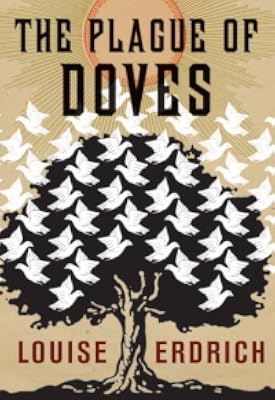
On This Page
Description
The unsolved murder of a farm family haunts the small, white, off-reservation town of Pluto, North Dakota. The vengeance exacted for this crime and the subsequent distortions of truth transform the lives of Ojibwe living on the nearby reservation and shape the passions of both communities for the next generation.Tags
Recommendations





Member Recommendations
tangentialine I love how the structure is similar, but also how in both books there is attention to some key characters and a focus on racial tension and the heritage of the past. And the language is breathtakingly gorgeous in both books.
30
BookshelfMonstrosity If you want to read more about the characters and events portrayed in The Round House, read The Plague of Doves, which shares characters and events with the later novel.

Member Reviews
The Plague of Doves – Louise Eldritch
4 stars
Plague of Doves is multi-generational story about the lives of the citizens of Pluto, North Dakota.
In some ways the book is a series of short stories told in the individual voices of various characters. Each character tells of lives affected by a single horrific event; the unsolved murder of a farm family and its subsequent lynching. There are multiple storylines and it is difficult to follow the way in which each narrative is connected to all the others. Erdrich draws a complex picture of the growing ripple effect of this early tragedy through the intertwined lives of the Ojibwe and white members of this small community.
This is the second Erdrich book I’ve read and I think she’s become show more my favorite new discovery. Her characters live and breathe. There’s great richness in her description and metaphor. I love her comic timing.
The tragicomical brothers, Mooshum and Shamengwa, are like jesters in a Shakespearean play. There are so many layers in her writing that I want to go back to the beginning and read it again. Once I read it again to clear up references that I just didn’t get the first time around, I’ll probably want to add the last star to my rating. show less
4 stars
Plague of Doves is multi-generational story about the lives of the citizens of Pluto, North Dakota.
In some ways the book is a series of short stories told in the individual voices of various characters. Each character tells of lives affected by a single horrific event; the unsolved murder of a farm family and its subsequent lynching. There are multiple storylines and it is difficult to follow the way in which each narrative is connected to all the others. Erdrich draws a complex picture of the growing ripple effect of this early tragedy through the intertwined lives of the Ojibwe and white members of this small community.
This is the second Erdrich book I’ve read and I think she’s become show more my favorite new discovery. Her characters live and breathe. There’s great richness in her description and metaphor. I love her comic timing.
The tragicomical brothers, Mooshum and Shamengwa, are like jesters in a Shakespearean play. There are so many layers in her writing that I want to go back to the beginning and read it again. Once I read it again to clear up references that I just didn’t get the first time around, I’ll probably want to add the last star to my rating. show less
While I generally avoid "multi-generational sagas," I do admire the work of Louise Erdrich, so when I saw this one in the local thrift store, I grabbed it. And THE PLAGUE OF DOVES (2008) did not disappoint, although I'll admit sometimes being confused over who was related to whom at various times, especially when the chapters and characters leapt back and forth in times and settings. The novel opens with a gruesome, bloody mass murder near a North Dakota reservation, and it takes most of the three hundred-plus pages to discover whodunit and who survived. But the characters rule here, and there are plenty of them, beginning with young Evelina Milk, and her grandfather and great-uncle, Mooshum and Shamengwa, Ojibwe elders. And there is show more Billy Peace, a darkly sinister charismatic who grows up to found a cult and a commune. And Antone Bazil Coutts, a grave digger who carries on a longtime affair with an older, married woman before studying law and becoming a lawyer and judge specializing in tribal law. These are only a few of the fascinating denizens of Pluto, ND, and the nearby rez who populate the pages in a page-turning story of perseverance, murder and heartache that spans generations. This is Louise Erdrich at the peak of her storytelling powers. Very highly recommended.
- Tim Bazzett, author of the memoir, BOOKLOVER show less
- Tim Bazzett, author of the memoir, BOOKLOVER show less
This novel tells the story of several North Dakota families, mostly Native American, whose lives intersect because of a racially-motivated murder in the distant past. Louise Erdrich introduces multiple narrators, each with their own limited and biased point of view. While the story unfolds over multiple generations, the narrative is not chronological and time passes without specific references to anchor the story. This slow reveal feels similar to working a jigsaw puzzle as the reader figures out who is related to whom, and the overall sequence of events.
The novel is not a “whodunnit,” focusing instead on the murder’s ripple effect through subsequent generations. Some of those effects are well known in the community, and some are show more closely guarded secrets which come to light by the end of the novel. Coupled with Erdrich’s typically colorful cast of characters, this makes for great reading. show less
The novel is not a “whodunnit,” focusing instead on the murder’s ripple effect through subsequent generations. Some of those effects are well known in the community, and some are show more closely guarded secrets which come to light by the end of the novel. Coupled with Erdrich’s typically colorful cast of characters, this makes for great reading. show less
A horrific crime affects many in the small town of Pluto, North Dakota: first the murder of a family and second the murder of a group of Ojibwa accused of the crime. Now, as Evelina and her brother grow up and hear the story from their grandfather, a generation or two later families of the perpetrators and victims intertwine and are all affected, in some way, with the aftermath.
Told in multiple perspectives and covering several years - not counting the stories we're told of a generation or two ago - this is a complex read and one I would reread with a pen in hand to tease out the chronology and genealogy of various characters. It's thought-provoking, excellent storytelling.
Told in multiple perspectives and covering several years - not counting the stories we're told of a generation or two ago - this is a complex read and one I would reread with a pen in hand to tease out the chronology and genealogy of various characters. It's thought-provoking, excellent storytelling.
This is the sort of book that demands a second reading. I am still gripped in the dizzying intricacies of the intertwining family legacies and coiling generations, for the story isn't really about the people of Pluto, ND, but about the myriad lives and souls that have graced the earth throughout all of time. There is something of the epic in her story, even though it is set in a small and rather unremarkable town, and does not directly interfere with the history of our relatively young country. So much of the book stands as a metaphor for so much else.
In a Faulkner-esque way, Erdrich employs the voices of several primary narrators to carry her story forward. Though some of the narrators seem to have only a bit part, and though some of show more their personal stories never seem to arrive at completeness, their different perspectives help the reader to piece together the puzzle of the past. We read knowing all the while that the town is dying, and the storytellers are dying. If we are going to get an answer to the mystery presented at the beginning of the story -- who killed five members of the Lochren family? everyone knows it wasn't the three Indians who were hanged for the crime -- it will have to happen soon. Erdrich makes us wait until the final pages of the novel to find out, and the secret nearly dies with the teller. The story ends with an overwhelming sense of the fragility of real history.
Perhaps, though, even without resolution to the mystery the story would still retain its impact. Each character plays a role that seems to be determined by his/her part in a larger family narrative, and a larger town narrative beyond that. Their lives are inextricably linked, and the characters cannot help but follow the path they see before them (regardless of how aware or unaware of that path they may be). One hears in Erdrich's narrative an echo of the despondency and fatality of "One Hundred Years of Solitude," in which the characters' lives are no less entwined and predetermined. Perhaps this is Erdrich's perception of the human condition -- or perhaps this sort of thing only happens in small towns where everyone knows everyone else. Regardless, the message is compelling.
On top of all this literary richness is Erdrich's elegant, breathtaking prose. Little attention is given to landscape or physical descriptions, but some of her short, clipped sentences more than compensate. "This deep thing had to do with the fiddle" (p. 202). "The dead of Pluto now outnumber the living" (p. 295). So much said in so few words -- a skill possessed by precious few writers. Even more compelling is her ability to shift narrative voice so adroitly. While this makes an initial reading somewhat jarring, Erdrich masterfully gives voice to characters of different ages, races, and generations, and brings to life the various inhabitants of her story. A first reading might be a bit confusing, but a second reading should reveal the depth of narrative and relationships that makes this book so much worth the read. show less
In a Faulkner-esque way, Erdrich employs the voices of several primary narrators to carry her story forward. Though some of the narrators seem to have only a bit part, and though some of show more their personal stories never seem to arrive at completeness, their different perspectives help the reader to piece together the puzzle of the past. We read knowing all the while that the town is dying, and the storytellers are dying. If we are going to get an answer to the mystery presented at the beginning of the story -- who killed five members of the Lochren family? everyone knows it wasn't the three Indians who were hanged for the crime -- it will have to happen soon. Erdrich makes us wait until the final pages of the novel to find out, and the secret nearly dies with the teller. The story ends with an overwhelming sense of the fragility of real history.
Perhaps, though, even without resolution to the mystery the story would still retain its impact. Each character plays a role that seems to be determined by his/her part in a larger family narrative, and a larger town narrative beyond that. Their lives are inextricably linked, and the characters cannot help but follow the path they see before them (regardless of how aware or unaware of that path they may be). One hears in Erdrich's narrative an echo of the despondency and fatality of "One Hundred Years of Solitude," in which the characters' lives are no less entwined and predetermined. Perhaps this is Erdrich's perception of the human condition -- or perhaps this sort of thing only happens in small towns where everyone knows everyone else. Regardless, the message is compelling.
On top of all this literary richness is Erdrich's elegant, breathtaking prose. Little attention is given to landscape or physical descriptions, but some of her short, clipped sentences more than compensate. "This deep thing had to do with the fiddle" (p. 202). "The dead of Pluto now outnumber the living" (p. 295). So much said in so few words -- a skill possessed by precious few writers. Even more compelling is her ability to shift narrative voice so adroitly. While this makes an initial reading somewhat jarring, Erdrich masterfully gives voice to characters of different ages, races, and generations, and brings to life the various inhabitants of her story. A first reading might be a bit confusing, but a second reading should reveal the depth of narrative and relationships that makes this book so much worth the read. show less
The violent murder of a family in the North Dakota plains brings out the worst in a small community and affects its residents for generations to come. The murders lead the community to accuse and lynch local Native Americans in an attempt to serve their own brand of wild justice.
The story is told from multiple narrators; including Evelina Harp, Judge Antone Bazil Coutts, Doctor Cordelia Lochren and Marn Wolde. It touches on racism, religion, snake charming, kidnapping, murder, bullying, and more. The scope of the novel and the disjointed style make keeping the characters and timeline straight incredibly hard. Evelina hears about many of the events second hand through her grandpa Mooshum’s tales.
Marn Wolde's character was one of the show more most interesting to me. She provides a unique religious perspective. Most of the characters deal with conflicts between their Native American spirituality and the idea of assimilating into Catholicism. However, Marn's husband, Billy Peace, is a religious fanatic and her view of religion is tainted by Billy’s controlling nature.
My main problem with the novel lies in the structure. It jumps in time and point-of-view and is sometimes hard to follow. I felt like as soon as I had a chance to get to know a character a little bit and be interested in their story, we’d move to a different decade and a different person and I had to start all over again.
BOTTOM LINE: It just wasn’t for me, but I’ve heard loads of praise for it. I would be willing to try another book by Erdrich, but I won’t be recommending this to anyone else. show less
The story is told from multiple narrators; including Evelina Harp, Judge Antone Bazil Coutts, Doctor Cordelia Lochren and Marn Wolde. It touches on racism, religion, snake charming, kidnapping, murder, bullying, and more. The scope of the novel and the disjointed style make keeping the characters and timeline straight incredibly hard. Evelina hears about many of the events second hand through her grandpa Mooshum’s tales.
Marn Wolde's character was one of the show more most interesting to me. She provides a unique religious perspective. Most of the characters deal with conflicts between their Native American spirituality and the idea of assimilating into Catholicism. However, Marn's husband, Billy Peace, is a religious fanatic and her view of religion is tainted by Billy’s controlling nature.
My main problem with the novel lies in the structure. It jumps in time and point-of-view and is sometimes hard to follow. I felt like as soon as I had a chance to get to know a character a little bit and be interested in their story, we’d move to a different decade and a different person and I had to start all over again.
BOTTOM LINE: It just wasn’t for me, but I’ve heard loads of praise for it. I would be willing to try another book by Erdrich, but I won’t be recommending this to anyone else. show less
The Plague of Doves by Louise Erdrich
"Nothing that happens, nothing, is not connected here by blood." So says Judge Antone Bazil Coutts, one of four narrators of Louise Erdrich's [The Plague of Doves], which is set in and around Pluto, North Dakota, an all-white town on the edge of an Indian reservation,
At the center of this tale, is an episode of "rough justice" following the brutal murders of almost an entire farm family. It happened in the early years of the twentieth century. The only survivor was an infant; her parents, sister, and two brothers were shot-gunned.
The murders were discovered by four Ojibwe Indians, drawn to the bawling of the family's cows, which hadn't been milked for several days and thus were suffering. They show more milked the cows, feeding the infant in the process. Knowing they would be accused of the crime, they left the baby in her crib and vanished, but one did, in the dead of night, leave a note in the sheriff's mailbox. In short order, the crime was discovered by the whites, and somehow the Indians quickly were rounded up. Seized from the sheriff's custody by the white community's bully-boys, they were lynched.
The story is told decades after the fact to Evelina Harp, another of the narrators, by Mooshum Milk, her grandfather. Mooshum is a full-blooded Ojibwa. As it happens, he was one of the four Indians hanged. The men who lynched them, however, didn't allow him to die.
Evelina is gobsmacked. Her mother, Moosum's daughter, and her father, the son of a local (failed) banker, have heard the story before, indeed they tried to dissuade its recital on this occasion. Evelina explains:
The story Mooshum told us had its repercussions—the first being that I could not look at anyone in quite the same way anymore. I became obsessed with lineage. As I came to the end of my small leopard-print diary…I wrote down as much of Mooshum's story as I could remember, and then the relatives of everyone I knew—parents, grandparents, way on back in time. I traced the blood history of the murders through my classmates and friends until I could draw out elaborate spider webs of lines and intersecting circles. I drew in pencil. There were a few people, one of them being Corwin Peace, whose chart was so complicated that I erased parts of it until I wore right through the paper. Still, I could not erase the questions underneath, and Mooshum was no help. He bore interrogation with a vexed wince and silence. I persisted, kept on asking for details, but answered in evasions, to get rid of me. He never spoke with the direct fluidity of that first telling. His medicine bottle, confiscated by our mother, had held whisky. No one knew from what source. She'd never get him to stop. I still loved Mooshum, of course, but with this tale something in my regard of him was disturbed, as if I'd stepped into a clear stream and silt had billowed up around my feet.
As the book progresses, Judge Coutts recounts the mid-winter expedition that sited Pluto, a brutal trek made by his grandfather and four local brothers, the Buckendorfs, led by two Ojibwas, Henri and Lafayette Peace. In time, the younger brother of Henri and Lafayette, Cuthbert Peace would be lynched by Emil Buckendorf (and others). And Sister Mary Anita Buckendorf, Evelina's elementary school teacher and grandaughter of Emil, will acknowledge that Mooshum was hanged, but not to kill him. "Yes, my dear," Mary Anita says. "Wildstrand cut him down at the last moment, yes…{T}hey never meant to hang him all the way. They wanted to terrify him, to intimidate him. A false hanging will do that."
Ultimately, the mystery is solved. It's an elaborate, multigenerational spider web. As the Judge pointed out: "Nothing that happens, nothing, is not connected here by blood."
Did I like it? Of course. Both thumbs up. show less
"Nothing that happens, nothing, is not connected here by blood." So says Judge Antone Bazil Coutts, one of four narrators of Louise Erdrich's [The Plague of Doves], which is set in and around Pluto, North Dakota, an all-white town on the edge of an Indian reservation,
At the center of this tale, is an episode of "rough justice" following the brutal murders of almost an entire farm family. It happened in the early years of the twentieth century. The only survivor was an infant; her parents, sister, and two brothers were shot-gunned.
The murders were discovered by four Ojibwe Indians, drawn to the bawling of the family's cows, which hadn't been milked for several days and thus were suffering. They show more milked the cows, feeding the infant in the process. Knowing they would be accused of the crime, they left the baby in her crib and vanished, but one did, in the dead of night, leave a note in the sheriff's mailbox. In short order, the crime was discovered by the whites, and somehow the Indians quickly were rounded up. Seized from the sheriff's custody by the white community's bully-boys, they were lynched.
The story is told decades after the fact to Evelina Harp, another of the narrators, by Mooshum Milk, her grandfather. Mooshum is a full-blooded Ojibwa. As it happens, he was one of the four Indians hanged. The men who lynched them, however, didn't allow him to die.
Evelina is gobsmacked. Her mother, Moosum's daughter, and her father, the son of a local (failed) banker, have heard the story before, indeed they tried to dissuade its recital on this occasion. Evelina explains:
The story Mooshum told us had its repercussions—the first being that I could not look at anyone in quite the same way anymore. I became obsessed with lineage. As I came to the end of my small leopard-print diary…I wrote down as much of Mooshum's story as I could remember, and then the relatives of everyone I knew—parents, grandparents, way on back in time. I traced the blood history of the murders through my classmates and friends until I could draw out elaborate spider webs of lines and intersecting circles. I drew in pencil. There were a few people, one of them being Corwin Peace, whose chart was so complicated that I erased parts of it until I wore right through the paper. Still, I could not erase the questions underneath, and Mooshum was no help. He bore interrogation with a vexed wince and silence. I persisted, kept on asking for details, but answered in evasions, to get rid of me. He never spoke with the direct fluidity of that first telling. His medicine bottle, confiscated by our mother, had held whisky. No one knew from what source. She'd never get him to stop. I still loved Mooshum, of course, but with this tale something in my regard of him was disturbed, as if I'd stepped into a clear stream and silt had billowed up around my feet.
As the book progresses, Judge Coutts recounts the mid-winter expedition that sited Pluto, a brutal trek made by his grandfather and four local brothers, the Buckendorfs, led by two Ojibwas, Henri and Lafayette Peace. In time, the younger brother of Henri and Lafayette, Cuthbert Peace would be lynched by Emil Buckendorf (and others). And Sister Mary Anita Buckendorf, Evelina's elementary school teacher and grandaughter of Emil, will acknowledge that Mooshum was hanged, but not to kill him. "Yes, my dear," Mary Anita says. "Wildstrand cut him down at the last moment, yes…{T}hey never meant to hang him all the way. They wanted to terrify him, to intimidate him. A false hanging will do that."
Ultimately, the mystery is solved. It's an elaborate, multigenerational spider web. As the Judge pointed out: "Nothing that happens, nothing, is not connected here by blood."
Did I like it? Of course. Both thumbs up. show less
Members
- Recently Added By
Published Reviews
Writing in prose that combines the magical sleight of hand of Gabriel García Márquez with the earthy, American rhythms of Faulkner, Ms. Erdrich traces the connections between these characters and their many friends and relatives with sympathy, humor and the unsentimental ardor of a writer who sees that the tragedy and comedy in her people’s lives are ineluctably commingled. Whereas some of show more her recent novels, like “Four Souls” (2004), have suffered from predictability and contrivance, her storytelling here is supple and assured, easily navigating the wavering line between a recognizable, psychological world and the more arcane world of legend and fable. . . . show less
added by climbingtree
Lists

Best 21st Century Books (So Far)
670 works; 86 members

Native American / Indigenous Literature
172 works; 100 members

Pulitzer Prize for Fiction - Finalists
88 works; 9 members

Books Set in North Dakota
8 works; 4 members

2008-2012 Notable Books for Adults
127 works; 10 members

Animals in the Title
498 works; 11 members

Favorite Romance Fiction
247 works; 115 members

2025 Reading List
51 works; 2 members

Library List - Pulitzer Adjacent
40 works; 1 member
Author Information

70+ Works 45,324 Members
Karen Louise Erdrich was born on June 7, 1954 in Little Falls, Minnesota. Erdrich grew up in Wahpeton, North Dakota, where both of her parents were employed by the Bureau of Indian Affairs. She is a member of the Turtle Mountain Band of Chippewa. Erdrich graduated from Dartmouth College in 1976 with an AB degree, and she received a Master of Arts show more in creative writing from Johns Hopkins University in 1979. Erdrich published a number of poems and short stories from 1978 to 1982. In 1981 she married author and anthropologist Michael Dorris, and together they published The World's Greatest Fisherman, which won the Nelson Algren Award in 1982. In 1984 she won the National Book Critics Circle Award for Love Medicine, which is an expansion of a story that she had co-written with Dorris. Love Medicine was also awarded the Virginia McCormick Scully Prize (1984), the Sue Kaufman Prize (1985) and the Los Angeles Times Award for best novel (1985). In addition to her prose, Erdrich has written several volumes of poetry, a textbook, children's books, and short stories and essays for popular magazines. She has been the recipient of numerous awards for professional excellence, including the National Magazine Fiction Award in 1983 and a first-prize O. Henry Award in 1987. Erdrich has also received the Pushcart Prize in Poetry, the Western Literacy Association Award, the 1999 World Fantasy Award, and the Scott O'Dell Award for Historical Fiction in 2006. In 2007 she refused to accept an honorary doctorate from the University of North Dakota in protest of its use of the "Fighting Sioux" name and logo. Erdrich's novel The Round House made the New York Times bestseller list in 2013. Her other New York Times bestsellers include Future Home of the Living God (2017). (Bowker Author Biography) show less
Some Editions
Awards and Honors
Awards
Distinctions
Notable Lists
Series

Belongs to Publisher Series
Work Relationships
Is contained in
Is a retelling of
Common Knowledge
- Canonical title
- The Plague of Doves
- Original title
- The plague of Doves
- Original publication date
- 2008
- People/Characters
- Evelina Harp; Antone Bazil Coutts; Geraldine Coutts; Marn Wolde; Billy Peace; Mooshum (show all 8); Neve Harp; Cordelia Lochren
- Important places
- Pluto, North Dakota, USA
- First words
- The gun jammed on the last shot and the baby stood holding the crib rail, eyes wild, bawling.
- Quotations
- Nothing that happens, nothing, is not connected here by blood.
But of course the entire reservation is rife with conflicting passions. We can't seem to keep our hands off one another, it is true, and every attempt to foil our lusts through laws and religious dictus seems bound instead to... (show all) excite transgression.
What men call adventures usually consist of the stoical endurance of appalling daily misery.
What doesn't happen in the heat of things? Someone has seized the moment to act on their own biases. That's it. Or history. Sometimes it is history.
I wrote down as much of Mooshum's story as I could remember, and then the relatives of everyone I knew--parents, grandparents, way on back in time. I traced the blood history of the murders through my classmates and friends u... (show all)ntil I could draw out elaborate spider webs of lines and intersecting circles. I drew in pencil. There were a few people, one of them being Corwin Peace, whose chart was so complicated that I erased parts of it until I wore right through the paper. Still, I could not erase the questions underneath, and Mooshum was no help. - Last words
- (Click to show. Warning: May contain spoilers.)I take my cane to feel the way, for the air is so black I think already we are invisible.
- Blurbers
- Roth, Philip
Classifications
- Genres
- Fiction and Literature, General Fiction, Historical Fiction, Mystery
- DDC/MDS
- 813.54 — Literature & rhetoric American literature in English American fiction in English 1900-1999 1945-1999
- LCC
- PS3555 .R42 .P55 — Language and Literature American literature American literature Individual authors 1961-
- BISAC
Statistics
- Members
- 2,420
- Popularity
- 8,055
- Reviews
- 94
- Rating
- (3.71)
- Languages
- 7 — Dutch, English, French, German, Italian, Korean, Spanish
- Media
- Paper, Audiobook, Ebook
- ISBNs
- 36
- ASINs
- 19