On This Page
Description
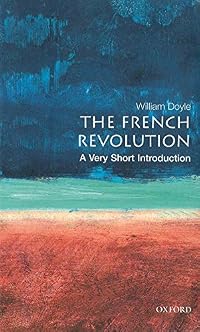
Beginning with a discussion of familiar images of the French Revolution, this work looks at how the ancien re?gime became ancien as well as examining cases in which achievement failed to match ambition.Tags
Recommendations




























Member Recommendations
Member Reviews
As an English historian, William Doyle goes head on into the topic by reminding how the French Revolution was perceived in Britain - from Burke and Carlyle, to Dickens and Orczy. It's a nice way to go in, as it sandwiches the book really well with its ending, where he rewinds the main academical controversies that has been fuelling its interpretation for the past few decades.
His retelling of such 'sustained period of uncertainty, disorder, and conflict, reverberating far beyond the borders of France' is fair. In fact, he can't help but deploying his views only in the concluding chapter, about the legacy of it all. It could have been done without referring to the Russian Revolution though, as much as I acknowledge the potential show more parallels and the fact, coincidental, that the Berlin wall fell two hundred years sharp after the fall of the Bastille.
All in all then, considering it's a vast and complex topic, here's a clear cut account which worth in its straight simplification of the raging controversies surrounding it. Recommended. show less
His retelling of such 'sustained period of uncertainty, disorder, and conflict, reverberating far beyond the borders of France' is fair. In fact, he can't help but deploying his views only in the concluding chapter, about the legacy of it all. It could have been done without referring to the Russian Revolution though, as much as I acknowledge the potential show more parallels and the fact, coincidental, that the Berlin wall fell two hundred years sharp after the fall of the Bastille.
All in all then, considering it's a vast and complex topic, here's a clear cut account which worth in its straight simplification of the raging controversies surrounding it. Recommended. show less
This small-format paperback is only 108 pages ("very short") but packs a wallop. The French Revolution is a hugely complex topic, not least because it remains to this day highly controversial, there are 100s of tomb-length books including the flood of books on the 200th anniversary in 1989. Where to start? Here. Doyle gives an overview of the basic events but that is not his main purpose. Rather his chapter titles explain: "Why it happened", "How it happened", "What it ended", "What it started" and "Where it stands." In other words, he uses historiography to put it into historical context. In the end the actual events are curious and interesting, but they were so confusing and full of contingencies that even contemporaries had trouble show more keeping track of what was happening around them. The bigger questions of Doyle's chapter titles provide a higher-level understanding that rises above the trees and gives an understanding that would take years of reading specialized books to arrive at. Doyle himself is well known for the Oxford history of the French Revolution, respected for its even-handed treatment, representing all sides and taking a neutral point of view. It can be read in an evening and the reader will come away with a clear understanding of why it's important and where the main axis of debate is today.
--Review by Stephen Balbach, via CoolReading (c) 2008 cc-by-nd show less
--Review by Stephen Balbach, via CoolReading (c) 2008 cc-by-nd show less
A clear, concise account of popular images of the French Revolution (Carlyle, Dickens, Orczy), what led to it, the events, the aftermath, and scholarship surrounding the bicentennial and afterwards.
Doyle provides a very compact and dense summary of the French Revolution. He summarizes the causes which started the revolution, the events which happened during the revolution, and the effects it caused, some of which have reverberated down to the modern day. The short chapters make the book easy to read in a few sittings, and the chapter titles give the reader the direction for the chapter (Why it happened, how it happened, what it ended, what it started). Doyle mentions all the key players, political parties, and the international incidents the revolution impacted.
Also included is a very detailed timeline, a note on the Revolutionary calendar, and a nice selection of suggestions for further reading. As always the Very Short show more Introductions pack a heavy punch in spite of their small size (this one is just 100 pages). show less
Also included is a very detailed timeline, a note on the Revolutionary calendar, and a nice selection of suggestions for further reading. As always the Very Short show more Introductions pack a heavy punch in spite of their small size (this one is just 100 pages). show less
Helpful book which aids in understanding the French Revolution.
Beginning with a discussion of familiar images of the French Revolution, garnered from Dickens, Baroness Orczy, and Tolstoy, as well as the legends of let them eat cake, and tricolours, Doyle leads the reader to the realization that we are still living with developments and consequences of the French Revolution such as decimalization, and the whole ideology of human rights. Continuing with a brief survey of the old regime and how it collapsed, Doyle continues to ellucidate how the revolution happened: why did the revolutionaries quarrel with the king, the church and the rest of Europe, why this produced Terror, and finally how it accomplished rule by a general. The revolution destroyed the age-old cultural, institutional and social show more structures in France and beyond. This book looks at how the ancien regime became ancien as well as examining cases in which achievement failed to match ambition. Doyle explores the legacy of the revolution in the form of rationality in public affairs and responsible government, and finishes his examination of the revolution with a discussion of why it has been so controversial. show less
Ratings
Members
- Recently Added By
Lists

Revolutions
72 works; 5 members
Author Information

21+ Works 1,982 Members
William Doyle is a writer and documentary producer whose previous book, Inside the Oval Office: The White House Tapes from FDR to Clinton, was a New York Times Notable Book. In 1998 he won the Writers Guild of America Award for Best TV Documentary for the A&E special "The Secret White House Tapes," which he cowrote and coproduced. He lives in New show more York City. (Bowker Author Biography) show less
Series

Common Knowledge
- Canonical title
- The French Revolution: A Very Short Introduction
- Original title
- The French Revolution: A Very Short Introduction
- Original publication date
- 2001
- People/Characters
- Napoleon Bonaparte; Louis XVI, King of France; Marie Antoinette; Jacques Necker; John Law; Charles Alexandre de Calonne (show all 14); Georges Jacques Danton; Jean-Paul Marat; Maximilien de Robespierre; Pope Pius VII; François Noël Babeuf; Filippo Michele Buonarroti; Louis XVIII; Charles X
- Important places
- France
- Important events
- French Revolution (1789-1799)
- First words
- 'Mr Worthing,' says Lady Bracknell in The Importance of Being Earnest (1895), 'I feel somewhat bewildered by what you have just told me.'
- Last words
- (Click to show. Warning: May contain spoilers.)'The truth', his friend replies, 'is rarely pure and never simple.'
- Original language
- English
Classifications
- Genres
- History, Nonfiction, General Nonfiction
- DDC/MDS
- 944.04 — History & geography History of Europe France and Monaco France Revolution 1789-1804
- LCC
- DC148 .D688 — History of Europe, Asia, Africa and Oceania France – Andorra – Monaco History of France Modern, 1515- Revolutionary and Napoleonic period, 1789-1815
- BISAC
Statistics
- Members
- 726
- Popularity
- 38,831
- Reviews
- 6
- Rating
- (3.64)
- Languages
- English
- Media
- Paper, Audiobook, Ebook
- ISBNs
- 12
- ASINs
- 3