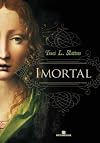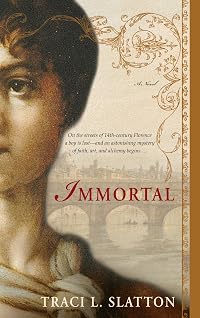
Immortal
by Traci L. Slatton 
On This Page
Description
In an age of wonderous beauty and terrible secrets, one man searches for his destiny... In the majestic heart of Florence, a beautiful golden-haired boy is abandoned and subjected to cruelty beyond words. But Luca Bastardo is anything but an ordinary boy. Across two centuries of passion and intrigue, Luca will discover an astonishing gift--one that will lead him to embrace the ancient mysteries of alchemy and healing and to become a trusted confidant to the powerful Medicis...even as he show more faces persecution from a sadistic cabal determined to wrest his secrets for themselves. But as the Black Death and the Inquisition wreak havoc on his beloved city, Luca's survival lies in the quest to solve two riddles. One is the enigma of his parents and his ageless beauty. The other is a choice between immortality and the only chance to find his one true love. As Luca journeys through the heights of the Renaissance, befriends Giotto and Leonardo Da Vinci--140 years apart--and pursues the most closely guarded secrets of religious faith and science for the answers to his own burning questions, his remarkable search will not only change him...but will change the course of history. show lessTags
Recommendations




Member Reviews
Summary: Luca Bastardo has seen - and been - it all: street urchin, child prostitute, gravedigger, alchemist, doctor, mercenary, and fisherman. Luca can take all of these roles, because he is not like other people... he ages at a fraction of the rate of other people, is immune to sickness, and is constantly surrounded by rumors of his parentage and by accusations of witchcraft, heresy, and sorcery. Still, he moves through early-Renaissance Florence as best as he is able, meeting and being influenced by the important artists, thinkers, and political figures of the times, searching for the one true love which he has been promised, and always trying to understand himself, his own existence, and the sort of God that would grant him such show more extended life in the midst of so much suffering and death.
Review: First of all, this book's strengths: Slatton does a fantastic job evoking fourteenth- and fifteenth-century Florence, from its slums, markets, and back alleys, to its gorgeous churches and the lush palazzos of its upper class. She also presents two hundred years of Florentine history in a more than palatable format, bringing historical figures and events to vivid life. Finally, there were segments of Luca's story that were intensely compelling and heartbreaking in their poignancy, and the pages just flew by, as I needed to know what would happen to Luca next.
However, I think this book's main problem is that it let its ambition get in the way of its story. This book wanted to be sweeping and epic, covering nearly two centuries of history, but its strongest bits were those with the narrowest focus and richest details - the years Luca spent in the brothel at the beginning, for example - while the sweeping passage of time and the foreshadowing of events to come were handled a little awkwardly. At times, especially towards the middle/end of the book, it felt as though every three pages Luca would briefly meet another famous historical person, who would impart some vague spiritual wisdom, and then disappear again - the historical fiction form of name-dropping, if you will.
I also thought the philosophical and religious aspects of this book were handled with a similar lack of subtlety. It's clear that the book aspires to have a deep philosophical level, as witnessed by the extensive discussions about art, alchemy, the nature of the self and of God. However, it's not the type of book where these ideas are suggested by the text and the reader is left to make their own interpretations and draw their own conclusions. Instead, Luca has made the conclusions for us and proceeds to lay them out, not really leaving a lot of room for discussion or dissension from the reader - a classic example of telling instead of showing. The ending, too, resolves the mystery of Luca's parentage in a similar way - the mystery is not really solved so much as flat-out explained, which makes it somewhat anticlimactic. In general, I think Immortal had all of the elements of a really good book, and it was still an enjoyable read, even with its flaws, but in the final analysis, it bit off a little more than it could chew, and just wound up getting in its own way. 3.5 out of 5 stars.
Recommendation: Fans of historical fiction should find this book enjoyable, if not necessarily world-shakingly phenomenal. I'll be looking forward to Slatton's future books - hopefully as she gains experience and confidence as an author, she'll also learn to trust her story to tell itself. show less
Review: First of all, this book's strengths: Slatton does a fantastic job evoking fourteenth- and fifteenth-century Florence, from its slums, markets, and back alleys, to its gorgeous churches and the lush palazzos of its upper class. She also presents two hundred years of Florentine history in a more than palatable format, bringing historical figures and events to vivid life. Finally, there were segments of Luca's story that were intensely compelling and heartbreaking in their poignancy, and the pages just flew by, as I needed to know what would happen to Luca next.
However, I think this book's main problem is that it let its ambition get in the way of its story. This book wanted to be sweeping and epic, covering nearly two centuries of history, but its strongest bits were those with the narrowest focus and richest details - the years Luca spent in the brothel at the beginning, for example - while the sweeping passage of time and the foreshadowing of events to come were handled a little awkwardly. At times, especially towards the middle/end of the book, it felt as though every three pages Luca would briefly meet another famous historical person, who would impart some vague spiritual wisdom, and then disappear again - the historical fiction form of name-dropping, if you will.
I also thought the philosophical and religious aspects of this book were handled with a similar lack of subtlety. It's clear that the book aspires to have a deep philosophical level, as witnessed by the extensive discussions about art, alchemy, the nature of the self and of God. However, it's not the type of book where these ideas are suggested by the text and the reader is left to make their own interpretations and draw their own conclusions. Instead, Luca has made the conclusions for us and proceeds to lay them out, not really leaving a lot of room for discussion or dissension from the reader - a classic example of telling instead of showing. The ending, too, resolves the mystery of Luca's parentage in a similar way - the mystery is not really solved so much as flat-out explained, which makes it somewhat anticlimactic. In general, I think Immortal had all of the elements of a really good book, and it was still an enjoyable read, even with its flaws, but in the final analysis, it bit off a little more than it could chew, and just wound up getting in its own way. 3.5 out of 5 stars.
Recommendation: Fans of historical fiction should find this book enjoyable, if not necessarily world-shakingly phenomenal. I'll be looking forward to Slatton's future books - hopefully as she gains experience and confidence as an author, she'll also learn to trust her story to tell itself. show less
Traci Slatton’s debut novel is not always easy to read, especially a substantial portion of the book that covers the several years that young Luca Bastardo was forced to work as a child prostitute in his native Florence. What happened to Luca and the other children in that establishment was so vile and disgusting that many readers will find themselves ready to move on long before Slatton gets around to it. But Luca spent his 180 years of life in the very cruel and turbulent fourteenth and fifteenth centuries and those were the facts of life as he experienced them.
In another sense, though, Luca lived in glorious times because he experienced the Italian Renaissance and witnessed the creation of some of the world’s greatest works of show more art as close friend and confidant of those who produced them. Luca Bastardo always had the sense that he was special in ways other than just the physical perfection and beauty that made him such a target of those who were willing to pay for, and profit from, the abuse of his body and spirit. As the years went by, Bastardo found that he was an extraordinarily fast healer, was immune to disease, and aged so slowly that some of Florence’s citizens wanted to see him burned as a witch.
Immortal is one man’s extended journey through life, a 180-year lifetime spent trying to avoid revenge-minded descendents of the man who placed him in prostitution when he was a boy, searching for the parents he could not remember, and hoping to find the one true love promised to him in a dream. Luca Bastardo’s life was as exciting as it was long, almost two centuries of violence, love, and a deeply felt ache to know his family history and to find the woman he had been promised. In the meantime, Florence was reaching its peak as one of the world’s great cities and Luca was lucky enough to befriend the likes of Leonardo da Vinci, Giotto, Boticello and Cosimo and Lorenzo di Medici.
But Bastardo came to realize, as those he loved left him time after time in deaths of their own, that immortality was not without its drawbacks. He struggled to remain a moral man in a world that was largely immoral and he was not always entirely successful. The guiding principle in his life was that everyone deserved respect regardless of his station in life, something he learned on the streets of Florence and which he practiced throughout his long lifetime. In his view, “Education does not make people worthy. People are born worthy, and they live their lives either to enhance that worth or not.”
Traci L. Slatton writes in a style that keeps this 513 page novel from ever reading like a burden. It is filled with the kind of action and attention to historical detail that makes it easy for its readers to lose themselves in the Florence of the 1300-1400s, years when life may have been cheap but during which was created some of the greatest beauty ever seen by the world.
Rated at: 4.0 show less
In another sense, though, Luca lived in glorious times because he experienced the Italian Renaissance and witnessed the creation of some of the world’s greatest works of show more art as close friend and confidant of those who produced them. Luca Bastardo always had the sense that he was special in ways other than just the physical perfection and beauty that made him such a target of those who were willing to pay for, and profit from, the abuse of his body and spirit. As the years went by, Bastardo found that he was an extraordinarily fast healer, was immune to disease, and aged so slowly that some of Florence’s citizens wanted to see him burned as a witch.
Immortal is one man’s extended journey through life, a 180-year lifetime spent trying to avoid revenge-minded descendents of the man who placed him in prostitution when he was a boy, searching for the parents he could not remember, and hoping to find the one true love promised to him in a dream. Luca Bastardo’s life was as exciting as it was long, almost two centuries of violence, love, and a deeply felt ache to know his family history and to find the woman he had been promised. In the meantime, Florence was reaching its peak as one of the world’s great cities and Luca was lucky enough to befriend the likes of Leonardo da Vinci, Giotto, Boticello and Cosimo and Lorenzo di Medici.
But Bastardo came to realize, as those he loved left him time after time in deaths of their own, that immortality was not without its drawbacks. He struggled to remain a moral man in a world that was largely immoral and he was not always entirely successful. The guiding principle in his life was that everyone deserved respect regardless of his station in life, something he learned on the streets of Florence and which he practiced throughout his long lifetime. In his view, “Education does not make people worthy. People are born worthy, and they live their lives either to enhance that worth or not.”
Traci L. Slatton writes in a style that keeps this 513 page novel from ever reading like a burden. It is filled with the kind of action and attention to historical detail that makes it easy for its readers to lose themselves in the Florence of the 1300-1400s, years when life may have been cheap but during which was created some of the greatest beauty ever seen by the world.
Rated at: 4.0 show less
Growing up on the streets of medieval Florence, uncommonly handsome Luca Bastardo knows how to survive. His skills come in handy as he goes on to have a lifespan that is absolutely extraordinary, experiencing the transition from medieval to Renaissance Florence; he endures many trials, some harder than others, in his search for his heart’s greatest desire.
This is one chunky historical novel. Not only is it fairly long at over 500 pages, but it also covers a fair span of history. Luca experiences the beginning of the Renaissance and is consistently involved with some of Florence’s most famous faces. I did find it a bit of a stretch that a homeless boy would encounter and befriend so many “famous” people, but I rolled with it and show more enjoyed guessing who he met before we were told.
The story is very engaging. It moves along, skipping many years when necessary, and with such a long lived character, we lost out on the many boring parts of Luca’s life. In general, I liked him, although he did irritate me at times. There is some magic involved; Luca practices alchemy and obviously his lifespan is not that of any normal human being. So we have to suspend our disbelief to enjoy the book, but as a reader of fantasy, I didn’t mind. I try to take historical fiction with a grain of salt and a bit of fantasy tossed in does help that. To my knowledge, however, the actual history is pretty accurate.
In short, I enjoyed this book and I’d recommend it to other readers of historical fiction.
http://chikune.com/blog/?p=240 show less
This is one chunky historical novel. Not only is it fairly long at over 500 pages, but it also covers a fair span of history. Luca experiences the beginning of the Renaissance and is consistently involved with some of Florence’s most famous faces. I did find it a bit of a stretch that a homeless boy would encounter and befriend so many “famous” people, but I rolled with it and show more enjoyed guessing who he met before we were told.
The story is very engaging. It moves along, skipping many years when necessary, and with such a long lived character, we lost out on the many boring parts of Luca’s life. In general, I liked him, although he did irritate me at times. There is some magic involved; Luca practices alchemy and obviously his lifespan is not that of any normal human being. So we have to suspend our disbelief to enjoy the book, but as a reader of fantasy, I didn’t mind. I try to take historical fiction with a grain of salt and a bit of fantasy tossed in does help that. To my knowledge, however, the actual history is pretty accurate.
In short, I enjoyed this book and I’d recommend it to other readers of historical fiction.
http://chikune.com/blog/?p=240 show less
I went into Immortal thinking it was going to be pretty straight-forward historical fiction. It is so much more than that (which should have been obvious from the title.) There is a mystical, supernatural element to Traci Slatton's debut novel and it flirts with time travel, too. While both require a certain suspension of belief on the part of the reader, I enjoyed the extra dimension they added to the story.
Luca, the 'immortal' main character was extremely well-developed. He was forgiveably flawed and easy to relate to. Slatton gives the reader other memorable, sympatheic characters. As Luca moves through is supernaturally long life, he gathers friends and enemies, and I loved the friends as much as I despised the enemies.
Immortal show more provides a vivid glimpse of Florence at a turbulent stage in its history. Several significant events are interwoven into the plot: the Black Death, the Inquisition, the rise of the powerful de Medici family, and the cultural revolution we know today as The Renaissance.
At certain places, I felt a little bogged down by the author's writing style, usually during the discussions of art and alchemy. Both subjects had their place in the novel, but the way they were handled interupted the flow of the plot and the book could just have been tighter and more succint in these areas.
From the beginning, Slatton used foreshadowing to suggest that things would turn out badly for Luca. However, the ending still managed to surprise and evoke emotion as she brought together various elements, including the mysteries of Luca's parentage and his immortal nature, in a masterful and powerful way. show less
Luca, the 'immortal' main character was extremely well-developed. He was forgiveably flawed and easy to relate to. Slatton gives the reader other memorable, sympatheic characters. As Luca moves through is supernaturally long life, he gathers friends and enemies, and I loved the friends as much as I despised the enemies.
Immortal show more provides a vivid glimpse of Florence at a turbulent stage in its history. Several significant events are interwoven into the plot: the Black Death, the Inquisition, the rise of the powerful de Medici family, and the cultural revolution we know today as The Renaissance.
At certain places, I felt a little bogged down by the author's writing style, usually during the discussions of art and alchemy. Both subjects had their place in the novel, but the way they were handled interupted the flow of the plot and the book could just have been tighter and more succint in these areas.
From the beginning, Slatton used foreshadowing to suggest that things would turn out badly for Luca. However, the ending still managed to surprise and evoke emotion as she brought together various elements, including the mysteries of Luca's parentage and his immortal nature, in a masterful and powerful way. show less
Traci Slatton's first novel, Immortal, is an impressive piece of historical fiction, with an intriguing fantastical bent. Growing up as an orphan on the streets of fourteenth-century Florence, Luca Bastardo realizes that he's different from ordinary boys. Blessed with extraordinary physical perfection, startling regenerative abilities, and a glacially-slow biological clock, Luca struggles in vain to track down information about his lost parents and a lineage that seems to be linked to the mysterious Cathars.
Betrayed by a friend, Luca is sold to a cruel brothel owner, forcing him to endure years of abuse and degradation. Only when Florence is decimated by the Black Death, decades later, does Luca manage to escape his bondage and turn show more his fortunes around. Luca's enjoyment of his newfound wealth and comfortable lifestyle is tempered, however, by a vivid prophesy in which he's forced to choose between immortality and the true love of a woman. As he cultivates friendships and alliances with various Renaissance figures like Leonardo da Vinci and the Medicis, seeks to master the secrets of alchemy, and searches for his soul mate, Luca's agelessness attracts the attention of sadistic persecutors at a time when the Renaissance is giving way to the Inquisition.
As one might expect in an epic spanning nearly two centuries that's brimming with authentic historical detail, Immortal has a density and pacing that requires patience and perseverance on the reader's part. The writing, while somewhat workmanlike, melodramatic, and overly-reliant on dialogue tags and explanation points to convey emotion, is precise and well-edited. I'm eager to see what this talented author will be able to accomplish once she sheds some of these conventional constraints and unleashes her full artistic talent. show less
Betrayed by a friend, Luca is sold to a cruel brothel owner, forcing him to endure years of abuse and degradation. Only when Florence is decimated by the Black Death, decades later, does Luca manage to escape his bondage and turn show more his fortunes around. Luca's enjoyment of his newfound wealth and comfortable lifestyle is tempered, however, by a vivid prophesy in which he's forced to choose between immortality and the true love of a woman. As he cultivates friendships and alliances with various Renaissance figures like Leonardo da Vinci and the Medicis, seeks to master the secrets of alchemy, and searches for his soul mate, Luca's agelessness attracts the attention of sadistic persecutors at a time when the Renaissance is giving way to the Inquisition.
As one might expect in an epic spanning nearly two centuries that's brimming with authentic historical detail, Immortal has a density and pacing that requires patience and perseverance on the reader's part. The writing, while somewhat workmanlike, melodramatic, and overly-reliant on dialogue tags and explanation points to convey emotion, is precise and well-edited. I'm eager to see what this talented author will be able to accomplish once she sheds some of these conventional constraints and unleashes her full artistic talent. show less
Immortal is a novel that sweeps through 150 years of Florentine history from Giotto to Leonardo da Vinci through the eyes of Luca Bastardo, whose first memories are of living in the street seemingly as an orphan. What makes Luca different is that he does not perceptively age. His long life did not start out pleasantly. While living on the streets, he made a couple of friends. His best friend ultimately sold him to a brothel owner who specialized in pedaling the flesh of young children. The only way he survived over twenty years of sexual abuse was by traveling to the gorgeous churches around Florence and through his friendship with Gioto. When Luca won his freedom from prostitution created a generations long family long vendetta against show more him. The discovery of alchemy, his talent for medicine and the search for his true love are what give him purpose as he keeps one step ahead of the those who want to destroy him.
This is not an easy novel to read. The scenes at the brothel and with Luca dealing with the plague were grueling. For me, the hardest parts weren’t the most emotionally difficult, but were those dealing heavily with alchemy and with Leonardo da Vinci. Alchemy most definitely had its place in this novel. Without it, Luca would never have foreseen and chose love over immortality. Luca’s dream of creating gold, however, felt hollow to me. I liked the way that played out, but that didn’t change my opinion that his interest in it was half-hearted. I also found Leonardo a difficult character to enjoy. He was much more than a precociuos child. I found his questions much too pointed and advanced for his age, even if he was a genious. Because of this, his character felt like a tool needed to move Luca along.
I finished this book over two weeks ago, but I’m still not sure how I feel about it. It was a book that felt as long as its 528 pages. The ending was amazing. It was a tremendous payoff. This wouldn’t have been dampened at all had the novel been pared down. At the same time, I was left wanting more information about the time Luca spent exiled from Florence. Despite my own ambivilence, this novel would be interesting to those who enjoy reading about Florence, art, and the Medici family. Luca’s view of the city as it changed so drastically over his lifetime and certainly provides a unique view of the city.
http://literatehousewife.wordpress.com/2008/10/14/109-immortal/ show less
This is not an easy novel to read. The scenes at the brothel and with Luca dealing with the plague were grueling. For me, the hardest parts weren’t the most emotionally difficult, but were those dealing heavily with alchemy and with Leonardo da Vinci. Alchemy most definitely had its place in this novel. Without it, Luca would never have foreseen and chose love over immortality. Luca’s dream of creating gold, however, felt hollow to me. I liked the way that played out, but that didn’t change my opinion that his interest in it was half-hearted. I also found Leonardo a difficult character to enjoy. He was much more than a precociuos child. I found his questions much too pointed and advanced for his age, even if he was a genious. Because of this, his character felt like a tool needed to move Luca along.
I finished this book over two weeks ago, but I’m still not sure how I feel about it. It was a book that felt as long as its 528 pages. The ending was amazing. It was a tremendous payoff. This wouldn’t have been dampened at all had the novel been pared down. At the same time, I was left wanting more information about the time Luca spent exiled from Florence. Despite my own ambivilence, this novel would be interesting to those who enjoy reading about Florence, art, and the Medici family. Luca’s view of the city as it changed so drastically over his lifetime and certainly provides a unique view of the city.
http://literatehousewife.wordpress.com/2008/10/14/109-immortal/ show less
This is a very impressive debut novel from Traci Slatton. The main character Lucas, goes from an orphan living on the streets of Florence to befriending Leonardo da Vinci 140 years later. His lifelong quest is to find out what happened to parents and how it is he has lived so long without aging. The novel moves a very good pace considering all the ground it covers. Slatton does a remarkable job of depicting the time of Rennaisance Italy and cleverly including Lucas in some important historical changes. Slatton obviously has a true passion for the art and history of Florence. This only furthers what in the end is a wonderful novel about love, hope and salvation.
Members
- Recently Added By
Lists

Set in the 15th and 16th Centuries
28 works; 4 members
Author Information

11 Works 280 Members
Traci L. Slatton is a LibraryThing Author, an author who lists their personal library on LibraryThing.
Awards and Honors
Distinctions
Series
Belongs to Publisher Series
Common Knowledge
- Original publication date
- 2008
- People/Characters
- Luca Bastardo; Leonardo da Vinci; Giotto di Bondone; Cosimo de' Medici; Lorenzo de' Medici; Francesco Petrarca (show all 8); Sandro Botticelli; Fra' Gerolamo Savonarola da Ferrara
- Important places
- Florence, Tuscany, Italy
- Important events
- Black Death
- Epigraph
- Jesus said, "If you bring forth what is within you, what you have will save you. If you do not have that within you, what you do not have within will kill you."--Saying 70, The Gospel of Thomas
- Dedication
- For Jessica, Naomi, Madeleine, Julia and Sabin.
- First words
- Your Grace, I pray you will excuse me for bringing to your attention a matter which may seem, at first, of little import.
- Last words
- (Click to show. Warning: May contain spoilers.)Everywhere there is light.
- Publisher's editor
- Alexander, Caitlin (Bantam Dell)
Classifications
Statistics
- Members
- 173
- Popularity
- 189,434
- Reviews
- 15
- Rating
- (3.64)
- Languages
- English, French, Portuguese, Spanish
- Media
- Paper, Ebook
- ISBNs
- 5
- ASINs
- 1