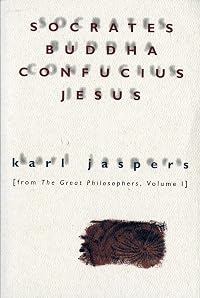
Socrates, Buddha, Confucius, Jesus: From The Great Philosophers, Volume I
by Karl Jaspers
The Great Philosophers (1)
On This Page
Description
A part of Jaspers’s planned universal history of philosophy, focusing on the four paradigmatic individuals who have exerted a historical influence of incomparable scope and depth. Edited by Hannah Arendt; Index. Translated by Ralph Manheim.Tags
Recommendations




























Member Reviews
In an effort to be very fair, I will review this book for what it is, and not what I wanted it to be. What is it? A highly serviceable introduction to the lives, thought, and influence of the four titular historical personages. I cannot stress the word "introduction" enough here. Unless you have had no exposure to the figure that you are curious about, you will be hard-pressed in learning anything new about him. This, however, wasn't my first encounter with any of the four figures.
What did I want this book to be? Considering the reputation of Jaspers, I was expecting something more scholarly, yet I should have known better from the length of the book (just under 100 pages, not including the endnotes and bibliography). Considering he is show more mostly known for his "Philosophy and Existence," I thought that he might try to take a syncretic approach, blending his own brand of thought with these paradigmatic figures of the past. No such luck. I also thought that it might have had something other than strictly a "summary" type of feel that it did. It reads like lecture notes in that it's somewhat disjointed, a lot of the thoughts he explores do not go fully developed, and you are left wanting more.
Unfortunately, much of the stuff here is derivative and fails to shed any new light on the material it covers. Since this series pulled together from a variety of different sources in Jaspers' own writing (edited by his mentee, Hannah Arendt), it is difficult to tell whether or not this is the way he intended it to be. However, as I mentioned above, the book is not without its audience. It would be very suitable ancillary material for an introductory course in world religions. show less
What did I want this book to be? Considering the reputation of Jaspers, I was expecting something more scholarly, yet I should have known better from the length of the book (just under 100 pages, not including the endnotes and bibliography). Considering he is show more mostly known for his "Philosophy and Existence," I thought that he might try to take a syncretic approach, blending his own brand of thought with these paradigmatic figures of the past. No such luck. I also thought that it might have had something other than strictly a "summary" type of feel that it did. It reads like lecture notes in that it's somewhat disjointed, a lot of the thoughts he explores do not go fully developed, and you are left wanting more.
Unfortunately, much of the stuff here is derivative and fails to shed any new light on the material it covers. Since this series pulled together from a variety of different sources in Jaspers' own writing (edited by his mentee, Hannah Arendt), it is difficult to tell whether or not this is the way he intended it to be. However, as I mentioned above, the book is not without its audience. It would be very suitable ancillary material for an introductory course in world religions. show less
There were a number of discrepancies between other references I have read about Socrates and certainly Jesus. Jaspers is not a Christian and his approach to philosophy is colored, but there is no doubt he brings much depth to the subjects.
a nice overview of the these four man, I am sure you can say they were thinkers, especially buddha and jesus. enjoyable read
Les grands fondateurs des religions vus par un philosophe. Une fresque.
Jun 7, 2018French
Ratings
Members
- Recently Added By
Lists

Philosophy
9 works; 1 member
Author Information

193+ Works 4,402 Members
Karl Jaspers was one of the originators of German existentialism. He began his career as a psychiatrist but was increasingly concerned about philosophical and moral issues. His was "a lucid and flexible intelligence in the service of a genuine and passionate concern for mankind." Removed from his professorship at the University of Heidelberg by show more the Nazis in 1937, he was reinstated in 1945 on the approval of the American occupation forces. In 1949 he went to the University of Basel. The New York Times wrote of him in his lifetime: "Jaspers shows himself . . . to be one of the most diligent and sensitive students of contemporary history. He has a good eye for the present because he knows what to fear in it---particularly the loss of individual freedom." Jaspers was deeply concerned about the human condition, and in his book The Future of Mankind (1957), entitled in its updated edition The Atom Bomb and the Future of Man (1961), he attempted to arouse conscience in the face of the deadly danger of atomic warfare "at the same time . . . attempt[ing] to apply the principles of his philosophy to a new field, and to lay the foundations of a political philosophy" (Times Literary Supplement). After the German publication of this book, Jaspers was awarded the German Peace Prize at the 1958 Frankfurt Book Fair. Hannah Arendt, who had been his student and a translator of some of his works, made the presentation. Jaspers's multivolume work, The Great Philosophers---edited by Hannah Arendt, translated by Ralph Manheim, and published in English from 1962 to 1966---was hailed by the Library Journal as "a major work, a brilliant book . . . Jaspers defends the unity of philosophy and his aim is to make philosophy available to all, to provide the serous reader with a guide "to the thinking of the great philosophers and to a personal encounter with them." The obituary of Jaspers in the New York Times said in assessing him: "With Soren Kierkegaard, Martin Heidegger, and Jean-Paul Sartre, Karl Jaspers was one of the makers and shapers of existentialist philosophy. For almost 50 years, in books, essays and lectures, he strove to give a personalist answer to modern man's questions about his own nature and the nature of existence." (Bowker Author Biography) show less
Some Editions
Series

Belongs to Publisher Series
Work Relationships
Common Knowledge
- Canonical title*
- LES GRANDS PHILOSOPHES 1
- Original title
- Die massgebenden Menschen: Sokrates, Buddha, Konfuzius, Jesus
- Original publication date
- 1960
- People/Characters*
- Socrates, 469-399 BC; Gautama Buddha; Confucius, 551–479 BCE; Jezus van Nazareth
- First words
- Great men have always been seen as images and myths, and have always found a following.
- Last words
- (Click to show. Warning: May contain spoilers.)With the forms he discovered, he made an immense contribution to the self-understanding of man; but he himself remains disembodied, because what he was, and what he was able to say, lie beyond any mere embodiment.
- Blurbers*
- Jaspers biedt een vernieuwende en stimulerende bezinning op de grondleggers van onze mensbeschouwing en onze moraal - New York Times Book Review-
*Some information comes from Common Knowledge in other languages. Click "Edit" for more information.
Classifications
Statistics
- Members
- 454
- Popularity
- 67,454
- Reviews
- 4
- Rating
- (3.61)
- Languages
- 9 — Chinese, Dutch, English, Finnish, French, German, Italian, Portuguese, Spanish
- Media
- Paper
- ISBNs
- 20
- ASINs
- 9