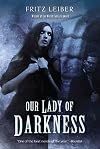
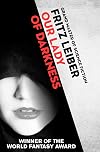
Our Lady of Darkness
by Fritz Leiber
On This Page
Description
Fritz Leiber (1910-1992) may be best known as a fantasy writer, but he published widely and successfully in the horror and science fiction fields. His fiction won the Hugo, Nebula, Derleth, Gandalf, Lovecraft, and World Fantasy Awards, and he was honored with the Life Achievement Lovecraft Award and the Grand Master Nebula Award. One of his best novels is the classic dark fantasy Our Lady of Darkness (1978 winner of the World Fantasy Award. Our Lady of Darkness introduces San Francisco show more horror writer Franz Westen. While studying his beloved city through binoculars from his apartment window, he is astonished to see a mysterious figure waving at him from a hilltop two miles away. He walks to Corona Heights and looks back at his building, to discover the figure waving at him from his apartment window--and to find himself caught in a century-spanning curse that may have destroyed Clark Ashton Smith and Jack London. show lessTags
Recommendations

























Member Recommendations
Member Reviews
This book is one of those that I first read in adolescence and liked--but coming back to it decades later, I can only wonder at what I thought I understood about it. Our Lady of Darkness teems with explicit allusions to other fiction and to occult history that I could not have possibly appreciated on my initial read of it. The protagonist is quite autobiographical (a bereaved horror writer named Franz emerging from a long mourning drunk) and the San Francisco setting is in every way integral to the plot.
As a horror novel, it's middling, not especially scary. But the theories of modern occultism initiated by Leiber in this book are important and influential. His notions of megapolisomancy (i.e. thaumaturgical urban psychogeography) and show more paramentals have persisted beyond this book, and are in fact scarier with each passing decade. Possible effects of the 5G network presently being built out far exceed the direst anticipations of Leiber's chiliastic sorcerer de Castries.
I re-read this book on my way to a conference in Barcelona at which one of the presenters was scheduled to speak on megapolisomancy. That whole conference seemed to be absorbed by the events of the book. At the end, I missed a flight connection, and I was re-routed through Oakland (the airport closest to downtown San Francisco and the landmarks given in the story). I joined up with a fellow passenger in London, where we were briefly stranded by a failed flight connection. He was a Mexican who works on construction in Chicago. His English was almost as bad as my Spanish, and we played chess in lieu of conversation. The synchronicity with events at the climax of the novel was a little disturbing. show less
As a horror novel, it's middling, not especially scary. But the theories of modern occultism initiated by Leiber in this book are important and influential. His notions of megapolisomancy (i.e. thaumaturgical urban psychogeography) and show more paramentals have persisted beyond this book, and are in fact scarier with each passing decade. Possible effects of the 5G network presently being built out far exceed the direst anticipations of Leiber's chiliastic sorcerer de Castries.
I re-read this book on my way to a conference in Barcelona at which one of the presenters was scheduled to speak on megapolisomancy. That whole conference seemed to be absorbed by the events of the book. At the end, I missed a flight connection, and I was re-routed through Oakland (the airport closest to downtown San Francisco and the landmarks given in the story). I joined up with a fellow passenger in London, where we were briefly stranded by a failed flight connection. He was a Mexican who works on construction in Chicago. His English was almost as bad as my Spanish, and we played chess in lieu of conversation. The synchronicity with events at the climax of the novel was a little disturbing. show less
Before there was Urban Fantasy... there was 1978's Fritz Leiber writing Urban Fantasy. :)
Strangely enough, I was very engaged with certain parts of this novel, how it set itself up as a horror within a horror, a horror writer going through a dark patch that then leads him into a very STRANGE patch where ideas intersect with an almost Lovecraftian (or Clark Ashton Smith-ian) becomes a novel of investigation and eldritch (idea) horror.
Just why did all those old friends, the horror triumvirate (and associated) back in the '20s and '30s, die early or suicide?
There's lots of great literary name dropping and history packed in this novel. And more than that, there is a lot of great collective unconsciousness meets virus meets memes action show more going on here... ESPECIALLY for the time this novel came out. I'm reminded of some of my favorite modern UFs that play with geek fandom or bibliomancy or the like, but the style is very much a mix between a noir mystery (with drug use) and a simmering 70's horror novel.
In other words... it doesn't quite FIT with the modern view of novels. :)
And for me? I love how strange it is. It might not be the strangest novel ever, but it definitely got under my skin. :) show less
Strangely enough, I was very engaged with certain parts of this novel, how it set itself up as a horror within a horror, a horror writer going through a dark patch that then leads him into a very STRANGE patch where ideas intersect with an almost Lovecraftian (or Clark Ashton Smith-ian) becomes a novel of investigation and eldritch (idea) horror.
Just why did all those old friends, the horror triumvirate (and associated) back in the '20s and '30s, die early or suicide?
There's lots of great literary name dropping and history packed in this novel. And more than that, there is a lot of great collective unconsciousness meets virus meets memes action show more going on here... ESPECIALLY for the time this novel came out. I'm reminded of some of my favorite modern UFs that play with geek fandom or bibliomancy or the like, but the style is very much a mix between a noir mystery (with drug use) and a simmering 70's horror novel.
In other words... it doesn't quite FIT with the modern view of novels. :)
And for me? I love how strange it is. It might not be the strangest novel ever, but it definitely got under my skin. :) show less
OUR LADY OF DARKNESS isn't an exciting read. It's a slow burner, a mass of details, all seeming inconsequential at first, that build and grow into something that is ultimately rich and strange and terrifying.
There's a lot going on here, in the range and depth of characters that remind me of some of Raymond Chandler's or Ross MacDonald's lost people in California, in the details of the occult nature of city building, and in the secret pasts of famous genre writers such as Jack London and Clark Ashton Smith among others.
It's all wrapped up in a mystery being solved by a broken man, trying to put a jigsaw of pieces back into some kind of order that might make sense to him.
It's compelling stuff, and the denouement is the stuff of nightmares show more for bibliophiles.
One of the great works of modern supernatural literature, it deserves to be much better known than it is. show less
There's a lot going on here, in the range and depth of characters that remind me of some of Raymond Chandler's or Ross MacDonald's lost people in California, in the details of the occult nature of city building, and in the secret pasts of famous genre writers such as Jack London and Clark Ashton Smith among others.
It's all wrapped up in a mystery being solved by a broken man, trying to put a jigsaw of pieces back into some kind of order that might make sense to him.
It's compelling stuff, and the denouement is the stuff of nightmares show more for bibliophiles.
One of the great works of modern supernatural literature, it deserves to be much better known than it is. show less
While Leiber's ability to build dread is decent--and I do admire this book for laying its Urban Fantasy groundwork--the writing is exorbitant: references galore, sentences full of unnecessary information, and loads of meandering dialogue. There's a touch of Pynchon in all of it (or at least, Leiber's got the post-modern "drown your reader in enigmatic prose" technique down pat), so perhaps that's why I struggled to make it through the story. The obsession with books doubtlessly comes from Borges and Nabokov, although Leiber fumbles when trying to channel their respective ideas and techniques. His knowledge of books and culture is impressive and immense on its own, but he writes about it as though he must absolutely show us how show more intelligent he is. It's annoying and definitely should've been toned down. And the dialogue is just flat-out ridiculous. The constant verbose one-uppery fails to be realistic or amusing after the first few chapters, and any time I saw the signs of an oncoming tangent, I began to skim for my life.
In a word, this book is overwrought.
Besides having wanted to read Fafhrd and the Grey Mouser for some years, I was eager to read this book in particular because it's touted as a main inspiration for The Ninth Gate, a psychological/supernatural horror movie (itself said to be one of the inspirations for the video game Inscryption, another favorite of mine). I now see the similarities between these three works, so at least I've satisfied my curiosity. But Our Lady of Darkness is rather disappointing. I was expecting something more concise, flowing, and atmospheric. Leiber writes so much about other horror authors' lives and their stories--and stories about those stories--that he leaves little room to carve out his own horror identity. The ending is a great surprise, but having to wade through a slow, overwritten middle is not so great. Bad writing, big ideas. show less
In a word, this book is overwrought.
Besides having wanted to read Fafhrd and the Grey Mouser for some years, I was eager to read this book in particular because it's touted as a main inspiration for The Ninth Gate, a psychological/supernatural horror movie (itself said to be one of the inspirations for the video game Inscryption, another favorite of mine). I now see the similarities between these three works, so at least I've satisfied my curiosity. But Our Lady of Darkness is rather disappointing. I was expecting something more concise, flowing, and atmospheric. Leiber writes so much about other horror authors' lives and their stories--and stories about those stories--that he leaves little room to carve out his own horror identity. The ending is a great surprise, but having to wade through a slow, overwritten middle is not so great. Bad writing, big ideas. show less
Harlan Ellison named this one of his favorite books in a supplement to "The Week" magazine a few years back, which I recently rediscovered while cleaning up my shelves. So, I decided to read it and picked it up at a used book store. I tried to put myself in the right frame of mind to be absorbed in a supernatural atmosphere, but despite the breathless blurbs on the covers (maybe I need to smoke or drink whatever those reviewers were having), I just couldn't get into the spirit of it. In tone, this is like one of those fun-to-read Jack Finney novels, but it lacks a substantive core. Leiber is having a good time, obviously, as he tries to create something in the vein of H.P. Lovecraft, who is frequently referred to, or Clark Ashton Smith, show more who is sort of a character in the book, and he even has the protagonist mention one of Leiber's own short stories. This is the sort of intrusion, along with way too many references to other apparent favorite authors or stories of Leiber, that severely detracts from a believable aura of the supernatural.
At the heart of the story is an evil book - though not quite in the league with the Necronomicon - that the protagonist has picked up along with a hand-written journal, presumably written by Clark Ashton Smith. It deals with the evil influence of massive buildings (to oversimplify it a bit), but Leiber fails to make the horror universal or something that I could feel personally threatened by (unlike, for instance, the Exorcist, with its potential for a devil taking someone over at any minute). The story sort of plods along as the lead character puts together the pieces of the puzzle, aided by his sort-of-girlfriend, who is a harpsichordist, a mysterious occultist whose house he visits, and a few others. Along the way, we do get an evocative picture of San Francisco. I'm sure this book has been pretty good for tourism, but as horror it fails to gel. The conclusion is more ridiculous than horrific, especially the way the lead character is rescued.
The opening quotation from Thomas De Quincy is much better and more frightening than Leiber's 183 pages that follow. show less
At the heart of the story is an evil book - though not quite in the league with the Necronomicon - that the protagonist has picked up along with a hand-written journal, presumably written by Clark Ashton Smith. It deals with the evil influence of massive buildings (to oversimplify it a bit), but Leiber fails to make the horror universal or something that I could feel personally threatened by (unlike, for instance, the Exorcist, with its potential for a devil taking someone over at any minute). The story sort of plods along as the lead character puts together the pieces of the puzzle, aided by his sort-of-girlfriend, who is a harpsichordist, a mysterious occultist whose house he visits, and a few others. Along the way, we do get an evocative picture of San Francisco. I'm sure this book has been pretty good for tourism, but as horror it fails to gel. The conclusion is more ridiculous than horrific, especially the way the lead character is rescued.
The opening quotation from Thomas De Quincy is much better and more frightening than Leiber's 183 pages that follow. show less
This is a difficult book to review, because it is so very much idea-centred, and your appreciation, or lack thereof, of it will very much depend on whether you'll find this idea appealing or not. In short: it's a novel about the possiblity of the geography cities possesing a sort of inherent occult power, discussed through the inquries of a '70s horror author into the life and work of a self-styled occultist living in San Francisco at the turn of the century.
As a narrative it might be somewhat lacking, with characters that, while not exactly flat or bland, never really get the chance to expand, and events that might seem a bit random and inexplicable. But premise, and the "core" of the ideas presented is thoroughly fascinating, at show more least to me. Also, it's really creepy at places, which is always a plus.
Objectively this might be a 2- or 3-star book, but to me it's worth more. show less
As a narrative it might be somewhat lacking, with characters that, while not exactly flat or bland, never really get the chance to expand, and events that might seem a bit random and inexplicable. But premise, and the "core" of the ideas presented is thoroughly fascinating, at show more least to me. Also, it's really creepy at places, which is always a plus.
Objectively this might be a 2- or 3-star book, but to me it's worth more. show less
Franz Westen is a horror/fantasy writer who becomes interested in a book written by (and subsequently the life of) Thibaut de Castries. The book deals with Thibaut's theories of the occult and big cities, specifically how paramental entities can thrive in metropolitan settings, and Westen find himself in the thick of De Castries' posthumous attempts to prove his own theories.
Groundbreaking in the genre of urban fantasy, this is a pretty cool little novel. A cool mix of the supernatural in the lovingly-described streets and districts of San Francisco with the (literal) horrors of an academic lifestyle, and with just the right amount of creepy blended in.
Groundbreaking in the genre of urban fantasy, this is a pretty cool little novel. A cool mix of the supernatural in the lovingly-described streets and districts of San Francisco with the (literal) horrors of an academic lifestyle, and with just the right amount of creepy blended in.
Members
- Recently Added By
Lists

Weird and Weirder Fiction
270 works; 35 members

Stephen King's Biggest Influences
46 works; 3 members

David Pringle's Modern Fantasy: The 100 Best Novels
100 works; 5 members

Stephen King's 'Danse Macabre' reading list
111 works; 25 members
Cawthorn and Moorcock's Fantasy: The 100 Best Books
110 works; 7 members

Best Horror Mega-List
342 works; 6 members

Jones and Newman's Horror: Another 100 Best Books
100 works; 7 members

Books Read in 2018
4,360 works; 110 members

Paperbacks from Hell
382 works; 9 members

Stephen King's Danse Macabre Full Appendix List
110 works; 2 members
BlackDog's Complete Paperbacks From Hell List
639 works; 3 members
Author Information

335+ Works 26,593 Members
Some Editions
Awards and Honors
Awards
Series
Belongs to Publisher Series
Work Relationships
Common Knowledge
- Canonical title*
- Notre-Dame des ténèbres
- Original title
- Our Lady of Darkness
- Original publication date
- 1978
- People/Characters
- Franz Westen; Cal; Clark Ashton Smith; Dashiell Hammett; Jack London; George Sterling (show all 7); Tybalt de Castries
- Important places
- San Francisco, California, USA; Rhodes 607
- Important events
- San Francisco Earthquake and Fire (1906)
- Epigraph
- But the third Sister, who is also the youngest—! Hush! whisper whilst we talk of her! Her kingdom is not large, or else no flesh should live; but within that kingdom all power is hers. Her head, turreted like that of... (show all) Cybele, rises almost beyond the reach of sight. She droops not; and her eyes, rising so high, might be hidden by distance. But, being what they are, they cannot be hidden; through the treble veil of crape which she wears the fierce light of a blazing misery, that rests not for matins or for vespers, for noon of day or noon of night, for ebbing or for flowing tide, may be read from the very ground. She is the defier of God. She also is the mother of lunacies, and the suggestress of suicides. Deep lie the roots of her power; but narrow is the nation that she rules. For she can approach only those in whom a profound nature has been upheaved by central convulsions; in whom the heart trembles and the brain rocks under conspiracies of tempest from without and tempest from within. Madonna moves with uncertain steps, fast or slow, but still with tragic grace. Our Lady of Sighs creeps timidly and stealthily. But this youngest Sister moves with incalculable motions, bounding, and with tiger's leaps. She carries no key; for, though coming rarely amongst men, she storms all doors at which she is permitted to enter at all. And her name is Mater Tenebrarum—our Lady of Darkness.
—Thomas de Quincey
"Levana and Our Three Ladies of Sorrow"
Suspiria de Profundis - First words
- The solitary, steep hill called Corona Heights was black as pitch and very silent, like the heart of the unknown.
- Last words
- (Click to show. Warning: May contain spoilers.)Cal says, "Everything's very chancy."
- Canonical DDC/MDS
- 813.54
- Canonical LCC
- PS3523.E4583
*Some information comes from Common Knowledge in other languages. Click "Edit" for more information.
Classifications
Statistics
- Members
- 642
- Popularity
- 45,412
- Reviews
- 23
- Rating
- (3.70)
- Languages
- 5 — English, French, German, Italian, Spanish
- Media
- Paper, Audiobook, Ebook
- ISBNs
- 18
- ASINs
- 9