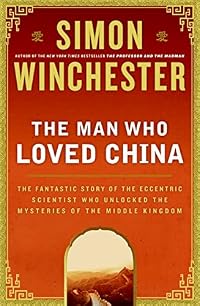
The Man Who Loved China: The Fantastic Story of the Eccentric Scientist Who Unlocked the Mysteries of the Middle Kingdom
by Simon Winchester
On This Page
Description
The extraordinary story of Joseph Needham, the brilliant Cambridge scientist who unlocked the most closely held secrets of China--long the world's most technologically advanced country. This married Englishman, a freethinking intellectual, while working at Cambridge University in 1937, fell in love with a visiting Chinese student, with whom he began a lifelong affair. He became fascinated with China, and embarked on a series of extraordinary expeditions to the farthest frontiers of this show more ancient empire. He searched everywhere for evidence to bolster his conviction that the Chinese were responsible for hundreds of mankind's most familiar innovations--including printing, the compass, explosives, suspension bridges, even toilet paper--often centuries before the rest of the world. His dangerous journeys took him across war-torn China to far-flung outposts, consolidating his deep admiration for the Chinese people. After the war, Needham began writing what became a seventeen-volume encyclopedia, Science and Civilisation in China.--From publisher description. show lessTags
Recommendations




Member Recommendations

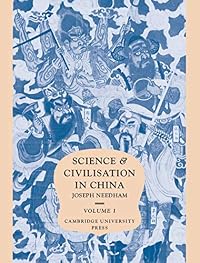
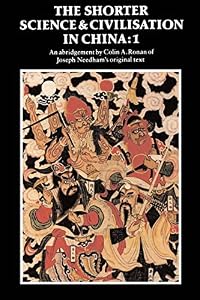
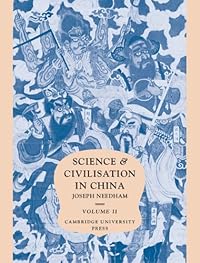
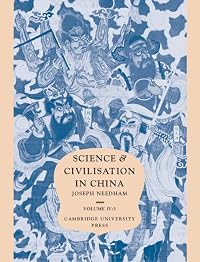
The shorter Science and civilisation in China: An abridgement of Joseph Needham's original text by Colin Alistair Ronan
wildbill An abridgment of Needham's great tome.
30
rakerman In many ways Rory Stewart is the modern equivalent of Joseph Needham - an informed observer of and participant in another country's history (Afghanistan, in Stewart's case)
20

rakerman because William Henry Jackson did extraordinary things including documenting a new country, albeit as an American photographer, rather than a British scientist and scholar

rakerman because the Blairs were also mad English adventurers exploring a new land
Member Reviews
Simon Winchester. The Man Who Loved China. 2008.
This is my first audiobook. Winchester's book is a fascinating account of Joseph Needham, a Cambridge biochemist who fell in love with a Chinese graduate student. She taught him bits of her language, and through that he fell in love with her civilization. He wandered around China under the guise of a British foreign diplomat, going first in the early 1940s and last around 1982. He supplied Chinese scientists with much-needed scientific materials, and eventually became enamored a culture which discovered many so-called “Western accomplishments” long before Europe did: printing press, clocks, and gunpowder, for example. From this he began a massive encyclopedia on “Science and show more Civilization in China,” which blew so out of scope that he died before he could finish it. He was also a nudist, Communist, and Morris dancer. He had no formal education in history or sinology.
First thing that struck me about the story was his way of finding China. Like me, he came to the language by falling in love with a Chinese woman, and realized what a rich, fascinating culture they have. He taught himself Chinese by keeping track of characters' different characteristics in self-made dictionaries. Not only do silly 17-year-old boys find the language through females, but so do distinguished Cambridge researchers!
Needham's goal in his work was to demonstrate to the West that China was not inferior, that they were not always the backward and unindustrialized nation they were in the 1800s and first part of the 1900s. By a combination of fear and arrogance, the West did not always like hearing this; but his works were acclaimed by academics. For me they fuel thoughts on scholarly work in general.
It was mentioned that he approached his topic with “empathetic insight.” He did not just want to analyze the Chinese, but he wanted to befriend them, understand them, see things from their point of view. It's a phrase that reminds me what one in religious studies should do as well. Always honor that which you seek to understand. If you learn only with the intent of refuting, how will you ever understand? William James wrote of the man at a party who argued with everyone. Soon nobody wanted to share their ideas with him. He may have thought himself the wisest man in the room, but really he was too idiotic to understand.
Needham also realized that the politics of his day were unimportant. Now he is remembered for his work – not for the political uproar he created when he publicly supported Mao in the 1950s, not for the academic politics at Cambridge when scholars in history and sinology were miffed at him for stepping on their turf with no credentials. He is remembered for the Needham question – why did China stop growing scientifically so that the West could shoot ahead in development? - a question that Chinese events since his death have rendered somewhat irrelevant. He did not solve the question well, but posing it opened new avenues for those more trained in historical analysis to delve into. As Jeremy said, the questions are more important than the answers.
His old age was the saddest part. His wife dead, his Chinese mistress dead, everyone his age dead, he continued working five hours a day until the day before he died. It was sad that he could not finish the project, and by his 80s volumes were being written mainly by others. What a reminder of the necessity of defining the scope of one's work! show less
This is my first audiobook. Winchester's book is a fascinating account of Joseph Needham, a Cambridge biochemist who fell in love with a Chinese graduate student. She taught him bits of her language, and through that he fell in love with her civilization. He wandered around China under the guise of a British foreign diplomat, going first in the early 1940s and last around 1982. He supplied Chinese scientists with much-needed scientific materials, and eventually became enamored a culture which discovered many so-called “Western accomplishments” long before Europe did: printing press, clocks, and gunpowder, for example. From this he began a massive encyclopedia on “Science and show more Civilization in China,” which blew so out of scope that he died before he could finish it. He was also a nudist, Communist, and Morris dancer. He had no formal education in history or sinology.
First thing that struck me about the story was his way of finding China. Like me, he came to the language by falling in love with a Chinese woman, and realized what a rich, fascinating culture they have. He taught himself Chinese by keeping track of characters' different characteristics in self-made dictionaries. Not only do silly 17-year-old boys find the language through females, but so do distinguished Cambridge researchers!
Needham's goal in his work was to demonstrate to the West that China was not inferior, that they were not always the backward and unindustrialized nation they were in the 1800s and first part of the 1900s. By a combination of fear and arrogance, the West did not always like hearing this; but his works were acclaimed by academics. For me they fuel thoughts on scholarly work in general.
It was mentioned that he approached his topic with “empathetic insight.” He did not just want to analyze the Chinese, but he wanted to befriend them, understand them, see things from their point of view. It's a phrase that reminds me what one in religious studies should do as well. Always honor that which you seek to understand. If you learn only with the intent of refuting, how will you ever understand? William James wrote of the man at a party who argued with everyone. Soon nobody wanted to share their ideas with him. He may have thought himself the wisest man in the room, but really he was too idiotic to understand.
Needham also realized that the politics of his day were unimportant. Now he is remembered for his work – not for the political uproar he created when he publicly supported Mao in the 1950s, not for the academic politics at Cambridge when scholars in history and sinology were miffed at him for stepping on their turf with no credentials. He is remembered for the Needham question – why did China stop growing scientifically so that the West could shoot ahead in development? - a question that Chinese events since his death have rendered somewhat irrelevant. He did not solve the question well, but posing it opened new avenues for those more trained in historical analysis to delve into. As Jeremy said, the questions are more important than the answers.
His old age was the saddest part. His wife dead, his Chinese mistress dead, everyone his age dead, he continued working five hours a day until the day before he died. It was sad that he could not finish the project, and by his 80s volumes were being written mainly by others. What a reminder of the necessity of defining the scope of one's work! show less
I couldn't tell you now when Joseph Needham and his project to produce a synoptic overview of Chinese scientific and technological endeavor first entered my consciousness, but it was probably when I was an undergrad at the University of Pittsburgh in the late 1970s; not that I really did anything about it at the time.
Flash forward to 2022, and having just read Winchester's "The Perfectionists," a chronicle of the precision revolution, I decided that his biography of Needham would be a good near-term reading choice.
This turned out to be the proverbial cracking good read, as Needham is one of those people who, if he appeared in a novel, would seem to be too amazing to be true. There is something of a "sliding door" aspect to this story, show more as had Needham had a child with his first wife Dorothy, that would have meant that the spark planted by Needham's mistress Lu Gwei-djen might not have ignited the intellectual fireworks and geopolitical adventures that ensued.
Of course, having come out in 2008, this book is starting to have a dated quality about it, as it is no longer obvious that the PRC has achieved the escape velocity that is going to make it next predominant power; though the current fight between Beijing and Washington might wreck both players for a generation or more.
And that brings one to Needham's great meta-question, essentially, why did the West achieve world dominance, and China did not? A good book to further examine that question would be Tonio Andrade's "The Gunpowder Age," which essentially concludes that a West that was going from technological strength to strength in the wake of the Napoleonic Wars, caught the Qing regime at a moment of internal weakness. The result being that the dynasty was never able to regain its balance (not helped by internal economic failures), leading to the collapse that the Chinese Communist Party has sought to reverse with grim determination and iron sacrifice. show less
Flash forward to 2022, and having just read Winchester's "The Perfectionists," a chronicle of the precision revolution, I decided that his biography of Needham would be a good near-term reading choice.
This turned out to be the proverbial cracking good read, as Needham is one of those people who, if he appeared in a novel, would seem to be too amazing to be true. There is something of a "sliding door" aspect to this story, show more as had Needham had a child with his first wife Dorothy, that would have meant that the spark planted by Needham's mistress Lu Gwei-djen might not have ignited the intellectual fireworks and geopolitical adventures that ensued.
Of course, having come out in 2008, this book is starting to have a dated quality about it, as it is no longer obvious that the PRC has achieved the escape velocity that is going to make it next predominant power; though the current fight between Beijing and Washington might wreck both players for a generation or more.
And that brings one to Needham's great meta-question, essentially, why did the West achieve world dominance, and China did not? A good book to further examine that question would be Tonio Andrade's "The Gunpowder Age," which essentially concludes that a West that was going from technological strength to strength in the wake of the Napoleonic Wars, caught the Qing regime at a moment of internal weakness. The result being that the dynasty was never able to regain its balance (not helped by internal economic failures), leading to the collapse that the Chinese Communist Party has sought to reverse with grim determination and iron sacrifice. show less
"No knowledge is ever to be wasted or despised."
(Dr Needham, snr)
Every hobby has an intellectual angle, and Needham (jr) was obsessively interested in everything.
An exhilarating change from my usual fare (though it fits with my fondness for China and Cambridge): a biography of Joseph Needham (1900-1995), an eccentric but brilliant multilingual Cambridge biochemist who fell in love with a Chinese woman, then her language and her country, becoming the world expert in and ambassador for the history of scientific discovery in China. He was also a free-loving Christian, a luxury-loving communist sympathiser, friend of the powerful, a fantastically organised workaholic, an enthusiastic but clumsy dancer, a diplomat, nudist, co-founder of show more UNESCO, Master of Gonville and Caius, and more.
His first trip to China was during WW2, when part of the country was under Japanese control. His role was to visit and support scientists there by boosting morale, getting books and equipment, and general diplomacy. But his own interests shone through and took over.
The scope of his investigations and the scale of what he wrote is truly staggering. It ended up as a series of 24 books, under the title "Science and Civilisation in China", published over more than 50 years, some volumes of which have never been out of print. "His search for the Chinese origin of just about everything... the central obsession of his life." What he searched for, he largely found.
The story of how this came about involves derring-do adventure, serendipity (good and bad), politics, war, globe-trotting, biological warfare (or not), unconventional relationships, the Unabomber(!), adulation and disgrace, espionage, and above all, extraordinary insights into China.
Amazing China
The three inventions that Francis Bacon said most profoundly changed the world were all invented in China (the compass, printing, and gunpowder) long before the rest of the world reinvented them, as were many, many more. And Needham found proof - by the cartload (literally).
For instance, there were written decrees prohibiting selling gunpowder to Tartars in AD1076, two centuries before Berthold Schwartz's alleged discovery of it, and the famous Diamond Sutra was printed from wood blocks six centuries before Gutenberg or Caxton.
Water, especially controlling rivers and crossings, has long been key in ruling China. Technology reflects that. Needham found a dam, more than two thousand years old, stone bridges nearly 1,500 years old, and a suspension bridge more than 300 years old, all still functioning. Even something a modern reader may think of trivial, can be crucial, such as the stirrup, enabling riders to stay in the saddle for longer, further, and over rougher terrain.
The number and especially the rate of inventions (estimated as 15 major inventions per century) is unsurpassed.
Needham's "Needham Question"
The conundrum for Needham was, why, if the Chinese were so clever and so endlessly inquisitive, inventive and creative, had they for so long been so poor and scientifically backward? Why were they so far ahead for so long, and then stalled around 1500 AD, after which scientific progress switched to the west?
When Winchester finally considers possible answers (in the epilogue), he concludes there is no good answer, but the consensus is that the Chinese "stopped trying". Cultural hegemony meant there was no need for a competitive advantage, and the culture has always been totalitarian. It felt rushed and inadequate and somewhat disrespectful to the man and the work he was praising.
But taking the much longer view (surely appropriate for such an ancient culture), as China rises, maybe we should consider those few centuries as a mere blip? In the words of a sign at a Chinese space base:
"Without haste. Without fear. We conquer the world."
Questions about Needham
What about the man himself? He was a principled man, though many of his principles did not align with the establishment of the time. He would certainly have been a wonderful, and perhaps rather intimidating man to meet. He undoubtedly loved Chinese culture and people, but nevertheless, one has to question the motives and actions of a European gathering so many documents and artifacts. Many were given - often unsolicited, and he made good use of them in evangelising for China, but whether that means all those documents should remain in the Needham Institute in Cambridge in perpetuity is harder to say.
Also, as Chrissie asks in her review (https://www.goodreads.com/review/show/21840347), was scientific cooperation the only reason the British government sent an academic all that way, at great expense, during a war? He mixed with spies (amongst others), but said almost nothing about them, but as a socialist and known communist sympathiser, he would surely not have been trusted as a spy, would he? Maybe it was just a last blast of Britain's colonial mindset, spiced up with a dash of guilt for the shameful opium wars?
Could there ever by another Needham - one who knows SO much about so many things (without resorting to the internet)? I suspect not, which is just one reason why this his life story is so important.
Paean to Who/What?
Winchester promises much. He says early on that Needham "would alter this perception of China [as backward], almost overnight and almost single-handedly" - though book goes on to mention many people who helped, Needham was an overpowering driving force.
Needham's life's work was a tribute to the country he came to love so much (sometimes too uncritically). This book is a tribute to Needham. It's a good and enjoyable book, and I don't think I can stomach 24 volumes of Needham's work, but it inevitably feels at one remove to the true inspiration of all that passion an effort.
A Chinese aphorism, written in his college room, would be a suitable epitaph:
"The man departs - there remains his shadow."
Facts, facts, facts - but it reads more like a story
That's a good thing. There's an index, bibliography, timeline and most importantly, a list of some of the inventions and discoveries credited with originating in China - tens, hundreds or even thousands of years before they were known in the rest of the world.
Issues with Winchester's Style
It's very readable. Definitely 4*. But I nearly demoted it to 3*.
I've not read Winchester before, so I wasn't sure if some of the very detailed impressions of obscure details were imagined by him. I found that a little irritating at first, but as I realised the scale and quantity of Needham's diaries, notebooks and letters, I relaxed and assumed Winchester was sticking to a broadly factual account.
Nevertheless, there were a few factual aspects I would quibble with:
* Did he check the rather hyperbolic claim that Morris dancing is "the oldest unchanged dance in England"? How would you check it anyway? And that 1946-7 was "the most terrible British winter of all time"!
* He certainly doesn't seem to have checked his claim that the word "punnet" derives from Mr Punnett, a strawberry-growing relative of someone Needham met. Everywhere I looked gave the origin as unknown (first appearing in print around 1822), with no mention of stawberries.
* When considering aspects of China that are unchanging, even in the 21st century, he cites the writing system, without even passing mention of the simplified script used in mainland China for half a century (not in Hong Kong and Taiwan) or the increasing use of Pinyin.
He also has an occasional tendency to repeat himself and to write sentences with a rather odd (though not incorrect) word order. Perhaps one should blame the editor - though the latter could be a deliberate stylistic choice. For instance, the bit of the longer quote above, "Why... had they for so long been so poor and...". It felt so unnatural, I had to retype it twice to get it right. Another was "This hubris, inevitably contributed to the problems that caused the empire in time to flounder and fall" (if you don't want to use commas, wouldn't "in time" be more natural at the end?). I realise I'm being picky, but having noticed it, I can't not mention it.
The epilogue is troubling in a different way. Winchester appears to have visited Chongqing to compare it with the city Needham knew. I've been there myself, and it is an extraordinary place, "Part Blade Runner, part Shinjuko, part Dickensian London" sums it up well. But as he finally attempts to tackle "The Needham Question", too little and too late, Winchester's language takes a slightly nasty tone where he muses on "national smugness" and a general "attitude of ineluctable and self-knowing Chinese superiority".
Quotes etc
* Learning Chinese was "a liberation... for it got you entirely out of the prison of alphabetic words, and into the crystalline world of ideographic characters."
* After trying and failing at a chaste and semi-monastic life, he decided to "worship the deity on his own term". What hubris.
* He and Dorothy had an open marriage from the start, and she "decided to accept the affair in a spirit of intellectually tolerant and fashionable left-wing complaisance".
* A review of one of his books likened it to Proust! "Proust and Needham have made of remembrance both an act of moral justice and of high art" - whatever that means! (Steiner in 1973.)
I read this partly on the basis of reviews by and discussions with:
Caroline
and
Will
Thank you! show less
(Dr Needham, snr)
Every hobby has an intellectual angle, and Needham (jr) was obsessively interested in everything.
An exhilarating change from my usual fare (though it fits with my fondness for China and Cambridge): a biography of Joseph Needham (1900-1995), an eccentric but brilliant multilingual Cambridge biochemist who fell in love with a Chinese woman, then her language and her country, becoming the world expert in and ambassador for the history of scientific discovery in China. He was also a free-loving Christian, a luxury-loving communist sympathiser, friend of the powerful, a fantastically organised workaholic, an enthusiastic but clumsy dancer, a diplomat, nudist, co-founder of show more UNESCO, Master of Gonville and Caius, and more.
His first trip to China was during WW2, when part of the country was under Japanese control. His role was to visit and support scientists there by boosting morale, getting books and equipment, and general diplomacy. But his own interests shone through and took over.
The scope of his investigations and the scale of what he wrote is truly staggering. It ended up as a series of 24 books, under the title "Science and Civilisation in China", published over more than 50 years, some volumes of which have never been out of print. "His search for the Chinese origin of just about everything... the central obsession of his life." What he searched for, he largely found.
The story of how this came about involves derring-do adventure, serendipity (good and bad), politics, war, globe-trotting, biological warfare (or not), unconventional relationships, the Unabomber(!), adulation and disgrace, espionage, and above all, extraordinary insights into China.
Amazing China
The three inventions that Francis Bacon said most profoundly changed the world were all invented in China (the compass, printing, and gunpowder) long before the rest of the world reinvented them, as were many, many more. And Needham found proof - by the cartload (literally).
For instance, there were written decrees prohibiting selling gunpowder to Tartars in AD1076, two centuries before Berthold Schwartz's alleged discovery of it, and the famous Diamond Sutra was printed from wood blocks six centuries before Gutenberg or Caxton.
Water, especially controlling rivers and crossings, has long been key in ruling China. Technology reflects that. Needham found a dam, more than two thousand years old, stone bridges nearly 1,500 years old, and a suspension bridge more than 300 years old, all still functioning. Even something a modern reader may think of trivial, can be crucial, such as the stirrup, enabling riders to stay in the saddle for longer, further, and over rougher terrain.
The number and especially the rate of inventions (estimated as 15 major inventions per century) is unsurpassed.
Needham's "Needham Question"
The conundrum for Needham was, why, if the Chinese were so clever and so endlessly inquisitive, inventive and creative, had they for so long been so poor and scientifically backward? Why were they so far ahead for so long, and then stalled around 1500 AD, after which scientific progress switched to the west?
When Winchester finally considers possible answers (in the epilogue), he concludes there is no good answer, but the consensus is that the Chinese "stopped trying". Cultural hegemony meant there was no need for a competitive advantage, and the culture has always been totalitarian. It felt rushed and inadequate and somewhat disrespectful to the man and the work he was praising.
But taking the much longer view (surely appropriate for such an ancient culture), as China rises, maybe we should consider those few centuries as a mere blip? In the words of a sign at a Chinese space base:
"Without haste. Without fear. We conquer the world."
Questions about Needham
What about the man himself? He was a principled man, though many of his principles did not align with the establishment of the time. He would certainly have been a wonderful, and perhaps rather intimidating man to meet. He undoubtedly loved Chinese culture and people, but nevertheless, one has to question the motives and actions of a European gathering so many documents and artifacts. Many were given - often unsolicited, and he made good use of them in evangelising for China, but whether that means all those documents should remain in the Needham Institute in Cambridge in perpetuity is harder to say.
Also, as Chrissie asks in her review (https://www.goodreads.com/review/show/21840347), was scientific cooperation the only reason the British government sent an academic all that way, at great expense, during a war? He mixed with spies (amongst others), but said almost nothing about them, but as a socialist and known communist sympathiser, he would surely not have been trusted as a spy, would he? Maybe it was just a last blast of Britain's colonial mindset, spiced up with a dash of guilt for the shameful opium wars?
Could there ever by another Needham - one who knows SO much about so many things (without resorting to the internet)? I suspect not, which is just one reason why this his life story is so important.
Paean to Who/What?
Winchester promises much. He says early on that Needham "would alter this perception of China [as backward], almost overnight and almost single-handedly" - though book goes on to mention many people who helped, Needham was an overpowering driving force.
Needham's life's work was a tribute to the country he came to love so much (sometimes too uncritically). This book is a tribute to Needham. It's a good and enjoyable book, and I don't think I can stomach 24 volumes of Needham's work, but it inevitably feels at one remove to the true inspiration of all that passion an effort.
A Chinese aphorism, written in his college room, would be a suitable epitaph:
"The man departs - there remains his shadow."
Facts, facts, facts - but it reads more like a story
That's a good thing. There's an index, bibliography, timeline and most importantly, a list of some of the inventions and discoveries credited with originating in China - tens, hundreds or even thousands of years before they were known in the rest of the world.
Issues with Winchester's Style
It's very readable. Definitely 4*. But I nearly demoted it to 3*.
I've not read Winchester before, so I wasn't sure if some of the very detailed impressions of obscure details were imagined by him. I found that a little irritating at first, but as I realised the scale and quantity of Needham's diaries, notebooks and letters, I relaxed and assumed Winchester was sticking to a broadly factual account.
Nevertheless, there were a few factual aspects I would quibble with:
* Did he check the rather hyperbolic claim that Morris dancing is "the oldest unchanged dance in England"? How would you check it anyway? And that 1946-7 was "the most terrible British winter of all time"!
* He certainly doesn't seem to have checked his claim that the word "punnet" derives from Mr Punnett, a strawberry-growing relative of someone Needham met. Everywhere I looked gave the origin as unknown (first appearing in print around 1822), with no mention of stawberries.
* When considering aspects of China that are unchanging, even in the 21st century, he cites the writing system, without even passing mention of the simplified script used in mainland China for half a century (not in Hong Kong and Taiwan) or the increasing use of Pinyin.
He also has an occasional tendency to repeat himself and to write sentences with a rather odd (though not incorrect) word order. Perhaps one should blame the editor - though the latter could be a deliberate stylistic choice. For instance, the bit of the longer quote above, "Why... had they for so long been so poor and...". It felt so unnatural, I had to retype it twice to get it right. Another was "This hubris, inevitably contributed to the problems that caused the empire in time to flounder and fall" (if you don't want to use commas, wouldn't "in time" be more natural at the end?). I realise I'm being picky, but having noticed it, I can't not mention it.
The epilogue is troubling in a different way. Winchester appears to have visited Chongqing to compare it with the city Needham knew. I've been there myself, and it is an extraordinary place, "Part Blade Runner, part Shinjuko, part Dickensian London" sums it up well. But as he finally attempts to tackle "The Needham Question", too little and too late, Winchester's language takes a slightly nasty tone where he muses on "national smugness" and a general "attitude of ineluctable and self-knowing Chinese superiority".
Quotes etc
* Learning Chinese was "a liberation... for it got you entirely out of the prison of alphabetic words, and into the crystalline world of ideographic characters."
* After trying and failing at a chaste and semi-monastic life, he decided to "worship the deity on his own term". What hubris.
* He and Dorothy had an open marriage from the start, and she "decided to accept the affair in a spirit of intellectually tolerant and fashionable left-wing complaisance".
* A review of one of his books likened it to Proust! "Proust and Needham have made of remembrance both an act of moral justice and of high art" - whatever that means! (Steiner in 1973.)
I read this partly on the basis of reviews by and discussions with:
Caroline
and
Will
Thank you! show less
I heard this years ago as a talking book but it was the pick for our book group so I read it with a degree of familiarity. Definitely as good as the first time around. I really like Simon Winchester's style of writing, it feels complete and well researched. I like his slight degree of understatement and his occasional bursts of enthusiasm. I've read quite a lot of his books and also like his choice of subject. Unlike Bill Bryson, his output quality never seems to vary, it is consistently excellent.
As to the subject matter, it sets out at the beginning to set the record straight about all the things that we white westerners claim to have invented but were in fact in usage in China, in some instance for centuries, before we came up with show more the same idea.
The title refers to a quote from somewhere about these three things being the most important inventions in human history. Having said that he doesn't really touch on any of them directly except for the invention of movable type around the 11th century in China and the mid 14th century in Europe.
Generally speaking, whatever you can think of the Chinese had it long before us.
The main character, Joseph Needham really comes to life in this book and you can clearly see him as a man before his time with views and actions well ahead of the era he lived in, except for maybe Morris Dancing :-)
Anyway, educate yourself! Go On! Get Smart! and get yourself a Chinese mistress too. Did I mention that? Oh well, you'll really have to read it now. show less
As to the subject matter, it sets out at the beginning to set the record straight about all the things that we white westerners claim to have invented but were in fact in usage in China, in some instance for centuries, before we came up with show more the same idea.
The title refers to a quote from somewhere about these three things being the most important inventions in human history. Having said that he doesn't really touch on any of them directly except for the invention of movable type around the 11th century in China and the mid 14th century in Europe.
Generally speaking, whatever you can think of the Chinese had it long before us.
The main character, Joseph Needham really comes to life in this book and you can clearly see him as a man before his time with views and actions well ahead of the era he lived in, except for maybe Morris Dancing :-)
Anyway, educate yourself! Go On! Get Smart! and get yourself a Chinese mistress too. Did I mention that? Oh well, you'll really have to read it now. show less
This book got me from the very start with his constant question of Why no developement. I was very impressed by the comment of former Secretary of State Haye (Haye?) about 1920 to the effect that one could tell what policy to adopt for the next five hundred years by watching China, despite the at that time apparent lack of effect China had on the world. What I love about the book overall is Needham's single-minded devotion to learning in detail about the language, although there is more than one, culture(s) and history of the land from which his mistress came, and then that he, she, and his wife shared that devotion. And that, most importantly of all, he set the historical record straight on the most ancient accomplishments of Chinese show more civilization, things that even Chinese historians had not had or taken the time to dust off and publish. Then he fought tooth and nail against racism and classism of all forms (perhaps thanks to that stay with a working class family when he was a young boy). What a tenacious and driven person, to whom we all owe a debt of history and following one's own conscience for the working classes, even if he was a bit overly naive at times. show less
Of all Simon Winchester's works, I have liked best his books which treat of books and book-people. His latest, The Man Who Loved China: The Fantastic Story of the Eccentric Scientist Who Unlocked the Mysteries of the Middle Kingdom (Harper, 2008), falls into that category. I knew little of Winchester's subject (Joseph Needham) his works, or their subject (the history of science in China, broadly speaking) before I began this book, and thus may be blissfully unaware of any omissions or errors, but come away from it thinking that Winchester has offered a timely and well-written biography of a man utterly deserving of one.
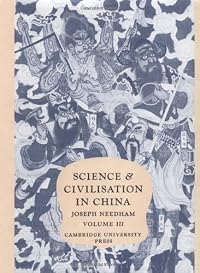
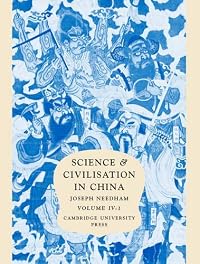
Joseph Needham's most important contribution to scholarship is the grand opus Science and Civilisation in China, the show more first volume of which was published by Cambridge University Press in 1954. Twenty-three more volumes have followed to date, and although the work's pioneer has gone from the scene, publication continues (and seems likely to do so for the forseeable future). The series examines the history of science in China from its early roots, in minute detail (the two most-recently published volumes cover only Metallurgy and Ceramic Technology).
In the course of telling Needham's rather unorthodox life story, Winchester chronicles the bizarre process by which this Cambridge don (trained as a biochemist) came to undertake Science and Civilisation in China, having no professional expertise in either Chinese or history. And while this is interesting, it was Needham's biography itself which held my attention most keenly, perhaps because it can be compared to none other that I can think of. I guess if you're going to be eccentric, you might as well go all the way, and Needham certainly did that - his complicated love life alone serves to boggle the mind, but throwing in the nudism, the socialism, the sometimes problematic political activism, and it's nearly overwhelming.
What comes through most clearly about Needham, though, if all the strange habits are set aside, is the intense appreciation and respect he came to feel for China and its myriad cultural accomplishments, a monument to which his great work is meant to be. An impressive list of these achievements comprises Winchester's first appendix, pp. 267-277.
In general a very lucid and intriguing book. Two minor annoyances: the font chosen was lovely except for the fact that it employs an uppercase I for the numeral 1, making years look strange (I948, &c.), and there are no reference notes, which I would have liked.
http://philobiblos.blogspot.com/2009/01/book-review-man-who-loved-china.html show less
Joseph Needham's most important contribution to scholarship is the grand opus Science and Civilisation in China, the show more first volume of which was published by Cambridge University Press in 1954. Twenty-three more volumes have followed to date, and although the work's pioneer has gone from the scene, publication continues (and seems likely to do so for the forseeable future). The series examines the history of science in China from its early roots, in minute detail (the two most-recently published volumes cover only Metallurgy and Ceramic Technology).
In the course of telling Needham's rather unorthodox life story, Winchester chronicles the bizarre process by which this Cambridge don (trained as a biochemist) came to undertake Science and Civilisation in China, having no professional expertise in either Chinese or history. And while this is interesting, it was Needham's biography itself which held my attention most keenly, perhaps because it can be compared to none other that I can think of. I guess if you're going to be eccentric, you might as well go all the way, and Needham certainly did that - his complicated love life alone serves to boggle the mind, but throwing in the nudism, the socialism, the sometimes problematic political activism, and it's nearly overwhelming.
What comes through most clearly about Needham, though, if all the strange habits are set aside, is the intense appreciation and respect he came to feel for China and its myriad cultural accomplishments, a monument to which his great work is meant to be. An impressive list of these achievements comprises Winchester's first appendix, pp. 267-277.
In general a very lucid and intriguing book. Two minor annoyances: the font chosen was lovely except for the fact that it employs an uppercase I for the numeral 1, making years look strange (I948, &c.), and there are no reference notes, which I would have liked.
http://philobiblos.blogspot.com/2009/01/book-review-man-who-loved-china.html show less
Joseph Needham's is an interesting life, and Winchester always tells a story well, lucidly, and engagingly. The science of China, and Needham's Science and Civilisation in China is a good story. Needham's life was unconventional, and his socialism to this reader is grating. He was fellow traveler enough to become a communist dupe during the Korean War, almost ruining his reputation, and apparently blind to the havoc wreaked by the communist Chinese he so loved. I abhor privileged, spoiled academics like Needham who espouse communistic ideals and turn a blind eye to communist crimes and abuses, all the while sitting ensconced in their ivory towers, enjoying fine meals, fancy living, never worrying about the next paycheck, and generally show more living high on the hog of a capitalism and democracy they denigrate. It means I can't like the man, though his scholarship and life might be important. show less
Members
- Recently Added By
Published Reviews
ThingScore 66
Simon Winchester tells the story, or part of it, in “The Man Who Loved China,” and like the other books of his I have read, it is amusing but unsatisfying. “The Professor and the Madman,” which first brought him to attention, was probably his best-crafted work. Since then he has tackled a number of curious and interesting topics, and instead of doing a good job of them has turned out show more incomplete bestsellers, full of chatty excursions and as much irrelevant salaciousness as he can fit into footnotes, but never quite telling the story that the subtitles pretend is inside the covers. show less
added by IslandDave
What happened after the rise of modern natural science c.1600 could not be like what came before, with the result that ‘both capitalist and socialist societies today are in qualitatively different situations from all preceding societies.’ There was no way back to the past, but there was a way forward. Needham never abandoned his belief in potential progress. Science and technology did not show more create the good society, but the tools that could bring it about, not least in China. ‘This is perhaps the promised peace on earth, and whoever puts first the real needs of real people will inherit it.’ All the same, Needham will not be remembered for his passionate longing for a better human future, or even for his biology-inspired organic Marxism, but for his extraordinary achievement in exploring and re-creating a past. Yet he remains a neglected thinker, remembered only in textbooks of developmental biology, and still awaits a biographer with a fuller understanding than Winchester’s of a remarkable man and the times and contexts that made him. show less
added by IslandDave
The name Joseph Needham is not well-known. Simon Winchester, who has written a succinct and enjoyable account of his life, first came across him while writing a travel book, The River at the Centre of the World (1996). He wanted to find out about the boats that plied the Yangtze, and Needham, he learnt, was one of two authorities on the matter. A notably eccentric Cambridge scholar, Needham show more was actually a biochemist by training, but his outstanding achievement was the 24-volumeScience and Civilisation in China, the first volume of which was published in 1954. show less
added by IslandDave
Lists

Vote: Science, Religion, and History Group Reads
30 works; 17 members

Non-Fiction Worth Reading
1,015 works; 261 members

The China Project Book List
100 works; 2 members
Talk Discussions
Past Discussions
The Man Who Loved China group read in 75 Books Challenge for 2014 (December 2014)
Author Information

53+ Works 38,561 Members
Simon Winchester was born in London, England on September 28, 1944. He read geology at St. Catherine's College, Oxford. After graduation in 1966, he joined a Canadian mining company and worked as field geologist in Uganda. The following year he decided to become a journalist. His first reporting job was for The Journal, Newcastle upon Tyne. In show more 1969, he joined The Guardian and was named Britain's Journalist of the Year in 1971. He also worked for the Daily Mail and the Sunday Times before becoming a freelancer. He is the author of numerous books including In Holy Terror, The River at the Center of the World, The Alice Behind Wonderland, The Professor and the Madman: A Tale of Murder, Insanity, the Making of the Oxford English Dictionary, and.Exactly: How Precision Engineers Created the Modern World. In 2006, he was made an Officer of the Order of the British Empire for services to journalism and literature. (Bowker Author Biography) show less
Awards and Honors
Notable Lists
Common Knowledge
- Alternate titles
- Bomb, Book & Compass ; The Man Who Loved China : Joseph Needham and the Making of a Masterpiece; The Man Who Loved China : The Fantastic Story of the Eccentric Scientist Who Unlocked the Mysteries of the Middle Kingdom
- Original publication date
- 2008
- People/Characters
- Joseph Needham; Frederick Gowland Hopkins; Zhou Enlai; Dorothy Needham; Lu Gwei-djen
- Important places
- Chongqing, China; University of Cambridge, Cambridge, Cambridgeshire, England, UK; Cambridge, Cambridgeshire, England, UK
- Important events
- World War II (1939 | 1945); Second Sino-Japanese War (1937-07-07 | 1945-09-09)
- Dedication
- For Setsuko
- First words
- (Prologue) The battered old Douglas C-47 Skytrain of the China National Aviation Corporation, its chocolate brown fuselage battle-scarred with bullet holes and dents, shuddered its way down through the rain clouds, the pilot ... (show all)following the slow bends of the Yangzi River until he had the sand-spit landing field in sight in front of him and the cliffs of China's capital city to his left.
Joseph Needham, a man highly regarded for his ability as a builder of bridges - between science and faith, privilege and poverty, the Old World and the New, and, most famously of all, between China and the West - was obliged ... (show all)to make an early start in the craft, as the only child of a mother and father who were ineluctably shacked in a spectacularly disastrous Edwardian marriage. - Last words
- (Click to show. Warning: May contain spoilers.)Such is the reverence for history in Cambridge it is likely that this singular memorial to Joseph Needham will remain in place for decades, and maybe for centuries.
(Click to show. Warning: May contain spoilers.)(Epilogue) And Joseph Needham would not be dismayed by that; nor would he be the slightest bit surprised. - Original language
- English
Classifications
Statistics
- Members
- 1,786
- Popularity
- 12,207
- Reviews
- 75
- Rating
- (3.77)
- Languages
- 6 — Chinese, English, German, Italian, Portuguese, Swedish
- Media
- Paper, Audiobook, Ebook
- ISBNs
- 29
- ASINs
- 14