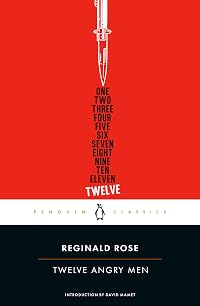
Twelve Angry Men: A Play in Three Acts
by Reginald Rose
On This Page
Description
Over the course of a steamy and tense afternoon, twelve jurors deliberate the fate of a 19 year-old boy alleged to have murdered his own father. A seemingly open and shut case turns complicated, igniting passions and hidden prejudices..
Tags
Recommendations




Member Recommendations
Member Reviews
Twelve men are sequestered in a stuffy room and tasked with determining the fate of a boy who was accused of murdering his father. The jurors are indentified only by their numbers (juror two, juror four), which you would think would be confusing, but it isn’t. They take a vote and realize that 11 of the 12 believe the defendant is guilty. They need a unanimous vote for a conviction and in the instant they know this won’t be as easy as they’d hoped.
It’s amazing that Rose was able to pack such a powerful story into just over 60 pages. Every line is taut with energy and irritation. You can almost smell the sweat and fuming testosterone in the room. The jurors are a diverse bunch and each one feels like someone you might know. I show more loved this play and its message that it takes a brave man to stand alone for what he believes in.
Usually the movie version of a book in wince-worthy, but this is an exception. Henry Fonda’s portrayal of the main juror is wonderful! I’ve also seen this one performed live (starring Richard Thomas from The Waltons) and it’s just as enthralling. show less
It’s amazing that Rose was able to pack such a powerful story into just over 60 pages. Every line is taut with energy and irritation. You can almost smell the sweat and fuming testosterone in the room. The jurors are a diverse bunch and each one feels like someone you might know. I show more loved this play and its message that it takes a brave man to stand alone for what he believes in.
Usually the movie version of a book in wince-worthy, but this is an exception. Henry Fonda’s portrayal of the main juror is wonderful! I’ve also seen this one performed live (starring Richard Thomas from The Waltons) and it’s just as enthralling. show less
You would think they would've forced us to watch Twelve Angry Men in law school, but they didn't. After reading the play and watching the movie a few weeks ago, I feel like every American should have to read Twelve Angry Men. The play centers on a jury deliberation. During several heated hours (literally and figuratively), twelve men discuss whether the verdict they come to will exonerate a young man for the murder of his father, or condemn him to a death sentence that the judge explained he had no qualms about ordering, should the verdict be guilty. Each man plays his part, from strong prejudice to neutral to easily swayed to chaotic to apathetic. I found this play to be riveting and extremely frightening. (specifically because I show more cannot stop thinking about the fact that most juries probably do not have that voice of reason or pay such close attention to detail. There are so many scary aspects to both human nature and the jury process, not least of which is that juries often have the life and/or liberty of another human being in their hands) The jurors are given no names, so it can be a feat to try to follow along with an understanding of which character is which, however the overall discussions are the most important aspect of the play, and a reader can easily follow the feel of the room and see whose arguments are most persuasive. This play can be read in a mere hour or so and I recommend it to everyone, especially people who want to read more classics. show less
Twelve Angry Men is preposterous, Kenneth. Eleven decent Americans are getting swayed by Jane Fonda’s father? - my only point of reference going into this play. And what a story it was.
Excellent (and necessarily broad) characterisations, a brilliant detective story with the reveals exceptionally well-paced, and a terrific ratcheting of tension to the climax. Perhaps it is preposterous, but how satisfyingly so.
Excellent (and necessarily broad) characterisations, a brilliant detective story with the reveals exceptionally well-paced, and a terrific ratcheting of tension to the climax. Perhaps it is preposterous, but how satisfyingly so.
The 1957 film version is one of the greatest pieces of cinema ever created, and one of my favorite movies. Near as I can tell from memory (I have seen the movie a lot), this is completely identical except for slight differences in the emotional breakdowns of the two least sympathetic jurors.
Juror number 10's breakdown is a bit tamer in the movie. He doesn't say anything about "those people" trying to "breed us out of existence," although the general idea certainly gets across. I like how much farther it goes in the play, it really shows the extent of his overwhelming fear and how it clouds his reasoning.
Juror number 3's breakdown at the very end was one of the most powerful moments to me, and I think it was slightly more effective in show more the movie. It felt more personal, more cathartic. You really get the sense that he's learned something he can apply to his relationship with his own son. I like to think after the movie ends he tries to reconnect with him, that he's realized his own faults that led to their falling out. The play is anticlimactic in comparison, it's not implied he's had a personal revelation about his relationship with his own son so much as he's just finally admitted not all kids are the same and he's willing to give somebody else's kid another shot at life because maybe that kid isn't as bad as his own. Still, that's no slight against this version. It more than deserves five stars. This is one of those special pieces of fiction that makes the world better simply by existing. Legit legendary status. show less
Juror number 10's breakdown is a bit tamer in the movie. He doesn't say anything about "those people" trying to "breed us out of existence," although the general idea certainly gets across. I like how much farther it goes in the play, it really shows the extent of his overwhelming fear and how it clouds his reasoning.
Juror number 3's breakdown at the very end was one of the most powerful moments to me, and I think it was slightly more effective in show more the movie. It felt more personal, more cathartic. You really get the sense that he's learned something he can apply to his relationship with his own son. I like to think after the movie ends he tries to reconnect with him, that he's realized his own faults that led to their falling out. The play is anticlimactic in comparison, it's not implied he's had a personal revelation about his relationship with his own son so much as he's just finally admitted not all kids are the same and he's willing to give somebody else's kid another shot at life because maybe that kid isn't as bad as his own. Still, that's no slight against this version. It more than deserves five stars. This is one of those special pieces of fiction that makes the world better simply by existing. Legit legendary status. show less
I have served on juries twice (once county, once federal). Even decades after it was first written, this play is still completely relevant. And accurate in its portrayal of the blend of personalities, the discussions, the tensions, the prejudices, the logic, the emotions, ... in my experience, at least. Phenomenal.
It's perhaps unfair that there's an iconic movie and a decent remake to compare this to, but it's inevitable, and it suffers in the comparison. What this really highlighted for me is how much of the play has to be carried by Juror 8 and 3 - Henry Fonda vs Lee Cobb or Jack Lemmon vs George C Scott in the movies, hard acts to follow. The words are all there but that intensity is not, nor is the timing. Perhaps there was more show carried in the physical performances, but we only have the audio to judge by.
This is a good story, but I don't think it has aged well.
I've been reading a lot of fiction from the 50s-70s recently and I am interested in how some stories age well and some do not. I feel that this play did not. First, it's 12 angry men. An all male jury seems unlikely in contemporary america and probably wasn't always the case even in the 50s. They also seem to be a racially homogeneous group. That might still happen, but would be odd enough to remark upon. They are also an overtly racist bunch. The script doesn't specifically identify anyone by race, thought the defendant is clearly part of some identifiable low status racial/ethnic group, and the general ill-will towards that group is open and obvious. One juror's obsession with show more baseball could easily be replaced with football. The physical aggression between jurors is from another time. Americans do still get in each other's faces, but among the older, employed, white-guy crowd in the play I don't think that happens very often.
The jurors seem less fragmented than a contemporary jury might be. If this were a contemporary jury room I think a democrat-republican political and ideological fault line would appear to internally divide the jury. I also think that political identification would make it more difficult for the jurors to change their minds.
Is this a metaphor for the changing American attitudes towards race? Initially, one man in twelve doubts the defendants guilt. Gradually a few more are won over through arguments and facts and in the end the final racist holdout concedes to vote not guilty not out of a genuine change of heart, but to form a consensus with he others and to go home. show less
I've been reading a lot of fiction from the 50s-70s recently and I am interested in how some stories age well and some do not. I feel that this play did not. First, it's 12 angry men. An all male jury seems unlikely in contemporary america and probably wasn't always the case even in the 50s. They also seem to be a racially homogeneous group. That might still happen, but would be odd enough to remark upon. They are also an overtly racist bunch. The script doesn't specifically identify anyone by race, thought the defendant is clearly part of some identifiable low status racial/ethnic group, and the general ill-will towards that group is open and obvious. One juror's obsession with show more baseball could easily be replaced with football. The physical aggression between jurors is from another time. Americans do still get in each other's faces, but among the older, employed, white-guy crowd in the play I don't think that happens very often.
The jurors seem less fragmented than a contemporary jury might be. If this were a contemporary jury room I think a democrat-republican political and ideological fault line would appear to internally divide the jury. I also think that political identification would make it more difficult for the jurors to change their minds.
Is this a metaphor for the changing American attitudes towards race? Initially, one man in twelve doubts the defendants guilt. Gradually a few more are won over through arguments and facts and in the end the final racist holdout concedes to vote not guilty not out of a genuine change of heart, but to form a consensus with he others and to go home. show less
Members
- Recently Added By
Lists

Books You Read During High School (For School)
301 works; 52 members

Top Five Books of 2013
1,562 works; 721 members

Recommend the 20 best books you've read in the last five years
2,168 works; 607 members

Favourite Books
1,820 works; 316 members

1950s
340 works; 22 members

Books Read in 2016
4,666 works; 197 members

20th Century Literature
1,161 works; 55 members

Plays I Like
230 works; 31 members
Essential/Recognized Stage Plays
115 works; 4 members
My Play Collection
769 works; 3 members
School Made Us Read It
380 works; 196 members

Books Read in 2025
4,128 works; 98 members

Top Five Books of 2025
954 works; 303 members
Author Information

21+ Works 2,136 Members
Awards and Honors
Awards
Series
Belongs to Publisher Series
Work Relationships
Has the adaptation
Has as a supplement
Has as a student's study guide
Common Knowledge
- Canonical title
- Twelve Angry Men: A Play in Three Acts
- Original publication date
- 1954
- People/Characters
- Juror 8; Juror 3; Foreman
- Related movies
- 12 Angry Men (1957 | IMDb); Studio One: Twelve Angry Men (1954 | IMDb); 12 Angry Men (1997 | IMDb); 12 (2007 | IMDb)
- First words
- AT RISE OF CURTAIN: The curtain comes up on a dark stage; then as the lights start to come up on the scene we hear the voice of the JUDGE, off stage.
- Last words
- (Click to show. Warning: May contain spoilers.)THREE. Not guilty! [THREE walks out of room. EIGHT glances around quickly, sighs, then turns and moves out through door. GUARD goes out, closing door.]
Classifications
Statistics
- Members
- 1,442
- Popularity
- 16,375
- Reviews
- 52
- Rating
- (4.10)
- Languages
- Dutch, English, French, German
- Media
- Paper, Audiobook, Ebook
- ISBNs
- 29
- UPCs
- 2
- ASINs
- 10