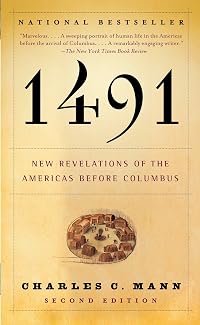
1491: New Revelations of the Americas before Columbus
by Charles C. Mann
On This Page
Description
Mann shows how a new generation of researchers equipped with novel scientific techniques have come to previously unheard-of conclusions about the Americas before the arrival of the Europeans: In 1491 there were probably more people living in the Americas than in Europe. Certain cities--such as Tenochtitlán, the Aztec capital--were greater in population than any European city. Tenochtitlán, unlike any capital in Europe at that time, had running water, beautiful botanical gardens, and show more immaculately clean streets. The earliest cities in the Western Hemisphere were thriving before the Egyptians built the great pyramids. Native Americans transformed their land so completely that Europeans arrived in a hemisphere already massively "landscaped" by human beings. Pre-Columbian Indians in Mexico developed corn by a breeding process that the journal Science recently described as "man's first, and perhaps the greatest, feat of genetic engineering."--From publisher description. show lessTags
Recommendations


















Member Recommendations

nsblumenfeld Nicholls' magnificent interdisciplinary account delves into ecology and history to explore the nature of American ecology at the time of discovery and how and why it has changed since. If you're interested in understanding the foundations on which America has been built you could do far worse than checking out this book.
11

electronicmemory While The History of White People is the more scholarly of the two works, both are engaging, thoughtful explorations of commonly held beliefs and misunderstandings of history in American culture.


Member Reviews
Lots of revelatory information in this book for me. I really appreciate Mann's push to complicate the overly simplified view of Indian culture and civilization prior to European contact. The common tropes about Native Americans, either positive or negative, often flatten them into a uncultured hoard or (more common these days) a prelapsarian society that was one with nature. Mann zips across thousands of years of history on two continents to show that Native American life was as rich and complicated (and often moreso) than that of the Europeans who "conquered" them. My takeaways are twofold: one, the sheer human toll of contact is mind-boggling - Mann describes disease running rampant across North and South America, demolishing whole show more cultures and civilizations. Two, the idea of the "New World" being some kind of pristine wilderness prior to Europeans arriving is in all likelihood a false narrative. Indians were engaged in vast operations of what we today might call permaculture at such a level of sophistication, scientists are still trying to figure out how they did it.
Mann has refreshingly contrarian perspective, critiquing misguided conceptions of Indian life from all sides. I especially appreciated his reflection on what the modern environmental movement can learn from the information he presents in the book; in an era where the concept of "wilderness" is long gone, Mann argues that where ever humans enter the picture, "wilderness" is probably more controlled than we'd like to think. Human beings are apex predators like any other - we need to be more honest and less idealistic about how we affect the organisms that surround us, so that we can more conciously decide what kind of world we would like to live in. show less
Mann has refreshingly contrarian perspective, critiquing misguided conceptions of Indian life from all sides. I especially appreciated his reflection on what the modern environmental movement can learn from the information he presents in the book; in an era where the concept of "wilderness" is long gone, Mann argues that where ever humans enter the picture, "wilderness" is probably more controlled than we'd like to think. Human beings are apex predators like any other - we need to be more honest and less idealistic about how we affect the organisms that surround us, so that we can more conciously decide what kind of world we would like to live in. show less
As an American of largely European descent raised in the latter half of the 20th century, I’ve always had a feeling of shame over how those ancestors treated the people they found on the American continents when they arrived. The appalling heights of hubris and greed are staggering. The loss of humanity and knowledge untold. It makes me sad and ashamed. Not guilty, mind you, as I personally did nothing to atone for, but ashamed.
Not that this book is a focus for ‘white guilt’ in any way; it merely shows up what was destroyed by accident or design when Europeans arrived in the Americas. Now when some smug Englishman tries to belittle me by saying that Americans have no history, I’ll merely reply that the illusion of no history show more lies in the utter genocide perpetrated here. There would have been plenty to learn from and be fascinated by if everyone hadn’t died.
Not that we had a garden of earthly delights over here in the Americas. There was plenty of war, corrupt governments, unjust laws and bad ideas. By today’s standards anyway. But Mann does a pretty good job of portraying things in a non-judgmental way. Neither attacking seemingly bloodthirsty practices nor mythologizing the already misjudged harmonious nature of many Indian groups.
That’s probably the most valuable thing I learned from reading 1491; that Indians were human like any other group of humans. They really didn’t differ much from their European counterparts. They built cities, grew crops, husbanded animals, worshipped gods. They just did many of these things so differently that the newcomers failed to recognized many practices and thus concluded that they didn’t exist. Or didn’t recognize a complete change of situation in a group and decided that’s the way they’d always been. The concept of Holberg’s Mistake isn’t only isolated to that one man misunderstanding what he saw.
Mann’s theories and concepts are indeed cutting edge and some are highly controversial. Even if they are proven to be outright wrong, at least it’s spurring conversation and further study. For hundreds of years the indigenous people were at worst massacred and at best treated like children. This book attempts to see them as fellow humans; doing amazing things sometimes, awful things other times and living as fully and selfishly as all humans do. show less
Not that this book is a focus for ‘white guilt’ in any way; it merely shows up what was destroyed by accident or design when Europeans arrived in the Americas. Now when some smug Englishman tries to belittle me by saying that Americans have no history, I’ll merely reply that the illusion of no history show more lies in the utter genocide perpetrated here. There would have been plenty to learn from and be fascinated by if everyone hadn’t died.
Not that we had a garden of earthly delights over here in the Americas. There was plenty of war, corrupt governments, unjust laws and bad ideas. By today’s standards anyway. But Mann does a pretty good job of portraying things in a non-judgmental way. Neither attacking seemingly bloodthirsty practices nor mythologizing the already misjudged harmonious nature of many Indian groups.
That’s probably the most valuable thing I learned from reading 1491; that Indians were human like any other group of humans. They really didn’t differ much from their European counterparts. They built cities, grew crops, husbanded animals, worshipped gods. They just did many of these things so differently that the newcomers failed to recognized many practices and thus concluded that they didn’t exist. Or didn’t recognize a complete change of situation in a group and decided that’s the way they’d always been. The concept of Holberg’s Mistake isn’t only isolated to that one man misunderstanding what he saw.
Mann’s theories and concepts are indeed cutting edge and some are highly controversial. Even if they are proven to be outright wrong, at least it’s spurring conversation and further study. For hundreds of years the indigenous people were at worst massacred and at best treated like children. This book attempts to see them as fellow humans; doing amazing things sometimes, awful things other times and living as fully and selfishly as all humans do. show less
Enlightening and eye-opening. Mann pulls together reams of research -- anthropological, archeological, epidemiological -- to show a very different picture of the Americas that were "conquered" by Europeans. He doesn't shy away from what modern revelations might mean when talking about things like guilt, responsibility, and reparation for North and South American Indians. Also a lot of food for thought regarding the future of humans on this planet. The Americas were homes to vast civilizations that disappeared in a generation. Humans are not invulnerable, even today.
It was interesting to see Wisconsin's own Prof. Bill Cronin, who is making a name for himself these days in fighting the corporate takeover of our state and beyond and show more revealing ALEC's nefarious work behind the scenes, cited early on in this book. show less
It was interesting to see Wisconsin's own Prof. Bill Cronin, who is making a name for himself these days in fighting the corporate takeover of our state and beyond and show more revealing ALEC's nefarious work behind the scenes, cited early on in this book. show less
1491 and 1493 are almost a single book, because they have the same subject - the epochal transference of flora, fauna, bacteria, and people known as the Colombian Exchange. 1491 is about the Americas before the Exchange, outlining the different ways historians have tried to understand the various peoples who lived there and how that understanding has changed. Plenty of great discussion of the ecologies, demographics, and social complexities of the various civilizations, with an eye towards pointing out how fragile historical knowledge really is. There's no noble savage-ism here, just a great summarizing sweep from Tierra del Fuego to Ellesmere Island.
I’m ashamed to confess I live less than 450 miles from Cahokia Mounds State Historic Park and have never visited. The ancient ruins of vanished American peoples tug at my imagination; and yet, living this close to the only major ruins of pre-Columbian civilization north of the Rio Grande, I haven’t been there. Someday I’ll climb one of those mounds and redeem myself.
Until then, I content myself with reading about ancient ruins of vanished American peoples. In this niche, I doubt there’s a more accessible read that covers more ground than Mann’s. I’ve read specialist literature in this genre, and it’s as hard plowing as you’d imagine. Mann, writing as a curious journalist for us normal people, transforms thuddingly-dull show more academic journals into portals overlooking the kaleidoscope of cultures that once sprawled from the Appalachians to the Andes.
Two things especially stood out to me. First, some geneticists believe that bottle-necked American immune systems not only had never fought Eurasian pathogens, but also lacked even the capacity to adapt to them. Fantasies of alternative history abound (“What if the Vikings colonized the New World? What if the Aztecs invaded Europe?”); but if these scientists are correct, there is virtually no chain of events in which Americans were not devoured by disease the moment the two worlds collided. I’m chilled by the idea of an entire hemisphere teeming with humans like me, building their cultures and hopes and dreams for millenia, biologically doomed without their knowledge and without recourse.
Second, the past always reflects the present. What I mean is that we project our knowledge of the past through a prism of partisan motivations. This is especially so when thinking of extinct or diminished cultures, and Mann brilliantly surfaces this tension that has dogged the writing of history since Herodotus. Depending on what matters most to you, America’s native inhabitants might be innocent children of the forest coexisting in harmony with Earth or brutish primitives savaging and wasting the land. Neither interpretation is quite right, but both serve the needs of moderns — even though it’s doubtful the subjects would recognize themselves in either. In that sense, it doesn’t matter if you’re a flag-wavin’ rural conservative or a soy-sippin’ urban progressive: the colonizing, intellectually, never ends.
Mann covers a lot of ground here, but he does so in a readable and thought-provoking style. He does a great job of explaining which theories he finds most convincing, while giving a fair shake to counterpoints and pushbacks. If you want to learn about the peoples of the Americas before Columbus, but you don’t want to subscribe to a bunch of boring journals or drive to Illinois and climb a giant dirt pile, then this is the book for you. show less
Until then, I content myself with reading about ancient ruins of vanished American peoples. In this niche, I doubt there’s a more accessible read that covers more ground than Mann’s. I’ve read specialist literature in this genre, and it’s as hard plowing as you’d imagine. Mann, writing as a curious journalist for us normal people, transforms thuddingly-dull show more academic journals into portals overlooking the kaleidoscope of cultures that once sprawled from the Appalachians to the Andes.
Two things especially stood out to me. First, some geneticists believe that bottle-necked American immune systems not only had never fought Eurasian pathogens, but also lacked even the capacity to adapt to them. Fantasies of alternative history abound (“What if the Vikings colonized the New World? What if the Aztecs invaded Europe?”); but if these scientists are correct, there is virtually no chain of events in which Americans were not devoured by disease the moment the two worlds collided. I’m chilled by the idea of an entire hemisphere teeming with humans like me, building their cultures and hopes and dreams for millenia, biologically doomed without their knowledge and without recourse.
Second, the past always reflects the present. What I mean is that we project our knowledge of the past through a prism of partisan motivations. This is especially so when thinking of extinct or diminished cultures, and Mann brilliantly surfaces this tension that has dogged the writing of history since Herodotus. Depending on what matters most to you, America’s native inhabitants might be innocent children of the forest coexisting in harmony with Earth or brutish primitives savaging and wasting the land. Neither interpretation is quite right, but both serve the needs of moderns — even though it’s doubtful the subjects would recognize themselves in either. In that sense, it doesn’t matter if you’re a flag-wavin’ rural conservative or a soy-sippin’ urban progressive: the colonizing, intellectually, never ends.
Mann covers a lot of ground here, but he does so in a readable and thought-provoking style. He does a great job of explaining which theories he finds most convincing, while giving a fair shake to counterpoints and pushbacks. If you want to learn about the peoples of the Americas before Columbus, but you don’t want to subscribe to a bunch of boring journals or drive to Illinois and climb a giant dirt pile, then this is the book for you. show less
I've been hearing about "1491" for quite some time now. Apparently it took me fifteen years to get around to reading it.
I've decided now is a good time for me to learn more about Native American history. I few months ago I started reading Roxanne Dunbar-Ortiz's "An Indigenous Peoples' History of the United States." A few chapters in, I decided that the book was covering such a broad swath of history as to be akin to reading an encyclopedia article, and I lost interest in the book and put it down. Denbar-Ortiz mentioned "1491" as a source for some of her research, and this prompted me to switch over to it.
As you might have guessed from the title, the premise of the book is looking at the pre-Columbian Americas. The book is the result of show more at least fifteen years of dedicated research on the part of Charles C. Mann.
The thesis of the book is that Native Americans have been here a very long time (with possibly five waves of immigration over the past 25,000 years). During the early Middle Ages, the Americas were home to one fifth of the world's population, and had civilizations that were at least as "advanced" as Europe. During the 150 years following first contact, 95% percent of Americans died of alien diseases, resulting in the largest-known genocide in history.
Although I anticipated a history, this book spends as much time dealing with the science of archaeology and various debates about how we might interpret the historical traces. I wonder how common understanding has evolved in the fifteen years since publications.
The book is effective at instilling a sense of awe and respect of previous civilizations of this continent.
One thread the book explores is the meaning we derive from alternative histories. Were Native Americans in balance with nature systems and cycles, and what can they teach contemporary civilizations about sustainability? Mann points out that there is no monolithic indigenous culture; the Americas were more diverse in pre-Colombian than post-Colombian times, and you would certainly have a hard time arguing that the Americas today form any kind of cohesive culture as a whole. So in other words, your answers to the question above depend on what specific nation you're holding in your consideration. On the one hand, we should be careful not to deceive ourselves that indigenous Americans were in some kind of perfect harmony with nature. On the other hand, as Drawdown suggests, there's a lot we can learn from indigenous stewardship, and we would do well to return more land to indigenous dominion. show less
I've decided now is a good time for me to learn more about Native American history. I few months ago I started reading Roxanne Dunbar-Ortiz's "An Indigenous Peoples' History of the United States." A few chapters in, I decided that the book was covering such a broad swath of history as to be akin to reading an encyclopedia article, and I lost interest in the book and put it down. Denbar-Ortiz mentioned "1491" as a source for some of her research, and this prompted me to switch over to it.
As you might have guessed from the title, the premise of the book is looking at the pre-Columbian Americas. The book is the result of show more at least fifteen years of dedicated research on the part of Charles C. Mann.
The thesis of the book is that Native Americans have been here a very long time (with possibly five waves of immigration over the past 25,000 years). During the early Middle Ages, the Americas were home to one fifth of the world's population, and had civilizations that were at least as "advanced" as Europe. During the 150 years following first contact, 95% percent of Americans died of alien diseases, resulting in the largest-known genocide in history.
Although I anticipated a history, this book spends as much time dealing with the science of archaeology and various debates about how we might interpret the historical traces. I wonder how common understanding has evolved in the fifteen years since publications.
The book is effective at instilling a sense of awe and respect of previous civilizations of this continent.
One thread the book explores is the meaning we derive from alternative histories. Were Native Americans in balance with nature systems and cycles, and what can they teach contemporary civilizations about sustainability? Mann points out that there is no monolithic indigenous culture; the Americas were more diverse in pre-Colombian than post-Colombian times, and you would certainly have a hard time arguing that the Americas today form any kind of cohesive culture as a whole. So in other words, your answers to the question above depend on what specific nation you're holding in your consideration. On the one hand, we should be careful not to deceive ourselves that indigenous Americans were in some kind of perfect harmony with nature. On the other hand, as Drawdown suggests, there's a lot we can learn from indigenous stewardship, and we would do well to return more land to indigenous dominion. show less
Most of us have the same hazy ideas of Indians that have been drilled into us from preschool: Small bands of hunter-gathers, living lightly on an edenic pristine wilderness. Mann ably summarizes the past fifty years of archaeological scholarship to show that this picture is wrong in every particular. Pre-contact Indians were largely agrarian, settled in cities as big as any in Europe, had a rich religious tradition that left massive monumental sites, and conducted wars and politics with hegemonic fury. They met the initial groups of European explorers as equals and more than equals, despite their lack of metal tools or domesticated animals. A century later, they were almost all dead, taken by waves of disease that may have had mortality show more rates of over 95%. Think of a room of 20 people. Now think of a room with 19 corpses and one survivor. The Indian of popular imagination is a post-apocalyptic survivor, living in an landscape of ecological collapse where previously marginal species like buffalo and the passenger pigeon spread like wild.
The status of the Indian is a political hot potato, since every American state rests on an initial act of massive genocide. The idea of a continent untouched by human hands is fundamental to modern environmentalism. Mann speaks clearly and deliberately to these ends. The exact arrival of Indians to the Americans is uncertain. The Clovis culture of 12000 years ago is well documented, but they may not have been the first. Indian civilizations changed the land deliberately, creating a continent wide-orchard. They also suffered their own ecological collapses, particularly the Maya and the Cahokia mound builders seem to have had political systems that fractured under environmental strains. The Amazon river basis may have supported a flourishing urban culture that succumbed to the same waves of epidemics.
Any book with ambitions as grand as a complete history of the Indian people is bound to be incomplete. Mann lavishes chapters on the uniqueness of domesticated maize, but leaves its actual domestication a mystery. Comparisons to familiar examples from European history are sometimes useful, and sometimes miss the mark. The pueblo cultures of the American southwest are unfortunately slighted, along with the Pacific Northwest. And as always, some of the most interesting cultures left behind nothing in the way of written records, either from a lack of an alphabet, or deliberate destruction by colonizers. Still, Mann has provide a precious counter to popular understanding, and a view of the cultures of 1491 as active participants in their own destiny, soon to be struck down by a fluke of biology rather than any innate flaw. show less
The status of the Indian is a political hot potato, since every American state rests on an initial act of massive genocide. The idea of a continent untouched by human hands is fundamental to modern environmentalism. Mann speaks clearly and deliberately to these ends. The exact arrival of Indians to the Americans is uncertain. The Clovis culture of 12000 years ago is well documented, but they may not have been the first. Indian civilizations changed the land deliberately, creating a continent wide-orchard. They also suffered their own ecological collapses, particularly the Maya and the Cahokia mound builders seem to have had political systems that fractured under environmental strains. The Amazon river basis may have supported a flourishing urban culture that succumbed to the same waves of epidemics.
Any book with ambitions as grand as a complete history of the Indian people is bound to be incomplete. Mann lavishes chapters on the uniqueness of domesticated maize, but leaves its actual domestication a mystery. Comparisons to familiar examples from European history are sometimes useful, and sometimes miss the mark. The pueblo cultures of the American southwest are unfortunately slighted, along with the Pacific Northwest. And as always, some of the most interesting cultures left behind nothing in the way of written records, either from a lack of an alphabet, or deliberate destruction by colonizers. Still, Mann has provide a precious counter to popular understanding, and a view of the cultures of 1491 as active participants in their own destiny, soon to be struck down by a fluke of biology rather than any innate flaw. show less
Members
- Recently Added By
Published Reviews
ThingScore 88
Mann has written an impressive and highly readable book. Even though one can disagree with some of his inferences from the data, he does give both sides of the most important arguments. 1491 is a fitting tribute to those Indians, present and past, whose cause he is championing.
added by Serviette
Mann has chronicled an important shift in our vision of world development, one our young children could end up studying in their textbooks when they reach junior high.
added by Serviette
Mann does not present his thesis as an argument for unrestrained development. It is an argument, though, for human management of natural lands and against what he calls the "ecological nihilism" of insisting that forests be wholly untouched.
added by Serviette
Lists

Top Five Books of 2013
1,562 works; 715 members

Non-Fiction Worth Reading
1,025 works; 264 members

Recommend the 20 best books you've read in the last five years
2,168 works; 609 members

Top Five Books of 2017
757 works; 231 members

Unread books
1,063 works; 84 members
Evan's Wish List
86 works; 2 members

Books in the Bibliography of The Dawn of Everything by Graeber & Wengrow
478 works; 2 members

Maybe This Year? Books to Look Forward To
414 works; 9 members
Books That Changed Our Perspective
423 works; 168 members

What A Year: Books titled with a particular year
147 works; 2 members

Books Read in 2024
4,727 works; 128 members

My List
302 works; 1 member

The Joe Rogan Experience Library
254 works; 3 members

r/History Recommended Reading List
603 works; 12 members

Terrapin's Deserted Island Ecology Reading List
13 works; 1 member

Latin America
45 works; 6 members

Penguin Random House
458 works; 4 members

Unshelved Book Clubs
579 works; 5 members

Environmental History
46 works; 8 members

Favourite Books
1,820 works; 316 members

Books in the Bibliography of Contested Continent by Peter Mancall
495 works; 1 member
Talk Discussions
Past Discussions
1491 in Dewey Decimal Challenge (March 2013)
Author Information

21+ Works 13,277 Members
Charles C. Mann is a correspondent for The Atlantic Monthly, Science, and Wired. He has also written for Fortune, The New York Times, Smithsonian, Technology Review, Vanity Fair, The Washington Post, the television network HBO, and the television series Law and Order. He has received writing awards from the American Bar Association, the American show more Institute of Physics, the Alfred P. Sloan Foundation, and the Lannan Foundation. He has written or co-written several books including The Second Creation: Makers of the Revolution in 20th-Century Physics, The Aspirin Wars: Money, Medicine, and 100 Years of Rampant Competition, Noah's Choice: The Future of Endangered Species, At Large: The Strange Case of the Internet's Biggest Invasion, and 1493: Uncovering the New World Columbus Created which made The New York Times Best Seller List for 2012. His book, 1491, won the National Academies Communication Award for the best book of the year. (Bowker Author Biography) show less
Some Editions
Awards and Honors
Awards
Distinctions
Work Relationships
Has the adaptation
Is abridged in
Common Knowledge
- Canonical title
- 1491: New Revelations of the Americas before Columbus
- Original title
- 1491: New Revelations of the Americas before Columbus
- Alternate titles
- New revelations of the Americas before Columbus
- Original publication date
- 2005-08-09
- Important places
- Amazon Rainforest, Amazon Basin, South America; Cahokia Mounds, Illinois, USA; Tenochtitlán, Mexica Empire
- Important events
- Colonizing the New World
- Related movies
- America Before Columbus (2009 | IMDb)
- Dedication
- For the woman in the next-door office--
Cloudlessly, like everything
--CCM - First words
- Preface: The seeds of this book date back, at least in part, to 1983, when I wrote an article for 'Science' about a NASA program that was monitoring atmospheric ozone levels.
The plane took off in weather that was surprisingly cool for central Bolivia and few east, toward the Brazilian border.
[Afterward to the Vintage Edition] When I set out to write 1491, my hope was that it would introduce readers to a subject that I found fascinating. - Last words
- (Click to show. Warning: May contain spoilers.)(Final sentence of the original 'Coda', not the 'Afterword to the Vintage Edition'). Is is too much to speculate that beneath the swirling tattoos, asymmetrically trimmed hair, and bedizened robes, you would recognize someone much closer to yourself, at least in certain respects, than your own ancestors?
(Click to show. Warning: May contain spoilers.)[Preface] In assembling this book, I hope to share the excitement I felt then, and have felt many times since.
(Click to show. Warning: May contain spoilers.)Is it too much to speculate that beneath the swirling tattoos, asymmetrically trimmed hair, and bedizened robes, you would recognize someone much closer to yourself, at least in certain respects, than your own ancestors?
(Click to show. Warning: May contain spoilers.)[Afterword to the Vintage Edition] I hope that in a small way this book reflects the infectious delight he took in unveiling the human story and in explaining his discoveries--and those of his colleagues--to anyone who wanted to learn. - Blurbers
- Rossi, Jim
- Original language
- English
Classifications
Statistics
- Members
- 8,473
- Popularity
- 1,309
- Reviews
- 221
- Rating
- (4.16)
- Languages
- 9 — Dutch, English, Finnish, French, German, Polish, Portuguese, Spanish, Turkish
- Media
- Paper, Audiobook, Ebook
- ISBNs
- 34
- UPCs
- 1
- ASINs
- 19